

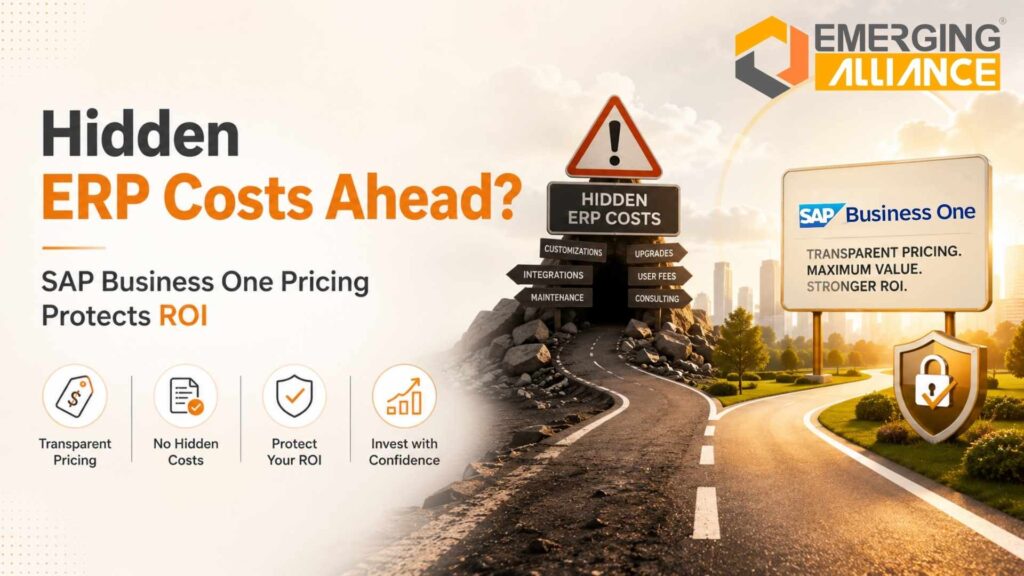
Hidden ERP Costs Ahead? SAP Business One Pricing Protects ROI
Budget Constraints and Cost Risks. SAP Business One Pricing Improves Planning Accuracy
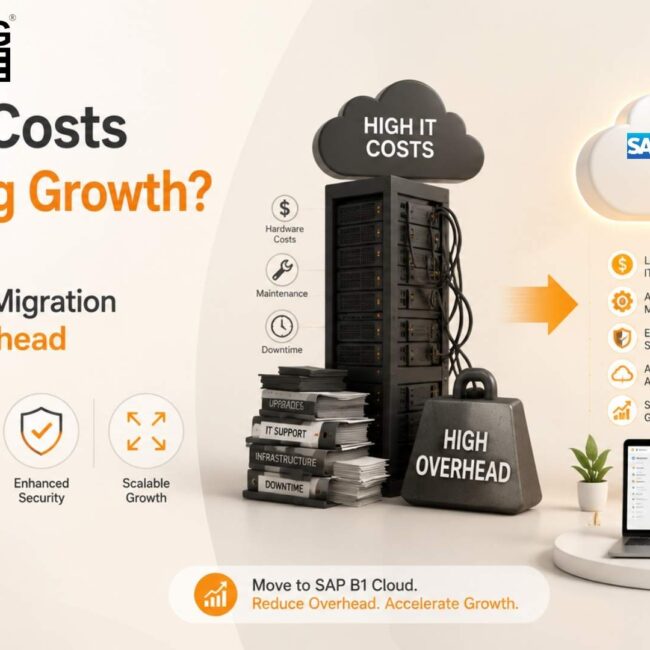
ERP investments rarely fail because of technology. They fail because businesses underestimate the true cost of ownership. Numerous businesses evaluating SAP Business One Pricing focus primarily on software quotations. They compare license fees and implementation costs while overlooking hidden expenses that emerge after go-live. Unexpected customization requirements, maintenance expenses, user expansion, integration complexity, and support costs can quietly reduce ROI and disrupt growth plans.
For CEOs, CIOs, Finance Leaders, and Operations Heads, the challenge is not finding the lowest SAP software price. The real challenge is ensuring that ERP investments deliver scalability, visibility, automation, and measurable business outcomes.
Strategic pricing decisions help organizations avoid cost overruns, improve planning accuracy, and maximize long-term returns.
Hidden ERP Cost Challenges
Budget Overruns and Planning Gaps
Many ERP projects exceed budgets because organizations only account for software costs while ignoring implementation complexity, training requirements, integrations, and future expansion.
Without accurate planning, hidden costs begin to surface after go-live, affecting profitability and delaying ROI.
Revenue Leakage and Process Inefficiencies
Disconnected systems, spreadsheet-based operations, and manual processes create:
- Inventory inaccuracies
- Delayed reporting
- Duplicate work
- Slow approvals
- Revenue leakage
These inefficiencies often cost far more than the ERP software itself.
Scalability Constraints and Growth Risks
As businesses grow, they need additional users, locations, and processes. Poor pricing decisions today can create expensive redesign projects tomorrow.
Visibility Gaps and Compliance Risks
Limited visibility across finance, inventory, sales, and operations makes decision-making difficult and increases compliance exposure.
ERP investments should eliminate uncertainty—not create more of it.
SAP Business One Pricing Cost Components
Understanding total ownership costs helps businesses avoid unpleasant surprises.
SAP Business One License Costs
SAP Business One license cost depends on:
- User count
- License type
- Business processes
- Functional requirements
Choosing the right SAP B1 license type prevents unnecessary spending and improves utilization.
Licensing or Subscription Costs
Organizations can choose between:
Perpetual Licensing
- One-time software purchase
- Annual maintenance fees
- Long-term ownership benefits
Subscription Model
- Lower upfront investment
- Monthly or annual payments
- Easier scalability
The right approach depends on growth strategy and financial priorities.
Price of SAP B1 Implementation
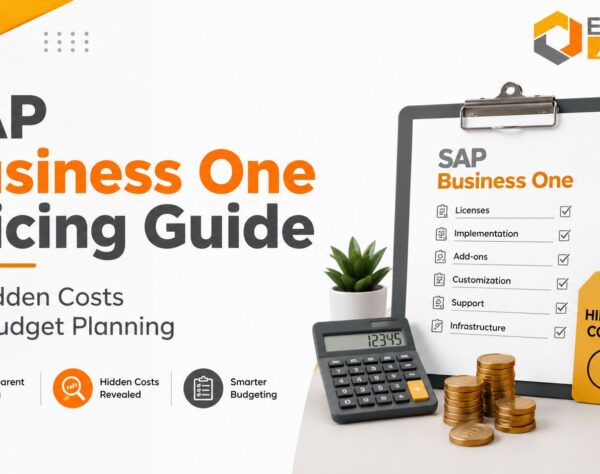
Implementation expenses generally include:
- Process consulting
- System configuration
- Data migration
- User training
- Reporting setup
- Integrations
- Go-live support
The price of SAP B1 implementation depends more on business complexity than company size.
SAP Business One Costs for Maintenance
Long-term success requires:
- Annual maintenance
- Upgrades
- Technical support
- Security enhancements
- Continuous optimization
Ignoring these expenses creates technical debt and operational inefficiencies.
Infrastructure and Integration Expenses
Additional costs may include:
- Cloud hosting
- Mobile access
- Third-party applications
- E-commerce integration
- Manufacturing systems
- BI and analytics tools
Understanding these factors improves planning accuracy and protects ROI.
SAP Business One Price in India and Budget Planning
SAP Business One Price in India Factors
There is no standard SAP Business One price in India.
Pricing depends on:
- Number of users
- Industry requirements
- Deployment model
- Integration complexity
- Customization requirements
Organizations searching for the Best SAP Business One Price in India should focus on long-term business outcomes rather than the lowest quotation.
SAP B1 License Type Selection
Proper user classification ensures:
- Lower software expenses
- Better utilization
- Reduced licensing waste
- Higher ROI
SAP Business One License Comparison Chart
| License Type | Best For |
| Professional User | Finance, Management, Operations |
| Limited Financial User | Accounting Teams |
| Limited Logistics User | Inventory and Procurement |
| CRM User | Sales and Service Teams |
Choosing the right license mix can significantly reduce SAP software license cost.
SAP B1 Cost for Small Business
Smaller businesses typically prioritize:
- Core finance
- Inventory management
- Sales automation
The focus is affordability and process standardization.
SAP B1 Cost for Medium-Sized Business
Medium enterprises generally require:
- Multiple departments
- Advanced reporting
- Warehouse management
- CRM integration
Scalability becomes increasingly important.
SAP B1 Cost for Large Enterprise
Large organizations often require:
- Multi-location operations
- Automation workflows
- Industry-specific capabilities
- Third-party integrations
Growth readiness matters more than initial cost.
SAP Business One Pricing Mistakes That Reduce ROI
License Decisions Based Only on Cost
Choosing the cheapest license option without understanding actual usage frequently leads to over-licensing or under-licensing.
Both increase long-term costs.
Underestimating Implementation Complexity
ERP projects become expensive when organizations ignore:
- Process complexity
- Legacy data migration
- Integration requirements
- User adoption
Excessive Customization Costs
Over-customization complicates upgrades and increases maintenance expenses.
Standardization often delivers faster ROI.
Ignoring Maintenance and Upgrade Planning
Many businesses budget for implementation but overlook ongoing optimization and support.
This creates hidden costs that accumulate over time.
Lack of Scalability Considerations
ERP should support future growth. Short-term decisions often create expensive limitations later.
SAP Business One Pricing Strategy for Better ROI
Calculate Implementation Costs Accurately
Effective budgeting should include:
Direct Costs
- SAP Business One license costs
- Infrastructure
- Implementation services
Operational Costs
- Training
- Support
- Maintenance
Growth Costs
- New users
- Additional locations
- Integrations
- Expansion projects
License Optimization and User Mapping
Aligning licenses with user roles reduces unnecessary spending and improves software utilization.
Deployment Model Evaluation
Businesses should evaluate:
- Cloud deployment
- On-premise infrastructure
- Hybrid models
Based on scalability and operational requirements.
Process Standardization and Automation
Automation helps eliminate:
- Manual errors
- Approval bottlenecks
- Reporting delays
- Duplicate work
Resulting in improved productivity and lower operational costs.
Long-Term Total Cost of Ownership Planning
The true question isn’t “What is SAP Business One Price?”
The question is:
“Will this investment support business growth over the next five years?”
SAP Business One Implementation Partners in India
Selecting the right implementation partner is critical.
Businesses need advisors who understand operations, not just software.
Key capabilities should include:
Business Process Assessment
Identifying inefficiencies and growth barriers before implementation.
License Optimization Framework
Aligning user roles with appropriate licenses.
Integration and Automation Strategy
Connecting ERP with CRM, eCommerce, manufacturing, and analytics systems.
Continuous ERP Improvement
Supporting businesses beyond go-live with ongoing optimization.
Business Outcomes from Strategic SAP Business One Pricing
Organizations that adopt a strategic approach often achieve:
Improved Budget Predictability
Reduced surprises and better financial planning.
Lower Operating Costs
Automation eliminates manual inefficiencies.
Faster Decision-Making
Real-time visibility improves responsiveness.
Better Compliance and Governance
Integrated processes strengthen operational control.
Scalable Growth
ERP becomes a foundation for expansion instead of a bottleneck.
Higher ROI
Technology investments deliver measurable business value.
Emerging Alliance Digital Transformation Approach
At Emerging Alliance, ERP discussions start with business outcomes—not software quotations.
Our approach includes:
ERP Strategy and Roadmap
Aligning technology investments with business objectives.
SAP Business One Optimization Services
Helping organizations maximize software utilization and efficiency.
Growth-Focused Implementation Framework
Delivering scalable ERP architectures that support future expansion.
Long-Term Value Realization
Continuous optimization ensures businesses achieve sustained ROI.
As a digital transformation and enterprise solutions partner, Emerging Alliance helps organizations modernize operations, improve visibility, and build scalable foundations for growth.
Conclusion
SAP Business One Pricing should never be viewed as a simple software purchase.
The true cost of ERP extends beyond licenses and implementation. Maintenance, scalability, integrations, automation, and long-term optimization all influence ROI.
Organizations that focus only on SAP software price often encounter hidden costs that reduce profitability and delay growth.
Businesses that adopt a strategic approach to SAP Business One Pricing gain better visibility, improved efficiency, stronger governance, and a foundation for sustainable growth.
Frequently Asked Questions
What is the total cost of SAP Business One beyond license pricing?
The total cost includes licenses, implementation, customization, integrations, training, infrastructure, and ongoing maintenance. Many businesses underestimate these additional costs, which can significantly impact ROI.
What hidden costs should businesses watch for in SAP Business One implementation?
Common hidden costs include data migration complexity, third-party integrations, customization, user training, change management, and post-go-live support. These often emerge after initial budgeting.
How can businesses reduce SAP Business One implementation costs?
Costs can be reduced by choosing the right license mix, minimizing unnecessary customization, standardizing processes, and working with experienced implementation partners who focus on efficiency.
Is SAP Business One subscription better than perpetual licensing?
Subscription models offer lower upfront costs and flexibility, while perpetual licensing provides long-term ownership benefits. The right choice depends on cash flow, growth plans, and scalability needs.
How does SAP Business One pricing scale as a company grows?
Pricing increases with additional users, modules, integrations, and locations. Planning for scalability early helps avoid expensive restructuring later.
What factors increase SAP Business One implementation complexity?
Complex business processes, multiple locations, legacy systems, heavy customization, and integration requirements can increase implementation time and cost.
How do businesses calculate ROI from SAP Business One?
ROI is measured through improved efficiency, reduced manual work, better inventory control, faster reporting, and increased visibility across operations.
Why do ERP projects exceed budget even after pricing is finalized?
Budget overruns often occur due to underestimated implementation scope, evolving business requirements, integration challenges, and lack of proper planning.
How important is choosing the right SAP Business One partner?
A knowledgeable partner helps optimize licensing, reduce implementation risks, streamline processes, and ensure long-term value from the ERP investment.
What is the best way to plan SAP Business One pricing for long-term growth?
Businesses should focus on total cost of ownership, scalability, process alignment, and future expansion needs rather than just initial software pricing.
Speak with Emerging Alliance and discover how strategic SAP Business One Pricing can protect ROI, improve planning accuracy, and support long-term business growth.