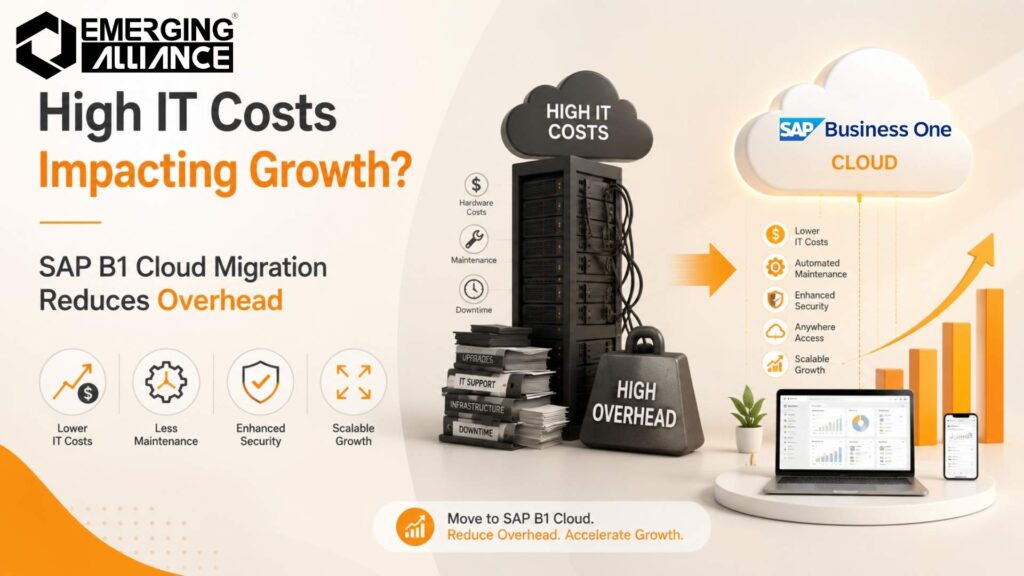
High IT Costs Impacting Growth? SAP B1 Cloud Migration Reduces Overhead
Rising Maintenance Burden. SAP B1 Cloud Migration Improves Efficiency
Modern businesses cannot afford to let IT infrastructure consume resources that should be driving growth. Yet many organizations running an on-premise SAP Business One ERP environment continue to spend heavily on servers, maintenance, upgrades, backups, and ongoing support. As complexity increases, these costs quietly impact profitability, agility, and scalability. SAP B1 Cloud Migration offers a strategic alternative. By moving to a cloud-based SAP Business One solution, organizations can reduce operational overhead, improve visibility, and create a more scalable foundation for growth.
For CEOs, CIOs, CTOs, Finance Leaders, and Operations Heads, cloud migration is no longer just an IT initiative—it is a business transformation decision.
Rising IT Costs And Operational Challenges
Many growing businesses still depend on aging infrastructure and legacy systems. While these environments may appear stable, they often create hidden inefficiencies that affect the entire organization.
On-Premise SAP Business One ERP Constraints
Infrastructure Expenses
Servers, hardware refreshes, backup systems, and maintenance increase total ownership costs over time.
IT Resource Dependency
Internal teams spend excessive time maintaining infrastructure instead of focusing on innovation and business improvement.
Scalability Limitations
Supporting new users, locations, and business units often requires additional investments.
Business Continuity Risks
Unexpected downtime, hardware failures, and manual backup processes can disrupt operations.
Visibility Gaps
Delayed reporting and disconnected information slow decision-making.
Business Impact Of Legacy Infrastructure
Technology inefficiencies eventually become business problems.
Operational And Financial Consequences
Rising Operating Costs
Infrastructure spending continues to increase without delivering proportional business value.
Workflow Bottlenecks
Slow systems and fragmented processes reduce employee productivity.
Revenue Leakage
Limited visibility creates delays in order processing, inventory management, and customer service.
Growth Constraints
Expanding into new markets becomes difficult when IT infrastructure cannot scale quickly.
Compliance And Security Exposure
Legacy environments require constant monitoring and upgrades to maintain security standards.
As organizations grow, these challenges directly affect profitability and competitiveness.
SAP B1 Cloud Migration Strategy
SAP B1 Cloud Migration helps organizations modernize their ERP landscape while reducing complexity and improving agility.
SAP Business One Cloud Solution Capabilities
Cloud-Based Accessibility
Employees gain secure access to business information from anywhere.
Lower Infrastructure Costs
Organizations eliminate server investments and reduce maintenance expenses.
Improved System Availability
Cloud platforms provide higher uptime and stronger disaster recovery capabilities.
Faster Updates And Enhancements
Businesses stay current without disruptive infrastructure projects.
Better Collaboration
Teams work from a centralized and integrated environment.
SAP Business One Cloud Hosting Environment
Modern cloud-based SAP Business One solutions provide:
- Centralized data management
- Secure access across locations
- Automated backups
- High availability
- Business continuity support
- Greater flexibility
Cloud transformation shifts IT from a maintenance function to a growth enabler.
SAP B1 Cloud Migration Process
Successful migration requires planning and alignment with business goals.
SAP Business One Cloud Migration Framework
Infrastructure Assessment
Evaluating current systems and identifying migration priorities.
Data Migration
Ensuring secure and accurate transfer of master and transactional data.
Application Optimization
Aligning workflows and configurations with operational requirements.
Integration Management
Connecting ERP with existing applications and business systems.
Testing And Validation
Ensuring performance and stability before go-live.
User Adoption And Training
Helping teams maximize productivity after migration.
A structured migration approach minimizes disruption and accelerates business value.
SAP Business One Cloud Outcomes
Moving to the cloud delivers measurable business improvements beyond cost savings.
Operational Efficiency Gains
Organizations benefit from:
Reduced IT Overhead
Less spending on hardware, maintenance, and infrastructure support.
Faster Decision-Making
Real-time information improves visibility across departments.
Increased Productivity
Automation reduces manual effort and repetitive tasks.
Improved Scalability
Businesses can expand users and operations without infrastructure limitations.
Stronger Business Continuity
Cloud environments provide backup and disaster recovery capabilities.
Enhanced Workforce Flexibility
Remote and multi-location teams access information securely.
The result is a more agile and resilient organization.
SAP Business One Cloud Migration Services
Technology implementation alone does not guarantee transformation success.
Organizations need a partner that understands operations, business processes, and long-term growth objectives.
SAP Business One Cloud Transformation Approach
Emerging Alliance helps organizations modernize ERP environments through:
Migration Readiness Assessment
Identifying risks and optimization opportunities.
Business Process Alignment
Ensuring technology supports operational goals.
Data Migration And System Integration
Delivering a seamless transition with minimal disruption.
Change Management And User Enablement
Accelerating adoption and maximizing ROI.
Continuous Improvement And Optimization
Supporting long-term business growth and digital transformation.
Emerging Alliance positions cloud migration as a strategic business initiative—not simply an infrastructure project.
Conclusion
Rising IT costs, infrastructure complexity, and scalability limitations can quietly slow growth and reduce operational efficiency.
SAP B1 Cloud Migration provides a practical path toward lower overhead, improved visibility, stronger business continuity, and better agility.
For business leaders, cloud transformation is not about replacing servers. It is about building an ERP foundation that supports future growth.
FAQs About SAP B1 for Cloud Migration
1. When does SAP B1 Cloud Migration deliver measurable cost savings?
Most organizations begin seeing savings after eliminating hardware refresh cycles, reducing maintenance efforts, and lowering infrastructure management costs. The full ROI depends on user count, existing infrastructure, and business complexity.
2. How does SAP B1 Cloud Migration reduce IT overhead compared to an on-premise SAP Business One environment?
A cloud-based SAP Business One solution removes the need for server maintenance, hardware upgrades, backup management, and day-to-day infrastructure administration, allowing IT teams to focus on business innovation instead of system maintenance.
3. What business risks should companies address before starting a SAP Business One Cloud migration?
Key risks include data quality issues, integration dependencies, customizations, user adoption challenges, and inadequate migration planning. A readiness assessment helps minimize disruption and migration-related risks.
4. Is SAP B1 Cloud Migration suitable for companies with multiple branches or remote teams?
Yes. SAP Business One Cloud provides centralized access to business data, making it easier to support multi-location operations, remote employees, and geographically distributed teams without maintaining separate infrastructure.
5. How does a cloud-based SAP Business One solution improve business continuity?
Cloud environments provide automated backups, disaster recovery capabilities, high availability, and redundancy, helping organizations minimize downtime and maintain operational continuity during unexpected events.
6. What should organizations evaluate when choosing a SAP Business One Cloud hosting provider?
Decision-makers should assess uptime guarantees, security controls, disaster recovery capabilities, SAP expertise, scalability options, support responsiveness, and the provider’s ability to support long-term digital transformation goals.
7. Can existing integrations and customizations be retained during SAP B1 Cloud Migration?
In most cases, yes. Existing add-ons, integrations, and custom developments can be assessed and optimized during migration to ensure compatibility and improve performance in the new cloud environment.
8. How does SAP B1 Cloud Migration support business growth and scalability?
A cloud-based SAP B1 solution enables organizations to add users, locations, and new business entities without major infrastructure investments, making expansion faster and more cost-effective.
9. What is the biggest hidden cost of delaying SAP Business One Cloud migration?
Delaying migration often leads to rising maintenance expenses, increasing cybersecurity risks, aging hardware, higher downtime exposure, and growing IT resource dependency, which collectively reduce operational efficiency and profitability.
10. Why is SAP B1 Cloud Migration considered a business transformation initiative rather than an IT project?
SAP B1 Cloud Migration affects operational efficiency, business agility, scalability, collaboration, and decision-making. Beyond infrastructure modernization, it helps organizations build a digital foundation that supports growth, resilience, and long-term competitiveness.
Speak with Emerging Alliance and discover how SAP Business One Cloud can transform IT overhead into business value.