
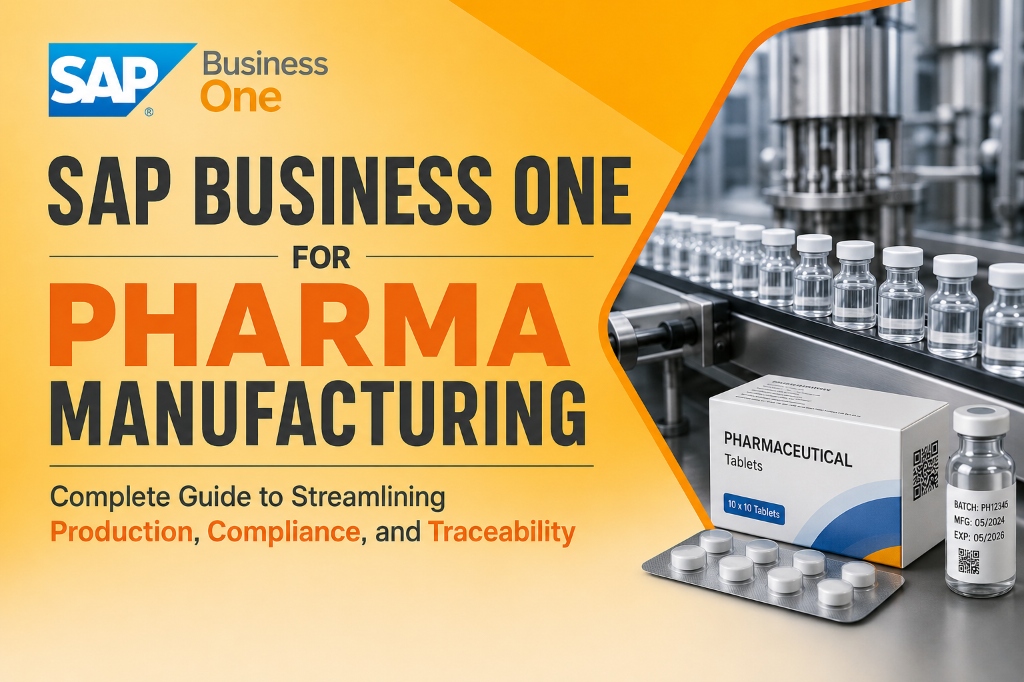
SAP Business One for Pharma Manufacturing: Complete Guide to Streamlining Production, Compliance, and Traceability
Quick Answer
SAP Business One for Pharma Manufacturing is an ERP solution that helps pharmaceutical companies manage production planning, inventory control, batch traceability, quality assurance, compliance, and financial operations from a single platform.
Why Pharmaceutical Manufacturers Need Better Systems
➔
➔
➔
➔
Why Pharmaceutical Manufacturers Need Specialized ERP Software
Pharmaceutical manufacturing is one of the most highly regulated industries in the world. Unlike standard manufacturing sectors, pharmaceutical operations require absolute precision, strict compliance with global quality standards, and immediate traceability of every single ingredient. Dealing with complex formulations, active pharmaceutical ingredients (APIs), strict shelf-life constraints, and mandatory audits means that standard spreadsheets or traditional, generic ERP systems simply cannot keep up.
A specialized ERP system like SAP Business One is essential to connect production planning, inventory tracking, quality control, and regulatory compliance into a single, unified source of truth. Without it, manufacturers face severe operational bottlenecks, compliance risks, and potential product recalls.
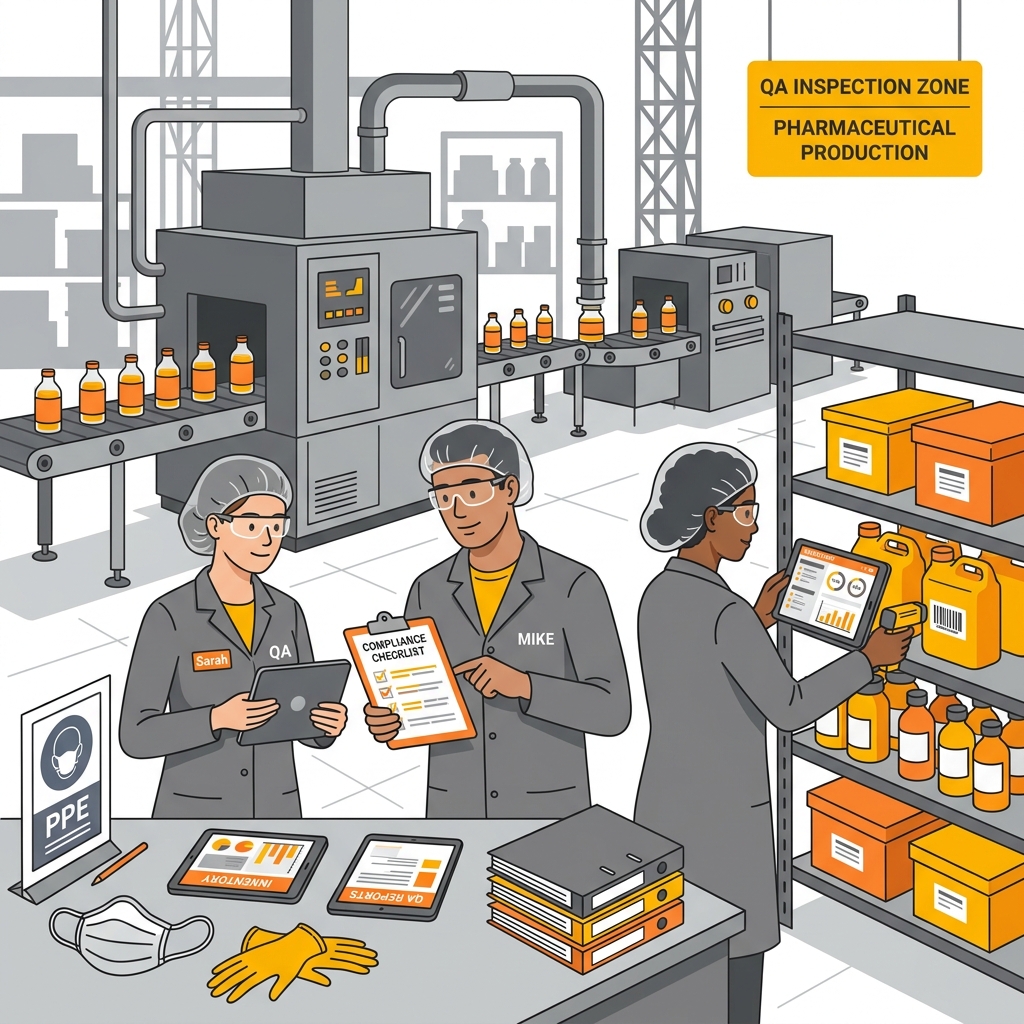
Managing Pharma Operations Without ERP Creates Bottlenecks.
Understanding SAP Business One for Pharma Manufacturing
SAP Business One provides integrated business management capabilities for pharmaceutical manufacturers. It bridges the gap between administrative processes and the shop floor, ensuring that financial systems, inventory control, and actual production floors remain perfectly aligned. With centralized data, operations managers gain complete visibility over the entire supply chain, enabling them to make data-driven decisions that cut waste and improve efficiency.
How SAP Business One Connects Operations
➔
➔
➔
➔
➔
Key Manufacturing Challenges in the Pharmaceutical Industry
Growing pharmaceutical manufacturers face a multitude of operational challenges daily, particularly when they rely on legacy databases, paper logs, or siloed spreadsheets. Managing these hurdles is crucial for long-term viability:
Complex Regulatory Requirements
Compliance with FDA 21 CFR Part 11, EU Annex 11, and Good Manufacturing Practice (GMP) is non-negotiable. Every change, action, and sign-off on the shop floor must be fully validated, recorded in audit trails, and secured with electronic signatures. Manual tracking of these records is highly error-prone and invites audit failures, fines, or operational halts.
Batch Traceability
If a defective batch of capsules or a contaminated shipment is detected, the manufacturer must execute a rapid recall. Fulfilling this requirement demands bidirectional traceability: tracing finished products back to their exact raw material batch numbers and tracing contaminated raw materials forward to all affected finished goods. Traditional tracking systems can take days to compile this data, whereas lives depend on recalls taking only minutes.
Inventory Management
Pharmaceutical ingredients are expensive and highly sensitive. Expiry dates, temperature levels, and shelf life must be meticulously monitored. Materials must transition through statuses like “Quarantined” (awaiting laboratory testing), “Released” (approved for production), and “Rejected”. An ineffective ERP leads to wasted inventory or, worse, the accidental use of unverified raw ingredients.
Production Planning
Managing drug formulations requires absolute precision. Scaling recipes for different batch sizes, checking resource availability, and scheduling cleanups between production runs (to avoid cross-contamination) are major challenges. Traditional scheduling models fall short under these complex requirements.

Managing alerts, tracking bottlenecks, and compliance issues.
Core SAP Business One Features for Pharmaceutical Manufacturing
To overcome these challenges, SAP Business One offers specialized modules that address core pharmaceutical manufacturing requirements out of the box:
Production Planning and Control
Define multi-stage Bill of Materials (BOMs), set precise formulation recipes, and handle unit of measure (UoM) conversions seamlessly. The system calculates active ingredient yields, tracks scrap rates, and handles actual batch costing so you maintain clear profit margins.
Material Requirements Planning (MRP)
MRP analyzes production schedules, inventory levels, lead times, and open purchase orders to automatically generate procurement recommendations. This ensures that essential chemical components and active ingredients are always in stock when production begins, without overinvesting in excess inventory.
Batch and Lot Management
Automate lot numbering during procurement and production. Standardize batch profiles with attributes such as expiry date, manufacturing date, and test certificate numbers. System rules ensure that materials close to expiration are automatically flagged or prioritized for use using First-Expired, First-Out (FEFO) rules.
Inventory Management
Manage multiple warehouses (including temperature-controlled storage), establish strict bin locations, integrate handheld barcode scanners, and handle quarantine inventory controls. The system locks quarantined batches automatically until Quality Assurance records an approved status.
Everything Managed from One ERP Platform
Batch Traceability and Compliance
Traceability is the cornerstone of pharmaceutical safety. SAP Business One records every movement of materials, from the moment raw ingredients arrive at the warehouse, through the mixing and packaging stages, to quality control sampling, and finally to shipment. The system automatically enforces quality control checks at defined production gates, ensuring no batch is released without formal QA sign-off.
By automating the data collection process, SAP Business One makes it possible to generate a comprehensive genealogy report for any batch in seconds. It logs every action, timestamp, and operator signature, fulfilling the requirements for FDA audits and ensuring your business is fully aligned with industry safety standards.
End-to-End Pharmaceutical Traceability
➔
➔
➔
➔
➔
SAP Business One Benefits for Pharmaceutical Manufacturers
SAP Business One vs Traditional Systems

Gain Real-Time Visibility Across Your Entire Manufacturing Operation.
Results Manufacturers Can Expect
Better Inventory Accuracy
Reduced stock-outs, accurate raw material planning, and less warehouse waste.
Production Planning
Streamlined batch sizing, minimized machine downtime, and faster order cycles.
Compliance Risk
Digital records, e-signatures, audit trails, and automatic lot/batch quarantine controls.
Operational Costs
Elimination of manual errors, faster recalls, and optimized material usage.
Conclusion
Implementing SAP Business One enables pharmaceutical manufacturers to improve production planning, strengthen compliance, enhance batch traceability, and achieve greater operational visibility through a single integrated ERP platform. By moving away from legacy spreadsheets and manual paper systems, pharma businesses can scale their operations confidently, knowing that their quality controls, inventory audits, and financial systems are fully integrated and secure.
Frequently Asked Questions (FAQs)
What is SAP Business One for Pharma Manufacturing?
How does SAP Business One support pharmaceutical compliance?
Can SAP Business One track pharmaceutical batches and lot numbers?
How does SAP Business One improve inventory management in pharmaceutical manufacturing?
What are the benefits of SAP Business One for pharmaceutical manufacturers?
Key benefits include:
- Improved production planning
- Better batch traceability
- Enhanced regulatory compliance
- Reduced inventory waste
- Increased operational efficiency
- Faster decision-making
- Lower operational costs
- Greater scalability