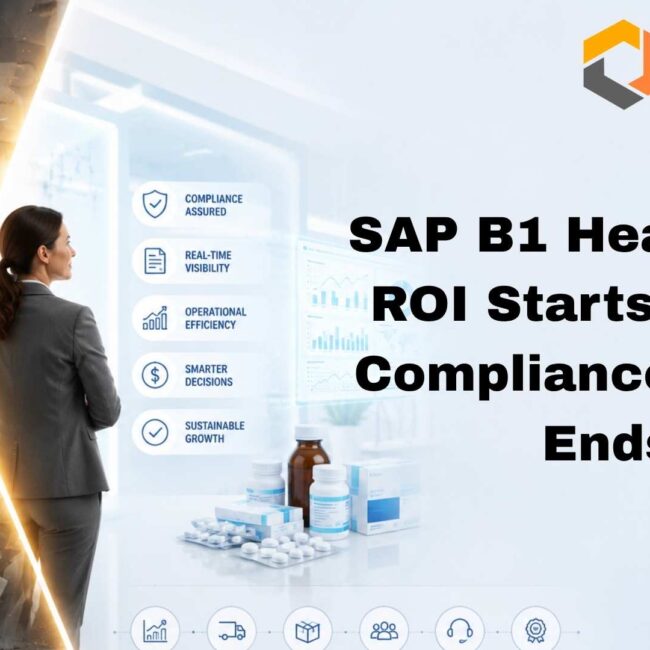

SAP B1 Pharma Compliance Gaps That Trigger Audit Failures in 2026
Fix SAP B1 Pharma audit risks before compliance breakdown impacts revenue and operations
SAP B1 Pharma environments are scaling fast—but many are quietly embedding compliance risk at the core of their operations.
Growing businesses using SAP Business One are expanding faster than ever, yet a critical gap is emerging beneath that growth.
Pharma companies don’t fail audits because they lack ERP.
They fail because their ERP cannot prove control under scrutiny.
In 2026, regulators are no longer asking:
- Whether your system exists
- But whether your data, processes, and decisions are defensible
This is exactly where most SAP Business One pharma environments begin to fracture.
And when they do, the consequences are not technical—they are financial and reputational:
- Batch recalls
- Compliance penalties
- Revenue disruption
- Loss of market credibility
The real question for CIOs and CTOs is straightforward:
Is your SAP B1 system audit-ready—or audit-exposed?
Where SAP B1 Pharma Compliance Actually Breaks Down
Most pharma ERP failures don’t happen at the feature level.
They happen at the execution layer.
Your system may have:
- Batch tracking
- Quality modules
- Audit logs
But audits fail when:
- Processes are not enforced
- Data is not consistent
- Decisions are not system-driven
👉 Compliance is not about capability.
👉 It’s about control architecture.
The Hidden Data Integrity Risk That Fails Audits
Regulators don’t trust reports.
They validate data consistency across systems.
In many SAP B1 pharma setups:
- Inventory ≠ Production data
- Quality ≠ Batch release decisions
- Manual overrides bypass validations
This creates a dangerous situation:
You have data—but you cannot defend it.
And in pharma compliance, non-defensible data = audit failure.
Batch Traceability: The #1 Audit Failure Trigger
Batch traceability is where most pharma companies collapse during audits.
Typical gaps:
- No backward traceability of batch splits
- No linkage between raw material and finished goods
- No real-time genealogy
During audits, this leads to:
- Delayed response time
- Incomplete trace reports
- Regulatory suspicion
👉 If you cannot reconstruct a batch in minutes,
your system is not compliant.
Quality Control Without Enforcement Is a Compliance Risk
Many SAP B1 systems record quality data—but don’t enforce it.
That means:
- Products can move without QC clearance
- Deviations are documented but ignored
- Release decisions are manual
This creates a critical risk:
👉 Your system allows non-compliant products to move forward.
In regulated environments, this is not inefficiency—it’s liability.
Supply Chain Complexity Multiplies Compliance Exposure
As pharma businesses scale:
- Vendors increase
- Warehouses expand
- Distribution networks grow
But most SAP B1 setups:
- Don’t integrate vendor qualification
- Don’t extend traceability beyond warehouses
- Don’t link distribution to compliance
Result:
👉 Compliance breaks outside your core system.
And regulators don’t care where the failure happened—they hold you accountable.
Why Cost-Driven SAP B1 Implementations Fail in Pharma
Many companies optimize:
- License cost
- Implementation cost
But ignore:
- Validation frameworks
- Audit readiness
- Compliance automation
This leads to a dangerous trade-off:
👉 Lower upfront cost → Higher regulatory risk
In pharma ERP,
cost optimization without compliance design is a strategic mistake.
What Audit-Ready SAP B1 Pharma Systems Actually Look Like
High-performing pharma ERP environments operate differently.
They don’t just track—they enforce.
They ensure:
- Every batch is fully traceable across lifecycle
- Every quality check blocks non-compliant movement
- Every transaction is logged with legal audit integrity
- Every deviation triggers controlled workflows
👉 This is the shift from ERP system → Compliance control engine
Why the Right SAP Partner Defines Compliance Success
Not all SAP partners are built for pharma.
Generic implementation partners focus on:
- Deployment
- Configuration
- Go-live
But pharma requires:
- Regulatory engineering
- Validation frameworks
- Audit simulation readiness
👉 This is where Emerging Alliance operates differently.
We don’t implement ERP.
We design audit-ready systems that withstand regulatory pressure.
The Future: SAP B1 as a Compliance Intelligence Platform
The next evolution of pharma ERP is clear:
- Real-time audit readiness
- Predictive compliance risk alerts
- Integrated quality + production intelligence
- Digitally enforced governance
Forward-looking companies are not upgrading ERP.
They are building compliance-first digital architecture.
Fix Your SAP B1 Before Auditors Do
If your SAP B1 system cannot confidently answer:
- Can we reconstruct any batch instantly?
- Are quality decisions fully enforced?
- Is our audit trail legally defensible?
Then your ERP is a risk surface—not a safeguard.
Emerging Alliance helps pharma companies transform SAP Business One into a fully compliant, audit-ready system.
FAQs About SAP B1 pharma
1. Why do SAP B1 pharma systems fail audits?
Because systems are configured for operations, not enforced compliance and audit defensibility.
2. Is SAP Business One compliant for pharma industry?
Yes, but only when implemented with GMP-focused validation and compliance controls.
3. What is the biggest audit risk in SAP B1 pharma?
Lack of batch traceability and inconsistent data across inventory, production, and quality.
4. How to improve SAP B1 audit readiness?
By implementing validation frameworks, enforcing workflows, and ensuring data integrity across modules.
5. Does SAP B1 support pharma batch tracking?
Yes, but it must be configured for full forward and backward traceability.
6. What role does data integrity play in audits?
It is the primary factor—regulators validate data consistency, not system features.
7. How can SAP B1 enforce quality control?
Through system-driven approvals, blocked transactions, and integrated QC workflows.
8. Why do pharma ERP implementations fail compliance?
Because they focus on cost and speed rather than regulatory design and validation.
9. Can SAP B1 handle pharma supply chain compliance?
Yes, with integrated vendor qualification, traceability, and distribution control mechanisms.
10. How to choose the right SAP partner for pharma?
Select a partner with deep pharma compliance expertise, not just ERP implementation experience.
Fill out the form to connect with our experts now