


Pharmaceutical ERP Software: Production Cost Reduction & Margin Improvement for Manufacturers
Quick Answer
Pharmaceutical ERP Software can reduce production costs by connecting production visibility, material control, batch costing, procurement, inventory, planning, waste analysis, and margin reporting in one operating model. When planned and actual consumption, purchase requirements, batch output, inventory value, and production costs are visible together, manufacturers can identify leakage faster, improve decisions, and protect margins more consistently.
Why Production Costs Are Reducing Pharmaceutical Margins
Pharmaceutical manufacturers can grow revenue while margins weaken because profitability depends on more than sales volume. Rising raw material and packaging costs, excess inventory, inefficient production planning, batch-level cost variation, rework, production delays, and underused resources can absorb the value created by higher sales.
The problem is often cumulative. Procurement may buy more than production needs, stores may carry slow-moving material, production may consume above standard, and finance may discover the effect only after month-end reporting. Individually, each issue may look manageable. Together, they can materially reduce contribution from a product, batch, or production line.
Production delays can also create hidden cost. Missing material, quality holds, unplanned changeovers, urgent purchasing, overtime, or idle resources increase the cost of producing the same finished quantity. When these events are not connected to costing, management sees lower margin without seeing the operational cause.
Revenue growth therefore does not guarantee stronger profitability. A manufacturer can ship more units while spending more to produce each unit or tying additional cash in inventory. Senior leaders need visibility into where cost is created, where it varies from plan, and which process is responsible.
That requirement leads directly to better production cost visibility. Without it, margin pressure remains a financial symptom; with it, management can investigate operational drivers.
Where Pharmaceutical Manufacturers Lose Production Cost Control
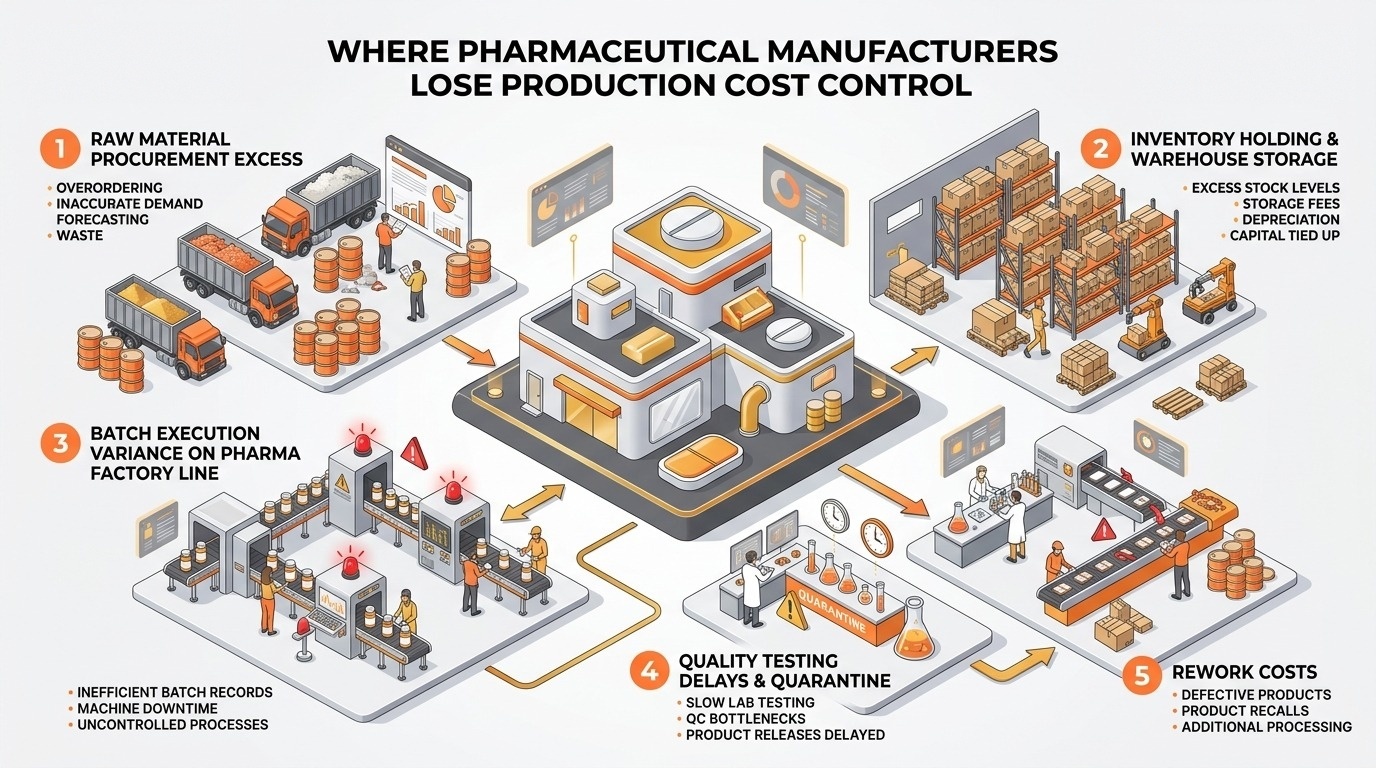
Key cost leakage points across pharmaceutical manufacturing: procurement overbuying, inventory handling, batch variance, quality delays, and rework.
Production cost control becomes difficult when purchasing, inventory, production, quality, and finance create separate records that must be reconciled manually. Management then cannot follow cost cleanly from purchase requirement to material receipt, production issue, actual consumption, output, and financial impact.
Leakage can begin in raw material purchasing. Buyers may order without complete visibility into available stock, open purchase orders, committed quantities, planned production, or supplier history. That can create excess inventory or urgent purchases.
Inventory handling creates another risk. Material may exist physically but be unclear by batch, location, status, or usable quantity. Production may report a shortage while finance still carries the stock value.
During batch execution, cost control depends on accurate material issues, returns, actual consumption, scrap, output, and timing. If these are recorded late, abnormal usage is harder to investigate. Rework can add material, labor, machine time, testing, and packaging cost that may not be visible in the original production plan.
Quality-related delays can extend production time and keep inventory tied up in work in progress. Standard labor or overhead assumptions may also differ from actual resource usage.
Disconnected data turns these events into departmental problems rather than one profitability picture. Management needs traceability between operational transactions and their financial consequences to determine where margin is actually being lost.
How Poor Batch Costing Affects Profit Margins
Batch costing converts production activity into financial evidence. A batch may use more material, take longer, produce lower yield, require rework, or absorb additional overhead even when the final quantity is eventually completed.
Management therefore needs visibility into planned versus actual material consumption, planned versus actual output, yield, production overheads, labor or resource costs, wastage, and rework. Without that comparison, the business may rely on a standard cost that no longer represents actual manufacturing performance.
Delayed costing is also a decision problem. If reliable batch cost information arrives days or weeks after production, operational teams may repeat the same loss pattern before management understands it. Pricing decisions may also depend on assumptions that do not reflect current input costs or actual production behavior.
Inaccurate batch costing can distort product profitability. A product may appear attractive because its standard cost is low while actual batches repeatedly consume more resources. Another product may be more stable operationally but look less profitable under weak allocation logic.
A connected batch costing process should therefore explain variance, not merely produce a final number. Decision-makers need to know which component changed and why it matters.
The relationship is direct: better cost visibility supports better production, purchasing, pricing, and product-mix decisions. Cost visibility does not create margin automatically, but it gives management a stronger basis for controlling it.
How Pharmaceutical ERP Software Controls Material Costs
Pharmaceutical ERP Software can improve material cost control by connecting procurement, inventory, production requirements, and finance. Instead of planning from isolated spreadsheets or departmental assumptions, teams can work from one view of what is required, available, ordered, committed, and expected to be consumed.
Material requirement planning can translate production demand into purchasing needs using inventory, open supply, and planned production. This helps reduce purchasing based only on historical patterns or urgent requests.
Supplier information can be reviewed with purchase history, pricing, delivery performance, and current requirements. The ERP does not replace negotiation, but it gives buyers better context for decisions.
Inventory visibility is equally important. Pharmaceutical inventory management requires clarity around batch or lot, location, status, committed quantity, and stock value. Better information can prevent purchases caused by incomplete stock visibility.
When materials are issued against production requirements and actual usage is recorded accurately, operations can compare planned and actual consumption. Returns, excess issues, or unused materials become visible transactions rather than manual adjustments.
The business outcome is tighter material control. A connected pharmaceutical ERP can help reduce avoidable overbuying, emergency purchasing, stock shortages, excess inventory, and unexplained material consumption. Results depend on configuration, data quality, process discipline, supplier conditions, and management action, so fixed savings should never be assumed.
How ERP Improves Pharmaceutical Production Planning
Production planning becomes more reliable when production orders, material availability, inventory priorities, planned quantities, resource capacity, and timelines are connected. A schedule that ignores any of these factors can create waiting time, rescheduling, urgent procurement, or inefficient capacity use.
ERP production planning can show whether a production order is materially ready before resources are committed. If critical material is unavailable, planners can see the constraint earlier instead of discovering it after the batch is scheduled.
Inventory levels also influence the plan. Finished or intermediate stock may justify delaying production, while confirmed demand may require earlier output. Connecting inventory with production requirements helps management balance service levels with working capital.
Planned quantities should then be compared with actual output and completion time. Repeated differences may indicate yield loss, downtime, material shortage, quality delay, scheduling issues, or resource constraints.
Better planning can reduce avoidable downtime and last-minute purchasing because material and capacity requirements become visible sooner. It can also improve utilization by sequencing production around readiness rather than assumptions.
The objective is not maximum utilization. Pharmaceutical production management requires the right quantity, materials, timing, and capacity while controlling inventory and loss. ERP supports that coordination by linking the production plan with operational and financial consequences.
How ERP Reduces Waste, Rework and Production Variance
Waste reduction starts with knowing where actual production differs from plan. Without structured variance data, management may know material usage is high or yield is weak without knowing which product, batch, process, or condition is responsible.
ERP can compare planned and actual material consumption, expected and actual output, target and achieved yield, planned and actual production time, wastage, rework, and batch performance. The purpose is operational diagnosis.
Repeated excess material consumption may indicate inaccurate material standards, handling loss, process variation, supplier-related issues, or recording errors. Lower yield may point to process inconsistency, equipment conditions, material quality, or production methods. Longer production time may reflect changeovers, resource constraints, scheduling conflicts, or quality holds.
Rework should also be visible as a distinct production event. Additional material, labor, machine time, testing, or packaging can change batch economics even when the final quantity is recovered.
ERP does not determine root cause automatically. It provides a structured history that production, quality, finance, and management teams can analyze together. That distinction matters because operational improvement depends on reliable data and disciplined investigation.
When recurring variance is visible, management can prioritize the losses with the greatest business impact and verify whether corrective action improves future batches.
How Real-Time Cost Visibility Supports Better Margin Decisions
CEOs and CFOs do not need more manufacturing data; they need timely information that explains margin movement. Connected ERP information can translate operational transactions into cost visibility so leaders understand how purchasing, production, inventory, and resource decisions are affecting profitability.
Product profitability is one example. A high-revenue product may absorb increasing material cost, repeated rework, higher overhead, or excess inventory. Without connected data, those changes can remain hidden in departmental reports.
Procurement decisions improve when buyers and finance can see purchase requirements alongside inventory and production demand. Inventory investment can be evaluated against usage, stock status, and production plans rather than treated only as a balance-sheet number.
Pricing also benefits from a more realistic cost basis. ERP does not set selling prices, but it can provide current production economics before commercial teams accept terms that may weaken margin.
Resource utilization adds another dimension. Underused capacity can increase unit cost, while overloaded resources can create overtime and delay. Timely information helps leaders distinguish capacity constraints from planning problems.
The decision chain is clear: operational data creates cost visibility; cost visibility supports better decisions; better decisions help protect margin. For senior management, this connection is one of the strongest business cases for Pharmaceutical ERP Software.
What Pharmaceutical Manufacturers Need From an ERP System
An ERP for pharmaceutical manufacturing should support the operating model behind cost control, not simply provide accounting and inventory functions. The most important capabilities are those that connect production execution with material movement, costing, traceability, quality-related visibility, and finance.
Production management should capture production orders, planned quantities, actual output, material issues, resource use, and status. That creates the transaction base required for manufacturing cost analysis.
Inventory and batch tracking should provide visibility by batch or lot, location, movement, status, commitment, and valuation. Procurement should connect purchase requirements with production demand and available stock so buyers can make decisions with better context.
Batch costing should connect actual consumption, resource use, waste, rework, and overhead with financial reporting. Financial integration matters because production cost control weakens when operational data must be re-entered or manually reconciled before finance can use it.
Quality-related process visibility and traceability are also important, but ERP software itself does not guarantee compliance. Compliance depends on appropriate procedures, controls, configuration, validation, governance, and organizational practices.
Reporting should allow leaders to move from a summary cost figure to the operational driver behind it. Scalability matters when plants, products, warehouses, users, or transaction volumes increase. Integration capability matters when laboratory, quality, warehouse, shop-floor, logistics, or other systems must exchange data with ERP.
The right pharmaceutical manufacturing ERP is therefore the system that supports the company’s production economics, control requirements, reporting needs, and future operating complexity without creating unnecessary fragmentation.
From Production Data to Better Pharmaceutical Profitability
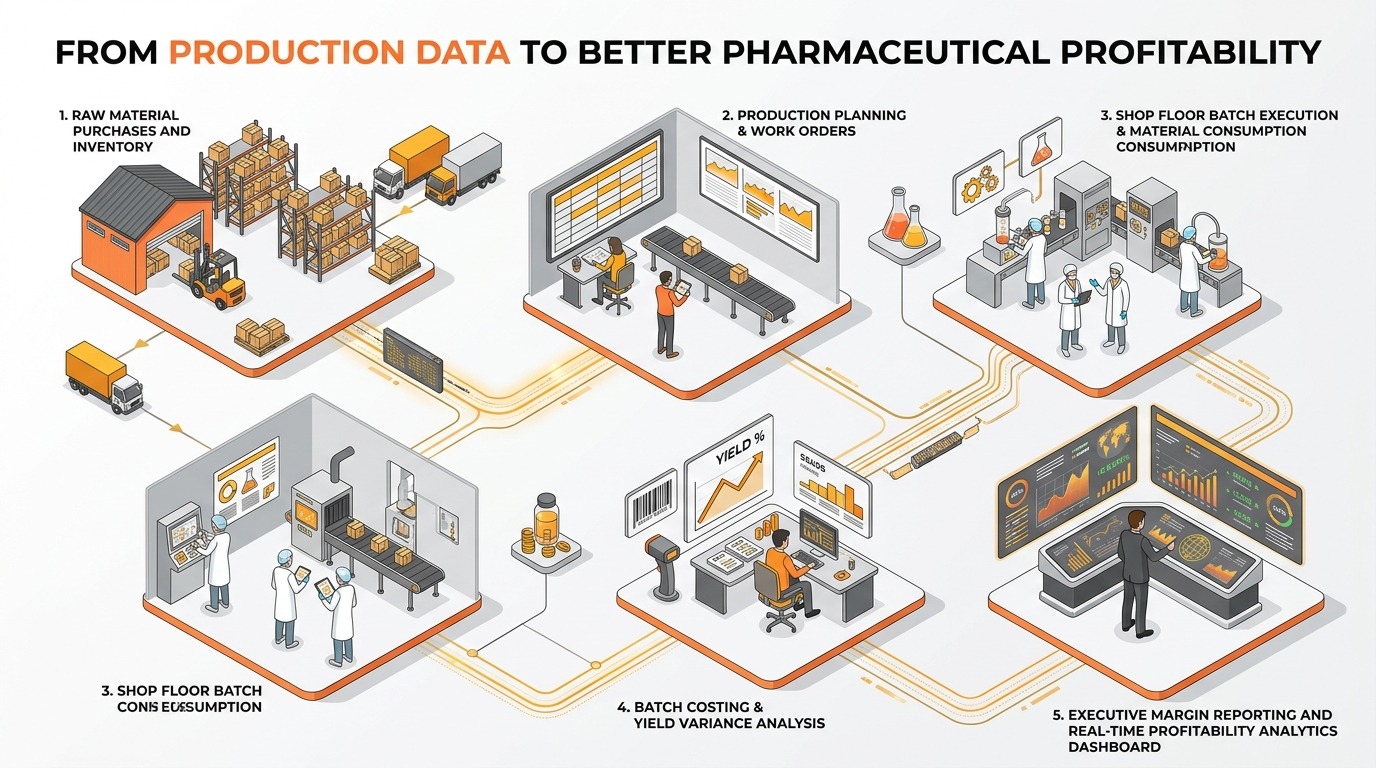
From production data to margin control: How connected ERP data links material purchasing, batch execution, and variance analysis to profitability.
Disconnected data creates delayed decisions. Procurement knows purchasing activity, stores knows inventory, production knows output, quality knows status, and finance knows summarized cost. When those views are reconciled only after the fact, leaders may know profitability changed without knowing which operational event caused it.
Connected ERP data creates a clearer chain. Purchases affect inventory. Inventory affects production planning. Production issues affect consumption. Consumption, output, resource use, waste, and rework affect batch cost. Batch cost then influences product profitability and management reporting.
This gives decision-makers a more complete view of pharmaceutical manufacturing profitability. A CFO can investigate whether margin pressure came from purchase price, yield loss, inventory exposure, resource use, or another cost driver. A COO can connect production variance with financial impact. A CEO can judge growth with better visibility into operating economics.
The progression is simple: disconnected data creates limited cost visibility and delayed decisions. Connected ERP data supports production cost visibility, faster analysis, improved cost control, and stronger margin management.
ERP does not automatically increase profit. Profitability still depends on commercial strategy, production capability, procurement discipline, quality management, market conditions, and execution. ERP provides the process structure and information required to identify cost drivers, assign responsibility, compare performance, and act with better evidence.
When Pharmaceutical ERP Software Becomes a Business Priority
Pharmaceutical ERP Software becomes a business priority when cost uncertainty starts affecting decisions, working capital, production reliability, or growth. The trigger is not company size alone. It is the point at which existing processes no longer provide timely and consistent control over manufacturing economics.
One signal is rising production cost without a clear explanation. Finance may see margin pressure while production believes performance is stable. Another appears when finance and operations report different numbers for inventory, consumption, or output because each team maintains separate calculations.
Slow batch costing is especially important. If managers must wait for manual reconciliation before knowing batch cost, pricing and production decisions rely on old information. The same weakness appears when inventory value is difficult to control or planners cannot distinguish usable, committed, or excess stock confidently.
Spreadsheet-dependent planning can also become fragile as products, warehouses, orders, and production constraints multiply. Multiple disconnected systems create similar risk when procurement, inventory, production, quality, and finance require repeated reconciliation.
Expansion often exposes these gaps. A new plant, warehouse, product portfolio, or higher transaction volume can turn informal coordination into a control problem.
At that stage, implementation expertise matters. An experienced SAP Business One partner can translate manufacturing requirements into process design, costing logic, reports, integrations, approval controls, and user responsibilities. Emerging Alliance supports SAP Business One implementation, pharmaceutical and manufacturing process alignment, customization, integration, reporting, support and maintenance, and cloud deployment options where appropriate.
The objective is not simply to install ERP. It is to configure a connected operating model that gives decision-makers information they can trust and use.
Conclusion: Production Cost Visibility Is a Margin Management Requirement
Pharmaceutical manufacturers cannot improve margins consistently when production costs remain difficult to see, explain, and control. Material price changes, poor planning, excess inventory, yield loss, rework, and weak batch costing can all reduce profitability even when revenue grows.
Pharmaceutical ERP Software can connect production, procurement, inventory, costing, and finance so management can identify cost leakage and make better-supported decisions. The system does not guarantee savings or compliance; it provides the visibility, traceability, and process control required to manage cost drivers deliberately.
Frequently Asked Questions
Take Control of Pharma Production Costs
Discover how ERP can help reduce cost leakage and improve manufacturing margins.
Schedule Your ERP Demo