
SAP Business One for Pharmaceutical SMEs: Fragmented Systems to Operational Visibility
Quick Answer
SAP Business One for pharmaceutical industry operations can help growing SMEs connect finance, purchasing, inventory, production, sales, and batch-related information within a unified ERP environment. This reduces dependence on disconnected spreadsheets and departmental systems while improving operational visibility. Leaders gain more consistent information for inventory control, batch traceability, production planning, financial oversight, and compliance governance. The result is a more scalable operating foundation for pharmaceutical growth.
Why Fragmented Systems Become a Growth Risk for Pharmaceutical SMEs
Fragmented systems rarely fail all at once.
Instead, they create small operational gaps across inventory, production, purchasing, finance, quality, and reporting. As the business grows, those gaps become harder and more expensive to manage.
Consider a pharmaceutical manufacturer using:
- accounting software for finance
- spreadsheets for production planning
- a separate inventory application
- manually maintained batch information
- independent quality or compliance records
- departmental management reports
Each application may perform its individual task effectively. The problem arises when management needs to understand the business as one connected operation.
Procurement may be working from one stock figure while production uses another. Finance may receive inventory adjustments after operational decisions have already been made. Quality information may sit outside the transaction history management is reviewing.
The real problem is decision latency.
If a CEO is evaluating a major customer order, management may need immediate answers to questions such as:
- Is enough stock available?
- Which batches can be allocated?
- Are the required raw materials available?
- Can production meet the requested date?
- What purchasing commitments are already open?
- What is the likely working-capital impact?
When those answers require several departments and manual spreadsheet reconciliation, decision-making slows.
For growing pharmaceutical SMEs, fragmentation therefore becomes more than an IT inconvenience. It can affect inventory efficiency, fulfilment, traceability, financial control, management reporting, and the ability to scale operations confidently.
Five Visibility Gaps That Affect Pharmaceutical Performance
The business case for pharmaceutical ERP software becomes clearer when leaders identify exactly where visibility is being lost.
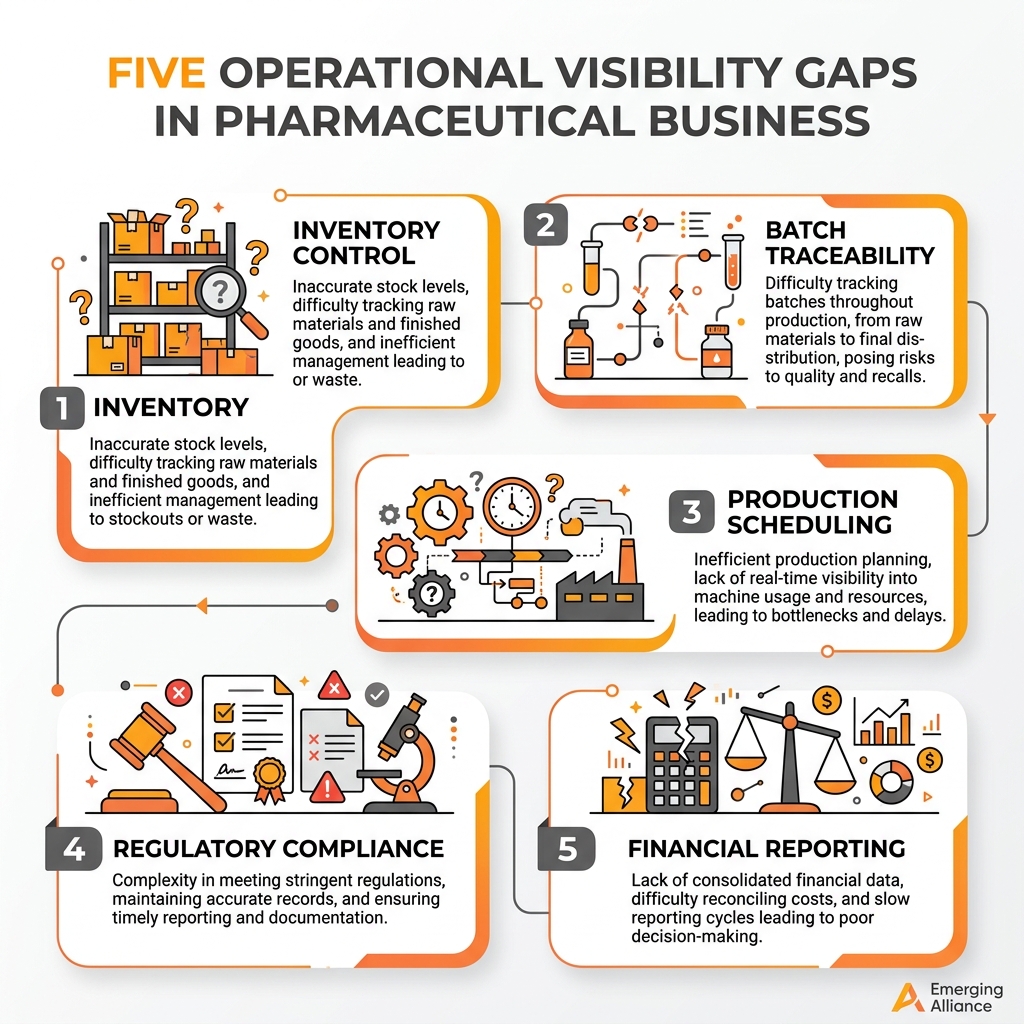
1. Inventory Visibility
Pharmaceutical inventory management involves more than total stock quantity.
Businesses may need visibility into:
- batches and lots
- warehouse locations
- available and committed quantities
- expiry-related information
- raw material requirements
- inventory movements
- slow-moving stock
- production demand
When inventory information sits outside purchasing, production, and sales processes, teams can make conflicting decisions.
Procurement may purchase materials that already exist elsewhere. Production may encounter unexpected shortages. Management may discover excess or ageing inventory only after working capital has already been tied up.
A connected pharma inventory management software environment gives decision-makers a more dependable view of stock and its operational context.
2. Batch Traceability
Batch traceability becomes difficult when information is distributed across spreadsheets, warehouse records, production documents, and sales transactions.
When management needs to investigate a particular batch, teams may have to reconstruct:
- where materials originated
- how they were consumed
- where finished goods were stored
- how inventory moved
- which customers received specific batches
- whether returns or transfers occurred
Integrated batch traceability software creates a clearer transactional chain.
This can support faster operational investigations, customer enquiries, recall preparedness, and stronger traceability governance.
3. Production Planning
Production planning depends on multiple operational variables.
Planners need to understand demand, available inventory, purchase commitments, raw materials, production requirements, and scheduling dependencies.
When these inputs remain disconnected, production plans can become reactive.
Materials may arrive too early and increase inventory pressure, or too late and delay manufacturing. Production capacity may be available while essential materials are not.
Connected pharmaceutical manufacturing software allows planning decisions to be made using a more consistent operational information base.
4. Compliance and Documentation
Pharmaceutical businesses require disciplined processes, controlled records, traceability, approvals, and defined responsibilities.
When operational evidence is spread across emails, spreadsheets, paper records, and independent applications, documentation becomes more difficult to retrieve and reconcile.
This does not mean ERP software automatically creates pharmaceutical compliance.
ERP should instead support controlled processes within a broader compliance framework that includes appropriate configuration, validation, procedures, documentation, training, access governance, and applicable regulatory requirements.
5. Financial Visibility
Financial reporting becomes less useful when operational transactions reach finance late.
Executives may understand inventory value, material consumption, purchasing exposure, manufacturing cost, or margins only after manual reconciliation.
By connecting operational activity with finance, ERP can help management understand financial consequences closer to when operational decisions occur.
What Operational Visibility Means in a Pharmaceutical ERP
Operational visibility means more than having dashboards.
It means that related transactions can be examined from a common information environment.
For a pharmaceutical SME, leadership should be able to connect questions across functions.
For example:
Customer demand → inventory availability → batch position → production requirement → purchasing requirement → financial impact
That relationship is difficult to manage when each function works independently.
A well-designed pharma ERP system creates a shared operational information model in which departments work with consistent master data, transactions, and reporting logic.
This is the key shift from fragmented applications to integrated operations.
How SAP Business One Creates a Connected Pharmaceutical Operating Model
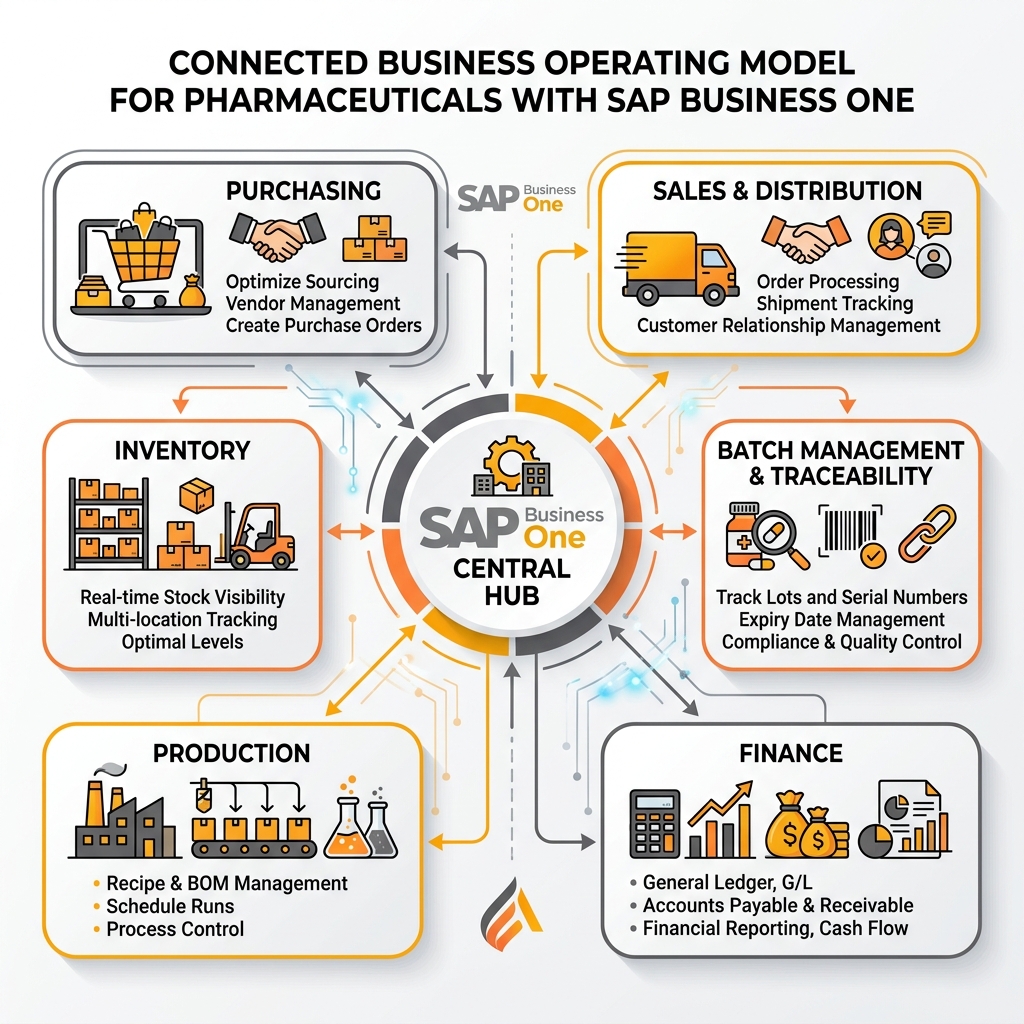
A strong SAP Business One for pharmaceutical industry strategy should focus on business integration rather than individual software modules.
Connected Business Data
SAP Business One brings core business processes such as financial management, purchasing, inventory, sales, and operational transactions into a connected ERP environment.
Instead of departments maintaining separate versions of business information, they can work from shared master and transactional data.
For pharmaceutical SMEs, this can improve the relationship between:
- products
- suppliers
- customers
- warehouses
- batches
- purchasing
- sales
- inventory
- production-related transactions
- financial reporting
The practical benefit is reduced reconciliation and clearer ownership of operational information.
Inventory and Warehouse Visibility
Authorized users can work with current inventory transactions and stock positions rather than waiting for separately prepared reports.
Management can investigate inventory availability before making purchasing, production, or customer commitments.
This also creates a stronger basis for monitoring:
- stock ageing
- excess inventory
- slow-moving products
- warehouse movements
- replenishment requirements
- working-capital exposure
Batch and Lot Management
Batch management can connect batch information with relevant inventory and business transactions.
This creates a more structured basis for tracing transactional relationships without reconstructing information manually from disconnected sources.
Pharmaceutical companies should nevertheless evaluate batch requirements using their own scenarios.
The correct design depends on products, warehouse processes, manufacturing workflows, customer requirements, regulatory obligations, integrations, and validation needs.
Production Integration
Production becomes significantly more valuable when it is connected with inventory, purchasing, material requirements, and financial information.
Management can gain clearer visibility into:
- planned production
- required materials
- material availability
- shortages
- procurement dependencies
- production-related inventory movements
- operational exceptions
This helps planning teams identify issues earlier rather than responding after schedules have already been affected.
Financial Integration
Operational transactions should not exist separately from their financial consequences.
Connecting purchasing, inventory, production-related activity, sales, and finance allows management to examine financial performance with stronger operational context.
Finance teams can spend less effort consolidating disconnected information and more time analysing cost, margins, cash requirements, inventory exposure, and exceptions.
Management Reporting and Business Intelligence
Dashboards, reports, queries, and business intelligence should answer management questions rather than simply display available data.
Examples include:
- Which inventory categories require attention?
- Where are shortages affecting production?
- Which purchasing commitments are increasing working capital?
- Which products or transactions require management review?
- What operational activity is affecting cash or profitability?
- Where are exceptions occurring across inventory or production?
An executive dashboard is valuable only when it helps management act.
From Operational Data to Executive Decisions
The value of SAP Business One pharma capabilities should be measured through better business decisions rather than the number of ERP features implemented.
Faster Management Decisions
Connected information can reduce the time employees spend collecting and reconciling reports.
Executives gain a more consistent basis for evaluating inventory, purchasing, production requirements, sales activity, and financial consequences.
A useful KPI is management reporting turnaround time.
Stronger Inventory Control
Better visibility across demand, stock, purchasing, and production can support more informed inventory decisions.
Management can monitor:
- inventory accuracy
- stock ageing
- stockouts
- inventory days
- emergency purchases
- write-offs
- excess stock
These measures provide a stronger business case than generic promises of inventory improvement.
Faster Traceability Investigations
A connected transaction trail can reduce the effort required to investigate batches.
Executives should measure current traceability response times before implementation and compare them with post-implementation performance.
Better Production Coordination
Production managers can track material availability and planning dependencies more consistently.
Relevant measures can include:
- schedule adherence
- material shortages
- planning exceptions
- production delays
- order completion
- emergency material requirements
Stronger Financial Oversight
Connecting operational transactions with finance helps leadership understand why financial outcomes are changing.
Management can investigate relationships among inventory, purchasing, production, sales, margins, and cash requirements rather than relying entirely on retrospective financial reports.
Greater Organizational Scalability
The long-term benefit is reduced dependence on individual employees, spreadsheet knowledge, and manual coordination.
As the company adds products, customers, warehouses, employees, or operational complexity, processes can scale without creating the same proportional increase in reconciliation and administrative work.
Where ERP Creates the Greatest Value
Not every pharmaceutical SME needs to replace its current systems immediately.
ERP becomes strategically important when fragmentation starts limiting control.
Warning signs can include:
| Business Signal | Management Impact |
|---|---|
| Multiple inventory spreadsheets | Low confidence in stock accuracy |
| Manual batch investigations | Slow traceability response |
| Frequent reconciliation between departments | Higher administrative effort |
| Production plans disconnected from inventory | More planning exceptions |
| Reporting dependent on specific employees | Key-person dependency |
| Significant spreadsheet-based approvals | Weak workflow control |
| Separate operational and financial reporting | Delayed performance insight |
| Increasing warehouses, SKUs or transactions | Rising operating complexity |
The important question is therefore not:
“Do our current applications still work?”
The better question is:
“Can our current operating model support the next stage of business complexity without creating more risk, delay, and manual coordination?”
A Practical Pharmaceutical ERP Transformation Path
Successful ERP transformation should happen in stages.
Start by identifying where information currently breaks between departments.
Typical areas include:
- sales to inventory
- inventory to production
- production to purchasing
- warehouse to finance
- batch records to sales transactions
- operational reporting to executive reporting
The objective is to identify business friction before discussing software configuration.
Executives should define what must become easier after implementation.
Examples include:
- faster monthly reporting
- improved inventory confidence
- quicker batch investigations
- fewer manual reconciliations
- better production visibility
- stronger purchasing control
- faster operational decision-making
These outcomes later become implementation success measures.
The organization can then define how purchasing, inventory, production, sales, finance, batch management, approvals, and reporting should operate together.
This stage should also address:
- master-data standards
- roles and authorizations
- integrations
- migration requirements
- reporting architecture
- quality responsibilities
- regulatory considerations
SAP Business One should be configured around approved business processes rather than forcing teams to reproduce every historical workaround inside the new ERP.
Testing should cover realistic cross-functional scenarios.
A pharmaceutical company should test complete workflows rather than only individual functions.
ERP value depends heavily on transaction discipline.
If employees continue maintaining critical operational information outside the ERP, fragmentation gradually returns.
Training, process ownership, management adoption, and governance therefore matter as much as technical implementation.
After stabilization, management should compare agreed KPIs with pre-implementation baselines.
Relevant indicators can include:
- inventory accuracy
- reporting turnaround time
- reconciliation hours
- batch traceability response time
- planning exceptions
- stock ageing
- emergency procurement
- operational spreadsheet dependency
This converts ERP performance into measurable business outcomes.
SAP Business One and Pharmaceutical Compliance: An Important Distinction
Pharmaceutical executives should approach compliance claims carefully.
SAP Business One can support controlled business processes through capabilities such as:
- user authorizations
- transaction records
- batch information
- approvals
- reporting
- controlled business data
- traceable operational transactions
However, SAP Business One alone should not be described as guaranteeing GMP compliance or regulatory compliance.
Compliance depends on the complete operating environment, including:
- system configuration
- validation
- standard operating procedures
- documentation
- employee training
- access controls
- quality processes
- regulatory requirements
- supporting systems and integrations
This distinction should be part of every pharmaceutical ERP evaluation.
Quality, compliance, IT, operations, finance, and management stakeholders should therefore participate in solution design where appropriate.
Why Pharmaceutical SMEs Work With Emerging Alliance
ERP success depends on both the platform and the implementation approach.
Emerging Alliance works with organizations to translate operational requirements into SAP Business One processes, integrations, reporting, and implementation priorities.
For pharmaceutical businesses, an effective engagement should begin with the operating model.
That includes understanding areas such as:
Implementation planning should then address data preparation, configuration, testing, authorization design, training, migration, cutover, reporting, and post-go-live support.
The objective is not merely to make SAP Business One operational.
It is to establish a connected information environment that helps management control a more complex pharmaceutical business.
Conclusion
Fragmented applications may continue supporting individual departments, but they become increasingly difficult to manage as pharmaceutical operations grow.
The strategic value of SAP Business One for pharmaceutical industry operations lies in connecting purchasing, inventory, production-related processes, sales, finance, and batch information around a more consistent operating model.
For executives, this can create:
ERP transformation should therefore begin with management outcomes rather than software features.
Frequently Asked Questions
Ready to improve pharmaceutical operational visibility?
Talk to our SAP Business One experts.