
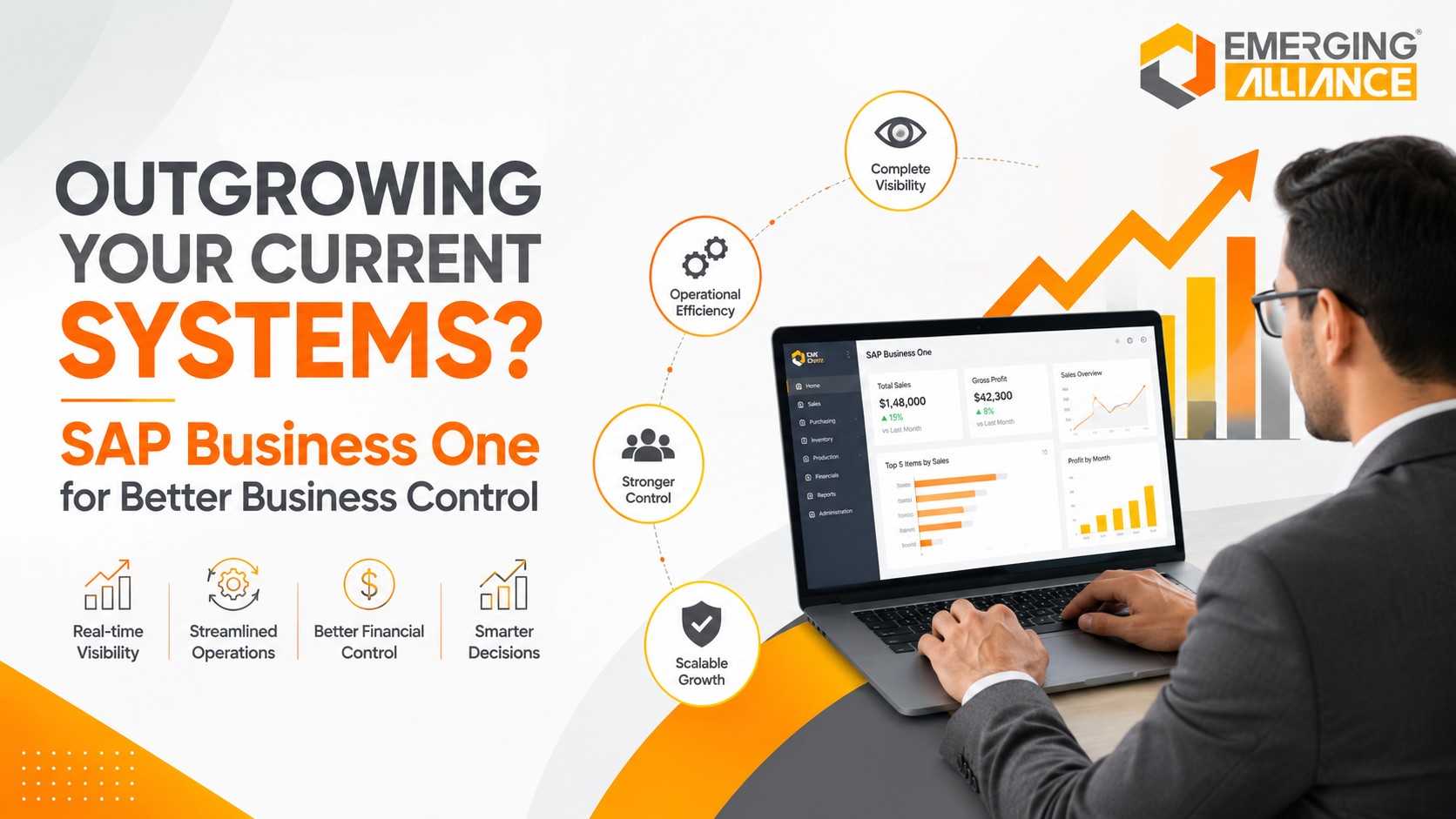
Outgrowing Your Current Systems? SAP Business One for Better Business Control
Quick Answer
A business may have outgrown its current systems when disconnected applications, spreadsheet-dependent processes, duplicate data entry, delayed reporting, and inventory inaccuracies begin limiting operational control.
SAP Business One connects finance, sales, purchasing, inventory, production, and customer management within one integrated ERP platform. Growing businesses gain centralized data, real-time visibility, automated workflows, and the scalable operational foundation required to manage expansion efficiently.
Signs Your Business Has Outgrown Its Current Systems
Business growth increases transaction volumes, reporting requirements, customer expectations, and operational complexity. Systems that supported a smaller organization may no longer provide the visibility, automation, or control required at the next stage of growth.
The following warning signs indicate that your current technology environment may be restricting business performance.
Disconnected Business Applications
Finance, sales, purchasing, inventory, and operations may each use separate software. Because these applications do not communicate consistently, employees must transfer information manually and reconcile conflicting records.
This fragmentation creates:
- Duplicate data entry
- Reporting inconsistencies
- Delayed communication
- Departmental silos
- Limited management visibility
As transaction volumes grow, disconnected systems become increasingly difficult and expensive to maintain.
Heavy Dependence on Spreadsheets
Spreadsheets are valuable for analysis, but they are not designed to manage complex, high-volume business operations.
Businesses that use spreadsheets for inventory, order management, purchasing, budgeting, and financial reporting frequently encounter:
- Formula errors
- Duplicate files
- Version-control problems
- Manual reconciliation
- Limited audit trails
- Delayed reporting
When employees spend more time validating spreadsheet data than analyzing it, the business has likely reached the limits of its current systems.

Operational inefficiencies, spreadsheet dependence, and communication gaps are clear indicators of system constraints.
Limited Business Visibility
Growing businesses need timely information about inventory, cash flow, sales performance, purchasing commitments, customer payments, and operational profitability.
Outdated systems often require information to be collected from multiple sources before management reports can be prepared. By the time leadership receives the report, the underlying business situation may already have changed.
Limited visibility prevents executives from identifying risks, responding to opportunities, and making informed decisions quickly.
Inventory Management Problems
Inventory becomes harder to control as the business adds products, suppliers, warehouses, customers, and sales channels.
Common warning signs include:
- Frequent stock shortages
- Excess or slow-moving inventory
- Incorrect stock balances
- Delayed replenishment
- Warehouse discrepancies
- Limited batch or serial-number visibility
Poor inventory control increases carrying costs, affects customer service, and ties up working capital unnecessarily.
Slow Financial Processes
Finance teams are often among the first to feel the impact of disconnected systems. Month-end closing takes longer because accountants must reconcile transactions from multiple departments and software platforms.
Budget tracking, cash-flow monitoring, profitability analysis, and management reporting also become difficult when financial and operational data are not connected.
Instead of supporting strategic decisions, finance teams spend excessive time collecting, correcting, and validating information.
Duplicate Data Entry
Customer records, supplier details, purchase orders, inventory transactions, invoices, and payment information may be entered repeatedly across different systems.
Duplicate entry creates hidden operational costs and increases the risk of:
- Inconsistent records
- Incorrect invoices
- Inventory errors
- Delayed order processing
- Reporting inaccuracies
As transaction volumes increase, even minor data-entry errors can affect several departments and business processes.
Departments Working in Silos
Business control depends on finance, sales, purchasing, inventory, production, and customer service working with shared information.
When departments operate through separate systems:
- Sales may promise delivery without checking stock.
- Purchasing may order materials without understanding current demand.
- Finance may lack visibility into operational commitments.
- Customer service may struggle to confirm order status.
These information gaps reduce productivity, weaken collaboration, and create inconsistent customer experiences.
Growth Becoming Harder to Manage
The clearest warning sign is when growth creates more administrative work than business value.
Adding customers, employees, warehouses, locations, or products should increase opportunity. However, businesses operating on fragmented systems often experience more reporting delays, manual processes, errors, and operating costs with every expansion.
At this stage, technology has become a constraint rather than a growth enabler.
Why Outdated Systems Reduce Business Control
Outdated systems do more than slow employees down. They gradually reduce management’s ability to understand, coordinate, and control the organization.
No Single Source of Truth
When different departments maintain separate records, employees may work with conflicting versions of inventory, customer, supplier, sales, or financial information.
Management meetings become focused on determining which report is correct instead of discussing business performance and strategy.
A single source of truth is essential for reliable reporting, coordinated operations, and confident decision-making.
Delayed Decision-Making
Business opportunities and operational problems require timely action. Leaders need current information when responding to customer demand, supplier delays, pricing changes, cash-flow pressure, and production issues.
Manual report preparation delays decisions and forces management to react after problems have already affected performance.
Poor Operational Visibility
Managers cannot control processes they cannot see.
Without live operational information, basic questions may require investigation across several departments:
- Which customers have overdue payments?
- Which products deliver the highest margin?
- Which purchase orders are delayed?
- What stock is available across warehouses?
- Which production orders are behind schedule?
The longer it takes to answer these questions, the greater the operational risk.
Increasing Manual Work
Businesses often compensate for system limitations by adding spreadsheets, emails, manual reports, paper approvals, and administrative staff.
These workarounds may keep operations moving temporarily, but they become unsustainable as the business grows. Employees spend more time maintaining processes and less time serving customers, improving operations, or supporting strategic priorities.
Higher Operating Costs
The cost of disconnected systems is spread across the organization and may not appear as a single expense.
Hidden costs include:
- Manual reconciliation
- Duplicate data entry
- Inventory inaccuracies
- Reporting delays
- Closing-period overtime
- Repeated software subscriptions
- Additional administrative staffing
Over time, these inefficiencies reduce profitability and limit investment in business growth.
Customer Service Delays
Customers expect fast answers, accurate delivery commitments, and consistent communication.
Disconnected systems make these expectations difficult to meet. Sales teams may lack current inventory information, service teams may not see complete order history, and finance teams may delay invoicing because transaction data has not been reconciled.
Slow or inaccurate responses weaken customer confidence and create competitive risk.
Difficulty Scaling Operations
Every new branch, warehouse, employee, customer, or product line introduces additional complexity.
Systems that depend on manual processes cannot scale efficiently. Expansion requires more people, more spreadsheets, and more reconciliation rather than creating proportional improvements in productivity.
An integrated ERP platform helps businesses scale without losing visibility or control.
How SAP Business One Improves Business Control
SAP Business One is an integrated ERP solution designed to help small and midsize businesses manage core business processes through a connected platform.
It brings finance, sales, purchasing, inventory, production, customer management, and reporting together so teams can work with consistent information and standardized workflows.

SAP Business One unifies all departmental workflows into a single system, giving leaders full operational visibility.
Centralized Business Data
Business Challenge
Customer records, inventory balances, purchase orders, financial transactions, and operational updates are stored across different systems.
SAP Business One Capability
SAP Business One centralizes core business information within one ERP environment. Approved transactions update related processes, helping departments work from consistent data.
Business Value
Employees spend less time transferring information or reconciling conflicting records.
Business Outcome
Leadership gains a reliable source of information for faster decisions, stronger accountability, and improved operational control.
Real-Time Business Visibility
Business Challenge
Management reports depend on manually consolidated information and frequently describe past performance rather than current conditions.
SAP Business One Capability
SAP Business One provides dashboards, operational KPIs, alerts, and reports across finance, sales, purchasing, inventory, and production.
Business Value
Managers can identify exceptions, trends, and emerging problems earlier.
Business Outcome
The organization becomes more proactive, responsive, and data-driven.
Better Financial Control
Business Challenge
Financial teams spend excessive time reconciling transactions, preparing reports, tracking budgets, and monitoring cash flow across disconnected systems.
SAP Business One Capability
SAP Business One connects accounting, accounts payable, accounts receivable, banking, budgeting, cost accounting, approvals, and financial reporting.
Business Value
Finance teams reduce manual reconciliation and gain more timely access to financial information.
Business Outcome
Executives can improve cash-flow management, cost control, budgeting, and profitability analysis.
Smarter Inventory Management
Business Challenge
Inaccurate inventory information causes shortages, excess stock, delayed purchasing, and customer-service problems.
SAP Business One Capability
The solution supports stock visibility across warehouses, inventory valuation, batch and serial-number management, stock movements, demand planning, and purchasing recommendations.
Business Value
Warehouse, sales, and purchasing teams work with more consistent inventory information.
Business Outcome
Businesses can reduce carrying costs, improve order fulfillment, and strengthen supply-chain control.
Integrated Sales and Customer Management
Business Challenge
Customer information is spread across email, spreadsheets, CRM tools, accounting applications, and order-management systems.
SAP Business One Capability
SAP Business One connects customer master data, opportunities, quotations, sales orders, deliveries, invoices, receivables, and service activities.
Business Value
Sales and customer-service teams can view relevant customer and transaction information from one system.
Business Outcome
Businesses improve response times, accelerate sales processing, strengthen collection visibility, and provide a more consistent customer experience.
Controlled Purchasing and Procurement
Business Challenge
Manual purchasing processes create delayed approvals, duplicate orders, inconsistent supplier information, and limited spending visibility.
SAP Business One Capability
The platform connects purchase requests, purchase orders, goods receipts, supplier invoices, approvals, and supplier records.
Business Value
Purchasing teams gain better visibility into procurement activities and supplier performance.
Business Outcome
Organizations improve purchasing discipline, control costs, and maintain more appropriate inventory levels.
Connected Production and Operations
Business Challenge
Manufacturers must coordinate customer demand, material availability, production capacity, and delivery commitments.
SAP Business One Capability
SAP Business One supports bills of materials, production orders, material requirements planning, resource information, and production-related inventory transactions.
Business Value
Sales, inventory, purchasing, and production teams work with connected operational information.
Business Outcome
Manufacturers can improve planning, reduce delays, strengthen material control, and deliver orders more reliably.
Workflow Automation
Business Challenge
Manual approvals, repetitive tasks, emails, and paper-based processes slow operations and create inconsistent execution.
SAP Business One Capability
Configurable approvals, alerts, notifications, and business rules help automate recurring processes and exception management.
Business Value
Employees spend less time following up on routine transactions.
Business Outcome
The organization improves process consistency, governance, approval speed, and operational scalability.
Reporting and Analytics
Business Challenge
Leadership depends on manually prepared reports that provide limited or outdated information.
SAP Business One Capability
The platform provides operational reports, financial statements, dashboards, KPIs, and role-based reporting capabilities.
Business Value
Executives and department managers receive more timely, relevant information.
Business Outcome
Businesses make better decisions related to profitability, inventory, sales, purchasing, cash flow, and operational performance.
Scalable Business Foundation
Business Challenge
Adding branches, users, warehouses, products, and transaction volumes creates increasing pressure on disconnected systems.
SAP Business One Capability
SAP Business One can support expanding operational requirements through additional users, locations, warehouses, processes, integrations, and industry-specific extensions.
Business Value
Businesses can expand without repeatedly replacing their core operational platform.
Business Outcome
Technology becomes a foundation for growth rather than a source of complexity.
Business Outcomes After Implementing SAP Business One
A well-planned SAP Business One implementation can improve performance across several areas of the organization.
Faster Decision-Making
Management gains access to more timely and consistent business information. Leaders can respond faster to customer demand, inventory issues, supplier delays, financial pressure, and market opportunities.
Stronger Financial Management
Integrated operational and financial transactions reduce reconciliation effort and improve visibility into cash flow, budgets, costs, receivables, and profitability.
Improved Inventory Performance
Better inventory visibility helps reduce shortages, excess stock, inaccurate balances, and unnecessary purchasing. Businesses can improve inventory turnover while supporting customer demand more reliably.
Greater Operational Efficiency
Employees spend less time entering duplicate data, correcting errors, preparing manual reports, and searching for information.
Standardized workflows also make processes easier to manage, measure, and improve.
Better Customer Experience
Connected sales, inventory, delivery, service, and finance information helps employees provide faster and more accurate responses throughout the customer lifecycle.
Increased Management Transparency
Dashboards, reports, KPIs, alerts, and centralized business information give leadership greater visibility into performance and operational risk.
More Controlled Business Growth
Expansion can be supported through a connected system rather than additional spreadsheets and standalone applications.
The business gains a more scalable operating model with standardized processes and shared information.
SAP Business One Readiness Checklist
Your business may be ready for SAP Business One when several of the following conditions apply:
The more frequently these challenges occur, the stronger the case for evaluating an integrated ERP solution.
Why Choose Emerging Alliance for SAP Business One
Selecting ERP software is only one part of a successful transformation. Business outcomes depend heavily on implementation planning, process alignment, data quality, user adoption, testing, and ongoing support.
Emerging Alliance helps growing organizations evaluate, implement, and optimize SAP Business One based on their operational priorities and long-term business goals.
Business-First ERP Assessment
The engagement begins with an assessment of current processes, system limitations, reporting gaps, and growth requirements. This helps define the implementation scope around measurable business outcomes rather than software features alone.
Industry-Aligned Configuration
SAP Business One can be configured around the operational requirements of manufacturing, wholesale distribution, trading, retail, and service-based businesses.
The objective is to support practical business processes while avoiding unnecessary complexity.
Structured Implementation Approach
Implementation services may include:
- Process discovery
- Solution design
- Project planning
- Data migration
- System configuration
- Integration support
- User acceptance testing
- End-user training
- Go-live assistance
- Post-implementation support
User Adoption and Change Support
Technology delivers value only when employees use it correctly. Structured training, process documentation, testing, and post-go-live support help teams adopt new workflows with less disruption.
Long-Term ERP Optimization
Business requirements continue to evolve after implementation. Emerging Alliance supports system improvements, additional functionality, reporting enhancements, integrations, and expansion initiatives as the organization grows.
Conclusion
Business growth should create opportunity, not operational confusion.
When disconnected applications, spreadsheets, manual approvals, duplicate data, and delayed reporting begin affecting performance, existing systems may no longer provide the control required for sustainable growth.
SAP Business One brings finance, sales, purchasing, inventory, production, customer management, and reporting into one integrated ERP platform. It helps businesses improve operational visibility, reduce repetitive work, strengthen financial control, and create a scalable foundation for future expansion.
The most effective ERP strategy begins by identifying where current systems are creating delays, risks, and unnecessary costs. Businesses can then evaluate how SAP Business One should be configured to address their specific operational priorities.
Frequently Asked Questions
Book Your SAP Business One Demo
See how SAP Business One can connect your operations, improve business visibility, and support scalable growth.
Book a personalized SAP Business One demo with Emerging Alliance to review your current challenges, explore relevant capabilities, and identify the right ERP approach for your business.