
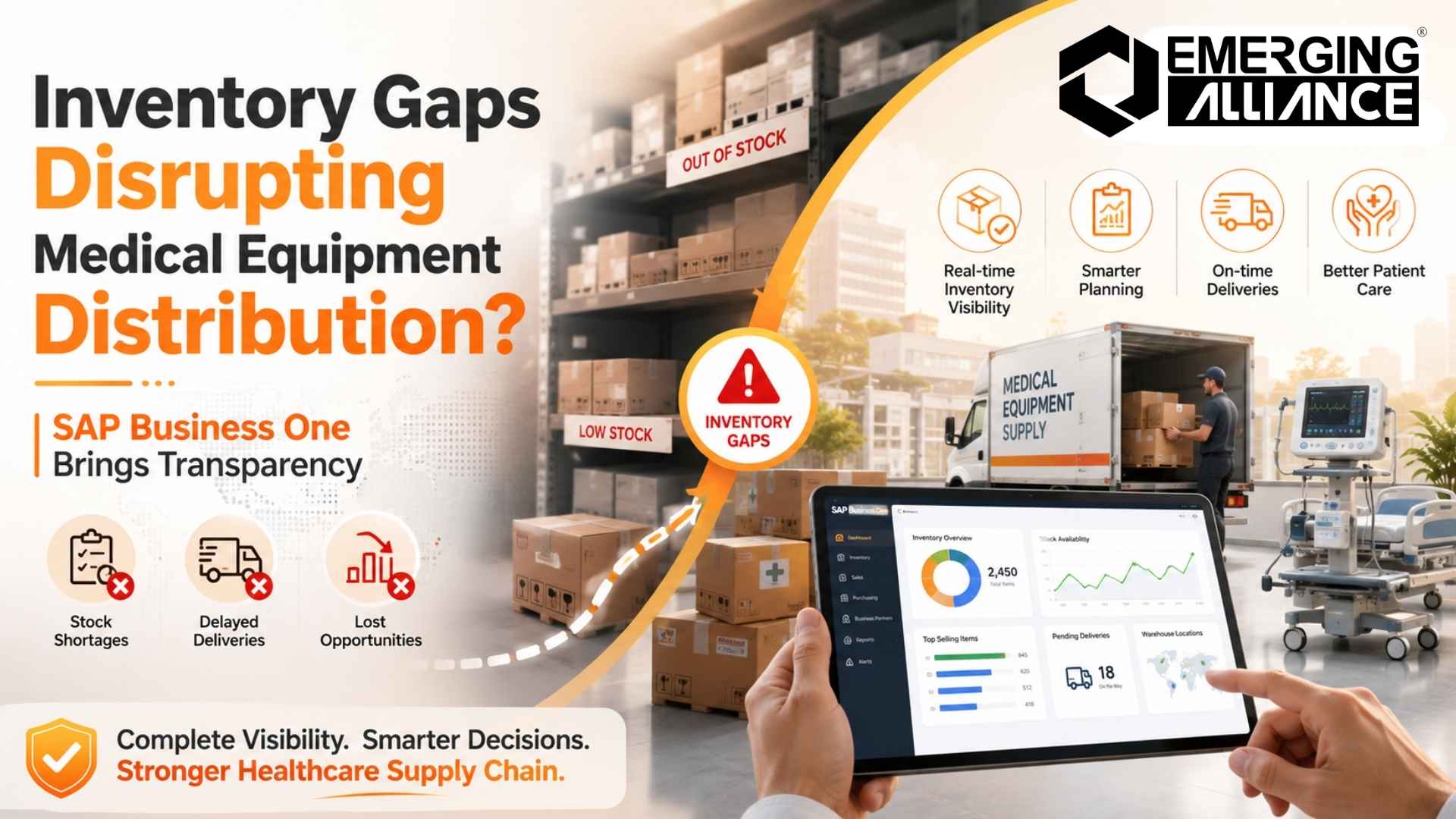
Inventory Gaps Disrupting Medical Equipment Distribution? SAP Business One Brings Transparency
SAP Business One for Medical Equipment Distribution: Reduce Stock Waste and Improve Inventory Accuracy
Medical equipment distributors operate in one of the most demanding supply chains. Hospitals expect immediate product availability, regulators require complete traceability, and businesses must balance inventory investment with healthy cash flow. Every delayed shipment, inaccurate stock count, or expired product directly affects profitability and customer trust.
Despite increasing investments in technology, many distributors still rely on disconnected systems, spreadsheets, and manual inventory processes. As businesses expand into new regions, warehouses, and product categories, maintaining inventory accuracy becomes increasingly difficult.
The challenge is no longer simply storing inventory—it is gaining complete operational visibility across procurement, warehousing, distribution, finance, compliance, and after-sales service.
SAP Business One helps medical equipment distributors transform fragmented operations into a connected, data-driven distribution business built for long-term growth.
Medical Equipment Inventory Management Challenges
Medical equipment inventory is fundamentally different from traditional wholesale inventory. Every product represents not only financial value but also regulatory responsibility, patient safety, warranty commitments, and service obligations.
Without centralized inventory management, businesses often struggle to maintain operational control across multiple warehouses and distribution locations.
Common inventory challenges include:
- Excess inventory and slow-moving stock
- Product expiry and obsolescence
- Stock inaccuracies across warehouses
- Delayed order fulfillment
- Manual inventory reconciliation
- Limited batch and serial traceability
- Poor inventory forecasting
- Rising inventory carrying costs
As product portfolios continue to expand, inventory complexity increases significantly. Without real-time visibility, organizations find it difficult to understand what inventory is available, where it is located, and how it impacts working capital.
Inventory Inefficiencies and Business Performance
Inventory challenges rarely remain isolated. Small operational issues gradually create larger business problems that affect profitability, customer satisfaction, and future growth.
Poor inventory visibility impacts every department.
Warehouse Operations
Warehouse teams spend unnecessary time searching for inventory, correcting stock discrepancies, and managing manual transfers between locations.
Procurement Operations
Purchasing decisions become reactive rather than strategic. Businesses frequently over-order products that already exist in another warehouse while experiencing shortages of fast-moving inventory.
Finance Operations
Inventory carrying costs continue to rise as capital becomes locked in excess stock, reducing available cash for business expansion.
Customer Experience
Hospitals and healthcare providers expect immediate product availability. Inventory inaccuracies delay deliveries and reduce customer confidence.
Compliance Exposure
Medical equipment distributors must maintain complete traceability for regulated products. Missing inventory records increase audit risks and complicate compliance reporting.
Over time, these operational inefficiencies create a cycle of increasing inventory costs, declining margins, and slower business growth.
SAP Business One for Medical Equipment Distribution
Rather than managing procurement, inventory, finance, compliance, and service through disconnected applications, SAP Business One provides a unified ERP platform that connects every stage of the distribution lifecycle.
By centralizing operational data, organizations gain complete visibility into inventory movement, purchasing, warehouse activity, sales, financial performance, and customer service.
Real-Time Inventory Management
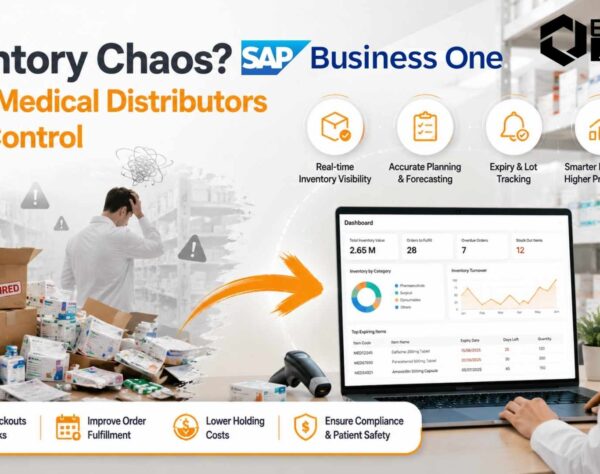
SAP Business One enables organizations to monitor inventory across multiple warehouses with complete visibility into stock availability, movement, valuation, and aging.
Key capabilities include:
- Real-time inventory visibility
- Multi-warehouse management
- Batch and serial number tracking
- Automated replenishment planning
- Stock aging analysis
- Inventory valuation reporting
- Product traceability
Intelligent Procurement Management
Integrated procurement workflows improve purchasing decisions by using live inventory and demand data.
Capabilities include:
- Supplier performance monitoring
- Automated purchase recommendations
- Procurement cost analysis
- Landed cost calculation
- Approval workflow automation
- Demand-based purchasing
Compliance and Product Traceability
Medical equipment distributors require complete documentation throughout the product lifecycle.
SAP Business One supports:
- Regulatory documentation
- Batch traceability
- Warranty management
- Equipment lifecycle records
- Audit-ready reporting
- Product history management
Service and Maintenance Management
Service operations become fully integrated with inventory and finance.
Organizations can manage:
- Preventive maintenance schedules
- Service contracts
- Spare parts inventory
- Technician assignments
- Equipment service history
- Customer support activities
Cloud Scalability
As businesses expand, SAP Business One supports additional warehouses, users, regions, and product lines without increasing operational complexity.
Cloud deployment provides:
- Centralized business data
- Mobile accessibility
- Automated reporting
- Secure infrastructure
- Faster decision-making
- Business continuity
Operational Visibility and Distribution Excellence
Implementing SAP Business One transforms medical equipment distribution from reactive inventory management to proactive business control.
Instead of working with disconnected information, decision-makers gain a real-time view of every operational function.
Inventory Optimization
- Lower inventory carrying costs
- Reduced stock obsolescence
- Improved inventory accuracy
- Faster warehouse operations
Financial Performance
- Better cash flow utilization
- Improved working capital management
- Higher inventory turnover
- More accurate cost tracking
Customer Service
- Faster order fulfillment
- Improved product availability
- Better delivery performance
- Higher customer satisfaction
Compliance Management
- End-to-end product traceability
- Audit-ready documentation
- Simplified regulatory reporting
- Reduced compliance risk
Enterprise Scalability
- Connected business operations
- Standardized workflows
- Automated reporting
- Data-driven decision-making
Rather than spending time resolving inventory issues, leadership teams can focus on expanding distribution networks, improving customer relationships, and driving sustainable growth.
Medical Equipment Distribution Transformation
Medical equipment distribution is becoming increasingly complex as inventory volumes grow, compliance requirements tighten, and customer expectations continue to rise.
Technology alone cannot solve these challenges. Success depends on connecting inventory, procurement, finance, warehousing, compliance, and service operations into a single, intelligent business platform.
Emerging Alliance helps medical equipment distributors implement SAP Business One with a business-first approach that aligns operational processes with long-term growth objectives.
Whether your priority is reducing inventory costs, improving cash flow, strengthening compliance, or building a scalable distribution network, our consultants help create an ERP roadmap designed around your business goals.
Frequently Asked Questions
1. What makes SAP Business One the ideal ERP solution for medical equipment distributors?
SAP Business One combines inventory management, purchasing, sales, finance, warehouse operations, and service management within a single ERP platform. This integrated solution helps medical equipment distributors improve operational efficiency, reduce costs, and support long-term business growth.
2. How does SAP B1 inventory management improve stock accuracy for medical distributors?
SAP B1 provides real-time inventory tracking, automated stock updates, cycle counting, barcode support, and warehouse visibility. These capabilities improve inventory accuracy, reduce stock discrepancies, and help maintain optimal inventory levels across distribution operations.
3. Can an ERP platform automate sales order processing for medical equipment distributors?
Yes. An integrated ERP platform automates the entire sales process—from quotation and sales order creation to invoicing, delivery, and payment tracking. This reduces manual effort, improves order accuracy, and accelerates customer fulfillment.
4. Does the solution offer warehouse management features for medical device distribution?
Yes. The solution supports multi-warehouse management, inventory transfers, bin location management, barcode integration, and warehouse reporting. These capabilities improve storage efficiency, inventory control, and warehouse productivity.
5. How does the ERP system improve order fulfillment for medical equipment distributors?
The ERP system provides real-time inventory availability, automated order processing, shipment tracking, and centralized order management. This enables distributors to fulfill customer orders faster while improving delivery accuracy and customer satisfaction.
6. How does SAP Business One ERP improve financial management for medical equipment distributors?
SAP Business One ERP integrates accounting, accounts payable, accounts receivable, banking, budgeting, fixed assets, and financial reporting into one platform. This gives finance teams real-time visibility into profitability, cash flow, and overall business performance.
7. How does the ERP solution support regulatory compliance for medical equipment distributors?
The ERP solution helps medical equipment distributors maintain compliance by tracking product information, managing documentation, monitoring expiration dates, and maintaining audit trails. These features ensure adherence to industry regulations while improving transparency and accountability across operations.
8. How does SAP Business One help medical equipment distributors scale their business?
SAP Business One supports business growth by automating workflows, streamlining cross-functional processes, managing higher transaction volumes, and centralizing business data. This enables organizations to expand operations without increasing operational complexity.
9. Can the ERP software improve supplier and vendor management for medical equipment distributors?
Yes. The ERP software centralizes supplier information, tracks purchasing history, evaluates vendor performance, compares supplier pricing, and simplifies procurement management. This helps businesses build stronger supplier relationships while improving purchasing decisions.
10. How does an integrated ERP solution support business decision-making with real-time data?
An integrated ERP solution delivers real-time analytics, customizable reports, interactive dashboards, and actionable business insights across inventory, procurement, sales, finance, and operations. This enables medical equipment distributors to make faster, data-driven decisions with greater confidence.
Fill out the form and our experts will contact you shortly