
SAP Business One Partner Evaluation: 10 Questions for Risk Reduction
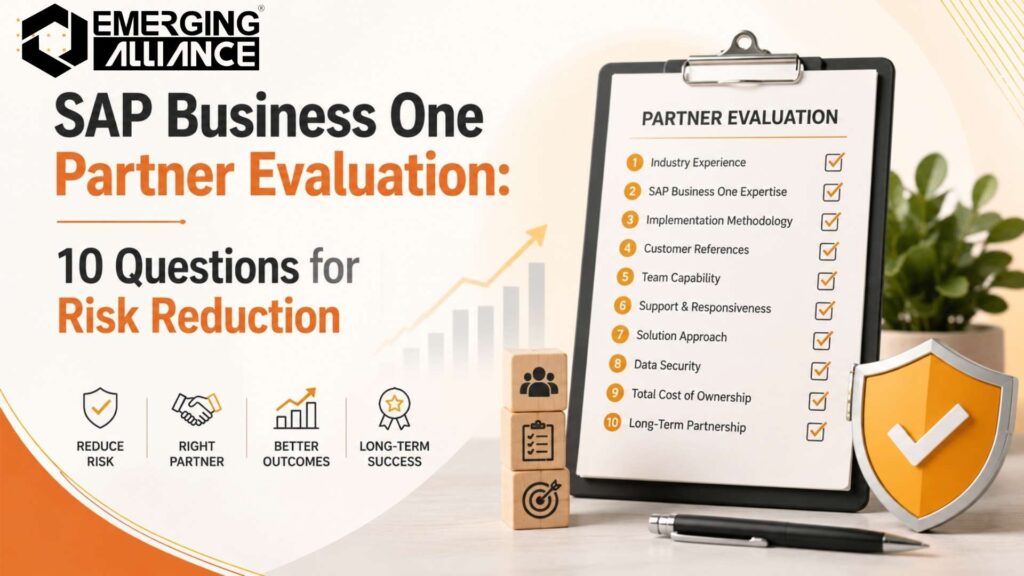
SAP Business One Partner Selection for Risk Reduction and ROI
Selecting an ERP solution is a major business investment, but selecting the right implementation partner is equally important. Even the most powerful ERP platform can fail to deliver value if it is implemented without the right expertise, governance, and business understanding. Many organizations evaluate SAP Business One Partners based primarily on pricing, implementation timelines, or software demonstrations. While these factors matter, they rarely determine long-term project success. The real differentiator is whether the partner understands your business, aligns the solution with your operational goals, and provides strategic guidance beyond deployment.
For CEOs, CIOs, CFOs, Operations Leaders, and Digital Transformation executives, choosing a SAP Business One Partner is a business decision rather than simply an IT decision. The right partner helps reduce implementation risk, improve operational efficiency, accelerate user adoption, and maximize return on investment.
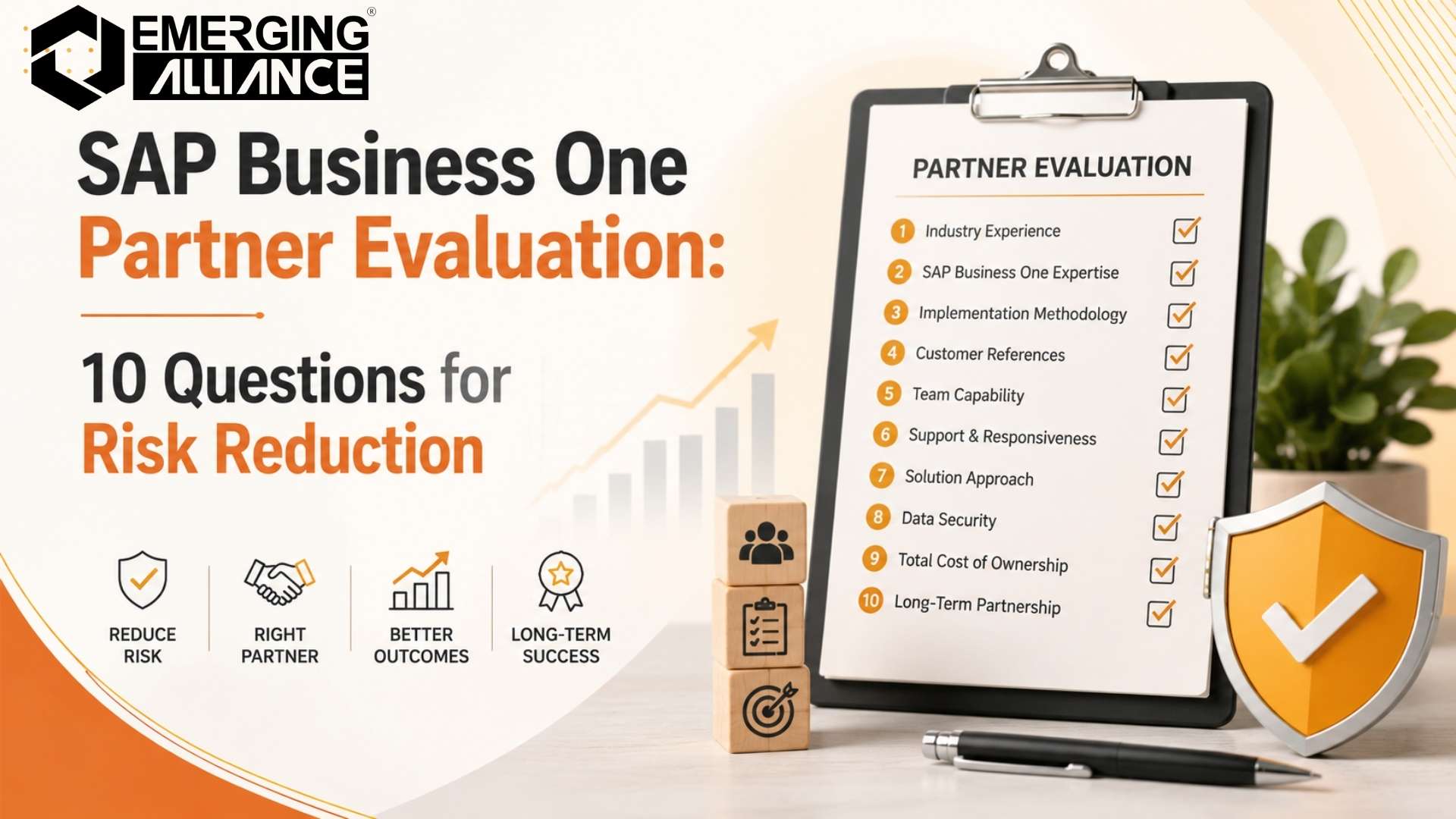
Before signing a contract, ask these ten strategic questions to evaluate whether a SAP Business One Partner is equipped to support your organization’s long-term success.
1. Does the SAP Business One Partner Understand My Industry?
Industry expertise directly impacts implementation speed and project success. A partner familiar with your sector already understands your operational workflows, compliance requirements, reporting needs, and common business challenges. Instead of learning your business during the project, they apply proven industry practices that reduce implementation risk and accelerate ROI.
Evaluation Checklist
- Industry-specific implementation experience
- Relevant customer references
- Understanding of regulatory requirements
- Knowledge of industry best practices
- Experience solving similar business challenges
Business Value
Industry expertise reduces implementation complexity, minimizes customization, and helps organizations achieve faster business outcomes.
2. How Much SAP Business One Implementation Experience Does the Partner Have?
Successful ERP projects require far more than software configuration. Experienced implementation partners follow structured delivery practices, anticipate project risks, and guide organizations through every phase of implementation with confidence.
Evaluation Checklist
- Number of SAP Business One implementations
- Certified SAP consultants
- Experience with similar business sizes
- Multi-industry project experience
- Proven customer success stories
Business Value
Greater implementation experience improves project predictability, reduces risk, and increases the likelihood of achieving planned business outcomes.
3. What SAP Business One Implementation Methodology Does the Partner Follow?
A documented implementation methodology keeps ERP projects on schedule, within budget, and aligned with business objectives. It ensures every stage—from discovery to go-live—is managed through a structured governance framework.
Evaluation Checklist
- Defined implementation phases
- Project governance framework
- Risk management approach
- Milestone tracking process
- Executive reporting and communication
Business Value
A structured methodology improves delivery quality, reduces project delays, and provides greater visibility throughout implementation.
4. Will the Partner Improve Our Business Processes or Simply Configure SAP Business One?
ERP should improve the way your business operates—not simply replace your existing system. The right partner evaluates current workflows, identifies inefficiencies, and recommends process improvements before configuring SAP Business One.
Evaluation Checklist
- Business process assessment
- Workflow optimization approach
- Automation recommendations
- Bottleneck identification
- Operational improvement strategy
Business Value
Business process optimization increases productivity, improves operational efficiency, and maximizes ERP return on investment.
5. How Will the SAP Business One Partner Manage Data Migration?
Reliable business decisions depend on accurate data. A structured migration strategy ensures master data is cleansed, validated, tested, and transferred without disrupting business operations.
Evaluation Checklist
- Legacy data assessment
- Data cleansing methodology
- Migration testing process
- Validation and reconciliation
- Risk mitigation plan
Business Value
High-quality data improves reporting accuracy, operational visibility, and user confidence after go-live.
6. Can the SAP Business One Partner Integrate with Our Existing Systems?
Most organizations rely on multiple business applications. SAP Business One should integrate seamlessly with CRM, eCommerce, payroll, warehouse, manufacturing, and other systems to create a connected business environment.
Evaluation Checklist
- API and integration expertise
- Third-party application support
- Previous integration projects
- Scalable architecture
- Ongoing integration maintenance
Business Value
Strong integration capabilities eliminate data silos, automate workflows, and improve enterprise-wide visibility.
7. What Post-Go-Live Support Does the Partner Provide?
Implementation is only the beginning. Continuous support ensures your ERP system remains secure, optimized, and aligned with changing business requirements.
Evaluation Checklist
- Service Level Agreements (SLAs)
- Response and resolution times
- System health checks
- Upgrade and enhancement support
- Dedicated support team
Business Value
Reliable post-go-live support improves system performance, minimizes downtime, and protects your ERP investment.
8. How Does the SAP Business One Partner Ensure User Adoption?
The success of an ERP project depends on how effectively employees adopt the system. Structured training and change management help users transition smoothly and maximize productivity.
Evaluation Checklist
- Change management strategy
- Role-based training
- User documentation
- Adoption measurement
- Transition support
Business Value
Higher user adoption improves productivity, process consistency, and long-term ERP success.
9. What Is the Total Cost of Working with This SAP Business One Partner?
The lowest implementation quote is not always the best value. Organizations should evaluate the total cost of ownership, including implementation, customization, support, upgrades, and future enhancements.
Evaluation Checklist
- Transparent pricing
- Implementation scope
- Customization costs
- Support and maintenance fees
- Change request process
Business Value
Commercial transparency enables better budgeting and prevents unexpected project costs.
10. Is This SAP Business One Partner Equipped to Support Our Future Growth?
Your ERP partner should support long-term business growth—not just the initial implementation. Strategic advisory services help organizations scale operations, adopt new technologies, and continuously improve business performance.
Evaluation Checklist
- Scalability planning
- Automation roadmap
- Cloud strategy
- Digital transformation expertise
- Long-term consulting services
Business Value
A strategic implementation partner helps future-proof your ERP investment while supporting sustainable business growth.
SAP Business One Partner Evaluation Checklist
Before making your final decision, evaluate every SAP Business One Partner against these ten criteria:
| Evaluation Question | Why It Matters |
| Does the partner understand my industry? | Reduces implementation risk |
| Does the partner have proven implementation experience? | Improves project success |
| Is there a structured implementation methodology? | Ensures predictable delivery |
| Will the partner optimize our business processes? | Maximizes operational efficiency |
| Is there a clear data migration strategy? | Improves data accuracy and reporting |
| Can the partner integrate with existing systems? | Eliminates data silos |
| Is post-go-live support clearly defined? | Protects long-term ERP performance |
| Is there a structured user adoption strategy? | Improves employee productivity |
| Are commercial terms fully transparent? | Prevents unexpected costs |
| Can the partner support future business growth? | Maximizes long-term ROI |
The more confidently a partner answers these questions, the lower your implementation risk and the greater your likelihood of achieving long-term ERP success.
SAP Business One Partner Selection Red Flags
Not every implementation partner delivers the same level of expertise. Watch for these warning signs during your evaluation process:
- Limited experience in your industry.
- No documented implementation methodology.
- Few or no customer references.
- Unclear project scope or pricing.
- Heavy reliance on custom development without business justification.
- Limited post-go-live support.
- No dedicated project manager or governance framework.
- Minimal focus on training and user adoption.
- Weak integration capabilities.
- Lack of a long-term digital transformation strategy.
Identifying these red flags early can help prevent costly delays, budget overruns, and operational disruption later in the project.
Business Value Delivered by Emerging Alliance
Choosing an implementation partner is about more than technical expertise. It is about working with a team that understands your business objectives and aligns technology with measurable business outcomes.
Emerging Alliance combines SAP Business One implementation with business consulting, process optimization, integration expertise, and long-term support. Our consultants work closely with executive teams to improve operational visibility, streamline workflows, automate manual processes, and build scalable ERP environments that support sustainable growth.
From business discovery and implementation to post-go-live optimization, our approach focuses on reducing implementation risk while helping organizations maximize the return on their SAP Business One investment.
Whether you are implementing SAP Business One for the first time or modernizing an existing ERP environment, Emerging Alliance provides the expertise, governance, and strategic guidance needed to achieve lasting business value.
Conclusion
Selecting a SAP Business One Partner is one of the most important decisions in your ERP journey. The right partner does more than deploy software—they help improve business processes, reduce operational risk, strengthen governance, and create a scalable foundation for future growth.
By asking the ten evaluation questions outlined in this guide, organizations can compare implementation partners more objectively and make decisions based on long-term business value rather than short-term cost.
A structured evaluation today can help prevent expensive implementation challenges tomorrow while ensuring your SAP Business One investment delivers measurable operational improvements and sustainable ROI.
If you’re evaluating SAP Business One Partners, Emerging Alliance can help you assess your requirements, identify implementation risks, and build a roadmap for a successful ERP transformation.
Frequently Asked Questions
1. How do I choose the right SAP Business One Partner?
Evaluate industry expertise, implementation experience, methodology, customer references, integration capabilities, support services, and long-term consulting expertise—not just pricing.
2. What questions should I ask an SAP Business One implementation partner?
Ask about industry experience, implementation methodology, data migration, integrations, training, post-go-live support, project governance, and total implementation cost.
3. What certifications should an SAP Business One Partner have?
Look for SAP-certified consultants, proven implementation experience, and a successful track record in delivering SAP Business One projects within your industry.
4. How important is industry experience when selecting a SAP Business One Partner?
Industry expertise helps the partner understand your business processes, compliance requirements, and operational challenges, reducing implementation time and project risk.
5. What implementation methodology should a SAP Business One Partner follow?
A structured methodology should include discovery, solution design, configuration, data migration, testing, training, deployment, and post-go-live optimization.
6. What post-go-live support should I expect from a SAP Business One Partner?
Expect defined SLAs, technical support, system monitoring, upgrade assistance, performance optimization, and ongoing business consulting.
7. Can SAP Business One integrate with my existing business applications?
Yes. SAP Business One supports integration with CRM, eCommerce, payroll, warehouse management, manufacturing, logistics, and other enterprise applications through APIs and certified integration frameworks.
8. What are the hidden costs of SAP Business One implementation?
Hidden costs may include customizations, integrations, data migration, user training, scope changes, support services, and future system enhancements. Always request a transparent commercial proposal.
9. How can I compare multiple SAP Business One Partners?
Use a structured evaluation checklist that compares industry expertise, implementation methodology, customer success, technical capabilities, support, governance, and long-term strategic value.
10. What are the biggest risks of choosing the wrong SAP Business One Partner?
Common risks include delayed implementations, budget overruns, poor user adoption, inaccurate data migration, weak integrations, operational disruption, and lower return on investment.
Fill out the form and our experts will contact you shortly