
SAP B1 for Medical Equipment Growth Strategy Guide 2026
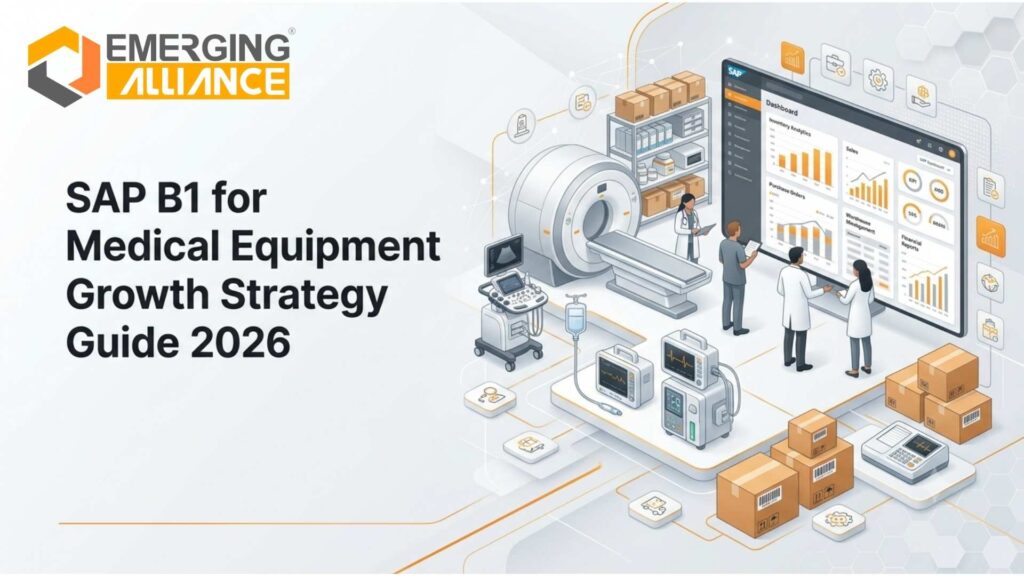
SAP B1 for Medical Equipment with End-to-End Inventory Visibility
Healthcare providers expect medical equipment suppliers to deliver products quickly, maintain complete traceability, and provide reliable after-sales service. At the same time, medical equipment companies must manage increasing regulatory requirements, rising inventory costs, and complex procurement processes. These challenges make operational visibility a strategic priority rather than simply an IT concern. SAP B1 for Medical Equipment helps organizations connect procurement, inventory, sales, finance, service management, and reporting within a single ERP platform. Instead of relying on disconnected spreadsheets and multiple standalone systems, decision-makers gain a unified view of business operations that supports faster, more informed decisions.
Whether you manufacture, distribute, or service medical equipment, the ability to see inventory movement, equipment history, supplier performance, and financial impact in real time directly influences profitability and customer satisfaction.
Why Medical Equipment Companies Outgrow Traditional Management Systems
Many organizations begin with accounting software, spreadsheets, or isolated inventory applications. While these tools work during the early stages of growth, they struggle as operations become more complex.
Medical equipment businesses must manage product availability, serial numbers, warranties, preventive maintenance schedules, service contracts, procurement planning, and regulatory documentation simultaneously. Managing these processes across disconnected systems creates operational blind spots.
Common business challenges include:
- Limited inventory visibility across warehouses
- Manual procurement approvals
- Difficulty tracking serialized equipment
- Delayed customer deliveries
- Inaccurate inventory forecasting
- Fragmented financial reporting
- Poor coordination between sales and service teams
- Limited operational insights for executives
A modern Medical equipment ERP eliminates these gaps by centralizing operational data into one integrated platform.
How SAP B1 for Medical Equipment Improves Operational Visibility
The primary value of SAP B1 for Medical Equipment is complete operational transparency. Every department works from the same real-time business data instead of maintaining separate records.
Executives gain immediate visibility into:
- Inventory availability
- Purchase orders
- Customer orders
- Equipment lifecycle
- Service requests
- Financial performance
- Warehouse operations
- Vendor commitments
Rather than reacting to issues after they occur, leadership teams can identify bottlenecks before they impact customers.
This visibility becomes especially valuable for organizations operating multiple warehouses, regional service centers, or expanding distribution networks.
End-to-End Inventory Visibility That Supports Business Growth
Inventory represents one of the largest investments for medical equipment organizations. Excess inventory ties up working capital, while shortages delay customer deliveries and reduce revenue opportunities.
SAP B1 medical equipment tracking system capabilities allow organizations to monitor inventory throughout its entire lifecycle—from procurement through delivery and after-sales service.
Organizations can track:
- Serialized medical equipment
- Batch-controlled products
- Warehouse transfers
- Goods in transit
- Customer deliveries
- Returns and replacements
- Service inventory
- Spare parts availability
Instead of manually reconciling inventory across locations, managers receive accurate stock information in real time.
The result is improved inventory accuracy, better purchasing decisions, and higher customer service levels.
Smarter Procurement with SAP B1
Procurement directly affects profitability in the medical equipment industry. Delayed purchasing decisions, inconsistent supplier performance, and poor inventory planning increase operational costs.
Medical equipment procurement software SAP B1 helps organizations standardize purchasing workflows while improving supplier management.
The platform supports:
- Automated purchase requests
- Multi-level approval workflows
- Vendor comparison
- Purchase order management
- Delivery tracking
- Supplier performance analysis
- Budget monitoring
Procurement teams can purchase based on actual demand rather than assumptions, reducing both overstocking and emergency buying.
As procurement becomes increasingly data-driven, executives gain better control over cash flow and supplier relationships.
Executive Insight: If procurement delays, inventory shortages, or inconsistent supplier performance are limiting operational growth, an ERP readiness assessment can often identify process improvements before a full transformation initiative begins.
Managing Serialized Equipment More Efficiently
Medical equipment cannot be managed like standard consumer products. Every asset may require individual identification, warranty tracking, installation records, maintenance history, and service documentation.
SAP B1 medical equipment management enables organizations to manage the complete lifecycle of each equipment unit from procurement through retirement.
Key capabilities include:
- Serial number tracking
- Equipment master records
- Warranty management
- Customer installation history
- Asset movement tracking
- Repair records
- Service contract management
This centralized approach reduces manual record-keeping while improving service quality and customer confidence.
Instead of searching multiple databases for equipment information, service teams access complete historical records from a single system.
Automating Business Processes Across Departments
Manual approvals and repetitive administrative work often slow down growing organizations. Employees spend valuable time moving information between systems instead of focusing on higher-value activities.
SAP B1 workflow automation medical equipment streamlines routine business processes through configurable workflows.
Examples include:
- Purchase approvals
- Sales order processing
- Inventory replenishment
- Vendor approvals
- Service ticket routing
- Document management
- Financial approvals
Workflow automation reduces processing delays while improving governance and accountability.
Because every transaction follows predefined business rules, organizations experience fewer manual errors and greater operational consistency.
Supporting Preventive Maintenance and After-Sales Service
For many medical equipment businesses, long-term customer relationships depend on reliable service rather than the initial sale. Missed maintenance schedules, delayed service visits, or unavailable spare parts can damage customer trust and reduce recurring revenue.
Medical equipment preventive maintenance SAP B1 capabilities help organizations plan and manage preventive maintenance activities using centralized equipment records and service schedules. Instead of relying on manual reminders, service teams can proactively manage maintenance commitments.
Typical capabilities include:
- Preventive maintenance scheduling
- Service contract management
- Installation history
- Warranty tracking
- Spare parts planning
- Service request management
- Technician assignment
- Maintenance history reporting
A structured maintenance process improves equipment uptime while helping customers comply with healthcare quality requirements.
Helping Medical Device Manufacturers Improve Production Visibility
For medical device manufacturers, operational visibility extends beyond inventory. Manufacturing teams must coordinate procurement, production planning, quality control, warehouse operations, and customer deliveries without delays.
SAP Business One connects these functions within a single ERP platform, allowing decision-makers to monitor production and business performance in real time.
Business leaders can gain visibility into:
- Material availability
- Production orders
- Work-in-progress inventory
- Procurement status
- Finished goods inventory
- Customer demand
- Financial performance
Instead of waiting for end-of-month reports, executives have access to operational data that supports faster planning and better resource allocation.
Executive Consideration: Before expanding operations or opening new distribution locations, many organizations benefit from an ERP process assessment to identify visibility gaps that could limit scalability.
Supporting Medical Equipment Distributors with Faster Operations
Distribution businesses operate in an environment where speed, inventory accuracy, and customer responsiveness directly influence competitiveness.
SAP B1 for medical equipment distributors provides integrated control over purchasing, warehousing, order fulfillment, logistics, and customer service.
The platform enables distributors to:
- Improve order accuracy
- Monitor inventory across multiple warehouses
- Reduce stock shortages
- Optimize replenishment
- Track serialized products
- Improve delivery performance
- Manage supplier relationships
- Generate real-time operational reports
Because inventory, sales, procurement, and finance share the same data, departments work together more efficiently and with fewer manual reconciliations.
This unified approach reduces operational delays while supporting business growth.
Executive Reporting That Enables Faster Decisions
Business growth requires timely, reliable information. When executives rely on manually compiled spreadsheets, reporting delays often lead to slower decisions and missed opportunities.
SAP B1 for Medical Equipment provides real-time dashboards and analytics that help leadership teams monitor operational performance from a single source of truth.
Executives can review:
- Revenue trends
- Inventory turnover
- Gross margins
- Procurement performance
- Warehouse utilization
- Customer order status
- Cash flow indicators
- Service performance
Instead of asking multiple departments for reports, leadership gains immediate access to business-critical information that supports strategic planning.
This level of visibility helps organizations respond more quickly to changing market conditions while improving operational control.
Why SAP B1 for Medical Equipment Delivers Better Business Outcomes
For CEOs, COOs, CIOs, and Operations Heads, ERP success is measured by business outcomes—not by software features alone.
A well-implemented SAP B1 for Medical Equipment strategy helps organizations improve operational efficiency while reducing business risk.
Expected business outcomes include:
- Improved inventory accuracy
- Lower inventory carrying costs
- Faster procurement cycles
- Better equipment traceability
- Reduced manual processing
- Improved customer service
- Higher operational visibility
- Better executive decision-making
- More predictable business growth
- Stronger cross-functional collaboration
Rather than managing disconnected processes, organizations operate through a unified platform that supports sustainable growth and greater operational resilience.
Conclusion
As the medical equipment industry becomes more competitive, organizations need more than basic inventory management. They require complete visibility across procurement, inventory, sales, finance, manufacturing, and after-sales service.
SAP B1 for Medical Equipment enables this transformation by connecting critical business functions within a single ERP platform. The result is greater operational control, improved customer service, better compliance, and stronger decision-making—key advantages for organizations planning sustainable growth in 2026 and beyond.
Frequently Asked Questions
1. How does SAP B1 for Medical Equipment improve inventory accuracy?
SAP B1 centralizes inventory data across warehouses, procurement, sales, and service operations. Real-time inventory updates reduce manual reconciliation, improve stock accuracy, and help prevent shortages or excess inventory.
2. Can SAP Business One manage serialized medical equipment?
Yes. SAP Business One supports serial number management, allowing businesses to track each equipment unit from procurement through installation, warranty, service, and eventual replacement. This improves traceability and customer support.
3. Is SAP B1 suitable for both manufacturers and distributors?
Yes. The platform supports manufacturing, distribution, procurement, inventory, finance, customer service, and reporting. It is flexible enough to address the operational needs of both medical device manufacturers and distributors.
4. How does SAP B1 support preventive maintenance?
Maintenance schedules, service contracts, warranty records, and equipment history can all be managed within the system. This enables service teams to plan preventive maintenance proactively rather than reacting to equipment failures.
5. What procurement improvements can organizations expect?
SAP B1 streamlines purchasing through automated workflows, approval processes, supplier management, and demand-based procurement planning. This helps reduce procurement delays and improve supplier performance.
6. Can SAP B1 integrate finance with inventory operations?
Yes. Inventory movements, purchasing, sales, and financial transactions are connected within the same ERP platform. This reduces duplicate data entry while improving financial reporting accuracy.
7. How does workflow automation benefit medical equipment companies?
Workflow automation standardizes approvals, document routing, purchasing, inventory replenishment, and service processes. This reduces manual work, improves governance, and accelerates business operations.
8. What reporting capabilities are available for executives?
Executives have access to dashboards covering inventory, procurement, sales, financial performance, warehouse operations, customer orders, and service metrics. These insights support faster and more informed strategic decisions.
9. How can SAP B1 help organizations preparing for expansion?
As organizations grow, SAP B1 provides standardized processes, centralized data, and scalable operations across multiple warehouses, branches, or distribution networks. This supports controlled expansion without increasing operational complexity.
10. What should organizations evaluate before implementing SAP B1 for Medical Equipment?
Organizations should assess existing business processes, inventory management practices, procurement workflows, reporting capabilities, service operations, and future growth objectives. A structured readiness assessment helps define implementation priorities and maximize long-term business value.
Talk to our expert and assess your business readiness for ERP