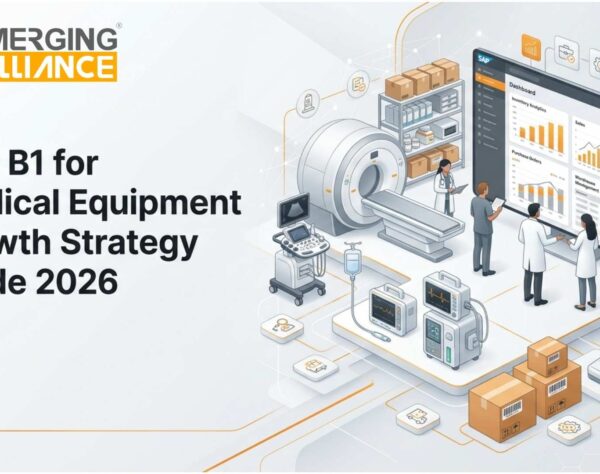

SAP B1 for Medical Equipment Tackling Industry Challenges
SAP B1 for Medical Equipment for Serialized Inventory, Service Control, Traceability, and Scalable Growth
Medical equipment businesses manage more than products and purchase orders. They must track individual devices, control high-value inventory, maintain warranty and service records, manage spare parts, and produce reliable information for customers, audits, and internal quality processes. These responsibilities become difficult when sales, inventory, service, procurement, and finance operate through separate applications or spreadsheets. SAP B1 for Medical Equipment provides an integrated ERP foundation that connects these business functions in one environment. It helps manufacturers, distributors, importers, and service providers improve serialized inventory control, equipment traceability, customer service, financial visibility, and operational decision-making.
The result is a more controlled business that can respond faster to customers, reduce avoidable manual work, and scale without losing visibility.
Why Medical Equipment Businesses Need SAP B1 for Medical Equipment
Medical equipment operations involve high-value products, individual serial numbers, contractual service obligations, and strict recordkeeping requirements. A single transaction may affect inventory, customer equipment history, warranty coverage, service planning, revenue recognition, and financial reporting.
When these processes are disconnected, common problems include:
- Inaccurate stock records
- Missing serial-number information
- Limited equipment history
- Slow warranty verification
- Delayed spare-parts allocation
- Duplicate customer and transaction data
- Time-consuming audit preparation
- Limited visibility across departments
SAP B1 for Medical Equipment centralizes these processes within a single ERP system. Teams can work from consistent customer, inventory, service, purchasing, sales, and financial data instead of maintaining separate records.
SAP Business One supports accounting, purchasing, inventory, sales, CRM, reporting, and analytics within one platform. It also supports serial- and batch-managed inventory, warehouse transactions, service contracts, customer equipment records, and service calls. (SAP)
This connected structure helps medical equipment businesses:
- Track serialized products from receipt to delivery
- Improve stock visibility across warehouses
- Link equipment with customers and service records
- Manage warranties and service contracts
- Improve purchasing and replenishment decisions
- Reduce duplicate data entry
- Strengthen operational and financial reporting
- Establish more consistent business controls
SAP Business One does not replace regulatory expertise or quality-management obligations. It provides the transactional visibility, traceability, approvals, and reporting foundation needed to support more controlled compliance processes.
Key Challenges SAP B1 for Medical Equipment Solves
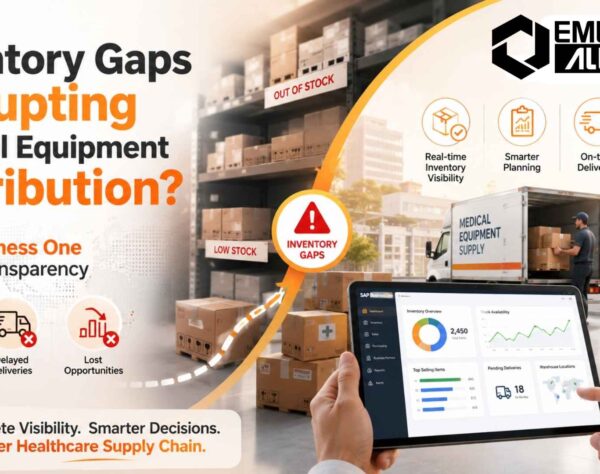
Serialized Inventory Gaps
Business problem
Medical devices, diagnostic equipment, and high-value components often need to be identified individually. Spreadsheet-based serial tracking can create mismatches between physical stock, warehouse records, invoices, customers, and service information.
SAP B1 approach
SAP Business One supports inventory managed by serial number or batch. Serial numbers can be recorded and updated through inventory transactions, including receipts, issues, transfers, and sales-related documents.
This helps teams:
- Record unique serial numbers
- Identify available serialized units
- Track inventory movements
- Connect delivered units with customer records
- Investigate discrepancies faster
- Improve inventory reconciliation
Business outcome
Businesses gain stronger stock accuracy, better equipment visibility, and faster access to transaction histories.
Incomplete Equipment Traceability
Business problem
When a customer raises a warranty request, service issue, or product query, teams may need information about the original sale, installation, serial number, coverage, service history, and components used.
Retrieving this information from separate systems delays resolution.
SAP B1 approach
SAP Business One customer equipment cards can associate serialized items with customers and related service contracts. Service information can then be accessed alongside relevant equipment and customer records.
Depending on implementation scope and integrations, organizations can build a more complete lifecycle view covering:
- Serial number
- Customer
- Sales or delivery reference
- Warranty status
- Service contract
- Service calls
- Equipment history
- Related attachments
Business outcome
Service teams can investigate issues faster, verify coverage more reliably, and reduce dependence on manual records.
Compliance and Audit Pressure
Business problem
Medical equipment organizations may need to demonstrate product traceability, transactional control, authorization, and record consistency. Missing or conflicting data can increase audit effort and operational risk.
SAP B1 approach
SAP Business One supports serial and batch records, transaction histories, user controls, approval processes, financial records, and reporting. These capabilities can support internal controls and audit readiness when they are configured correctly and governed by documented procedures.
Business outcome
Organizations can reduce manual evidence gathering, improve record consistency, and respond more efficiently to audits or internal reviews.
Important: SAP Business One supports compliance processes but does not independently guarantee regulatory compliance. Requirements must be mapped to the relevant jurisdiction, product classification, quality framework, and company procedures.
Warranty and Service Contract Complexity
Business problem
Medical equipment businesses may manage manufacturer warranties, regular service contracts, annual maintenance agreements, coverage conditions, and response commitments. Manual tracking can result in expired coverage being overlooked, incorrect billing, or inconsistent service.
SAP B1 approach
SAP Business One supports regular and warranty service contracts. Contracts may be based on a customer, item group, or specific serial number. Warranty contracts can also be generated automatically for eligible serialized items when configured appropriately.
Businesses can maintain:
- Contract start and end dates
- Covered serialized items
- Coverage periods
- Contract type
- Service calls
- Resolution commitments
- Customer equipment information
Business outcome
Service entitlements become easier to verify, contract administration improves, and teams can reduce incorrect or delayed service decisions.
Preventive Maintenance Coordination
Business problem
Missed maintenance activities can increase equipment downtime, emergency service costs, and customer dissatisfaction.
SAP B1 approach
SAP Business One provides the equipment, service contract, customer, activity, and service-call information needed to support maintenance processes. More advanced preventive-maintenance automation—such as recurring work orders, field-service routing, asset-specific maintenance plans, or automated alerts—may require configuration, workflows, reports, integrations, or a suitable add-on.
Business outcome
With the right solution design, businesses can improve maintenance visibility, reduce missed service obligations, and coordinate technicians more effectively.
Spare-Parts Availability
Business problem
A service team cannot complete repairs efficiently when critical spare parts are unavailable. Excess stock, however, ties up cash and increases carrying costs.
SAP B1 approach
SAP Business One connects inventory, purchasing, warehouses, sales, and service information. Teams can review stock, transfers, purchasing requirements, and consumption patterns before committing to service timelines.
Its inventory functionality supports item records, serial and batch numbers, goods movements, inventory transfers, counts, and inventory reports.
Business outcome
Organizations can improve parts visibility, reduce emergency purchasing, and make better replenishment decisions.
Manual Reporting and Data Silos
Business problem
When each department maintains separate files, managers receive delayed or conflicting reports. Employees spend time reconciling information instead of acting on it.
SAP B1 approach
SAP Business One integrates operational and financial transactions. Its CRM module links relevant master data, business documents, and reports, while its financial functionality supports accounting operations and reporting.
Business outcome
Management gains more consistent information, faster reporting, and a clearer view of inventory, service, sales, purchasing, and finance.
Key Features of SAP B1 for Medical Equipment
Serial and Batch Number Management
SAP Business One supports serial- and batch-controlled products, helping organizations identify individual devices or groups of items and record their movement through relevant transactions.
Multi-Warehouse Inventory Control
Organizations can monitor stock across warehouses, process transfers, perform inventory counts, and review item availability from a connected system.
Customer Equipment Cards
Customer equipment cards help associate serialized products with customers and service-related information. This creates a more reliable reference point for equipment support.
Warranty and Service Contracts
Businesses can manage warranty and regular service contracts based on specific serial numbers, customers, or item groups.
Service Calls and Coverage Management
Service teams can record service calls, review contract coverage, manage relevant queues, and route issues to responsible teams or employees.
Purchasing and Inventory Planning
Connected purchasing and inventory data helps teams review demand, supplier transactions, stock availability, and replenishment requirements.
Integrated CRM
Sales opportunities, customer activities, quotations, business documents, and related records can be managed within an integrated CRM environment.
Financial Management
SAP Business One connects operational transactions with accounts receivable, accounts payable, general ledger, cash flow, cost accounting, budgeting, and financial reporting.
Dashboards and Analytics
SAP Business One provides predefined and configurable dashboards for areas such as inventory, sales, service calls, cash flow, and purchasing. Some dashboard availability depends on database, analytics, configuration, or implementation choices.
Traditional Operations vs SAP B1 for Medical Equipment
| Traditional medical equipment operations | SAP B1 for Medical Equipment |
| Serial numbers stored in spreadsheets | Serial-controlled inventory linked to transactions |
| Separate inventory and service records | Connected inventory, equipment, customer, and service data |
| Manual warranty verification | Structured warranty and service-contract records |
| Limited warehouse visibility | Centralized multi-warehouse inventory information |
| Disconnected purchasing and stock data | Integrated purchasing and inventory processes |
| Separate CRM and service applications | Connected customer, sales, and service information |
| Delayed financial reconciliation | Operational transactions linked with financial records |
| Manual management reporting | Dashboards and reports based on ERP data |
| Duplicate departmental data | A more consistent source of business information |
| Reactive issue management | Faster access to operational and service information |
Business Benefits of SAP B1 for Medical Equipment
Better Inventory Accuracy
Serial-controlled transactions and centralized warehouse data help reduce discrepancies and improve confidence in available stock.
Faster Order Fulfilment
Sales, purchasing, inventory, and warehouse teams can access connected information, reducing delays caused by manual stock confirmation.
Stronger Product Traceability
Serialized equipment can be linked with relevant inventory, customer, and service records, making product-related investigations more efficient.
More Consistent Service Delivery
Service contracts, customer equipment records, and service calls provide teams with clearer information about coverage and prior service activity.
Improved Compliance Support
Traceability, transaction histories, approvals, and centralized records can strengthen internal control and audit-readiness processes.
Lower Administrative Work
Integrated processes reduce duplicate data entry, spreadsheet consolidation, and manual report preparation.
Better Financial Visibility
Because operational transactions connect with financial data, decision-makers can evaluate revenue, cost, inventory value, receivables, payables, and business performance more consistently.
Faster Decision-Making
Dashboards and reports help leaders identify stock issues, service workload, sales performance, purchasing requirements, and financial trends earlier.
Scalable Business Control
SAP Business One provides a structured ERP foundation for organizations adding products, warehouses, service operations, users, or locations.
Choosing the Right SAP Business One Partner
The value of SAP B1 for Medical Equipment depends heavily on implementation quality. Businesses need a partner that understands both SAP Business One and the operational realities of serialized products, warranty support, spare-parts management, equipment servicing, and regulated records.
A capable partner should not simply reproduce existing spreadsheets inside a new system. The implementation should redesign weak processes, define data ownership, establish controls, map service requirements, and determine where standard SAP Business One functionality is sufficient and where additional configuration or extensions are justified.
SAP B1 Implementation Readiness Checklist
| Readiness requirement | Validation question |
| SAP Business One expertise | Has the partner completed comparable SAP Business One projects? |
| Industry-process understanding | Can the team map serialized inventory, equipment, warranty, and service workflows? |
| Scope definition | Are standard functions, configurations, integrations, and add-ons clearly separated? |
| Data migration | Is there a plan for item, customer, serial-number, stock, service, and financial data? |
| Process ownership | Has each business process been assigned an internal owner? |
| Compliance mapping | Have applicable regulatory and quality requirements been documented? |
| Testing | Will users test complete procure-to-pay, order-to-cash, inventory, and service scenarios? |
| Training | Is role-based user training included before go-live? |
| Support model | Are response times, escalation paths, and post-go-live responsibilities defined? |
| Scalability | Can the solution support future locations, users, products, and service volumes? |
Why Emerging Alliance for SAP B1 for Medical Equipment
Emerging Alliance helps medical equipment businesses evaluate, implement, and support SAP Business One around their operational requirements.
The engagement can cover:
- Business-process assessment
- SAP Business One solution design
- Serial and batch inventory configuration
- Customer equipment and service-process setup
- Purchasing, sales, CRM, and financial integration
- Data migration
- User acceptance testing
- Role-based training
- Go-live support
- Ongoing support and managed services
The objective is not simply to deploy ERP software. It is to create a reliable operational system that improves visibility, reduces manual work, supports service delivery, and gives management greater control as the business grows.
Conclusion
Medical equipment companies need accurate inventory, reliable equipment traceability, structured service records, strong financial control, and fast access to business information.
SAP B1 for Medical Equipment brings inventory, purchasing, sales, CRM, service, and finance into a connected ERP environment. It can help businesses track serialized products, manage warranty and service information, improve stock visibility, reduce manual reporting, and establish more scalable processes.
Success depends on accurate process mapping, realistic scope definition, clean data, user adoption, and the right implementation partner.
FAQs
Can SAP Business One track serialized medical equipment?
Yes. SAP Business One supports items managed by unique serial numbers. Businesses can record serialized units during relevant inventory transactions and track their movement through receipt, transfer, delivery, return, and other processes. This supports stronger inventory accuracy, equipment identification, warranty verification, and service-related traceability.
Does SAP B1 manage medical equipment warranties?
SAP Business One supports warranty and regular service contracts. Contracts can cover a specific serial number, customer, or item group. When configured correctly, warranty contracts can be generated automatically for eligible serialized products during delivery or invoicing, helping teams verify service entitlement and coverage periods.
Can SAP B1 schedule preventive maintenance?
SAP Business One provides service calls, customer equipment records, contracts, activities, and related service information that can support maintenance planning. Advanced recurring preventive-maintenance schedules, automated field-service workflows, technician routing, or maintenance work orders may require additional configuration, workflow design, integration, or an industry-specific add-on.
How does SAP B1 support medical equipment compliance?
SAP Business One can support compliance through serial and batch traceability, transaction histories, approvals, financial controls, attachments, and reporting. However, compliance is not automatic. Each organization must map the system to applicable regulations, quality procedures, documentation requirements, user responsibilities, and internal controls.
Does SAP B1 include CRM and service management?
Yes. SAP Business One includes CRM and service capabilities. Organizations can manage customer information, sales opportunities, activities, business documents, equipment cards, service calls, warranties, and service contracts. This gives sales and service teams access to more consistent customer and equipment information.
Is SAP B1 suitable for growing medical equipment businesses?
SAP Business One is designed for small and midsize businesses and subsidiaries. It can support increasing transaction volumes, products, warehouses, users, customers, and service operations. Scalability still depends on infrastructure, implementation design, integrations, reporting requirements, data quality, and the complexity of future business processes.
How should a medical equipment company select an SAP B1 partner?
Evaluate the partner’s SAP Business One experience, understanding of serial-controlled inventory and service processes, implementation methodology, data-migration approach, training model, support capability, and ability to distinguish standard functionality from add-ons or custom requirements. Ask for clear scope, responsibilities, deliverables, testing criteria, and post-go-live support terms.
Build a More Controlled Medical Equipment Operation
Emerging Alliance can assess your current inventory, service, sales, purchasing, and financial processes and identify where SAP Business One can deliver the greatest operational value.
Schedule an SAP Business One consultation with Emerging Alliance to evaluate your requirements, implementation scope, and readiness for a connected medical equipment ERP environment.