
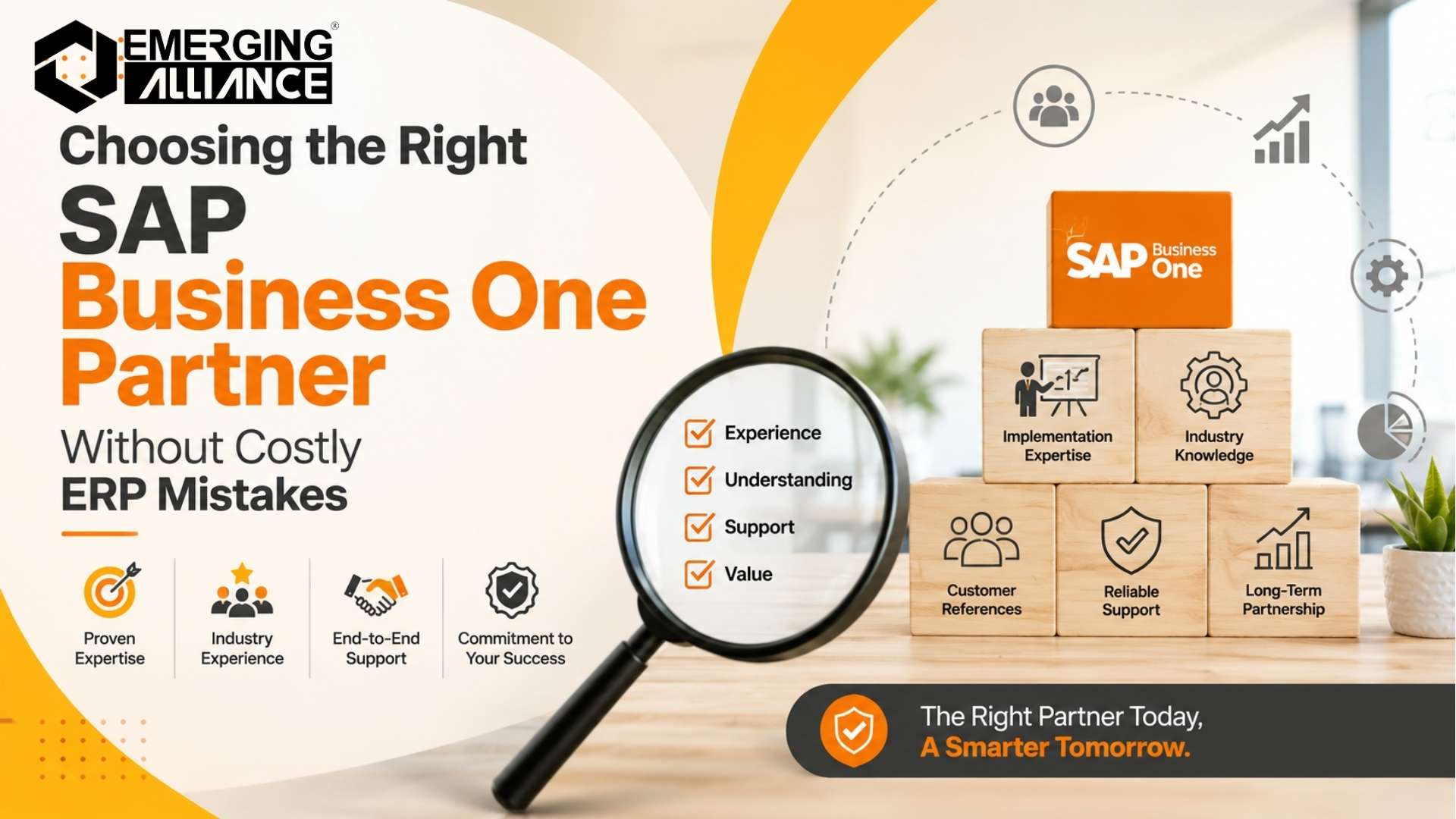
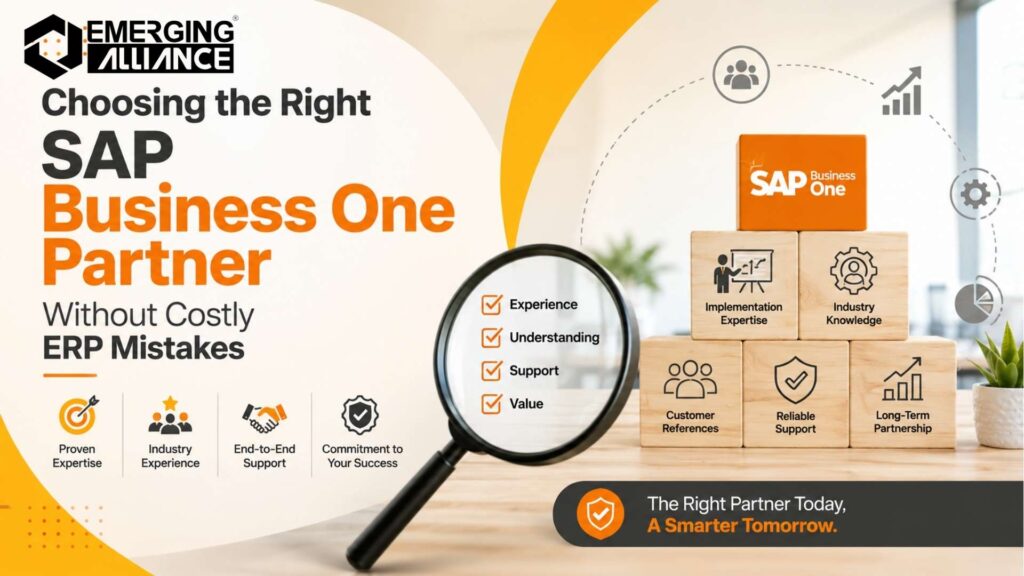
Choosing the Right SAP Business One Partner Without Costly ERP Mistakes
SAP Business One Partner for Lower Risk and Faster ROI
Selecting the right SAP Business One Partner is one of the most important business decisions an organization will make during an ERP transformation. While executives often compare software capabilities, implementation success depends far more on the partner responsible for planning, configuring, integrating, and supporting the solution. Many ERP projects fail not because of technology limitations, but because of weak implementation strategy, poor industry understanding, unrealistic timelines, and inadequate post-go-live support. Choosing the right partner reduces implementation risks, shortens time-to-value, and helps organizations realize measurable business outcomes much faster.
Whether you’re evaluating the Best SAP Business One (B1) Partner in India, comparing SAP B1 companies in India, or planning your first SAP B1 Implementation, this guide explains the strategic factors executives should evaluate before making a long-term ERP investment.
Why Does Choosing the Right SAP Business One Partner Matter?
The right implementation partner determines how quickly your ERP begins creating business value—not simply whether the software is installed successfully.
A strong SAP Business One Partner aligns technology with business objectives, redesigns inefficient processes, manages organizational change, and prepares the system for future growth. A weak partner often delivers only technical deployment while leaving operational inefficiencies untouched.
An experienced partner helps organizations:
- Reduce implementation risk
- Improve project governance
- Minimize operational disruption
- Accelerate user adoption
- Ensure long-term scalability
- Improve return on ERP investment
ERP should become a business transformation initiative rather than an IT deployment.
Common ERP Mistakes That Cost Organizations Time and Money
Most implementation failures follow predictable patterns. Identifying them early significantly improves project success.
Choosing Based Only on Price
The lowest implementation quote rarely represents the lowest total cost of ownership.
Underestimating consulting effort often results in change requests, delayed milestones, rework, and higher long-term expenses.
Ignoring Industry Experience
Every industry has unique operational processes.
Manufacturing, pharmaceuticals, distribution, engineering, retail, food processing, and professional services all require different ERP configurations. A partner without industry expertise spends valuable project time learning your business instead of solving your challenges.
Poor Business Process Discovery
Many projects begin configuration before understanding current operational workflows.
Without structured discovery workshops, organizations risk automating inefficient processes rather than improving them.
Weak Change Management
ERP implementation affects employees, departments, approvals, reporting, and decision-making.
Organizations that overlook user training and adoption frequently experience low utilization even after successful deployment.
Limited Post-Go-Live Support
Implementation does not end on go-live day.
Business requirements evolve, reporting changes, new users join, compliance requirements expand, and integrations increase over time. Long-term support is essential for sustained ROI.
Executive Insight: Before comparing implementation costs, many organizations benefit from an ERP readiness assessment that identifies operational risks, integration complexity, and process gaps before the project begins.
What Should You Evaluate in a SAP Business One Partner?
Selecting a partner requires evaluating both technical capability and business consulting expertise.
The following criteria should be part of every executive evaluation process.
1. Industry-Specific Experience
Ask whether the partner has implemented SAP Business One (SAP B1) within organizations similar to yours.
Relevant industry experience reduces project uncertainty because the partner already understands common workflows, compliance requirements, reporting expectations, and operational challenges.
2. Business Process Consulting
Implementation should begin with business process analysis—not software configuration.
An experienced SAP B1 Partner identifies opportunities to simplify approvals, automate manual work, improve inventory visibility, and strengthen financial control before configuring the ERP system.
3. Proven Implementation Methodology
Successful partners follow structured implementation frameworks that include:
- Business discovery
- Process mapping
- Solution design
- Configuration
- Testing
- User training
- Go-live planning
- Hypercare support
A documented methodology significantly reduces implementation risk.
4. Integration Capabilities
Modern organizations operate multiple business systems.
Your ERP partner should demonstrate experience integrating:
- CRM
- Warehouse systems
- E-commerce platforms
- Banking
- Payment gateways
- Manufacturing equipment
- Third-party logistics
- Business intelligence tools
Integration capability becomes increasingly important as organizations scale.
5. Long-Term Support Strategy
ERP is a long-term business platform.
Ask prospective partners about:
- Support SLAs
- Response times
- Dedicated consultants
- System health checks
- Performance optimization
- Upgrade planning
The relationship should continue well beyond implementation.
Why Industry Knowledge Matters More Than Technical Expertise Alone
Technical implementation alone does not guarantee business improvement.
The best SAP B1 Partner in India combines ERP expertise with operational consulting to redesign inefficient business processes before configuring the solution.
For example:
Manufacturing organizations require production visibility.
Distributors require inventory optimization.
Healthcare organizations prioritize traceability.
Engineering firms need project costing.
Retail businesses depend on real-time inventory accuracy.
Industry expertise allows the ERP system to reflect business reality rather than forcing organizations to adapt to generic configurations.
Planning Tip: If you’re evaluating multiple SAP B1 companies in India, request a solution workshop focused on your operational challenges instead of a standard product demonstration. The quality of that discussion often reveals implementation maturity.
Signs You’ve Found the Right SAP Business One Partner
Strong implementation partners consistently demonstrate business maturity rather than simply technical capability.
Look for partners who:
- Ask business questions before discussing software
- Focus on measurable operational outcomes
- Provide implementation governance
- Share relevant customer success stories
- Understand executive priorities
- Recommend process improvements
- Offer structured post-go-live support
- Build scalable ERP architectures
These characteristics reduce project uncertainty while improving long-term value.
How the Right SAP Business One Partner Improves ROI and Reduces Risk
The right implementation partner delivers value far beyond software deployment.
Organizations typically experience:
- Faster implementation timelines
- Lower project risk
- Better user adoption
- Higher reporting accuracy
- Improved operational visibility
- Reduced manual processes
- Better inventory control
- Stronger financial management
- Easier business scaling
- Higher long-term ERP utilization
For CEOs, CIOs, COOs, and Operations Leaders, these outcomes translate into faster decision-making, lower operational costs, and stronger business resilience.
A successful SAP B1 Implementation is measured not by go-live dates but by measurable improvements in productivity, profitability, and operational control.
Conclusion
Choosing the right SAP Business One Partner is ultimately a strategic business decision rather than a software procurement exercise. The right partner helps organizations avoid expensive implementation mistakes, align ERP with long-term business goals, and create measurable operational improvements that continue long after deployment.
Organizations that invest time in evaluating industry expertise, implementation methodology, governance, and support capabilities are significantly more likely to achieve faster ROI and sustainable business growth.
Frequently Asked Questions
1. How do I evaluate a SAP Business One Partner beyond certifications?
Look beyond certifications by assessing industry experience, implementation methodology, governance practices, customer references, and long-term support capabilities. Ask for examples of measurable business improvements delivered to clients with similar operational requirements.
2. What is the biggest reason SAP Business One implementations fail?
Most failures result from poor planning rather than software limitations. Inadequate process discovery, unclear project scope, weak executive sponsorship, and insufficient user adoption are common causes of implementation delays and reduced ROI.
3. How important is industry experience when selecting a SAP B1 Partner?
Industry knowledge significantly reduces implementation risk. A partner familiar with your sector already understands operational workflows, reporting needs, regulatory requirements, and common challenges, resulting in faster implementation and fewer configuration changes.
4. Should implementation cost be the deciding factor?
No. The lowest implementation price often leads to additional customization costs, project delays, and long-term support issues. Total business value and implementation quality should take priority over initial pricing.
5. How long does a typical SAP B1 Implementation take?
Implementation timelines vary depending on business complexity, number of users, integrations, customizations, and data migration requirements. Proper planning and stakeholder involvement generally have a greater impact on timelines than company size alone.
6. What support should I expect after go-live?
Post-go-live support should include issue resolution, user assistance, performance monitoring, system optimization, enhancement planning, and periodic health checks. Continuous support helps organizations maximize long-term ERP value.
7. Can SAP Business One integrate with existing business applications?
Yes. SAP Business One (SAP B1) supports integration with CRM systems, e-commerce platforms, warehouse applications, banking systems, manufacturing equipment, and various third-party business solutions through standard APIs and integration frameworks.
8. What should executives ask during partner selection meetings?
Focus on implementation governance, risk management, customer success metrics, industry expertise, resource allocation, change management, support models, and project ownership. These discussions provide better insight than product demonstrations alone.
9. How can organizations reduce implementation risk before the project begins?
Conducting a structured readiness assessment helps identify process gaps, integration challenges, data quality issues, and organizational readiness before implementation starts. Early planning reduces unexpected project delays and budget overruns.
10. Why is long-term partnership important after implementation?
Business requirements continue to evolve through expansion, acquisitions, regulatory changes, and new technologies. A trusted SAP Business One Partner provides continuous optimization, strategic guidance, and ongoing support to ensure the ERP system evolves alongside the business.
Talk to our specialists to evaluate your implementation readiness, identify potential risks, and build a roadmap that delivers faster ROI with lower implementation risk.
Book your SAP Business One consultation today.