

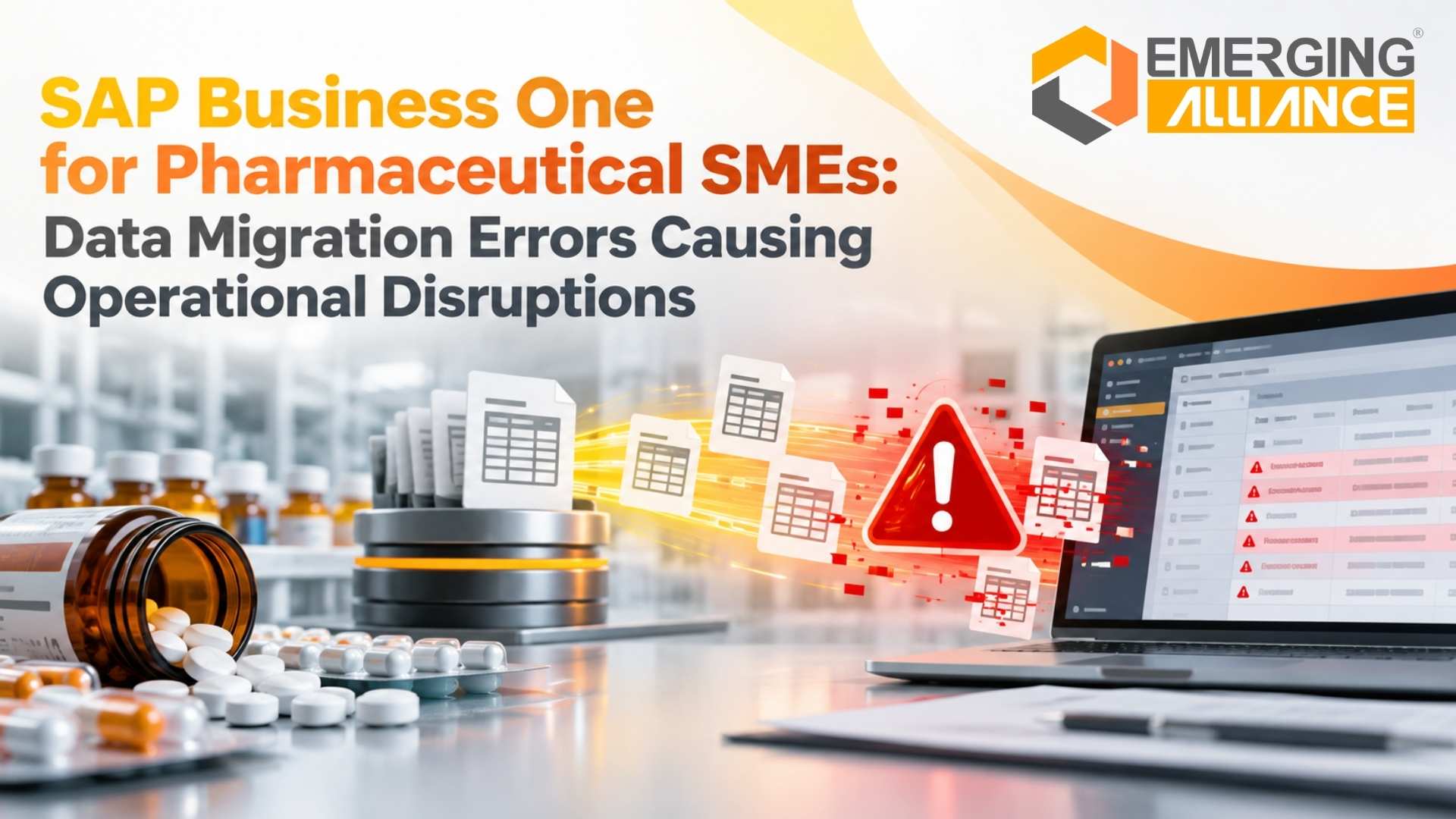
SAP Business One for Pharmaceutical SMEs: Data Migration Errors Causing Operational Disruptions
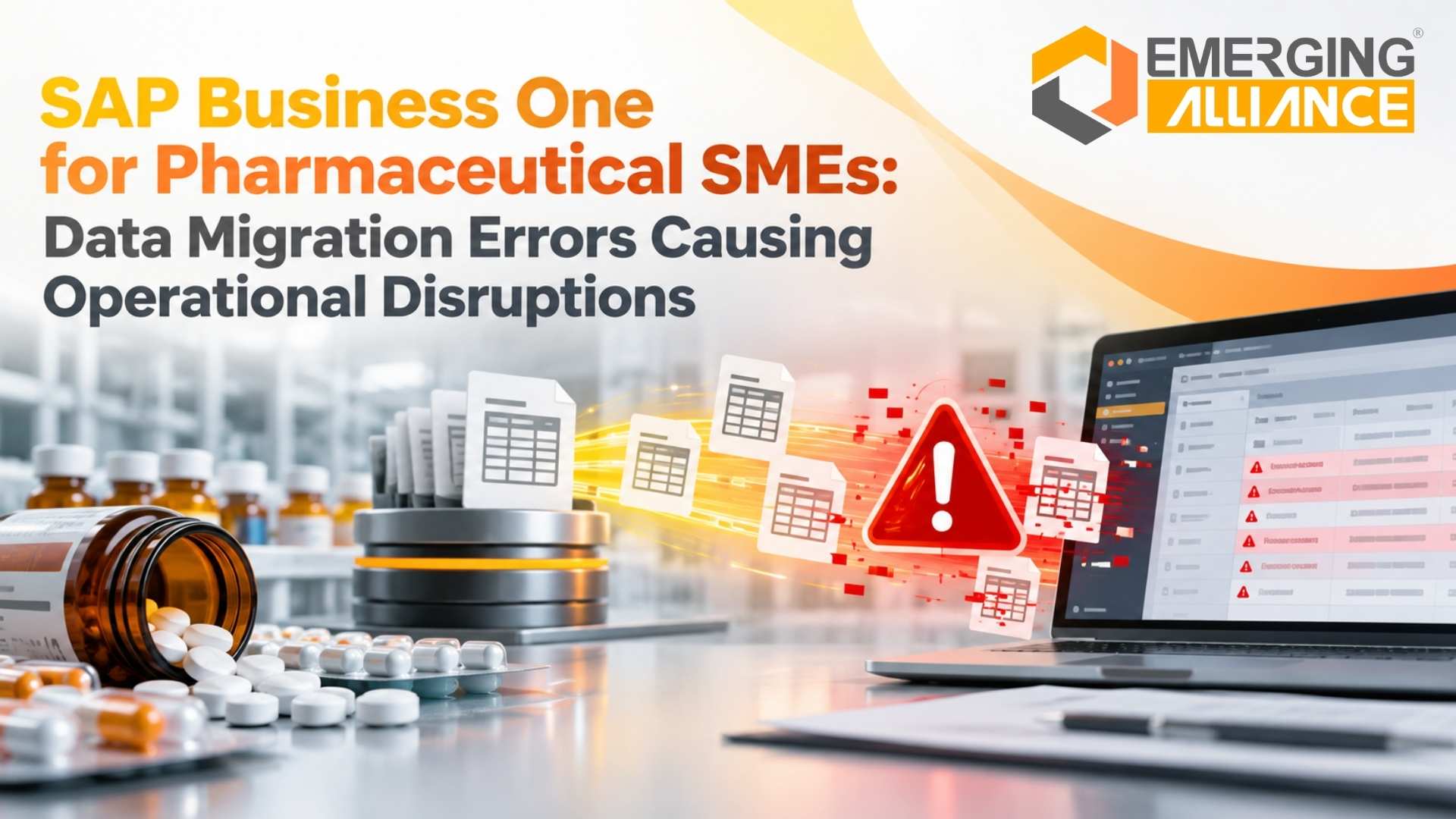
Quick Answer
Data migration errors in SAP Business One for Pharmaceutical SMEs can compromise inventory accuracy, batch traceability, product records, purchasing, production planning, and financial reporting. These problems often originate from incomplete records, incorrect mappings, or unreconciled balances. Structured data validation, reconciliation, business-process testing, and appropriate technical support are essential. Pharmaceutical businesses should assess discrepancies before they spread across connected operations.
Data Migration Errors Affecting Pharmaceutical Operations in SAP Business One
Pharmaceutical businesses depend on accurate, consistent ERP records to manage products, materials, suppliers, batches, and financial transactions. During migration to SAP Business One, information transferred from spreadsheets, legacy ERP systems, or other applications may not retain its original structure or meaning.
A successful technical import does not necessarily mean that the migrated information is complete, correct, or usable.
Consider the following data-quality problems:
- Incorrect item master records: Product descriptions, material classifications, item groups, or inventory settings differ from approved source information.
- Missing batch information: Lot identifiers, expiry dates, or associated quantities are incomplete or incorrectly linked to items.
- Incorrect opening inventory balances: Initial stock quantities do not agree with the agreed migration cut-off records.
- Incomplete business partner records: Supplier identifiers, customer details, addresses, or payment terms are missing.
- Inconsistent units and codes: Legacy item numbers or measurement units are transferred without appropriate conversion or mapping.
- Inaccurate financial balances: Opening ledger values or outstanding transaction balances differ from verified accounting records.
These errors may originate before migration or arise during extraction, transformation, loading, and validation.
For example, a spreadsheet might contain several descriptions for the same raw material, while the new ERP requires one controlled item identity. Importing those descriptions without cleansing can create duplicate records.
Similarly, an old system may store inventory quantities in cartons while SAP Business One uses individual units. An incorrect conversion can produce misleading opening quantities even when the import completes successfully.
The immediate concern is therefore data reliability, not simply whether information has appeared inside the new system.
For pharmaceutical SMEs, migration acceptance should depend on verified records and agreed business rules rather than import completion alone.
Operational Risks of ERP Data Migration Errors in Pharmaceutical Businesses

Operational risks from ERP data migration errors: Inaccurate inventory, supplier record mismatches, and production discrepancies disrupting daily pharmaceutical SME workflows.
Migration defects become more serious when employees begin using incorrect records for everyday transactions. The impact depends on which data objects are affected and how departments rely on them.
Inventory Availability and Warehouse Decisions
A pharmaceutical distributor completes its migration and discovers that a finished product has a higher recorded quantity than the physical warehouse count.
The warehouse team may initially treat the difference as an ordinary stock adjustment. However, sales employees could accept orders based on inventory that is not actually available.
Dispatch commitments then become difficult to fulfil.
Management should investigate whether the difference existed at migration cut-off, resulted from subsequent transactions, or reflects an incorrect unit conversion.
Purchasing and Supplier Coordination
A procurement team attempts to reorder packaging materials after go-live. Several supplier records contain outdated identifiers or incomplete purchasing information.
Employees must manually verify the correct supplier before completing purchase orders.
The resulting administrative work can delay material replenishment and make purchasing status less transparent.
Leadership should examine whether the problem concerns a few supplier records or a broader business partner mapping failure.
Production Planning and Material Availability
A pharmaceutical manufacturer prepares a production schedule using imported material balances.
One ingredient appears available in SAP Business One, but the warehouse confirms that its usable quantity is lower.
Production planners may need to revise material allocations, check alternative scheduling options, or postpone releasing work.
The relevant concern is not merely the quantity discrepancy. It is whether production decisions rely on information that has not been reconciled.
Warehouse Processing and Transaction Accuracy
A migrated item code may not match the identifier used in warehouse documentation.
Employees then spend additional time identifying the correct material before recording receipts, transfers, or issues.
Repeated identification checks increase manual handling and create opportunities for transaction mistakes.
Where barcode processes or external warehouse applications are involved, interface mappings may also require investigation.
Management Reporting and Financial Visibility
A finance manager compares the first post-migration inventory valuation report with approved closing records from the previous system.
The totals differ without a documented explanation.
Management may find it difficult to interpret inventory value, purchasing exposure, or financial performance until the opening position is reconciled.
Executives should distinguish migration discrepancies from legitimate transactions recorded after the cut-off date.
Across these scenarios, the leadership priority is to identify which decisions depend on questionable records and establish temporary controls while the underlying discrepancy is investigated.
Batch Traceability and Product Data Accuracy in Pharmaceutical ERP Systems
Pharmaceutical inventory often requires reliable identification of individual product batches, their associated quantities, and relevant expiry information.
SAP Business One supports batch-managed inventory processes, but the reliability of those processes depends on appropriate configuration, accurate transactions, and trustworthy records.
Migration introduces particular risks when product identity or historical batch information is incomplete.
- Product identity: An item master must consistently represent the intended pharmaceutical product or material. Incorrect codes or descriptions can make it difficult to distinguish similar strengths, pack sizes, or formulations.
- Batch identification: Imported batch identifiers must correspond with the appropriate items and inventory records. Missing or duplicated identifiers may complicate investigations into specific stock movements.
- Expiry information: Incorrect dates can undermine stock reviews and expiry-based handling decisions. Teams should compare migrated dates with approved underlying records rather than assuming imported values are correct.
- Lot-level quantities: Batch quantities need reconciliation with the relevant inventory position. A correct overall item quantity does not establish that quantities have been assigned correctly between batches.
- Transaction history: Historical information may require separate treatment depending on migration scope, available source records, and the implemented solution. Businesses should not assume every legacy movement becomes an equivalent SAP Business One transaction.
Separating Migration Defects from Process Problems
Not every traceability issue is caused by migration.
A missing batch reference might result from incorrect source information, an unsuitable item setting, an integration problem, or a transaction completed through an inappropriate process.
The investigation should therefore compare source records, migrated data, system settings, and transaction behaviour.
Quality personnel and warehouse owners should agree on which critical records require verification before operational reliance.
Where discrepancies remain unresolved, affected records should be clearly identified and managed under appropriate business controls.
Root Causes of SAP Business One Data Migration Failures in Pharmaceutical SMEs
Understanding the origin of an error determines which corrective action is appropriate. A visible discrepancy may have several possible causes.
| Root cause | Migration-related weakness |
|---|---|
| Poor legacy data | Outdated or incomplete source records are transferred without establishing their reliability. |
| Duplicate master records | Different identifiers represent the same material, supplier, or customer. |
| Incorrect field mapping | Source attributes are assigned to unsuitable SAP Business One fields. |
| Missing reference values | Required classifications, codes, or related master records are unavailable. |
| Incompatible measurement units | Conversion factors or unit relationships are undefined or incorrect. |
| Incomplete batch details | Batch identifiers, expiry information, or quantities are excluded from the migration scope. |
| Incorrect opening balances | Cut-off timing, outstanding transactions, or reconciliation assumptions are inconsistent. |
| Insufficient testing | Technical import checks occur without adequate operational validation by business users. |
These weaknesses require different responses.
Poor legacy data needs cleansing and ownership decisions. Incorrect mapping requires a review of transformation specifications. Missing reference values may require approved master data corrections or configuration assessment.
Batch-related omissions need particular attention because different sources may contain complementary information. The item master, batch register, inventory ledger, and physical count might not share identical structures.
Financial opening differences require agreement on the accounting cut-off, treatment of outstanding documents, and applicable reconciliation methodology.
Another frequent weakness is unclear acceptance criteria.
A project team may confirm that records loaded successfully without defining acceptable tolerances, exception categories, or required evidence.
Pharmaceutical business owners should participate in approving these criteria because technical teams cannot independently determine whether every migrated value is commercially or operationally appropriate.
Root-cause analysis should establish whether the defect originated in source data, transformation logic, migration execution, configuration, or subsequent transactions.
That distinction prevents corrective work from addressing symptoms while leaving the original weakness unresolved.
Identifying Data Migration Errors Through ERP Validation and Reconciliation
A structured diagnostic review helps pharmaceutical SMEs determine whether post-go-live problems represent isolated exceptions or widespread migration defects.
The investigation should use approved records, documented cut-off dates, and transaction evidence.
Establish a Reliable Comparison Baseline
Start by identifying the source system, migration date, data objects, and extraction files used during implementation.
Confirm which records were intended for migration and which historical information remained outside the agreed scope.
Without that baseline, comparisons may incorrectly classify expected differences as errors.
Compare Source and Target Records
Select important item masters, suppliers, customers, inventory records, and financial entries.
Compare field values between the approved source and SAP Business One.
Check identifiers, descriptions, classifications, units, quantities, dates, and relevant reference relationships.
A comparison should account for approved transformations rather than expecting every field to remain identical.
Reconcile Inventory and Opening Balances
Match source closing balances with the corresponding SAP Business One opening position.
Review transaction cut-off timing, stock locations, inventory units, and legitimate movements occurring after migration.
Finance should separately reconcile opening accounting balances against approved financial records.
Unexplained differences require documented investigation before adjustment.
Examine Master Data and Batch Exceptions
Identify duplicated identifiers, missing mandatory information, unexpected values, and inconsistent mappings.
For batch-managed items, compare batch numbers, expiry dates, quantities, and item relationships with authorised supporting information.
Use risk-based sampling initially, expanding the review when repeated discrepancies suggest broader exposure.
Review Migration Evidence
Where available, examine import logs, rejected records, transformation specifications, exception reports, and migration reconciliation files.
These records can reveal whether similar defects affected several data objects.
However, missing documentation does not establish that migration succeeded or failed.
It simply limits the available evidence.
Test Connected Business Transactions
Reproduce relevant purchasing, inventory, production, or financial transactions using a controlled test environment where appropriate.
Determine whether the unexpected behaviour follows the migrated record or persists independently of it.
Document the test conditions, expected outcome, actual result, and supporting evidence.
Prioritize Findings
Maintain a discrepancy register containing:
- Affected record and data object.
- Suspected cause and available evidence.
- Relevant department and business owner.
- Operational severity and urgency.
- Proposed investigation or corrective action.
- Validation status and approval responsibility.
An isolated incorrect description may require a controlled master data change.
Conversely, identical errors across hundreds of records may indicate defective transformation rules.
The diagnostic objective is to establish the error pattern before choosing the correction method.
Corrective Strategies for Pharmaceutical ERP Data Migration Problems

Structured remediation framework for pharmaceutical SMEs: Systematic data cleansing, mapping correction, balance reconciliation, and controlled transaction testing.
Effective remediation requires coordinated technical and business decisions. Corrections must protect existing transactions and preserve an understandable record of changes.
1. Assess the Scope and Severity
Classify identified discrepancies by operational importance, affected record count, and potential consequences.
Prioritize records influencing active inventory, critical materials, batch identification, or financial accuracy.
Restrict unsupported changes while the impact is assessed.
2. Identify Affected Data Dependencies
Determine which SAP Business One objects, documents, reports, and integrations use the questionable information.
For example, changing an item identifier may affect connected records and interfaces.
The dependency review establishes what must be tested before approval.
3. Establish the Source of Truth
Assign an appropriate business owner to verify disputed values using approved source records and supporting documentation.
Where competing records exist, document the decision and its evidence.
A technical consultant should not independently invent missing business values.
4. Correct the Underlying Cause
Select the intervention according to the diagnosis.
Data cleansing addresses inaccurate or duplicated source information.
Mapping correction changes how source fields correspond to target fields.
Reconciliation identifies and explains differences between approved records and resulting balances.
Configuration changes address unsuitable application settings when these contribute to the issue.
Technical remediation may address import procedures, integration behaviour, scripts, or other implementation defects.
These activities are related but cannot substitute for one another.
5. Reconcile Corrected Information
Compare proposed values against verified records and confirm that totals, relationships, and supporting references remain consistent.
Document exceptions requiring further investigation.
6. Test Before Production Changes
Where an appropriate non-production environment is available, test proposed corrections using representative records and connected transactions.
Consider effects on existing documents, batch-managed inventory, reporting, and integrations.
Some corrections may require supported SAP Business One procedures rather than direct database changes.
7. Obtain Business Approval
Secure validation from the responsible finance, inventory, production, or quality owner before approved production changes proceed.
Record responsibilities, change evidence, recovery considerations, and acceptance criteria.
8. Monitor Subsequent Transactions
After implementation, review affected transactions and reports to confirm that the expected behaviour continues.
Investigate unexpected results through the established change process.
Bulk updates without dependency analysis can compound existing discrepancies. They may also make it harder to determine which change caused a later problem.
Professional SAP Business One support becomes appropriate when errors recur, dependencies are complex, causes remain uncertain, or critical operations could be affected.
Preventing Future ERP Data Migration Errors Through Stronger Data Controls
Pharmaceutical SMEs should treat future migrations, acquisitions, system upgrades, and substantial data changes as controlled information transitions.
Preventive safeguards work best when responsibilities are established before extraction begins.
Define Data Ownership
Assign accountable owners for pharmaceutical item records, supplier information, inventory balances, batch details, and finance data.
Ownership prevents unresolved decisions about which source record should be considered authoritative.
Maintain Approved Mapping Specifications
Document source fields, SAP Business One destinations, transformation rules, default values, and relevant dependencies.
A mapping specification helps prevent incorrect interpretation of product attributes and inconsistent conversions.
Establish Cleansing Rules
Agree on duplicate detection, mandatory fields, naming conventions, inactive records, and acceptable reference values.
Apply these rules consistently before migration testing.
Use Representative Test Migrations
Include batch-managed items, alternative units, multiple warehouses, outstanding documents, and unusual but legitimate data conditions.
Testing only straightforward records can overlook weaknesses within more complex pharmaceutical workflows.
Implement Exception Reporting
Capture rejected imports, invalid values, missing relationships, and reconciliation differences.
Assign each exception an owner and resolution status.
This creates a traceable basis for acceptance rather than relying on verbal assurances.
Require Business Reconciliation
Finance should approve financial comparisons. Warehouse personnel should verify inventory and location information.
Production representatives should review planning-related master data, while relevant quality personnel validate critical product and batch attributes.
Technical teams should demonstrate mapping and import behaviour, not replace business approval.
Complete User Acceptance Testing
Ask users to execute representative transactions and assess whether the resulting records support their actual responsibilities.
Testing should follow documented scenarios and expected outcomes.
Establish Formal Sign-Off
Define acceptance thresholds, unresolved exception treatment, cut-off procedures, and escalation responsibilities.
Formal approval demonstrates that accountable stakeholders understand the remaining limitations before operational use.
These controls reduce foreseeable migration risks, although they cannot eliminate every future data or process problem.
When Pharmaceutical SMEs Need Specialist ERP Migration Support
Internal teams can often resolve clearly identified master data discrepancies when the correct values, ownership, and supported correction procedures are established.
Specialist assistance becomes more relevant when the investigation extends beyond ordinary record maintenance.
Important escalation indicators include persistent inventory differences after go-live, unreliable batch or expiry information, repeated mapping failures, and opening financial balances that cannot be reconciled.
Cross-departmental errors deserve particular attention because their causes may involve multiple records, processes, or interfaces.
Unclear responsibility is another warning sign. Finance, operations, and technical teams may each identify different symptoms without having enough evidence to establish the primary defect.
Production changes requiring specialised technical knowledge should also receive appropriate assessment.
An experienced SAP Business One partner can help structure the investigation, review available migration evidence, identify dependencies, prioritise findings, and plan suitable validation activities.
External support should complement accountable internal business ownership rather than replace it.
How Emerging Alliance Supports SAP Business One Data Migration Recovery
Emerging Alliance is a potential consultation partner for pharmaceutical SMEs seeking an independent assessment of SAP Business One migration concerns.
Businesses can discuss affected records, operational symptoms, existing investigation findings, and the expertise required to evaluate possible corrective actions.
The appropriate engagement scope should depend on the actual system environment, available evidence, technical complexity, and business priorities.
A consultation can help determine whether targeted assistance, deeper technical investigation, or a broader remediation plan is justified.
Frequently Asked Questions About SAP Business One Data Migration in Pharma
Get Expert Guidance on SAP Business One Data Migration Issues
Unresolved SAP Business One data migration errors can affect pharmaceutical inventory accuracy, batch traceability, production decisions, and financial records.
Request a consultation with Emerging Alliance to discuss your migration issues, review existing findings, and identify practical next steps.