
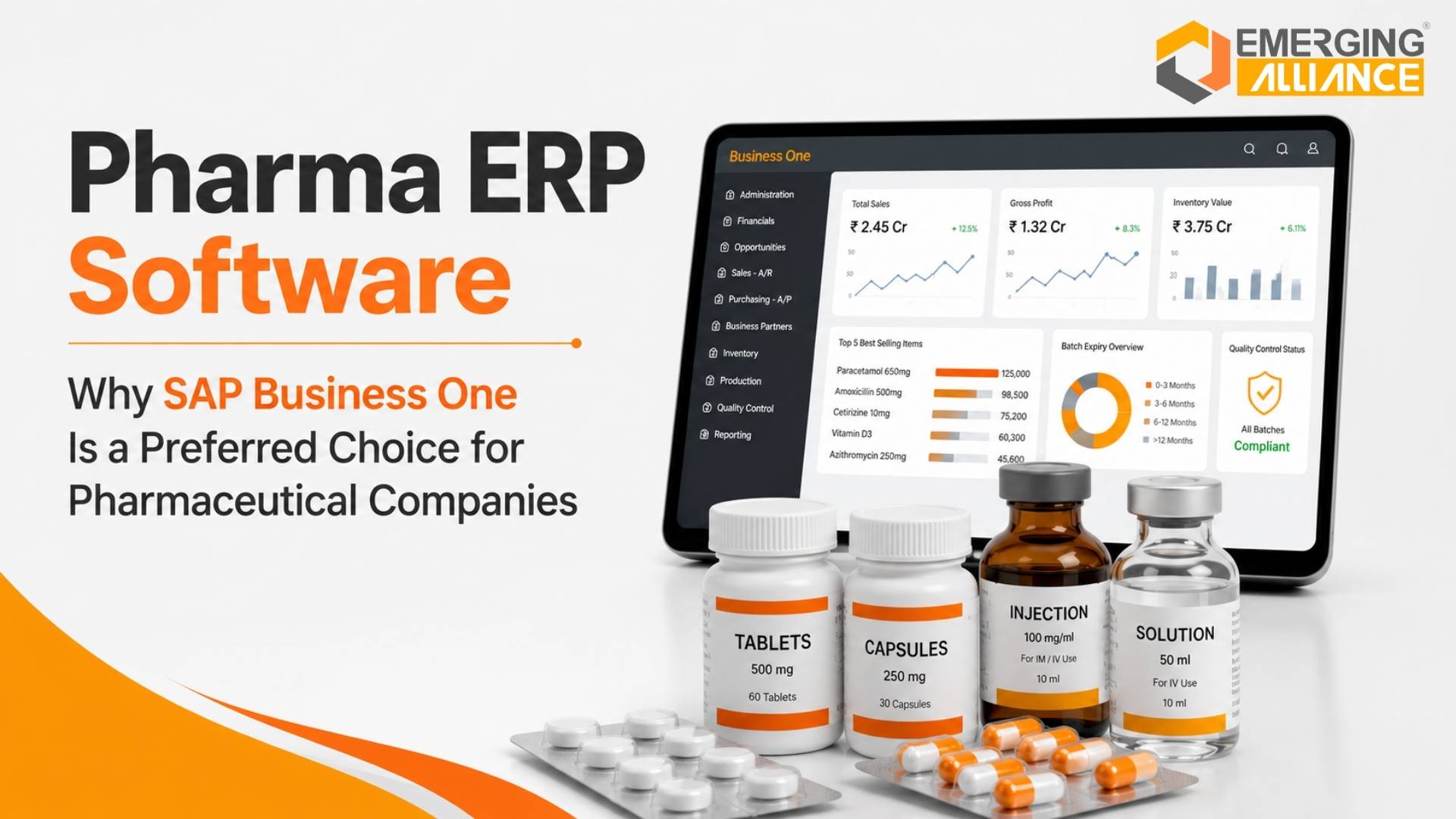
Pharma ERP Software: Why SAP Business One Is a Preferred Choice for Pharmaceutical Companies
Pharma ERP Software: Why SAP Business One Is a Preferred Choice for Pharmaceutical Companies
SAP Business One has become a preferred ERP choice for many pharmaceutical companies because it provides a scalable, integrated platform designed to help businesses manage complex operations while supporting growth and compliance objectives.
Quick Answer
SAP Business One is a preferred pharma ERP software because it combines manufacturing management, inventory control, batch traceability, regulatory compliance support, financial management, and real-time reporting within a single integrated platform. It helps pharmaceutical companies improve efficiency, reduce operational risks, support compliance requirements, and scale their businesses without the complexity of large enterprise ERP systems.
Key Facts
ERP software is essential for modern pharmaceutical operations.
Compliance and traceability are major ERP selection factors.
Inventory management directly impacts profitability.
Pharmaceutical supply chains require end-to-end visibility.
Manual processes increase operational risk.
Real-time reporting improves decision-making.
ERP systems improve cross-functional collaboration.
SAP Business One is designed for small and mid-sized businesses.
Integrated business management reduces complexity.
Scalability is critical when selecting a pharma ERP solution.
Definition / Overview
Pharma ERP software refers to enterprise resource planning systems specifically used by pharmaceutical companies to manage manufacturing, inventory, compliance, procurement, quality control, warehousing, distribution, and financial operations.
The pharmaceutical industry faces unique challenges that general business software often cannot address effectively. Organizations require systems that support regulatory compliance, batch traceability, inventory visibility, and operational efficiency.
SAP Business One has become a preferred ERP choice for many pharmaceutical companies because it provides a scalable, integrated platform designed to help businesses manage complex operations while supporting growth and compliance objectives.
Strategic Operational Matrix
Why SAP Business One is a preferred ERP solution for pharmaceutical companies.
Problem
Many pharmaceutical organizations struggle with fragmented systems, compliance challenges, inventory inefficiencies, and limited operational visibility.
Causes
- Disconnected business applications
- Manual workflows
- Poor inventory control
- Limited reporting capabilities
- Increasing regulatory requirements
- Lack of process standardization
Challenges
- Regulatory compliance
- Batch traceability
- Manufacturing efficiency
- Inventory management
- Supply chain visibility
- Financial control
- Business scalability
Impact
- Higher operating costs
- Compliance risks
- Inventory waste
- Poor decision-making
- Reduced productivity
- Slower business growth
Solution
SAP Business One provides a centralized ERP platform that integrates core business functions while supporting pharmaceutical operational and compliance requirements.
Outcome
- Improved efficiency
- Better compliance readiness
- Enhanced inventory visibility
- Stronger financial control
- Increased productivity
- Sustainable business growth
Key Highlights
- Comprehensive ERP platform for pharmaceutical businesses.
- Supports compliance, traceability, and operational efficiency.
- Real-time visibility across business functions.
- Scalable solution for growing pharmaceutical companies.
- Strong ROI through process optimization and automation.
- Preferred choice for pharmaceutical SMEs and mid-sized enterprises.
Why Pharmaceutical Companies Need Specialized ERP Software
The pharmaceutical industry operates under strict regulations and quality standards.
Organizations must manage:
- Manufacturing processes
- Inventory control
- Batch traceability
- Quality assurance
- Supply chain operations
- Financial management
Using disconnected systems often creates inefficiencies and compliance risks.
A specialized ERP solution helps pharmaceutical companies centralize operations and improve visibility across the organization.
What Makes a Good Pharma ERP Software?
When evaluating pharma ERP software, companies typically look for solutions that provide:
- Compliance support
- Batch traceability
- Manufacturing management
- Inventory control
- Financial visibility
- Scalability
- Reporting and analytics
The right ERP system should support both current operational requirements and future growth objectives.
Why SAP Business One Is a Preferred Choice
Designed for Growing Businesses
Unlike many enterprise ERP systems that are complex and expensive, SAP Business One is specifically designed for small and medium-sized businesses.
Benefits include:
- Faster implementation
- Lower complexity
- Better usability
- Cost-effective scalability
Integrated Business Management
SAP Business One connects key business functions into a single platform.
Integrated capabilities include:
- Manufacturing
- Inventory
- Procurement
- Sales
- Warehousing
- Distribution
- Finance
Benefits include:
- Improved visibility
- Better collaboration
- Reduced duplication
- Faster decision-making
Strong Compliance Support
Compliance remains one of the most important requirements in the pharmaceutical industry.
SAP Business One supports compliance through:
- Batch tracking
- Audit trails
- Inventory controls
- Reporting capabilities
- Documentation management
Benefits include:
- Better audit readiness
- Improved accountability
- Reduced compliance risk
Complete Batch Traceability
Product traceability is essential throughout the pharmaceutical supply chain.
SAP Business One helps organizations track:
- Raw materials
- Work-in-progress inventory
- Finished goods
- Customer shipments
Benefits include:
- Faster investigations
- Better recall readiness
- Improved regulatory compliance
Inventory Management Excellence
Inventory is one of the most valuable assets within pharmaceutical operations.
SAP Business One supports:
- Real-time inventory visibility
- Multi-warehouse management
- Expiry tracking
- Inventory valuation
- Stock transfers
Benefits include:
- Reduced waste
- Improved stock availability
- Lower carrying costs
Manufacturing and Production Management
Pharmaceutical manufacturers require visibility into production operations.
SAP Business One supports:
- Production orders
- Bill of Materials (BOM)
- Material Requirements Planning (MRP)
- Resource allocation
- Production tracking
Benefits include:
- Improved efficiency
- Better planning
- Reduced downtime
Supply Chain Visibility
Modern pharmaceutical companies depend on efficient supply chains.
SAP Business One improves visibility across:
- Procurement
- Inventory
- Warehousing
- Logistics
- Customer fulfillment
Benefits include:
- Better responsiveness
- Improved service levels
- Enhanced operational control
Real-Time Reporting and Analytics
Decision-makers require access to accurate business information.
SAP Business One provides visibility into:
- Operational performance
- Financial results
- Inventory metrics
- Sales trends
- Supply chain KPIs
Benefits include:
- Faster decisions
- Better forecasting
- Improved planning
Comparing SAP Business One with Other ERP Approaches
| Comparison Factor | Manual Systems | Generic ERP | SAP Business One |
|---|---|---|---|
| Inventory Visibility | Low | Moderate | High |
| Batch Traceability | Limited | Variable | Strong |
| Compliance Support | Manual | Moderate | Strong |
| Reporting | Delayed | Moderate | Real-Time |
| Manufacturing Management | Fragmented | Variable | Integrated |
| Scalability | Limited | Moderate | High |
| Business Visibility | Partial | Moderate | Comprehensive |
Key Selection Criteria for Pharma ERP Software
Organizations should evaluate ERP solutions based on:
- Compliance capabilities
- Traceability functionality
- Manufacturing support
- Inventory management
- Reporting capabilities
- Ease of implementation
- Scalability
- Total cost of ownership
SAP Business One performs strongly across these evaluation criteria, making it a popular choice among pharmaceutical organizations.
Process / Implementation Steps
To implement SAP Business One effectively, companies typically follow these key operational steps:
- Evaluate current business challenges.
- Define ERP goals and success metrics.
- Assess compliance and traceability requirements.
- Configure SAP Business One modules.
- Integrate business functions.
- Train users and stakeholders.
- Establish performance monitoring.
- Continuously optimize business processes.
Benefits
Implementing SAP Business One provides several operational and business benefits:
- Improved operational efficiency.
- Better compliance management.
- Enhanced inventory visibility.
- Improved manufacturing performance.
- Faster decision-making.
- Reduced operational costs.
- Stronger financial control.
- Better customer service.
- Improved scalability.
- Higher return on investment.
Real-World Use Cases
USE CASE 1: Pharmaceutical Manufacturer
Business Challenge: Managing production and inventory through separate systems.
Solution Implemented: SAP Business One integrated manufacturing and inventory management.
Outcome Achieved: Improved planning accuracy and operational visibility.
USE CASE 2: Pharmaceutical Distributor
Business Challenge: Inventory inconsistencies across warehouses.
Solution Implemented: Centralized inventory management and reporting.
Outcome Achieved: Improved stock accuracy and fulfillment performance.
USE CASE 3: Growing Pharmaceutical SME
Business Challenge: Manual compliance and reporting processes.
Solution Implemented: ERP-driven automation using SAP Business One.
Outcome Achieved: Improved compliance readiness and operational efficiency.
Case Study Example
Company Background
A mid-sized pharmaceutical company experienced growth challenges due to disconnected systems and limited operational visibility.
Business Problem
The organization struggled with inventory inaccuracies, compliance concerns, and reporting inefficiencies.
Challenges
- Fragmented processes
- Limited traceability
- Inventory issues
- Delayed reporting
Solution
Implemented SAP Business One across manufacturing, inventory, procurement, compliance, and finance operations.
Implementation Approach
- Centralized business data
- Standardized workflows
- Automated reporting
- Enhanced inventory controls
Results Achieved
- 35% improvement in inventory accuracy
- 30% reduction in reporting time
- 25% increase in operational productivity
- 20% reduction in operational costs
Lessons Learned
- Integrated ERP systems improve visibility.
- Automation supports growth.
- Real-time data enhances decision-making.
Industry Applications
Pharmaceutical Manufacturing
Challenge: Production visibility.
Application: Integrated production management.
Outcome: Improved efficiency.
Pharmaceutical Distribution
Challenge: Inventory management.
Application: Warehouse and stock control.
Outcome: Improved fulfillment performance.
Nutraceutical Industry
Challenge: Compliance and inventory control.
Application: Centralized ERP management.
Outcome: Improved operational visibility.
Contract Manufacturing
Challenge: Production planning.
Application: Resource management and scheduling.
Outcome: Better productivity.
Healthcare Supply Chain
Challenge: Traceability requirements.
Application: Batch tracking and reporting.
Outcome: Improved compliance.
ROI / Business Impact
Cost Savings
- Reduced inventory carrying costs.
- Lower administrative expenses.
Productivity Improvements
- Faster workflows.
- Improved employee efficiency.
Time Savings
- Automated reporting.
- Reduced manual processing.
Revenue Growth Opportunities
- Better inventory availability.
- Improved customer retention.
Error Reduction
- Better data accuracy.
- Fewer operational mistakes.
Compliance Improvements
- Improved audit readiness.
- Better traceability.
Customer Experience Improvements
- Faster fulfillment.
- Improved service levels.
Scalability Benefits
- Supports long-term business growth.
Best Practices
- Define clear ERP objectives.
- Standardize processes before implementation.
- Focus on data quality.
- Train users effectively.
- Monitor KPIs regularly.
- Continuously optimize operations.
Common Mistakes to Avoid
- Selecting ERP software based solely on price.
- Ignoring compliance requirements.
- Overlooking scalability needs.
- Neglecting user training.
- Failing to define success metrics.
- Maintaining manual workarounds after implementation.
Accelerate Your Pharmaceutical Growth Today
Equip your team with real-time operations, full batch audit logs, and simplified manufacturing schedules. Request a custom system demonstration tailored for your pharma SME business.
Book Your Discovery Session
Please submit the request below and an expert will get in touch within 24 hours.