
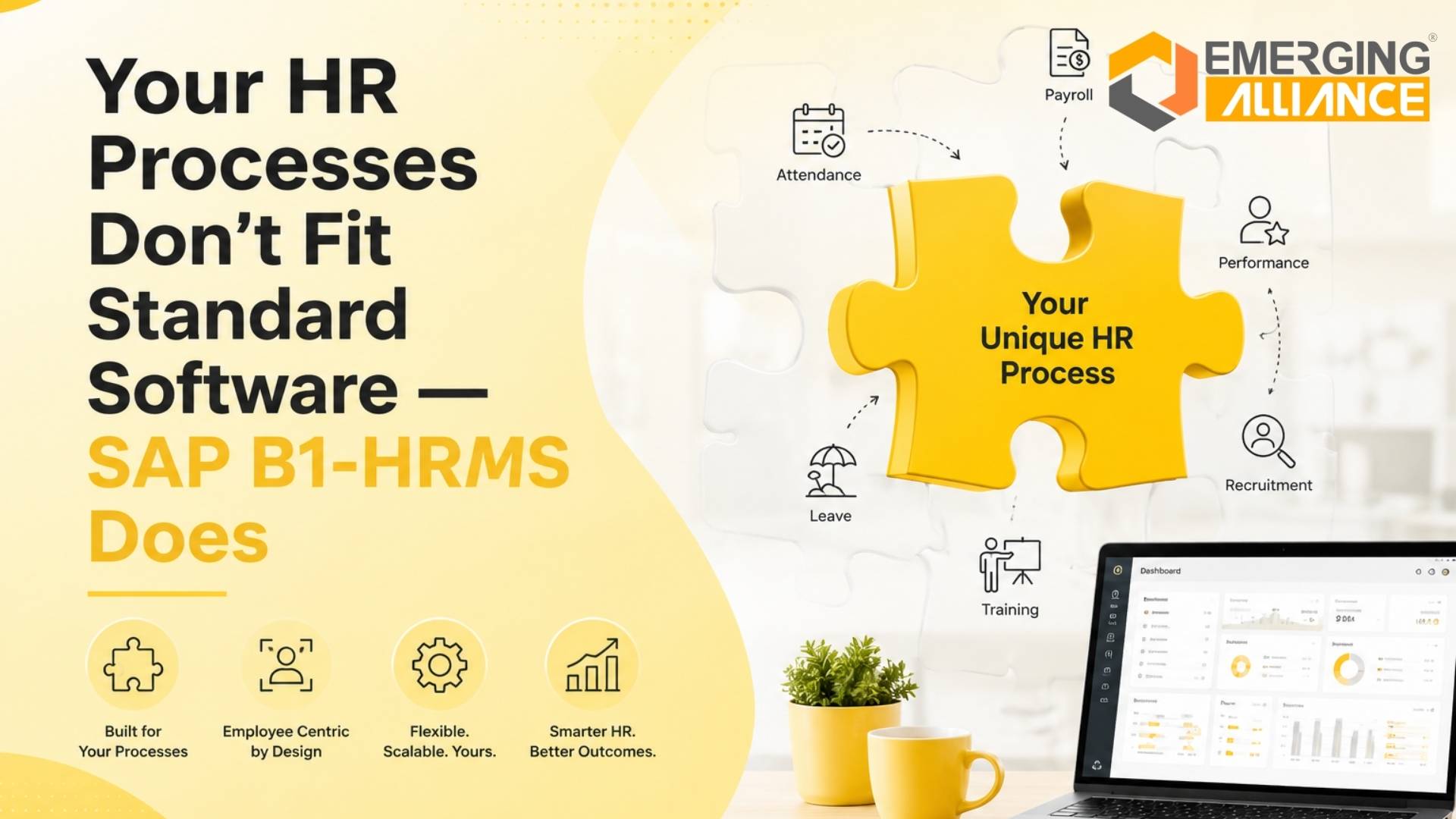
Your HR Processes Don’t Fit Standard Software — SAP B1-HRMS Does
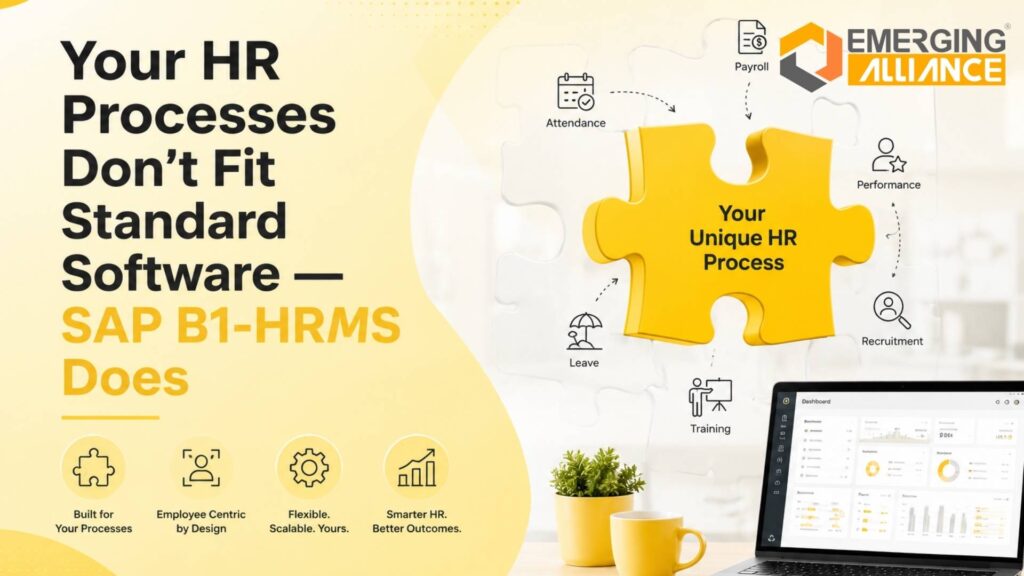
SAP B1-HRMS adapts to your workforce, workflows, and business structure
SAP B1 HRMS is becoming critical for enterprises facing workforce complexity, payroll inefficiencies, and disconnected HR operations. As businesses scale, traditional HR software often creates visibility gaps between HR, finance, compliance, and operations. Many organizations still manage payroll, attendance, approvals, and employee records across multiple systems. This slows decision-making, increases compliance risks, and creates operational bottlenecks that directly affect enterprise efficiency.
Modern enterprises require more than standalone HR software. They need an ERP-integrated workforce automation framework that aligns people, processes, and business operations inside a single connected ecosystem.
Current Industry Challenge: HR Systems Are Struggling to Scale
Most traditional HR platforms were built for administrative management — not enterprise-wide operational visibility.
As organizations grow across locations and departments, HR complexity increases rapidly. Payroll approvals become slower, attendance data becomes inconsistent, and workforce reporting loses accuracy. Leadership teams struggle to gain real-time visibility into workforce costs, productivity, and compliance exposure.
This operational disconnect creates:
- Payroll reconciliation delays
- Attendance tracking inconsistencies
- Limited workforce visibility
- Manual compliance dependencies
- Slow approval workflows
Hidden Operational Risks Inside Fragmented HR and Payroll Processes
Disconnected HR systems create risks that often remain invisible until they affect operations, audits, or profitability.
A growing enterprise may process salaries on time but still struggle with inaccurate attendance mapping, manual overtime calculations, inconsistent statutory deductions, or approval delays between departments.
These inefficiencies create larger enterprise problems:
Revenue Leakage Through Payroll Inaccuracies
Even small payroll inconsistencies across large employee bases can impact profitability over time. Manual payroll adjustments increase dependency on HR teams and create reconciliation challenges for finance departments.
Compliance Exposure
Modern enterprises face increasing regulatory and statutory reporting requirements. Without centralized employee records and automated payroll compliance management, businesses remain exposed during audits and inspections.
Lack of Workforce Visibility
Leadership teams often lack real-time insights into workforce productivity, leave utilization, employee costs, and department-wise resource allocation.
Without integrated reporting, decision-making becomes reactive instead of strategic.
Workflow Delays
Disconnected HR approvals create operational slowdowns across onboarding, reimbursement processing, leave approvals, performance evaluations, and payroll closures.
As organizations scale, these bottlenecks multiply.
How SAP B1 HRMS Solves Enterprise Workforce Challenges
Unlike standalone HR software, SAP Business One HRMS operates within an ERP-connected environment. This allows HR, payroll, finance, and operational workflows to function as a unified system instead of disconnected processes.
The platform helps enterprises automate workforce operations while improving reporting visibility and operational control.
Key capabilities include:
- Automated payroll processing
- HR and finance integration
- Employee self-service portal
- Attendance and leave automation
- Centralized workforce reporting
SAP Business One HRMS Use Cases Across Enterprise Operations
The value of Payroll software for SAP Business One extends beyond HR departments.
Manufacturing Enterprises
Manufacturers often manage shift-based operations, overtime structures, contract labor, and multi-location attendance systems. Integrated workforce automation improves payroll accuracy and operational visibility.
Pharma and Healthcare Organizations
Compliance-heavy industries require audit-ready employee records, role-based approvals, and payroll governance. A centralized employee database improves compliance readiness.
Distribution and Retail Businesses
Large distributed teams require scalable HR management systems capable of handling attendance synchronization, branch payroll processing, and workforce reporting.
Service Organizations
Project-driven companies require accurate resource allocation, employee performance tracking, and real-time workforce analytics to improve operational efficiency.
ROI and Operational Impact of SAP B1 Payroll Integration
The biggest advantage of HR and payroll integration with SAP B1 is operational alignment.
Enterprises no longer manage HR as a disconnected administrative function. Instead, workforce management becomes part of enterprise decision-making.
Key business outcomes include:
- Faster payroll closure cycles
- Reduced manual processing effort
- Improved compliance management
- Better workforce visibility
- Reduced approval bottlenecks
For leadership teams, the real ROI comes from improved control, visibility, and enterprise scalability.
As organizations grow, standardized workforce automation becomes critical for maintaining operational efficiency.
Why Enterprises Choose Emerging Alliance for SAP B1 HRMS Transformation
Successful HR transformation is not about software deployment alone.
Enterprises require a strategic partner capable of aligning HR operations with broader business transformation goals.
Emerging Alliance helps enterprises modernize workforce operations through ERP-driven automation strategies designed for scalability, compliance, and operational visibility.
Our approach focuses on:
- Enterprise workflow alignment
- HR and finance process integration
- Payroll automation strategy
- Compliance-driven system architecture
- Scalable workforce frameworks
Rather than implementing isolated HR software, Emerging Alliance helps organizations build connected enterprise ecosystems that support long-term growth.
Build a Workforce System That Scales With Your Enterprise
Standard HR software forces businesses to adapt to system limitations.
SAP B1 HRMS changes that model.
It allows enterprises to create workforce processes that align with operational complexity, compliance requirements, growth plans, and business structure.
For CEOs, CIOs, CFOs, and Operations Leaders, workforce automation is no longer an HR initiative alone. It is a strategic operational priority tied directly to scalability, visibility, efficiency, and enterprise control.
If your current HR processes are creating bottlenecks, compliance risks, or visibility gaps, now is the time to rethink how workforce operations connect with the rest of your enterprise.
FAQs About SAP B1 for HRMS
1. How does SAP B1 HRMS help businesses reduce manual HR workload?
SAP B1 HRMS automates core HR activities such as employee record management, payroll processing, attendance tracking, leave approvals, and reporting workflows, helping businesses reduce manual administrative effort and improve operational efficiency.
2. How does SAP B1 Payroll improve payroll accuracy?
SAP B1 Payroll automates salary calculations, attendance mapping, overtime computation, statutory deductions, and approvals, reducing manual payroll errors and processing delays.
3. Can HRMS for SAP Business One integrate with finance operations?
Yes. HR and payroll integration with SAP B1 allows payroll expenses, reimbursements, and employee-related financial data to connect directly with finance and accounting operations.
4. Is SAP Business One HRMS suitable for multi-location enterprises?
Yes. The platform supports centralized employee management, multi-branch payroll processing, and enterprise-wide workforce reporting for growing organizations.
5. How does Payroll software for SAP Business One support compliance management?y
The system helps automate statutory calculations, payroll compliance reporting, audit-ready documentation, and employee record management.
6. Can SAP B1 HRMS support attendance and leave tracking automation?
Yes. The platform supports attendance integration, leave workflows, shift management, and approval automation across departments.
7. What industries benefit most from SAP Business One HR software?
Manufacturing, healthcare, pharma, distribution, retail, logistics, and service-based enterprises commonly benefit from ERP-integrated HRMS frameworks.
8. How scalable is the best HRMS for SAP B1 for growing enterprises?
The solution is designed to scale alongside workforce expansion, multi-location operations, complex payroll structures, and evolving compliance requirements.
9. What are the migration challenges when moving from legacy HR systems to SAP B1 HRMS?
Common challenges include employee data standardization, workflow redesign, payroll mapping, and integration planning. Strategic implementation reduces operational disruption.
10. How does ERP-integrated HRMS improve executive reporting?
It provides centralized HR analytics and reporting across workforce costs, productivity trends, payroll liabilities, attendance metrics, and operational performance.
Connect with Emerging Alliance SAP Business One Solutions to evaluate how SAP B1-HRMS can streamline workforce automation, improve compliance visibility, and support enterprise growth.