
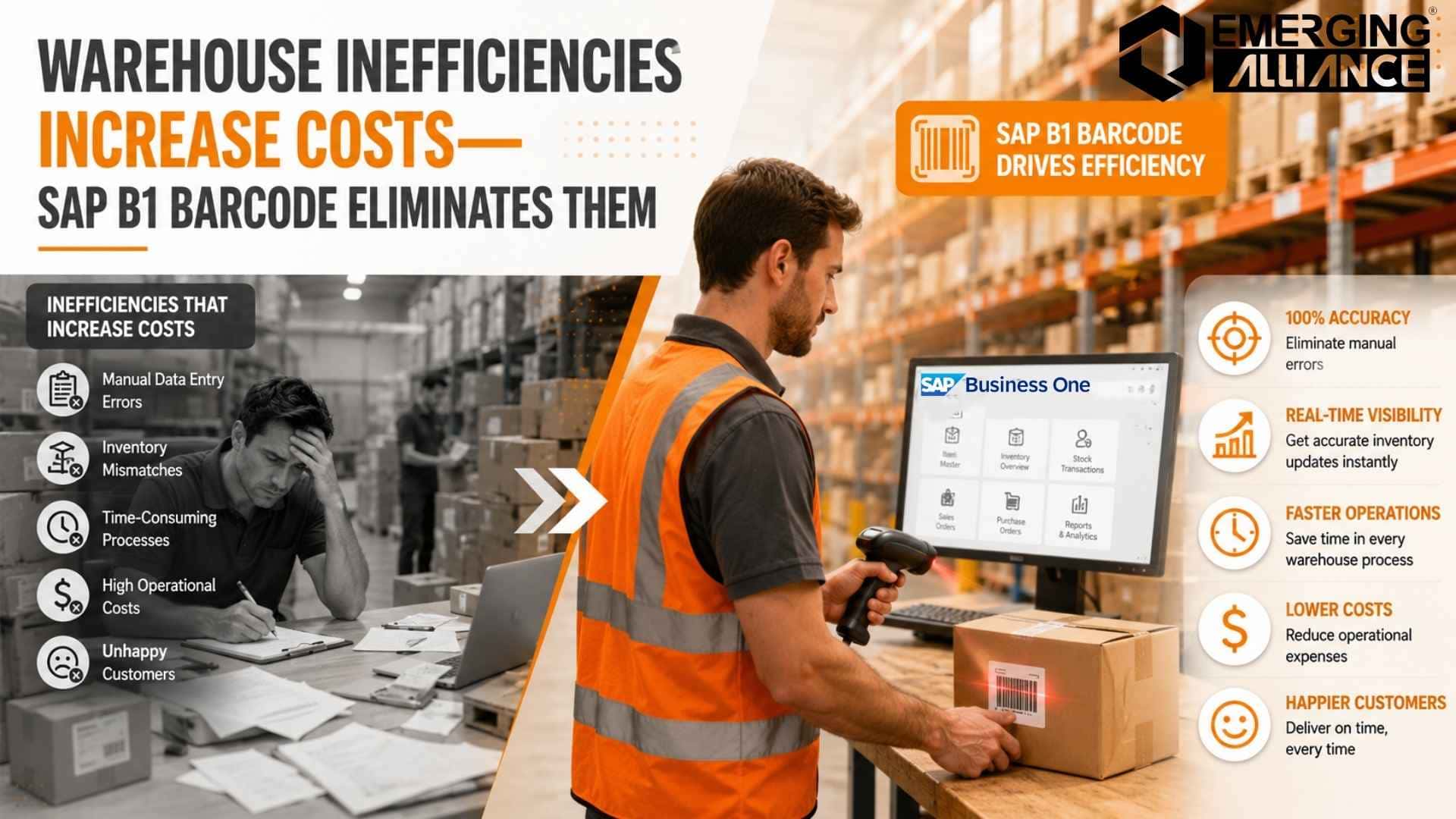
Warehouse Inefficiencies Increase Costs—SAP B1 Barcode Eliminates Them
SAP B1 Barcode Streamlines Inventory and Warehouse Operations
Warehouse performance directly impacts profitability, customer satisfaction, and operational scalability. However, many organizations struggle with manual inventory processes, paper-based transactions, and disconnected warehouse workflows. SAP B1 Barcode helps address these challenges by providing real-time inventory visibility, automated warehouse transactions, and seamless integration with SAP Business One. Without a barcode-enabled warehouse system, businesses often face inventory inaccuracies, delayed order fulfillment, and operational inefficiencies that increase costs and limit growth.
Inventory inaccuracies lead to stockouts and excess inventory. Delayed warehouse operations slow customer deliveries. Manual data entry introduces errors that affect purchasing, production, and financial reporting. Most importantly, limited real-time visibility prevents leadership teams from making informed operational decisions.
As businesses grow, these inefficiencies compound, creating operational bottlenecks that increase costs while reducing agility.
CEO Insight:
Many organizations lose 5–15% of warehouse productivity due to manual inventory handling, inaccurate stock data, and inefficient warehouse workflows.
SAP B1 Barcode helps eliminate these challenges by connecting warehouse activities directly with SAP Business One, creating a faster, more accurate, and scalable warehouse environment.
Why Traditional Warehouse Processes Are Costing More Than You Think
Many warehouse inefficiencies remain invisible until they begin impacting revenue, customer service, and operational performance.
Inventory Inaccuracies
Manual inventory tracking often results in:
- Stock mismatches
- Phantom inventory
- Overstocking
- Stockouts
- Inventory reconciliation challenges
When inventory data becomes unreliable, purchasing decisions become reactive rather than strategic.
Slow Goods Movement
Warehouse teams often spend valuable time locating products, validating inventory, and manually recording transactions.
Common consequences include:
- Delayed receiving
- Slower dispatch processes
- Increased labor dependency
- Reduced warehouse throughput
Manual Data Entry Errors
Manual processes increase the risk of:
- Duplicate transactions
- Incorrect quantities
- Wrong item postings
- Administrative inefficiencies
Even small errors can create costly downstream disruptions.
Lack of Real-Time Visibility
Without live inventory information, organizations struggle to:
- Forecast accurately
- Plan procurement effectively
- Manage production schedules
- Respond quickly to customer demands
Poor Traceability
Tracking inventory movement becomes increasingly difficult when warehouse activities are not digitally captured.
This creates challenges in:
- Product recalls
- Compliance audits
- Serial number tracking
- Batch management
Business Impact
Organizations often experience:
- Increased operational expenses
- Lower warehouse productivity
- Reduced customer satisfaction
- Revenue leakage
- Delayed decision-making
- Higher inventory carrying costs
Warning Signs Your Warehouse Needs Digital Transformation
Many organizations recognize warehouse problems only after operational performance begins to decline.
If your business experiences any of the following, warehouse modernization should become a strategic priority:
✓ Frequent stock discrepancies
✓ Warehouse staff spending hours on stock counts
✓ Delayed shipments and fulfillment issues
✓ Increasing warehouse labor costs
✓ Customer complaints regarding incorrect deliveries
✓ Limited access to real-time inventory reports
✓ Difficulty scaling warehouse operations
✓ Growing inventory carrying costs
✓ Excessive manual paperwork
✓ Lack of inventory traceability
These indicators often signal underlying process inefficiencies that technology can address.
Why Real-Time Warehouse Visibility Matters for Business Growth
As warehouse operations become more complex, real-time visibility is essential for maintaining efficiency, accuracy, and control. Businesses that rely on delayed updates or manual inventory tracking often struggle with stock discrepancies, fulfillment delays, and inefficient decision-making.
Real-time warehouse visibility enables organizations to monitor inventory movements as they happen, providing accurate information across purchasing, sales, production, and logistics functions.
With immediate access to inventory data, businesses can respond faster to customer demands, optimize stock levels, reduce operational risks, and improve overall warehouse performance.
For growing organizations, real-time visibility is not just an operational advantage—it is a critical capability for scaling efficiently and maintaining a competitive edge.
Key SAP B1 Barcode Capabilities That Reduce Costs
Barcode-Based Inventory Management
Inventory transactions become faster, more accurate, and easier to manage.
Benefits include:
- Faster inventory movements
- Improved stock accuracy
- Reduced manual entry
- Better inventory control
Real-Time Stock Visibility
Warehouse teams and executives gain immediate access to inventory information.
Benefits include:
- Accurate inventory data
- Better purchasing decisions
- Reduced stockouts
- Improved planning
Goods Receipt Automation
Incoming inventory can be processed quickly through barcode scanning.
Benefits include:
- Faster receiving
- Reduced receiving errors
- Improved supplier inventory accuracy
Pick, Pack, and Ship Optimization
Barcode-driven fulfillment processes streamline order processing.
Benefits include:
- Faster order fulfillment
- Improved shipping accuracy
- Higher customer satisfaction
Warehouse Transfer Management
Inventory transfers become fully traceable.
Benefits include:
- Accurate location tracking
- Better inventory visibility
- Reduced inventory loss
Cycle Counting Automation
Organizations can maintain inventory accuracy continuously.
Benefits include:
- Reduced counting effort
- Improved inventory reliability
- Fewer operational disruptions
The Operational and Financial Impact of SAP B1 Barcode
| Operational Challenge | SAP B1 Barcode Outcome |
| Inventory errors | Higher stock accuracy |
| Slow warehouse operations | Faster processing |
| Manual paperwork | Automated transactions |
| Limited visibility | Real-time reporting |
| High operating costs | Reduced warehouse expenses |
| Order fulfillment delays | Faster customer deliveries |
| Poor traceability | Improved compliance readiness |
| Scaling challenges | Operational scalability |
These improvements contribute directly to stronger business performance and improved operational resilience.
Real ROI: How SAP B1 Barcode Improves Profitability
Warehouse automation is not simply a technology initiative—it is a profitability initiative.
Reduced Labor Costs
Organizations reduce manual effort by automating inventory transactions and warehouse processes.
Lower Inventory Carrying Costs
Better inventory visibility helps reduce excess stock and optimize working capital.
Increased Warehouse Throughput
Warehouse teams can process more transactions with greater efficiency.
Improved Customer Retention
Accurate and timely deliveries strengthen customer trust and satisfaction.
Better Executive Decision-Making
Real-time warehouse analytics provide leadership teams with actionable operational insights.
CEO Perspective
The value of SAP B1 Barcode is not just warehouse automation—it is operational profitability.
How SAP B1 Barcode Extends the Value of SAP Business One
Organizations select SAP B1 Barcode because it aligns seamlessly with their ERP strategy.
Key advantages include:
- Native SAP Business One integration
- Real-time data synchronization
- Faster employee adoption
- Scalable architecture
- Reduced implementation complexity
- Improved inventory governance
- Enhanced operational visibility
For growing businesses, these capabilities support both immediate efficiency gains and long-term scalability.
Industry Use Cases
Manufacturing
Challenge: Material tracking and production inventory inaccuracies.
Solution: Barcode-enabled inventory transactions and material movement tracking.
Outcome: Improved production efficiency and inventory accuracy.
Distribution
Challenge: Multi-location inventory visibility.
Solution: Real-time warehouse barcode tracking.
Outcome: Faster fulfillment and reduced inventory discrepancies.
FMCG
Challenge: High-volume inventory movement.
Solution: Automated barcode scanning across warehouse operations.
Outcome: Increased throughput and order accuracy.
Medical Equipment
Challenge: Traceability and compliance requirements.
Solution: Barcode-driven serial and batch tracking.
Outcome: Improved compliance readiness and product visibility.
Automotive Components
Challenge: Inventory control across complex supply chains.
Solution: Real-time inventory movement monitoring.
Outcome: Better inventory control and production continuity.
Food & Beverage
Challenge: Batch management and expiry tracking.
Solution: Barcode-enabled inventory traceability.
Outcome: Improved quality control and compliance management.
Case Scenario: Before vs After SAP B1 Barcode
| Before | After |
| Manual stock updates | Barcode-driven warehouse operations |
| Inventory discrepancies | Real-time inventory accuracy |
| Slow order fulfillment | Faster shipments |
| High warehouse costs | Lower operational costs |
| Limited inventory visibility | Instant inventory visibility |
| Time-consuming stock counts | Automated warehouse workflows |
The transformation creates measurable improvements across productivity, accuracy, and customer service.
Questions Every CEO and CTO Should Ask Before Automating the Warehouse
Before evaluating warehouse modernization initiatives, leadership teams should ask:
- How much revenue is lost due to inventory inaccuracies?
- How much labor is spent on manual inventory handling?
- Can we see inventory in real time?
- Are warehouse delays affecting customer satisfaction?
- Can our current warehouse processes support future growth?
- Are inventory discrepancies impacting profitability?
- How quickly can we fulfill increasing customer demand?
- Do we have sufficient inventory traceability?
The answers often reveal significant opportunities for operational improvement.
Conclusion
Warehouse inefficiencies directly impact profitability, customer satisfaction, and growth.
Manual inventory processes create hidden costs that increase operational complexity and limit scalability. As organizations grow, these inefficiencies become increasingly difficult to manage.
SAP B1 Barcode helps organizations eliminate these challenges through real-time inventory visibility, barcode-driven automation, and improved warehouse control.
Businesses that modernize warehouse operations gain a measurable competitive advantage through faster execution, better inventory accuracy, and improved operational efficiency.
More importantly, they create the foundation for scalable and sustainable growth.
FAQs About SAP B1 for Barcode
1. How do warehouse inefficiencies impact business profitability?
Warehouse inefficiencies increase labor costs, create inventory inaccuracies, delay order fulfillment, and reduce productivity. Over time, these issues can lead to revenue leakage, higher operating expenses, and lower customer satisfaction.
2. Why is real-time inventory visibility important for growing businesses?
Real-time inventory visibility helps organizations make faster purchasing, production, and fulfillment decisions. It reduces stock discrepancies, prevents stockouts, and improves overall operational control.
3. What business problems does SAP B1 Barcode solve?
SAP B1 Barcode helps eliminate manual inventory tracking, data entry errors, inventory inaccuracies, warehouse bottlenecks, and visibility gaps by automating warehouse transactions within SAP Business One.
4. How does a barcode inventory management system improve warehouse accuracy?
Barcode scanning captures inventory movements instantly, reducing human error and ensuring inventory records remain synchronized with actual warehouse stock levels.
5. Can SAP B1 Barcode support multi-warehouse operations?
Yes. SAP B1 Barcode provides visibility across multiple warehouse locations, helping organizations track inventory movement, transfers, and stock availability in real time.
6. How does barcode automation improve order fulfillment performance?
Barcode-driven picking, packing, and shipping processes reduce fulfillment errors, accelerate order processing, and improve delivery accuracy, resulting in a better customer experience.
7. Is SAP B1 Barcode suitable for manufacturing environments?
Yes. Manufacturers use SAP B1 Barcode to track raw materials, work-in-progress inventory, finished goods, batches, and warehouse movements, improving production efficiency and traceability.
8. How does barcode-enabled warehouse management help reduce operating costs?
By reducing manual transactions, minimizing inventory errors, and improving warehouse productivity, barcode automation helps organizations lower labor costs and optimize inventory carrying expenses.
9. What should organizations evaluate before implementing a warehouse barcode system?
Businesses should assess inventory accuracy challenges, warehouse workflows, scalability requirements, integration capabilities, traceability needs, and expected operational outcomes before selecting a solution.
10. Why do companies choose SAP B1 Barcode over standalone barcode applications?
Organizations prefer SAP B1 Barcode because it integrates directly with SAP Business One, provides real-time data synchronization, reduces duplicate processes, and supports long-term operational growth.
Fill out the form and our experts will contact you shortly