


SAP B1 License Risks Every Growing Business Should Avoid
Quick Answer
SAP B1 License risk grows when new users, departments, branches, and responsibilities are added without reassessing who actually needs access and why. Decision-makers should review current usage, employee roles, access requirements, inactive accounts, and planned growth before buying more licenses. A role-based licensing strategy helps control cost, governance exposure, and future scalability.
When Business Growth Changes the SAP B1 Licensing Requirement
A SAP B1 License decision that worked at implementation may stop fitting the business after new users, departments, branches, processes, or responsibilities are added. Licensing requirements change because the organisation changes.
A growing company may add warehouse teams, branch accountants, procurement specialists, production planners, sales managers, controllers, or new operating locations. Existing employees may also take on broader duties that require different SAP B1 access.
The risk appears when licensing remains static while the operating model evolves. A department requests access, IT assigns what is available, and new licenses are purchased only when somebody is blocked. Over time, this can create unnecessary allocation, insufficient access, inactive users, inconsistent role design, and poor visibility over future requirements.
Growth therefore needs to be connected directly to SAP Business One licensing. Before a branch opens, a department expands, or responsibilities shift, management should understand which roles will use SAP B1, what those users must do, and how frequently they need access.
The objective is not to predict every future user. It is to prevent licensing from becoming a reactive administrative task. When business planning and license allocation are reviewed together, decision-makers gain better control over cost, access, governance, and scalability.
That visibility becomes more important as organisational complexity increases.
The First Risk: Buying Licenses Without Matching Actual User Responsibilities
The first licensing risk appears when companies assign access based mainly on job titles, hierarchy, or convenience instead of what employees actually need to do in SAP B1.
Two people with similar titles may use the system very differently. One finance employee may post transactions, reconcile accounts, and prepare reports. Another may only need narrower access for specific operational tasks. The same difference can exist across sales, purchasing, warehouse, and management roles.
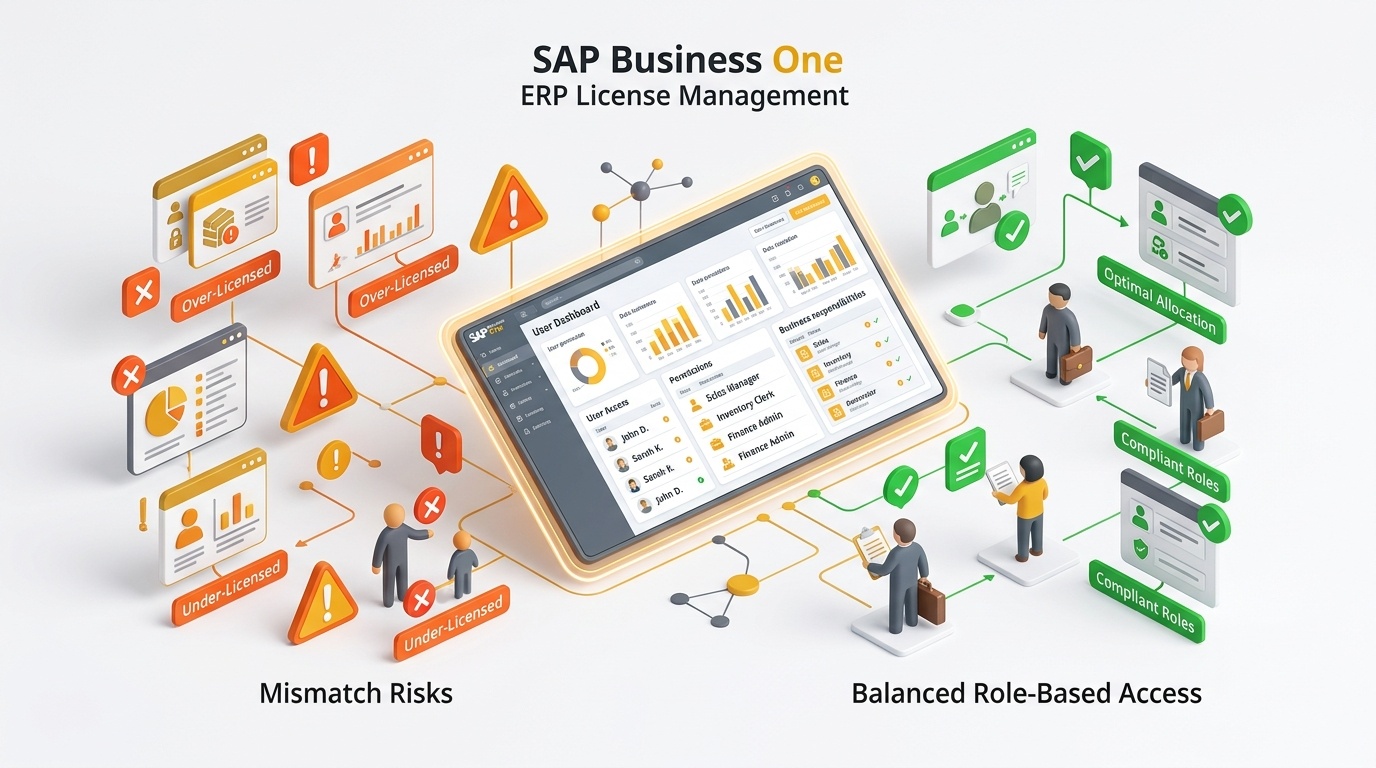
SAP B1 License Allocation vs Actual User Responsibilities: Aligning user roles to actual transactional needs eliminates cost inflation and workflow bottlenecks.
When these differences are ignored, over-licensing and under-licensing become more likely. Broader access than a role requires can increase expenditure without adding business value. Insufficient access can create delays, repeated IT requests, dependency on colleagues, or workarounds outside the intended process.
Management feels the effect across functions. Finance sees avoidable cost. IT spends time correcting access. Department heads face process delays. Employees become frustrated when their responsibilities and system capability do not match.
A better approach defines the business responsibility first and the licensing requirement second. Decision-makers should ask what the user must accomplish in SAP B1, how frequently those activities occur, what information or transactions are involved, and whether the role is expected to expand.
That role-based approach creates a defensible reason for every SAP B1 License allocation as the company grows.
The Cost Problem: Where SAP B1 Licensing Can Become Expensive
SAP B1 licensing costs can rise unnecessarily when organisations add licenses one request at a time without reviewing the wider user environment.
The immediate logic may seem reasonable: a new employee joins, a department expands, or a manager needs access, so another license is purchased. The problem appears when nobody checks whether inactive users remain allocated, existing roles still fit current responsibilities, or planned hiring will create a larger requirement soon.
Cost control therefore depends on context, not simply on buying fewer licenses.
The cheapest immediate decision can also create a more expensive operating outcome. If access does not adequately support a user’s responsibilities, the business may face repeated reconfiguration, manual workarounds, approval delays, or later licensing changes. Conversely, purchasing broader access “just in case” can commit budget to capability that is not actually needed.
For CFOs and business owners, the better question is not “What is the lowest SAP B1 License price?” It is “What licensing structure supports the required work at a sensible total cost without creating access, governance, or scalability problems?”
A planned review gives management visibility over current allocation, likely user growth, future budget requirements, and potential mismatches before spending becomes fragmented. Effective cost control comes from disciplined license allocation and role planning, not from isolated purchase decisions.
This is especially important when several departments are expanding at the same time.
The Compliance Risk: When User Access and License Usage Do Not Align
SAP B1 license compliance should be treated as a practical governance and contractual concern, not as a fear-based legal issue.
The objective is alignment: the people using SAP Business One, the access assigned to them, their current responsibilities, and the licensing rights purchased by the organisation should remain consistent.
That alignment can weaken over time. Employees move between departments. Managers gain approval responsibilities. Staff leave, but accounts or allocations are not promptly reviewed. Temporary access becomes permanent. In some environments, teams may even rely on shared credentials because requesting the correct access appears inconvenient.
Each situation creates a control gap. Shared access reduces accountability. Dormant allocations can hide unnecessary cost. Unreviewed role changes can leave users with access that no longer reflects what they are expected to do.
These situations do not automatically mean a company is breaching a specific SAP agreement. Actual entitlements and restrictions depend on the organisation’s contract and applicable SAP terms. However, weak control makes it harder to demonstrate that user access and license allocation are being managed deliberately.
A practical governance process should connect HR changes, department ownership, IT access control, and licensing review. When an employee joins, moves, changes responsibilities, or exits, the licensing impact should be considered alongside account provisioning.
This keeps access decisions traceable internally.
The Scalability Problem: Why Licensing Should Be Planned Before the Next Growth Stage
Licensing becomes a scalability problem when today’s user count is treated as the only planning input.
A company preparing to add a new warehouse, sales office, manufacturing line, service team, or regional branch is not simply adding people. It is also adding processes, approval paths, reporting responsibilities, transactions, and system interactions. Those changes can alter how many SAP B1 users the organisation needs and how those users should be supported.
New departments may introduce roles that did not exist during implementation. New locations may require local finance, inventory, purchasing, sales, or management access. Employee responsibilities may broaden as decisions become more decentralised. Process expansion can also move work that previously happened outside SAP B1 into the ERP.
Transaction growth does not, by itself, define a licensing requirement. However, higher activity can change how work is divided and how many employees need timely system access. New integrations or operational requirements can also affect the user model and should be assessed against current SAP terms and the company’s technical design.
The strategic question is therefore not only “How many licenses do we need today?” It is “What user and access model will support the next operating stage?”
Forward planning provides visibility without requiring every future license to be purchased in advance.
That visibility reduces disruptive licensing decisions during expansion.
The Solution: Build a Role-Based SAP B1 Licensing Strategy
A role-based SAP B1 licensing strategy starts with the work people perform, not with an assumption about the license they should receive.
First, determine who genuinely needs SAP B1 access. Some employees depend on the system throughout the day to create, update, approve, or analyse business information. Others may need narrower or less frequent interaction. That distinction helps prevent broad access from becoming the default.
Next, define what each user actually does. Map business activities to system responsibilities: which records the person creates, which transactions they process, what information they review, what approvals they perform, and which reports they rely on.
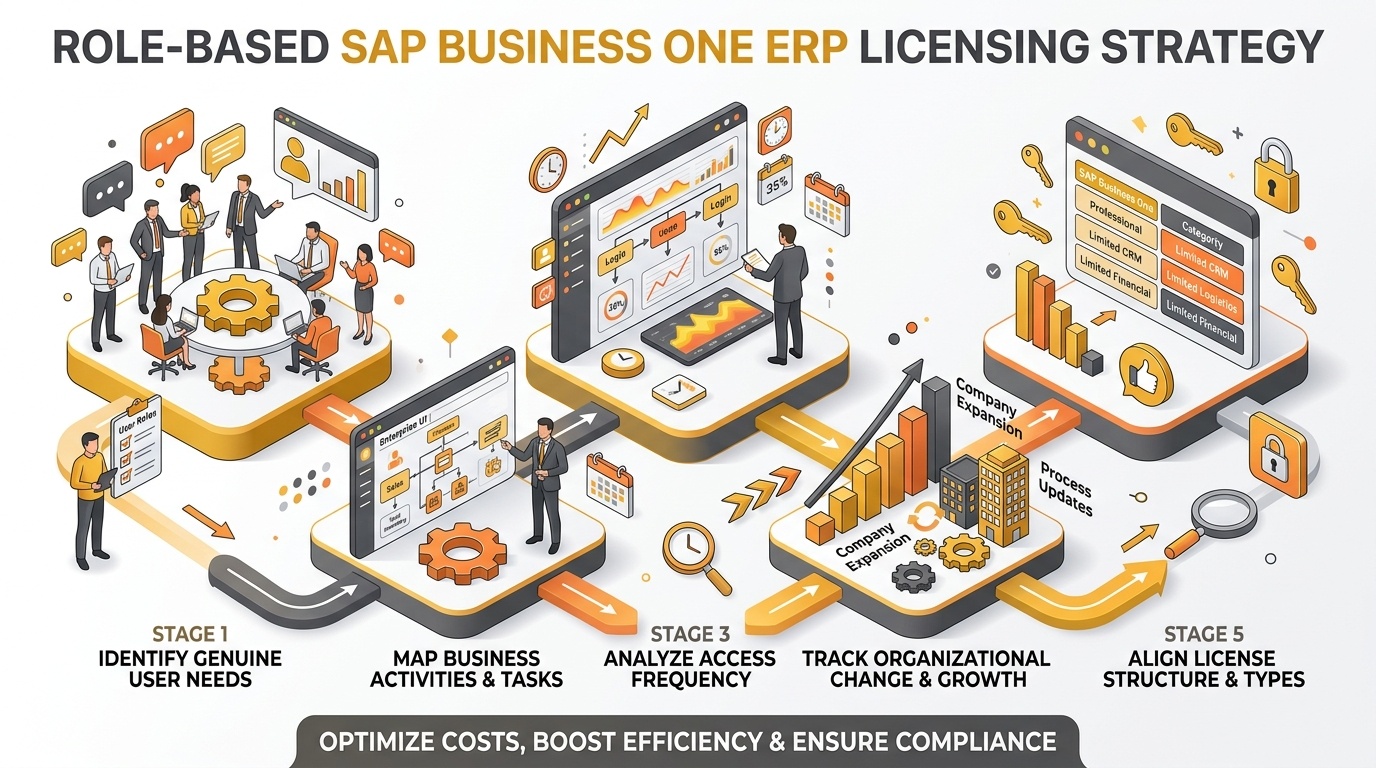
Role-Based SAP B1 Licensing Strategy Framework: Five key stages to optimize license costs, operational capability, and governance compliance.
Frequency adds useful context. A daily transactional user should not automatically be assessed the same way as someone who accesses SAP B1 periodically. Frequency does not determine licensing by itself, but it clarifies the operating requirement.
Decision-makers should then look for change. Are responsibilities expanding? Are managers taking on approvals? Are new hires expected? Are finance users supporting additional locations? Are inactive users still allocated?
Finally, compare those role requirements with the existing SAP Business One licensing structure. The objective is to identify where current allocation and actual responsibility diverge.
A sound licensing strategy balances both sides of the risk: avoiding unnecessary access while ensuring users have sufficient capability to perform required work.
That balance protects budget, productivity, accountability, and the organisation’s future growth plans.
How to Review Your Current SAP B1 License Setup Before Adding More Users
Before purchasing more licenses, management should review the environment in a deliberate sequence: current users, actual usage, business roles, access requirements, upcoming changes, licensing gaps, and cost implications.
Start with the current user population. Identify active employees, their departments, responsibilities, and the business owner for each account. This establishes whether every allocated user still has a valid purpose.
Next, compare allocation with actual usage. The objective is not to remove access simply because somebody logs in infrequently. Some roles genuinely require periodic access. Instead, investigate inactive accounts, changed responsibilities, temporary arrangements, or users whose assigned access appears broader or narrower than their work requires.
Then review business roles with department heads, not only IT. A system record can show that access exists; operational leaders can explain what the employee is expected to accomplish.
After the current-state review, examine upcoming hiring, restructuring, branch expansion, process changes, and new approval responsibilities. These events can create fresh SAP B1 user requirements.
Now identify gaps. A gap may mean excess allocation, insufficient access, an inactive user, or a future role that has not been planned.
Finally, assess the cost and operational implications. Which users need reassessment? Which changes require a budget? Which requirements should be addressed now rather than urgently later?
This process helps management identify both over-licensing and under-licensing before approving another SAP B1 License purchase.
It also creates a clearer audit trail for internal decisions.
SAP B1 License Management as the Business Scales
SAP B1 license management should continue after implementation because the organisation continues to change.
A practical governance model creates review triggers instead of waiting for a problem. New hires should prompt an access and role assessment. Departures should trigger account closure and allocation review. Department transfers should lead to reassessment. Promotions may create new approval or reporting needs. Branch expansion can introduce groups of users whose requirements should be considered together.
Periodic review is also valuable when no major project is underway. A quarterly, half-yearly, or other business-appropriate cadence can help IT, finance, and department owners compare current users with current responsibilities. The right frequency depends on how rapidly the company changes.
Ownership matters. SAP B1 user access should not sit only with IT, because IT may not know when operational responsibilities shift. Finance should not own it alone because licensing affects multiple functions. Department leaders should not make isolated decisions without cost or contractual context.
A stronger model is cross-functional. Management or HR signals people changes. Department heads define responsibilities. IT manages access. Finance evaluates cost. ERP leadership or an SAP Business One specialist helps interpret licensing implications.
This creates a current, explainable link between people, roles, access, and license allocation as the business scales responsibly.
When to Get Expert SAP B1 Licensing Guidance
Professional guidance becomes valuable when the licensing environment is changing faster than internal teams can assess it.
Rapid user growth is one signal. If several employees are being added across finance, sales, warehouse, and operations, reviewing the access model may be more effective than buying licenses individually.
Complexity is another signal. Different departments can use SAP B1 in very different ways, making title-based allocation unreliable. Expansion into new branches or locations can add users and responsibilities at the same time. Restructuring can move existing employees into roles that require different access.
Unexpected licensing costs should also trigger review. The issue may not be the price of one license; it may be poor allocation, inactive users, fragmented purchasing, or missing growth planning. Repeated complaints about insufficient access can indicate the opposite problem.
Compliance concerns are another reason to seek specialist input. If management is uncertain whether user access, account practices, and purchased rights remain aligned, an assessment can identify questions that need validation against the organisation’s SAP agreement and current terms.
The goal of expert guidance is not automatically more licensing or less licensing. It is a clearer, evidence-based decision about what the business needs now and next.
How Emerging Alliance Can Help with SAP B1 Licensing Decisions
Emerging Alliance can support growing businesses by reviewing SAP B1 licensing decisions in the context of operations rather than treating licensing as an isolated procurement task.
The process starts with understanding current SAP B1 usage: who has access, what roles they perform, which departments they support, and which business activities depend on the system.
From there, user and role requirements can be reviewed against current allocation. This can highlight situations where access no longer reflects responsibilities, where inactive users deserve attention, or where employees may need a different access approach to perform required work.
Emerging Alliance can also help decision-makers assess licensing gaps before new users are added. This is particularly relevant when businesses are hiring quickly, opening branches, changing responsibilities, or expanding SAP Business One into additional processes.
Licensing planning can then be connected with growth planning. Instead of approving one request at a time, management gains a clearer view of expected SAP B1 users, role changes, budget considerations, and decisions that may require confirmation under SAP terms.
The objective is better visibility and decision discipline. That helps CEOs, CFOs, CIOs, CTOs, COOs, IT Heads, and ERP decision-makers align licensing expenditure with operational need.
Conclusion
SAP B1 licensing should evolve with the organisation.
As users, departments, locations, responsibilities, and processes expand, the original licensing structure may stop reflecting how the business operates. Risks can appear as unnecessary expenditure, restricted access, weak account governance, unclear license allocation, or disruptive changes during expansion.
The objective is not simply to minimise license numbers. Cutting access too aggressively can damage productivity, while assigning broad access without reviewing responsibilities can create avoidable cost and governance concerns.
A sustainable approach keeps the right users at the right level of access through role definitions, periodic review, and forward planning.
Before adding more SAP B1 users, decision-makers should understand the environment, identify changing responsibilities, anticipate growth, and validate licensing requirements against SAP terms.
When that picture is unclear, SAP B1 licensing guidance can turn a reactive purchase into a business decision.
FAQs
SAP B1 Licensing Guidance for Your Next Growth Stage
As your business grows, changing users, roles, and locations can affect your SAP B1 requirements. Explore how SAP Business One can support your current operations and future growth.
Speak with an SAP Business One specialist to understand the right setup for your business.
Book an SAP Business One Demo