
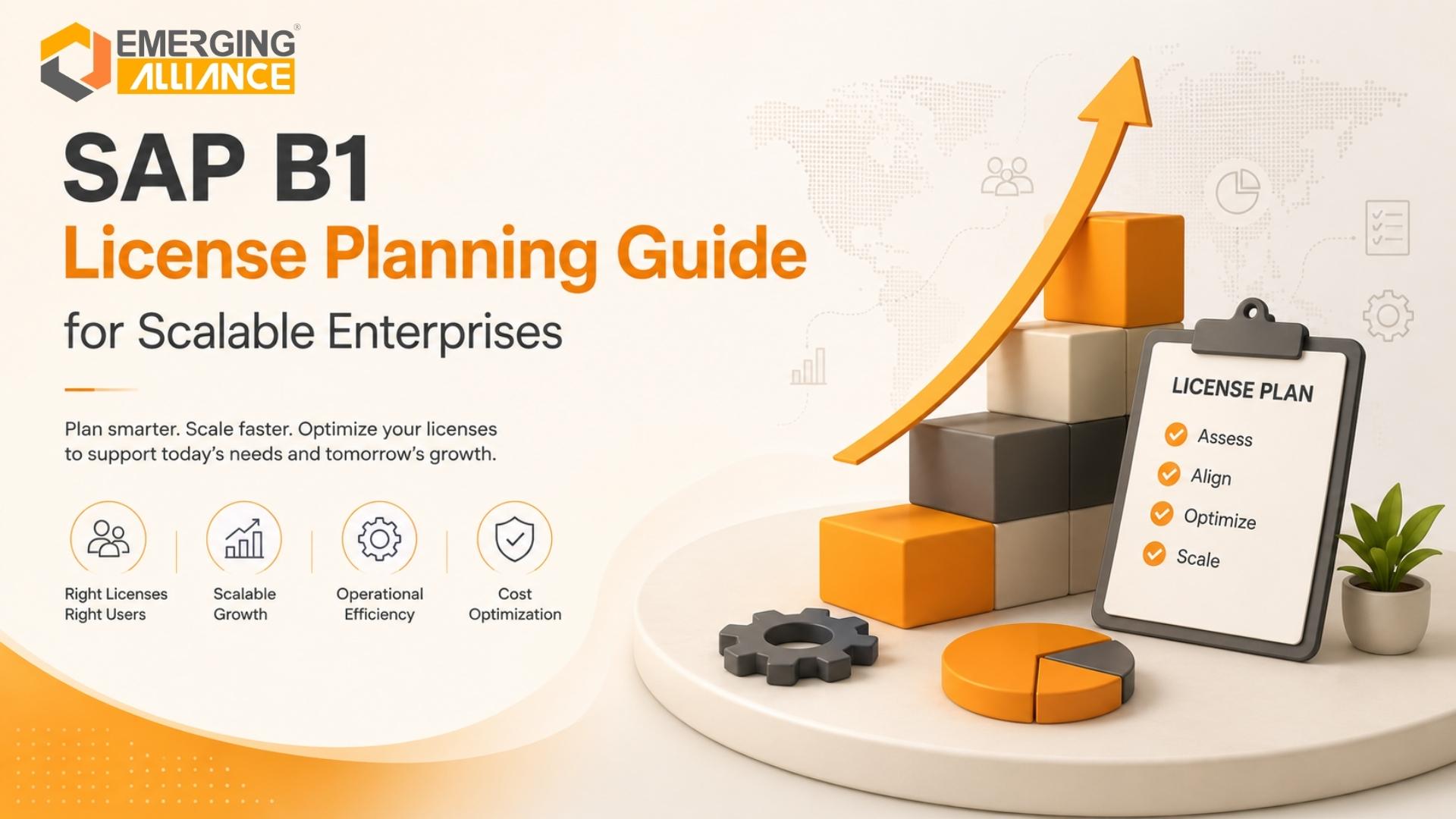
SAP B1 License Planning Guide for Scalable Enterprises

Build a Future-Ready SAP B1 License Strategy That Supports Growth Without Cost Spikes
Enterprise growth rarely fails because of technology limitations. It often slows down because organizations underestimate how quickly software licensing requirements evolve as teams expand, processes become more complex, and new business units come online. A poorly planned SAP B1 License strategy can create operational bottlenecks, unnecessary software expenses, compliance concerns, and delayed digital transformation initiatives. Many organizations focus only on current user requirements while ignoring future scalability, resulting in reactive license purchases, budget overruns, and fragmented ERP usage.
license planning is not simply an IT activity. It is a strategic business decision that directly impacts productivity, ROI, governance, and long-term enterprise growth.
This guide explains how organizations can build a scalable SAP Business One licensing strategy that supports expansion while maintaining cost control and operational efficiency.
Why SAP B1 License Planning Matters More Than SAP Business One Price
Many businesses evaluating SAP Business One price in India focus heavily on initial software investment. However, the larger challenge often emerges after implementation when user growth, process automation, and business expansion create new licensing demands.
Without a structured license roadmap, organizations frequently encounter:
- Unplanned SAP license cost increases
- Duplicate user allocations
- Underutilized licenses
- Department-level access restrictions
- Audit and compliance risks
- Delayed onboarding of new employees
- Reduced ERP adoption across business functions
The true objective is not finding the lowest SAP software price but maximizing business value from every license purchased.
A strategic licensing model aligns software investments with organizational growth plans, ensuring resources are available when needed without creating unnecessary expenditure.
Understanding SAP B1 Pricing and License Allocation for Growth
When organizations evaluate SAP B1 Pricing, they often underestimate how user roles impact licensing requirements.
Different employees require different levels of system access. Finance teams, operations managers, procurement professionals, warehouse personnel, and executives all interact with SAP Business One differently.
A scalable license structure should account for:
Current Operational Requirements
Identify who actively uses the system today and what functions they perform.
Future Workforce Expansion
Growth plans may require:
- Additional finance users
- New branch offices
- Manufacturing expansion
- Sales team growth
- Additional warehouse operations
Automation Initiatives
As businesses automate workflows, license usage patterns often change significantly.
Leadership Visibility Requirements
Executives increasingly require real-time dashboards, analytics, and reporting access, which should be considered during license planning.
Organizations that evaluate SAP B1 User License Cost alongside long-term business objectives typically achieve stronger ROI and better cost predictability.
Hidden Costs That Increase SAP License Cost in India
The biggest licensing challenge is often not the initial purchase but ongoing inefficiencies.
Many enterprises discover they are paying for more than they actually use.
Common causes include:
Inactive Users
Former employees, transferred staff, or temporary users may still retain active licenses.
Incorrect License Assignment
Premium access may be assigned to users who only require basic functionality.
Lack of Usage Visibility
Organizations often lack clear insights into actual system utilization.
Unplanned Expansion
Rapid growth can trigger urgent license purchases at unexpected times.
Poor Governance
Without periodic reviews, licensing structures become outdated and disconnected from business realities.
A proactive governance strategy helps control SAP license cost in India while ensuring operational continuity.
Businesses that regularly assess licensing utilization can often improve efficiency without disrupting ERP operations.
Building a Scalable License Strategy for Enterprise Expansion
A future-ready licensing framework should support both current operations and long-term growth objectives.
Align Licensing with Business Roadmaps
ERP licensing should reflect:
- Revenue growth targets
- Geographic expansion plans
- New business units
- Manufacturing scale-up initiatives
- Digital transformation projects
Create Role-Based Access Models
Rather than assigning licenses individually, create standardized role profiles for:
- Finance
- Procurement
- Sales
- Manufacturing
- Warehouse
- Executive Leadership
This improves governance and simplifies future scaling.
Forecast Growth Scenarios
Evaluate licensing needs based on:
- 12-month growth projections
- 24-month expansion plans
- Acquisition strategies
- New operational locations
Review Usage Regularly
Quarterly license reviews help identify:
- Underutilized licenses
- Access gaps
- Compliance concerns
- Optimization opportunities
Organizations that treat licensing as an ongoing strategic process avoid sudden cost spikes while maintaining business agility.
SAP Business One Pricing Should Support ROI, Not Just Cost Reduction
When evaluating SAP Business One Pricing, focusing exclusively on software cost can lead to poor decisions.
The real question should be:
Does the licensing model support business growth, operational efficiency, and decision-making?
An effective SAP Business One environment delivers value through:
- Faster reporting
- Improved operational visibility
- Reduced manual work
- Better inventory control
- Enhanced financial governance
- Streamlined approvals
- Stronger compliance management
A well-planned licensing strategy ensures these benefits scale alongside the business.
The most successful organizations evaluate SAP B1 Cost, implementation strategy, process maturity, and growth objectives together rather than treating licensing as a standalone procurement exercise.
This approach creates a stronger foundation for digital transformation and sustainable enterprise growth.
How Emerging Alliance Helps Enterprises Optimize SAP Business One License Investments
Licensing decisions impact much more than ERP access.
They influence operational performance, compliance readiness, user adoption, and future scalability.
At Emerging Alliance, we help organizations move beyond simple software procurement by aligning SAP Business One licensing strategies with business objectives.
Our approach includes:
- SAP B1 license assessment
- Usage analysis and optimization
- Growth-based license planning
- Role-based access strategy
- ERP roadmap consulting
- Cost optimization recommendations
- Scalable digital transformation planning
Whether you are implementing SAP Business One for the first time or optimizing an existing deployment, our experts help ensure your licensing strategy supports long-term business growth without unnecessary spending.
Ready to Build a Smarter SAP Business one License Strategy?
Speak with Emerging Alliance to evaluate your current licensing model, identify optimization opportunities, and develop a scalable roadmap aligned with your growth objectives.
FAQs About SAP Business One for License
1. How often should businesses review their SAP B1 licensing strategy?
Organizations should review their SAP B1 licensing strategy at least quarterly to ensure licenses align with current user requirements, business growth plans, and operational changes. Regular reviews help optimize costs, improve compliance, and support scalability.
2. How does SAP Business One price in India vary across industries?
Pricing varies based on user count, industry-specific requirements, integrations, customizations, and implementation scope.
3. What is included in SAP B1 implementation cost?
Implementation typically includes software setup, configuration, training, data migration, testing, and deployment services.
4. Can SAP Business One support enterprise growth without major licensing changes?
Yes. Proper license planning enables organizations to scale users, locations, and processes without significant disruption.
5. How can businesses reduce SAP license cost in India?
Regular license audits, role-based allocation, usage monitoring, and optimization reviews help control costs.
6. Does SAP Business One integrate with third-party applications?
Yes. SAP Business One supports integrations with CRM platforms, eCommerce systems, manufacturing applications, analytics tools, and business applications.
7. How does SAP Business One improve reporting and visibility?
The platform provides centralized data, real-time dashboards, automated reporting, and actionable business insights.
8. Is SAP Business One suitable for manufacturing and distribution companies?
Yes. It is widely used across manufacturing, distribution, retail, pharmaceutical, engineering, and service industries.
9. What compliance benefits does SAP Business One provide?
It helps improve audit readiness, financial governance, process control, reporting accuracy, and operational transparency.
10. What should organizations evaluate before migrating to SAP Business One?
Businesses should assess existing processes, scalability needs, data quality, integration requirements, licensing strategy, and long-term growth goals.
Book a consultation today and discover how a future-ready SAP Business One environment can drive operational efficiency, visibility, and enterprise scalability.