
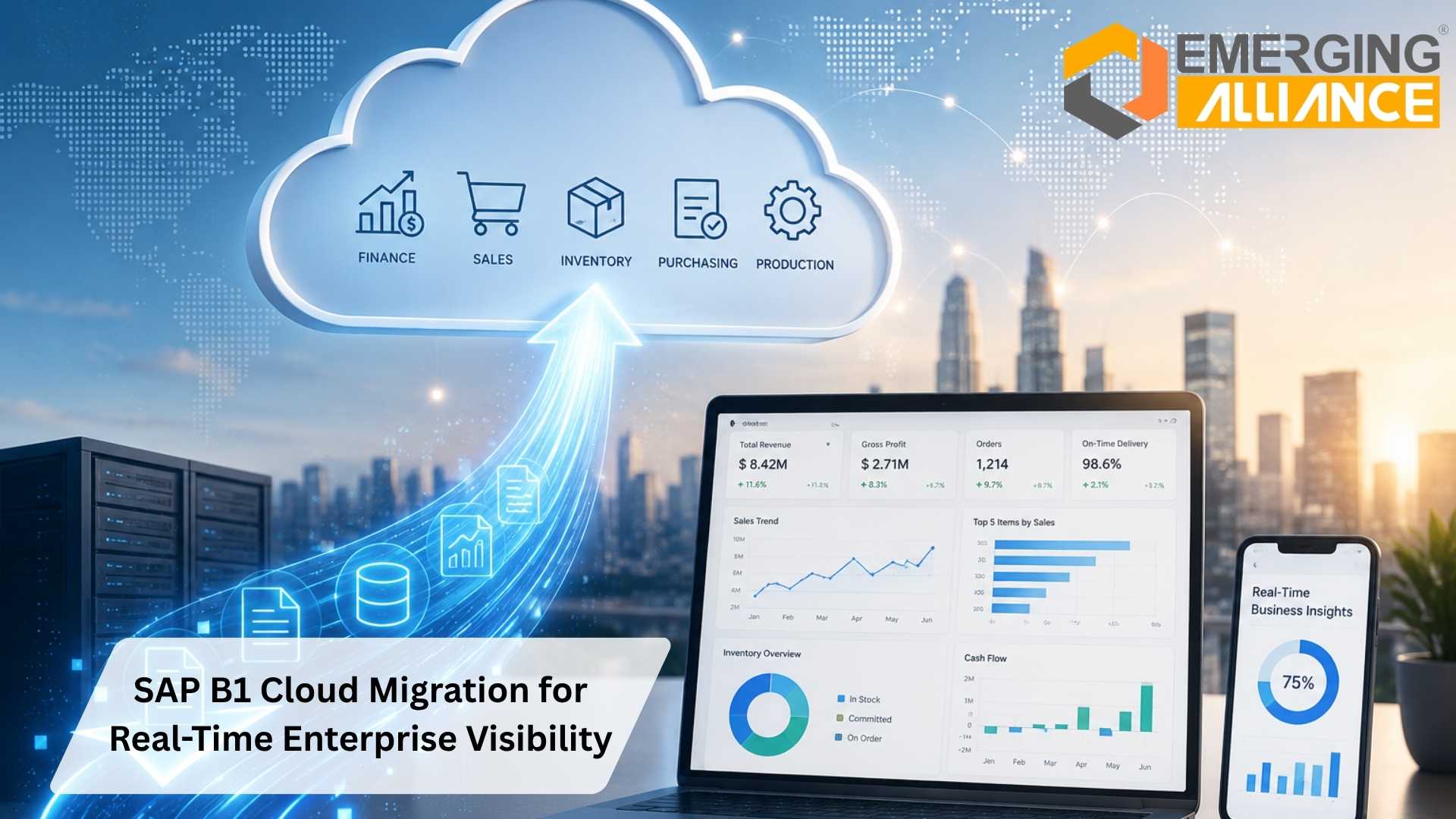
SAP B1 Cloud Migration for Real-Time Enterprise Visibility
Enable faster decisions through SAP B1 cloud migration insights
SAP B1 Cloud Migration is no longer just an infrastructure upgrade. For modern enterprises, it has become a strategic requirement for operational visibility, scalability, automation, and decision velocity.
Many organizations still operate SAP Business One in fragmented on-premise environments that were originally designed for stability—not agility. Over time, these systems create hidden inefficiencies across finance, inventory, procurement, sales, and operational reporting.
Executives begin noticing the symptoms gradually:
- Delayed business reporting
- Limited remote access visibility
- Workflow bottlenecks across branches
- Increasing infrastructure maintenance costs
- Data synchronization challenges
- Slow decision-making during critical business events
- Difficulty scaling operations across regions
The issue is rarely the ERP itself. The issue is the environment surrounding it.
As enterprises grow, operational complexity increases faster than traditional infrastructure can support. This creates visibility gaps that directly affect profitability, customer responsiveness, compliance readiness, and enterprise scalability.
This is where a structured SAP Business One Cloud migration strategy becomes a business transformation initiative rather than a technical migration project.
Current Industry Challenge: Visibility Without Agility
Modern enterprises operate in environments where leadership teams require real-time access to operational intelligence.
Finance teams need live cash flow visibility.
Operations teams need inventory transparency.
Sales leaders need forecasting accuracy.
Management requires consolidated reporting across locations.
However, many legacy ERP environments continue to rely on:
- Local server dependency
- Manual backup management
- Limited mobile accessibility
- Delayed synchronization between departments
- Infrastructure scalability limitations
- High dependency on internal IT teams
In rapidly growing businesses, these limitations create enterprise-wide friction.
A manufacturing organization running multiple warehouses may struggle with delayed stock visibility between locations. A distribution company may face reporting inconsistencies due to disconnected operational workflows. A multi-branch enterprise may experience performance degradation during peak operational periods.
The result is not just inefficiency—it is delayed business execution.
Hidden Operational Risks in Traditional ERP Infrastructure
Revenue Leakage Through Delayed Visibility
When leadership teams do not have access to real-time operational intelligence, small inefficiencies compound into larger financial problems.
Inventory inaccuracies lead to overstocking or stockouts.
Procurement delays affect production timelines.
Financial reconciliation becomes reactive instead of controlled.
Customer service teams operate with incomplete information.
These issues rarely appear as “system failures.” Instead, they silently reduce operational efficiency and profitability over time.
Compliance and Business Continuity Risks
Traditional infrastructure environments also increase exposure to operational disruption.
Many organizations still rely on localized backup processes, inconsistent disaster recovery planning, and aging server infrastructure. As compliance expectations increase across industries, infrastructure resilience becomes a board-level concern.
Without a modern cloud-based SAP Business One environment, businesses often struggle with:
- Audit readiness
- Data security governance
- Controlled user access management
- Secure remote operations
- Business continuity planning
For growing enterprises, infrastructure instability can directly affect customer trust and operational reliability.
Why Traditional Systems Fail Modern Enterprise Growth
On-Premise ERP Was Not Designed for Modern Scalability
Legacy ERP infrastructure often performs adequately during early growth stages. The problem emerges when operational scale increases.
As enterprises expand across locations, users, business units, and workflows, on-premise systems begin introducing constraints such as:
Infrastructure Bottlenecks
Server limitations affect system responsiveness, reporting speed, and concurrent user performance.
High IT Dependency
Internal teams spend excessive time managing infrastructure instead of enabling strategic innovation.
Limited Workforce Mobility
Modern leadership teams require access to business intelligence from anywhere. Traditional systems restrict operational flexibility.
Delayed Decision Cycles
When reporting is delayed, leadership decisions become reactive instead of predictive.
This directly impacts operational agility in competitive markets.
How SAP Business One Cloud Migration Solves the Problem
SAP Business One Cloud Enables Real-Time Enterprise Control
A properly structured SAP Business One Cloud migration transforms ERP from a static operational system into a real-time business intelligence layer.
Instead of relying on localized infrastructure, enterprises gain access to a scalable and secure cloud ERP solution that supports visibility, automation, and operational continuity.
With SAP Business One Cloud hosting, organizations can centralize operations across departments while improving accessibility, system performance, and reporting responsiveness.
Unified Enterprise Visibility
A cloud-enabled ERP environment provides leadership with centralized operational intelligence across:
- Finance
- Procurement
- Inventory
- Sales
- Service
- Production
- Distribution
Executives no longer wait for fragmented reports from different departments. Information becomes available in real time, enabling faster business decisions.
Business Process Automation
Modern enterprises increasingly depend on automation to reduce operational friction.
A structured SAP B1 cloud migration initiative allows organizations to automate workflows such as:
- Approval management
- Inventory synchronization
- Procurement routing
- Financial reporting
- Order processing
- Customer communication workflows
This reduces manual dependency while improving operational consistency.
Secure Cloud Infrastructure for Enterprise Continuity
A professionally managed SAP Business One Cloud hosting provider environment improves resilience through:
- Secure data management
- Automated backups
- Disaster recovery planning
- Controlled access governance
- Performance monitoring
- Infrastructure scalability
For enterprises operating across multiple locations, this creates a more reliable and future-ready ERP ecosystem.
Key Business Benefits of SAP B1 Cloud Migration
Faster Decision-Making
Leadership teams gain immediate access to operational data, enabling faster responses to market changes and business risks.
Improved Scalability
Cloud infrastructure supports enterprise growth without repeated hardware investments or infrastructure redesign.
Reduced Operational Complexity
Internal IT teams can focus more on innovation initiatives rather than infrastructure maintenance.
Enhanced Remote Accessibility
Executives, managers, and operational teams can securely access ERP intelligence from anywhere.
Better Workflow Visibility
Departments operate with synchronized information, reducing communication gaps and reporting inconsistencies.
Stronger Operational Resilience
Cloud-enabled ERP environments improve business continuity and reduce infrastructure-related operational disruptions.
ROI & Operational Impact of ERP Cloud Migration
The ROI from ERP cloud migration is rarely limited to infrastructure savings alone.
The larger impact comes from operational acceleration.
Organizations typically experience measurable improvements in:
- Reporting speed
- Operational coordination
- User productivity
- Approval cycle efficiency
- Data accessibility
- Cross-functional collaboration
- Infrastructure predictability
For finance leaders, this creates better visibility into enterprise performance.
For operations leaders, it improves execution consistency.
For CEOs and CIOs, it enables a scalable digital transformation foundation.
More importantly, cloud ERP modernization helps enterprises transition from reactive management to predictive operational control.
What Makes Emerging Alliance the Right Enterprise Technology Partner
At Emerging Alliance, SAP transformation is approached as a long-term operational strategy—not a one-time technical deployment.
As an experienced SAP ecosystem partner, Emerging Alliance helps enterprises align ERP modernization initiatives with business scalability, operational visibility, and automation goals.
Our approach focuses on:
- Business process alignment
- Infrastructure modernization
- Migration risk reduction
- Operational continuity
- Cloud optimization strategy
- Workflow automation enablement
- Enterprise scalability planning
Rather than simply moving systems to the cloud, we help organizations create a modern ERP operating model designed for long-term enterprise growth.
Whether businesses are planning SAP B1 on-premise to cloud transformation, infrastructure modernization, or enterprise-wide operational optimization, Emerging Alliance provides strategic guidance built around measurable business outcomes.
The Future of Enterprise ERP Is Real-Time, Connected, and Scalable
Enterprises cannot achieve modern operational agility using outdated infrastructure models.
As business complexity increases, leadership teams require ERP environments capable of supporting:
- Real-time visibility
- Secure remote operations
- Automation
- Enterprise scalability
- Faster decision-making
- Continuous operational intelligence
This is why SAP Business One Cloud migration has become a strategic priority for organizations focused on operational resilience and long-term growth.
The question is no longer whether cloud ERP modernization is necessary.
The real question is whether existing infrastructure can continue supporting enterprise growth without creating operational limitations.
FAQs About SAP Business One for Cloud migration
1. How does SAP Business One Cloud migration support real-time reporting?
A cloud-enabled SAP Business One environment provides faster access to centralized business data, allowing leadership teams to monitor finance, inventory, sales, and operational performance in real time.
2. Why are enterprises moving from on-premise ERP to SAP Business One Cloud?
Many enterprises are shifting to SAP Business One Cloud to reduce infrastructure dependency, improve remote accessibility, strengthen business continuity, and support long-term digital transformation initiatives.
3. Can SAP Business One Cloud hosting improve operational efficiency?
Yes. SAP Business One Cloud hosting helps streamline workflows, reduce manual intervention, improve system accessibility, and support better coordination between departments.
4. Is SAP B1 cloud migration suitable for growing mid-sized enterprises?
SAP B1 cloud migration is highly suitable for growing enterprises that require scalable infrastructure, centralized visibility, and flexible ERP access across multiple users and locations.
5. How does cloud-based SAP Business One help remote teams?
Cloud-based SAP Business One enables secure access to ERP data from anywhere, helping finance teams, management, sales teams, and operations leaders work more efficiently across distributed environments.
6. What business risks can SAP Business One Cloud migration reduce?
A structured migration strategy can reduce risks related to server downtime, data loss, limited reporting visibility, infrastructure failures, and operational disruptions.
7. Does SAP Business One Cloud support enterprise automation initiatives?
Yes. SAP Business One Cloud supports workflow automation across approvals, procurement, inventory movement, financial reporting, and operational processes.
8. How long does a typical SAP Business One Cloud migration take?
Migration timelines vary based on infrastructure complexity, integrations, user count, data volume, and customization requirements. A proper assessment helps define a realistic migration roadmap.
9. Can SAP Business One Cloud integrate with existing business applications?
Yes. SAP Business One Cloud can integrate with CRM systems, ecommerce platforms, analytics tools, warehouse applications, and other enterprise software environments.
10. Why should enterprises work with an SAP Partner for cloud migration?
An experienced SAP Partner helps enterprises reduce migration risks, optimize ERP performance, align workflows with business goals, and build a scalable cloud transformation strategy.