


Facility Management Challenges: SAP Business One for Better Operational Control
Quick Answer: How SAP Business One Supports Facility Management
SAP Business One can support facility management by connecting relevant inventory, purchasing, financial transactions, supplier records and management reporting in one ERP environment. Businesses can use this connected information to improve visibility into facility-related spending, monitor spare-parts availability, coordinate procurement and understand the financial impact of operational activities.
However, SAP Business One is not a dedicated computerized maintenance management system (CMMS). Advanced preventive maintenance scheduling, work orders and equipment servicing may require additional functionality, an industry-specific add-on or integration with a maintenance platform.
For organizations managing multiple facilities, equipment inventories, maintenance suppliers and recurring operational expenses, the right ERP configuration can help establish more consistent processes and better-informed management decisions.
Facility Management Challenges That Disrupt Operational Control
Facility management involves more than maintaining buildings and arranging repairs. It includes coordinating equipment, consumables, service providers, procurement, budgets and operational records. When these activities operate through disconnected spreadsheets, email conversations and separate applications, management may struggle to establish an accurate view of costs and resource availability.
Disconnected Inventory and Spare-Parts Records
Facility teams often depend on spare parts, maintenance materials, cleaning supplies, safety equipment and other operational consumables. If inventory records are maintained separately across locations, employees may not know which items are available, where they are stored or whether replenishment is required.
These gaps can lead to unnecessary purchases, delayed repairs, excess stock and unreliable inventory valuations.
An ERP-connected inventory process can improve visibility into recorded stock balances, receipts, issues and purchasing activity. Actual functionality depends on the selected SAP Business One configuration and any supporting warehouse or maintenance application.
Limited Visibility into Facility Maintenance Costs
Facility expenditure can include replacement components, contractor services, equipment-related purchases, utilities and other operating expenses. When costs are recorded inconsistently or allocated to the wrong department, managers may find it difficult to understand spending patterns.
Without reliable financial information, budget reviews become reactive. Management may identify overspending only after expenses have accumulated, rather than investigating cost variances while corrective action is still possible.
Delays in Procurement and Supplier Coordination
Facility operations frequently depend on external service providers and suppliers. Delays in approvals, purchase orders, deliveries or invoice processing can affect service continuity and increase administrative workload.
A connected procurement process can help teams track purchasing documents and related financial transactions. It does not automatically eliminate supplier delays, but it can improve process visibility and accountability.
Incomplete Equipment and Asset Information
Equipment details may be scattered across maintenance logs, invoices, spreadsheets and departmental systems. This makes it difficult to connect an asset’s purchasing history with its associated expenditure or supporting records.
Businesses need to establish which asset information is maintained in SAP Business One, which activities require configuration, and whether specialist asset or maintenance software is necessary.
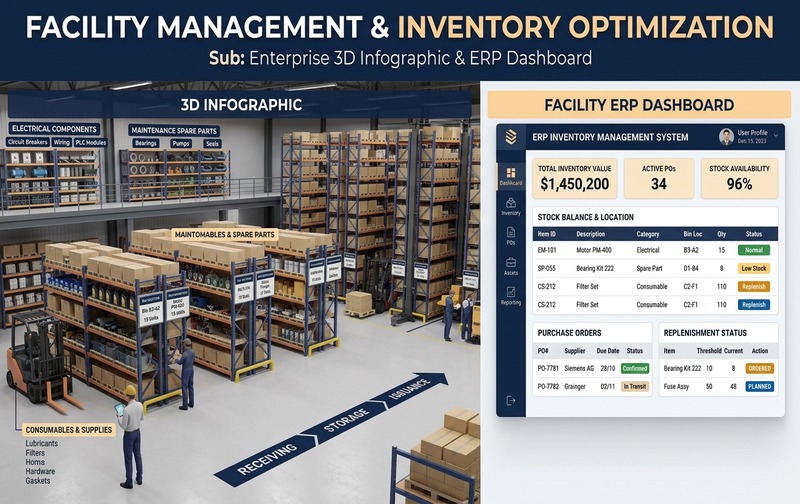
Facility inventory and spare parts visibility: Structuring maintenance consumables, replacement components, and procurement replenishment in SAP Business One prevents stockouts and costly repair delays.
SAP Business One for Facility-Related Inventory and Procurement
Inventory and purchasing are important areas where an ERP system can support better facility operations. SAP Business One provides inventory management and purchasing capabilities that businesses can configure to support relevant operational requirements.
Improve Visibility into Facility Inventory
Businesses can use appropriate item records, warehouse structures and inventory transactions to organize facility-related materials. This can help authorized users review recorded stock quantities, inventory movements and purchasing requirements.
For example, a company managing a manufacturing site may maintain separate inventory records for electrical components, replacement parts, cleaning materials and safety supplies. Suitable item categorization and warehouse processes can make those records easier to review.
The design should reflect actual operating requirements. Companies should not assume that a standard ERP inventory record automatically provides maintenance-specific information such as equipment compatibility, service intervals or technician work history.
Connect Replenishment with Purchasing
When a required item is unavailable, employees may need to identify a supplier, request purchasing approval, create a purchase order and confirm receipt.
Connecting relevant inventory and purchasing processes can reduce the need to reconstruct transaction histories from multiple spreadsheets. It also helps finance and operations teams work from consistent purchasing records.
Businesses should validate the required approval rules, replenishment logic and any integrations during implementation.
Strengthen Purchasing Accountability
A documented purchasing process helps management understand what was requested, what was ordered and what was received or invoiced. Supplier records and purchasing documents can support this visibility when configured and used consistently.
The objective is not simply to digitize paperwork. It is to establish a traceable process that makes procurement activity easier to review and helps teams identify recurring delays or unnecessary expenditure.
Equipment and Asset Tracking Across Facility Operations
Equipment visibility is another important consideration when evaluating SAP Business One for facility management.
Businesses may need to maintain information about production equipment, building systems, electrical assets, material-handling equipment and other operational resources. The information required will vary according to asset criticality, regulatory obligations and maintenance complexity.
Establish Consistent Equipment Records
A defined asset-information process should identify each relevant asset, its location, responsible department and supporting documentation. Depending on the solution design, additional information may be maintained through SAP Business One extensions or an integrated asset management application.
A practical implementation should answer three questions:
- Which equipment records must be maintained in the ERP?
- Which application will store maintenance history, inspection results and service schedules?
- How will asset-related costs and transactions be connected to financial reporting?
Answering these questions prevents businesses from assuming that general ERP records automatically provide a complete equipment lifecycle management system.
Connect Asset Information with Financial Records
When equipment purchases, related invoices and other expenses are recorded through connected financial processes, authorized users can establish a clearer view of relevant expenditure.
However, financial reporting for fixed assets, depreciation, maintenance costs and capital expenditure requires appropriate accounting policies and configuration. These categories should not be treated as interchangeable.
Finance teams should work with the implementation partner to define asset accounting requirements, cost allocation rules and reporting responsibilities.
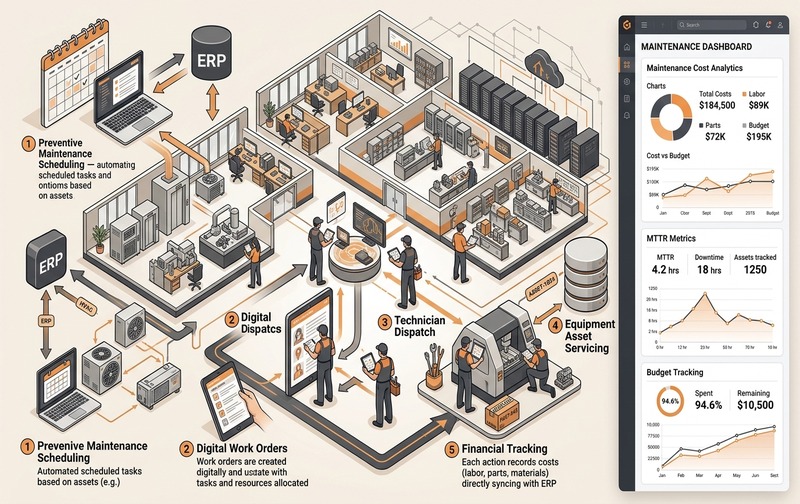
Coordinating maintenance planning with ERP financials: Connecting work orders, contractor services, and asset maintenance history with SAP Business One ensures complete cost visibility and budget control.
Maintenance Planning, Work Orders and ERP Integration
Maintenance management often requires more specialized functionality than inventory and purchasing alone.
Preventive maintenance schedules, technician assignments, service-level tracking, inspection checklists, work orders and equipment downtime records may require a dedicated maintenance platform or an SAP Business One add-on.
Coordinate Maintenance Activities with ERP Processes
An integrated solution can connect maintenance-related requirements with inventory, purchasing and financial processes. For example, a maintenance team may identify a requirement for replacement parts, while the ERP supports the corresponding purchasing and inventory transactions.
A well-designed workflow can help teams coordinate material availability, purchasing activity and financial records without maintaining every transaction in separate systems.
The exact workflow depends on the integration architecture and the functionality of the maintenance application.
Evaluate Integration Requirements Before Implementation
Before selecting an approach, businesses should document the maintenance activities that need digital support.
These may include preventive maintenance scheduling, corrective maintenance requests, work-order assignment, technician records, service history, inspection documentation and downtime reporting.
The implementation team should then classify each requirement as:
- Supported by standard SAP Business One functionality.
- Available through configuration or an approved add-on.
- Dependent on a third-party maintenance application or custom integration.
This assessment is essential for setting realistic budgets, timelines and functional expectations.
Facility Management Workflows Across Finance, Operations and Procurement
Facility management improves when teams agree on how information moves between departments.
Consider a facility that requires a replacement component for critical equipment. The maintenance team identifies the requirement, checks availability and requests replenishment. Purchasing coordinates the order, the warehouse records the receipt, and finance processes the related financial documents.
A connected ERP workflow can help authorized users trace relevant inventory and purchasing transactions. If maintenance software is integrated, the workflow may also connect the component requirement with a service request or work order.
The intended outcome is better coordination and more consistent records, not the assumption that every step happens automatically.
Before implementation, document process ownership, required approvals, exception handling and the information each department needs. This reduces ambiguity and helps prevent manual workarounds from undermining the system.
Facility Maintenance Costs and Financial Reporting in SAP Business One
Facility managers and finance leaders need more than transaction records. They need information that supports spending reviews, budget decisions and operational planning.
SAP Business One can support relevant financial visibility through its accounting, purchasing and reporting capabilities when transactions are recorded consistently and the required reporting structures are configured.
Improve Facility Expense Visibility
Businesses should define how facility-related costs will be identified and reviewed. Depending on their accounting design, this may involve suitable expense accounts, departments, cost centers, projects or other reporting dimensions.
A consistent structure helps management distinguish routine operating expenditure from capital investments and other financial categories.
The reporting model should reflect the company’s accounting policies rather than rely on informal spreadsheet classifications.
Monitor Budget Variances
Budget-versus-actual reporting can help managers identify differences between planned expenditure and recorded spending when budgets and transactions are structured appropriately.
A useful review should examine the size of the variance, the reason behind it, the affected facility or department and the action required.
ERP reporting provides information for investigation; it does not independently determine whether a variance is justified or prevent overspending without appropriate controls.
Build Actionable Facility Management KPIs
Businesses can use operational and financial data to develop indicators suited to their processes. Examples include:
- Maintenance cost variance: Actual maintenance expenditure minus budgeted maintenance expenditure.
- Inventory stockout rate: Number of relevant demand events that could not be fulfilled from available stock divided by total demand events, multiplied by 100.
- Preventive maintenance compliance: Preventive maintenance activities completed on time divided by activities scheduled, multiplied by 100.
- Mean time to repair (MTTR): Total repair time divided by the number of completed repairs.
- Procurement cycle time: Elapsed time between a defined purchasing request milestone and the selected completion milestone.
| KPI | Formula & Calculation Basis | Operational Value |
|---|---|---|
| Maintenance cost variance | Actual maintenance expenditure minus budgeted maintenance expenditure. | Highlights spending variances and overruns before budgets are exhausted. |
| Inventory stockout rate | Number of relevant demand events that could not be fulfilled from available stock divided by total demand events, multiplied by 100. | Assesses spare-parts availability to prevent critical repair and service stoppages. |
| Preventive maintenance compliance | Preventive maintenance activities completed on time divided by activities scheduled, multiplied by 100. | Measures equipment servicing discipline and protects operational uptime. |
| Mean time to repair (MTTR) | Total repair time divided by the number of completed repairs. | Evaluates maintenance efficiency and operational recovery speed. |
| Procurement cycle time | Elapsed time between a defined purchasing request milestone and the selected completion milestone. | Tracks purchasing bottlenecks and measures supplier fulfillment performance. |
These KPIs require reliable source data. Preventive maintenance compliance and MTTR, for example, normally depend on maintenance schedules and work-order records that may reside outside standard SAP Business One.
Management should define each metric consistently before using it to compare facilities or evaluate performance.
SAP Business One vs. Dedicated Facility Maintenance Software
SAP Business One and dedicated facility maintenance software serve different primary purposes. The appropriate choice depends on the company’s operational complexity and functional requirements.
| Evaluation area | SAP Business One | Dedicated maintenance platform |
|---|---|---|
| Financial transactions and accounting | Core ERP capability | Depends on the product and integrations |
| Inventory and purchasing | Core ERP capabilities | May offer specialized maintenance inventory workflows |
| Supplier and purchasing records | ERP purchasing processes | Depends on integration and product scope |
| Preventive maintenance schedules | May require an add-on or integration | Often a central capability |
| Work orders and technician assignments | Depends on solution design | Often a central capability |
| Consolidated financial reporting | ERP accounting and reporting | May require integration with an ERP |
| Equipment servicing history | Depends on configuration or connected applications | Often a central capability |
This comparison is a general evaluation framework, not a guarantee of functionality in every product edition or implementation.
For companies that need strong financial and purchasing controls alongside specialist maintenance workflows, an integrated approach may be appropriate. Businesses with complex inspections, technician scheduling, service-level agreements or high volumes of maintenance work should evaluate dedicated functionality carefully.
Implementation Requirements for Facility Management with SAP Business One
A successful implementation starts with process requirements rather than a predetermined feature list.
An implementation partner should provide a scope that identifies deliverables, assumptions, integration dependencies and ongoing support requirements.
Measuring Facility Management Performance with ERP Data
After deployment, management should evaluate whether the new process improves visibility and decision-making.
Useful measures may include inventory accuracy, stockout frequency, purchasing cycle time, facility expense variance, reporting delays and the percentage of transactions processed through the defined workflow.
Where maintenance software is integrated, businesses can also assess on-time preventive maintenance, equipment downtime and repair performance.
Establish a baseline before implementation and compare results after users have adopted the new processes. Interpret changes alongside operational conditions, data quality and other business initiatives rather than attributing every improvement to the ERP alone.
Is SAP Business One the Right Fit for Your Facility Management Requirements?
SAP Business One may be suitable for organizations seeking to connect facility-related inventory, purchasing, financial records and management reporting within a broader ERP environment.
Its suitability depends on the level of maintenance functionality required, the complexity of the company’s facilities, integration needs, reporting expectations and existing systems.
Businesses should evaluate the complete workflow rather than assume that an ERP implementation alone will provide every capability found in specialist facility management software.
A structured assessment should establish the required functionality, the standard ERP capabilities that can support it, the additional components needed and the expected implementation effort.
Conclusion: Improve Facility Management Through Connected ERP Processes
Disconnected inventory records, fragmented purchasing workflows and limited cost visibility can make facility operations difficult to manage. SAP Business One can help address relevant information gaps by connecting inventory, purchasing, accounting and reporting processes.
The best results depend on appropriate configuration, reliable data, clear process ownership and a realistic assessment of maintenance requirements. Where specialist scheduling, work orders or equipment servicing are necessary, businesses should evaluate suitable add-ons and integrations.
The priority is to build an operational model that gives facility, procurement and finance teams reliable information for day-to-day decisions while supporting management’s financial and operational objectives.
Frequently Asked Questions
Evaluate SAP Business One for Facility Management
Improve visibility into inventory, purchasing, and facility costs with SAP Business One.
Request a SAP Business One Demo to evaluate the right ERP solution for your operational needs.