

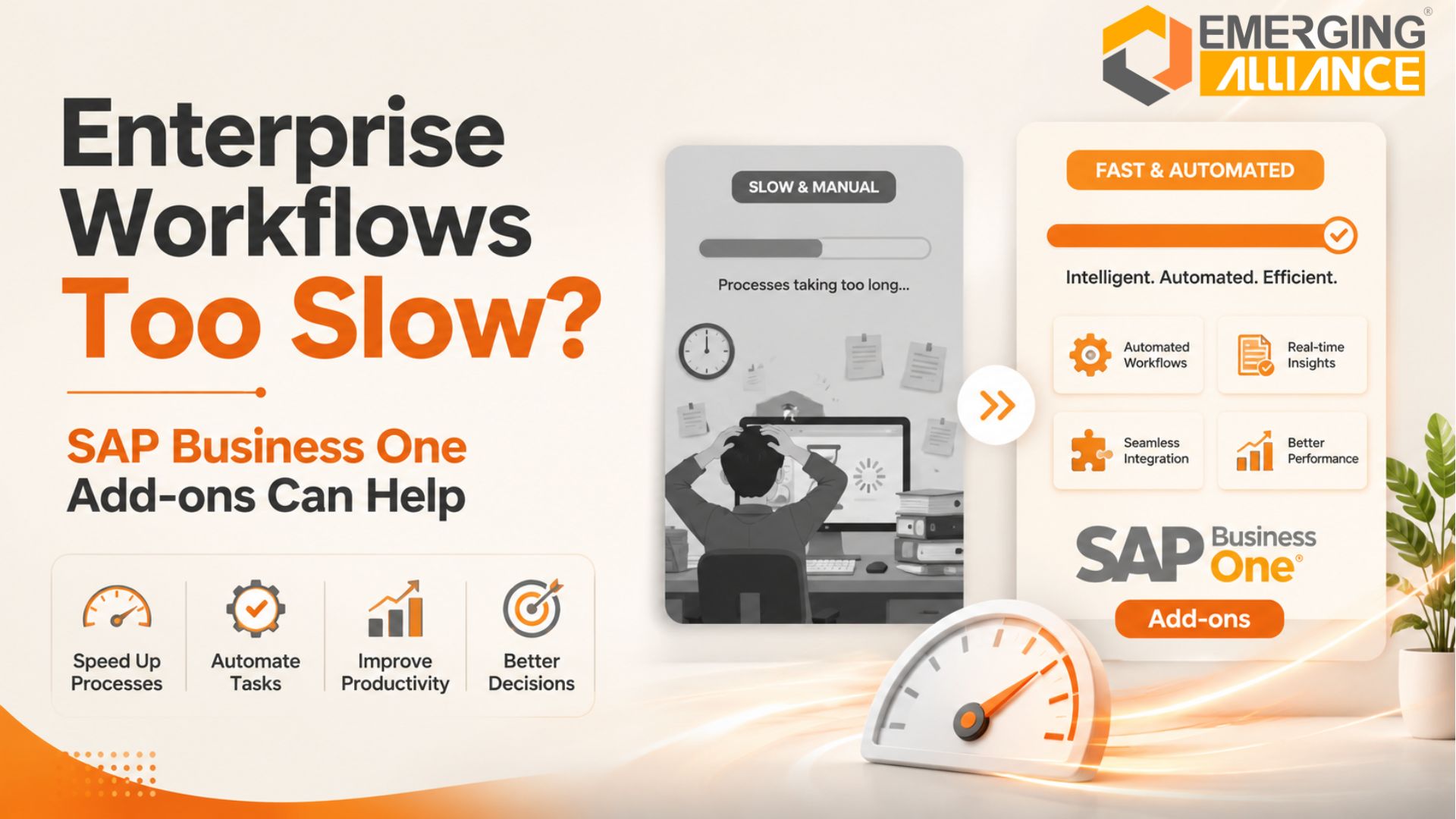
Enterprise Workflows Too Slow? SAP Business One Add-ons Can Help
SAP Business One Add-ons reduce manual work, improve reporting, and automate business processes.
Most organizations invest in SAP Business One to streamline operations and improve visibility. Initially, these goals are achieved—data becomes centralized, processes are more controlled, and teams operate more efficiently.
However, as the business grows, new challenges begin to surface.
Approval processes become more complex, teams rely on spreadsheets to fill reporting gaps, and manual work starts creeping back into daily operations. Over time, these small inefficiencies create delays, reduce visibility, and slow decision-making.
At this stage, the issue is rarely the ERP itself. Instead, it’s the gap between evolving business needs and how workflows are supported.
This is where SAP Business One Add-ons play a critical role—helping organizations extend their ERP to support modern processes, eliminate inefficiencies, and maintain operational agility.
SAP Business One Add-ons Eliminate Workflow Gaps Beyond Core ERP
Business growth rarely follows the original ERP blueprint. As organizations expand into new markets, introduce additional products, or add more people and departments, operational complexity increases much faster than standardized processes. What once worked efficiently for a smaller organization gradually becomes difficult to manage at scale.
This is why many companies experience workflow delays even after successfully implementing SAP Business One. The ERP continues to process transactions as expected, but the activities surrounding those transactions become increasingly fragmented. Approvals move through email instead of structured workflows. Reports are prepared manually because information exists across multiple sources. Employees re-enter the same data into different systems simply to keep operations moving.
Individually, these workarounds seem manageable. Collectively, they create operational friction that affects every department.
Sales teams wait for approvals before confirming customer commitments. Procurement experiences delays because purchasing requests follow inconsistent processes. Finance spends valuable time validating information instead of analyzing performance. Leadership receives reports days after decisions should have been made, reducing the ability to respond quickly to changing business conditions.
These inefficiencies are often mistaken for ERP limitations. In reality, they are workflow limitations.
The challenge is not that SAP Business One lacks capability. The challenge is that business processes have evolved while operational workflows have remained largely unchanged. As a result, organizations continue relying on manual effort to bridge the gap between departments, systems, and decision-makers.
This hidden operational gap has a measurable business impact:
- Longer approval cycles that delay revenue and purchasing decisions
- Manual document creation that increases administrative effort
- Duplicate data entry that reduces information accuracy
- Spreadsheet-driven reporting that slows executive decision-making
- Limited process visibility across departments
- Greater compliance and operational risk caused by inconsistent workflows
Over time, these issues become more than operational inconveniences. They influence customer experience, employee productivity, governance, and ultimately profitability. Leaders find themselves investing more time resolving process issues than pursuing growth opportunities.
Recognizing this shift is important because it changes the solution. If the ERP remains fundamentally sound, replacing it offers limited value. The greater opportunity lies in strengthening the processes surrounding it.
That is precisely where a well-planned SAP B1 Add-ons Implementation becomes the next logical step. Rather than introducing another disconnected application, it extends SAP Business One with automated workflows, connected business processes, and greater operational visibility—allowing the ERP to evolve alongside the business instead of holding it back.
This establishes the narrative and naturally hands the reader to the next chapter:
SAP B1 Add-ons Implementation Connects People, Processes, and Data
From there, the story shifts from “why the problem exists” to “how organizations solve it,” without feeling like a new, disconnected topic.
SAP B1 Add-ons Implementation Connects People, Processes, and Data
Once organizations recognize that workflow inefficiencies exist outside the ERP rather than within it, the path forward becomes much clearer. The objective is no longer to replace SAP Business One but to remove the operational barriers that prevent it from delivering its full value.
This is where a strategic SAP B1 Add-ons Implementation makes a measurable difference. Instead of changing how the ERP works, it extends existing capabilities by connecting people, processes, and information into a single, streamlined workflow.
The impact becomes visible across the entire organization.
A purchase request no longer waits in an inbox for approval. Sales quotations follow predefined authorization rules without manual intervention. Customer documents are generated automatically from ERP data, eliminating repetitive administrative work and reducing the risk of errors. Managers receive notifications the moment action is required instead of discovering delays after they have already affected operations.
As each workflow becomes connected, the organization begins operating with greater consistency. Departments no longer depend on individual employees to move information from one stage to another. Instead, business rules drive every process, ensuring that approvals, documentation, and reporting follow the same standards across the organization.
This shift creates benefits that extend far beyond operational efficiency.
Automation That Strengthens Business Control
Organizations often associate automation with reducing manual effort. While that is an important outcome, the greater advantage lies in creating predictable and governed business processes.
High-impact automation typically includes:
- Sales quotation and order approval workflows
- Purchase requisition and procurement approvals
- Document generation and distribution
- Inventory movement and warehouse authorization
- Accounts payable and finance approvals
- Service request and customer support workflows
Each automated process removes unnecessary delays while improving accountability and process visibility. Managers know where every transaction stands, who is responsible for the next action, and whether any exceptions require attention.
Real-Time Visibility for Faster Decisions
Connected workflows also transform how information moves through the business. When data is captured once and shared automatically across departments, reporting becomes significantly more reliable.
Instead of consolidating spreadsheets from multiple teams, executives gain access to real-time dashboards that reflect current business performance. Finance closes reporting cycles faster. Operations identify bottlenecks before they disrupt production or customer commitments. Sales leaders monitor order progress without requesting manual updates from different departments.
This level of visibility enables faster, more confident decision-making because every department works from the same trusted source of information.
Perhaps more importantly, automation reduces dependency on individual knowledge. Business processes become institutionalized rather than employee-dependent, making the organization more resilient as teams grow and responsibilities change.
However, as businesses continue expanding, another challenge begins to emerge. While standard workflow automation solves many operational issues, every organization eventually develops unique processes shaped by its industry, customers, and competitive strategy. At that point, extending standard functionality is no longer enough. Businesses need solutions designed around the way they operate.
That is where a Custom SAP Business One Add-on becomes the next stage in the organization’s digital transformation journey.
Custom SAP Business One Add-on Solutions Adapt ERP to Your Business
By this stage, the business has already addressed many of its operational bottlenecks. Workflows move faster, approvals are automated, and reporting becomes more reliable. Yet another realization often follows. No two organizations operate in exactly the same way.
As businesses expand, they introduce unique products, serve different customer segments, enter new markets, and comply with industry-specific regulations. These changes create operational requirements that standard ERP functionality cannot always accommodate.
The objective is no longer to automate generic processes. It is to ensure the ERP reflects how the business actually operates.
This is where a Custom SAP Business One Add-on becomes a strategic advantage.
Rather than forcing teams to adapt their processes to software limitations, custom add-ons extend SAP Business One around the organization’s operational model. The ERP remains the central business platform, while specialized functionality supports the workflows that differentiate the business from its competitors.
For example, a manufacturing company may require multi-level production approvals and quality inspections before goods are released. A distribution business may need automated pricing, rebate calculations, or route-specific order processing. A project-based organization might depend on milestone billing, resource planning, and customer-specific approval workflows. These are not exceptional requirements—they are part of how modern businesses operate.
Supporting these processes within SAP Business One creates greater consistency across the organization. Employees no longer rely on external spreadsheets or disconnected applications to complete critical activities. Every transaction follows standardized business rules while remaining fully integrated with finance, inventory, procurement, sales, and customer data.
The business benefits extend well beyond process efficiency.
Organizations that invest in customized workflow capabilities often experience:
- Greater operational agility as business requirements evolve
- Higher user adoption because the ERP reflects real business processes
- Improved compliance through standardized and auditable workflows
- Better customer experiences driven by faster and more consistent execution
- Reduced dependence on manual workarounds and disconnected systems
Perhaps most importantly, customization protects long-term scalability. As the organization continues to grow, the ERP evolves alongside it instead of becoming a constraint that employees must work around.
At this point, the discussion shifts once again. Leadership is no longer evaluating whether SAP Business One Add-ons improve operations—they have already seen the strategic value. The remaining question is whether the investment delivers measurable business returns over the long term.
That changes the conversation from functionality to financial value, making SAP Business One Add-ons Pricing the next logical consideration in the decision-making process.
SAP Business One Add-ons Pricing Should Be Measured by Business Value, Not Software Cost
By the time organizations reach this stage, the discussion is no longer about whether SAP Business One Add-ons improve operations. The improvements are already evident through faster workflows, greater process visibility, and better decision-making. The real question now is whether the investment will continue delivering value as the business grows.
This is where many organizations make a critical mistake.
They compare SAP Business One Add-ons Pricing based solely on licensing or implementation costs. While upfront investment is important, it represents only a small part of the overall business case. The larger cost often comes from maintaining inefficient processes that continue to consume employee time, delay decisions, and create avoidable operational risks.
Every manual approval extends business cycle times. Every spreadsheet introduces the possibility of inconsistent data. Every disconnected workflow reduces visibility across departments. Individually, these issues appear manageable. Collectively, they increase operational costs every single day.
This is why successful organizations evaluate add-ons as business investments rather than software purchases.
Looking Beyond the Initial Investment
A strategic evaluation considers how the solution contributes to long-term operational performance instead of focusing only on implementation expenses.
Key evaluation criteria include:
- Reduction in manual administrative effort
- Faster approval and decision-making cycles
- Improved reporting accuracy and real-time visibility
- Scalability to support future business growth
- Compatibility with future SAP Business One upgrades
- Vendor expertise, implementation methodology, and long-term support
These factors provide a far more accurate picture of return on investment than software pricing alone.
Measuring ROI Through Business Outcomes
The value of an add-on should ultimately be reflected in measurable business improvements.
Leadership teams should assess questions such as:
- How much employee time will automation save each month?
- Which workflow bottlenecks will be eliminated?
- How quickly will management gain access to business-critical information?
- How will improved process consistency reduce compliance and operational risk?
- Can existing teams support higher business volumes without increasing headcount?
When evaluated this way, the conversation shifts away from software expenditure and toward business performance. Organizations gain a clearer understanding of how operational efficiency translates into lower costs, improved customer service, and stronger profitability over time.
This perspective also changes how implementation partners are selected. The right partner does more than deploy technology—they understand business processes, identify improvement opportunities, and recommend solutions that continue creating value long after implementation is complete.
Ultimately, the organizations that achieve the greatest return are not those that spend the least. They are the ones that invest strategically in solutions aligned with their long-term business objectives.
With the right implementation approach, customized workflows, and a clear focus on measurable business outcomes, SAP Business One evolves from an operational system into a platform for continuous business improvement. That is where the true value of SAP B1 Add-ons is realized.
This naturally sets up the final conclusion, where you’ll bring the story full circle by returning to the opening message:
“You didn’t invest in SAP Business One simply to digitize transactions—you invested to build a business that can scale efficiently.”
The conclusion will resolve the entire narrative rather than introducing any new ideas, giving the blog a strong executive finish.
SAP Business One Add-ons Turn ERP into a Platform for Continuous Business Growth
The journey often begins with a simple operational concern. Workflows take longer than expected. Approvals become increasingly complex. Reports require manual effort, and teams spend more time managing processes than moving the business forward.
Over time, those isolated challenges reveal a much larger issue. The ERP is no longer the constraint—the business processes surrounding it are.
That is why organizations achieve better outcomes by extending SAP Business One rather than replacing it. The right SAP Business One Add-ons remove operational friction, connect departments through automated workflows, and provide leadership with the visibility needed to make faster, more informed decisions.
As business complexity increases, these improvements become even more valuable. Standardized workflows improve governance, automation reduces repetitive work, and real-time information enables departments to respond quickly to changing business demands. Instead of constantly adapting to operational bottlenecks, teams can focus on serving customers, improving performance, and supporting growth.
More importantly, well-planned add-ons create an ERP environment that continues evolving with the organization. Whether expanding into new markets, introducing new product lines, or managing higher transaction volumes, businesses gain the flexibility to scale without increasing operational complexity.
For executive teams, this changes the role of SAP Business One. It is no longer viewed as a system that records business transactions after they happen. It becomes an intelligent operational platform that actively supports productivity, collaboration, compliance, and strategic decision-making.
Ultimately, the question is not whether your organization needs more software. The more important question is whether your existing ERP is fully supporting the way your business operates today—and whether it is ready to support where your business is going next.
Organizations that answer that question proactively are better positioned to improve efficiency, strengthen governance, and accelerate sustainable growth.
Frequently Asked Questions About SAP Business One Add-ons
1. Why do businesses invest in SAP Business One Add-ons?
Businesses invest in SAP Business One Add-ons to eliminate manual processes, improve productivity, automate workflows, and extend ERP functionality without replacing their existing SAP Business One system. Add-ons help organizations address specific operational challenges while maximizing the value of their ERP investment.
2. When should a business consider SAP B1 Add-ons Implementation?
Organizations should consider a SAP B1 Add-ons Implementation when manual approvals, spreadsheet-based reporting, repetitive data entry, or disconnected workflows begin slowing business operations. These are indicators that the ERP needs workflow enhancements rather than replacement.
3. Are Custom SAP Business One Add-on solutions necessary for every business?
Not always. Many businesses benefit from standard add-ons for workflow automation and reporting. However, organizations with industry-specific processes, regulatory requirements, or unique operational models often achieve greater value through a Custom SAP Business One Add-on tailored to their business needs.
4. How should SAP Business One Add-ons Pricing be evaluated?
Rather than focusing only on implementation costs, businesses should evaluate SAP Business One Add-ons Pricing based on long-term business value. Factors such as reduced manual effort, faster approvals, improved reporting accuracy, scalability, and operational efficiency provide a more meaningful measure of return on investment.
5. Which business functions benefit the most from SAP Business One Add-ons?
High-impact areas typically include sales approvals, procurement, inventory management, finance workflows, document automation, customer service, reporting, and compliance. The greatest value is achieved by automating processes that are repeated frequently and directly influence business performance.
6. Will SAP Business One Add-ons affect future ERP upgrades?
Well-designed add-ons developed using SAP best practices are built to remain compatible with future SAP Business One upgrades. Choosing an experienced implementation partner helps ensure long-term maintainability and minimizes upgrade risks.
7. How do SAP Business One Add-ons improve executive decision-making?
By automating workflows and providing real-time operational data, add-ons eliminate reporting delays and improve data consistency. This enables executives to make faster, more informed decisions based on accurate business information rather than manually consolidated reports.
8. How do I choose the right SAP Business One Add-ons partner?
Look beyond technical expertise. The right partner should understand your business processes, identify operational bottlenecks, recommend scalable solutions, and provide long-term support. The goal is not simply to implement software but to improve business performance through a well-planned digital transformation strategy.
9. Can SAP Business One Add-ons integrate with third-party business applications?
Yes. Many SAP Business One Add-ons can integrate seamlessly with third-party applications such as CRM platforms, eCommerce websites, payment gateways, logistics providers, HR systems, and business intelligence tools. These integrations improve data consistency, eliminate duplicate data entry, and create a more connected business ecosystem.
10. What are the key benefits of implementing SAP Business One Add-ons?
SAP Business One Add-ons help businesses streamline operations, reduce manual work, improve process accuracy, accelerate approvals, enhance reporting, strengthen regulatory compliance, and support business growth. By extending ERP capabilities, organizations can increase operational efficiency while adapting to evolving business requirements without major system changes.
Talk to our SAP Business One experts to discover how the right add-ons can unlock the full potential of your ERP investment.