
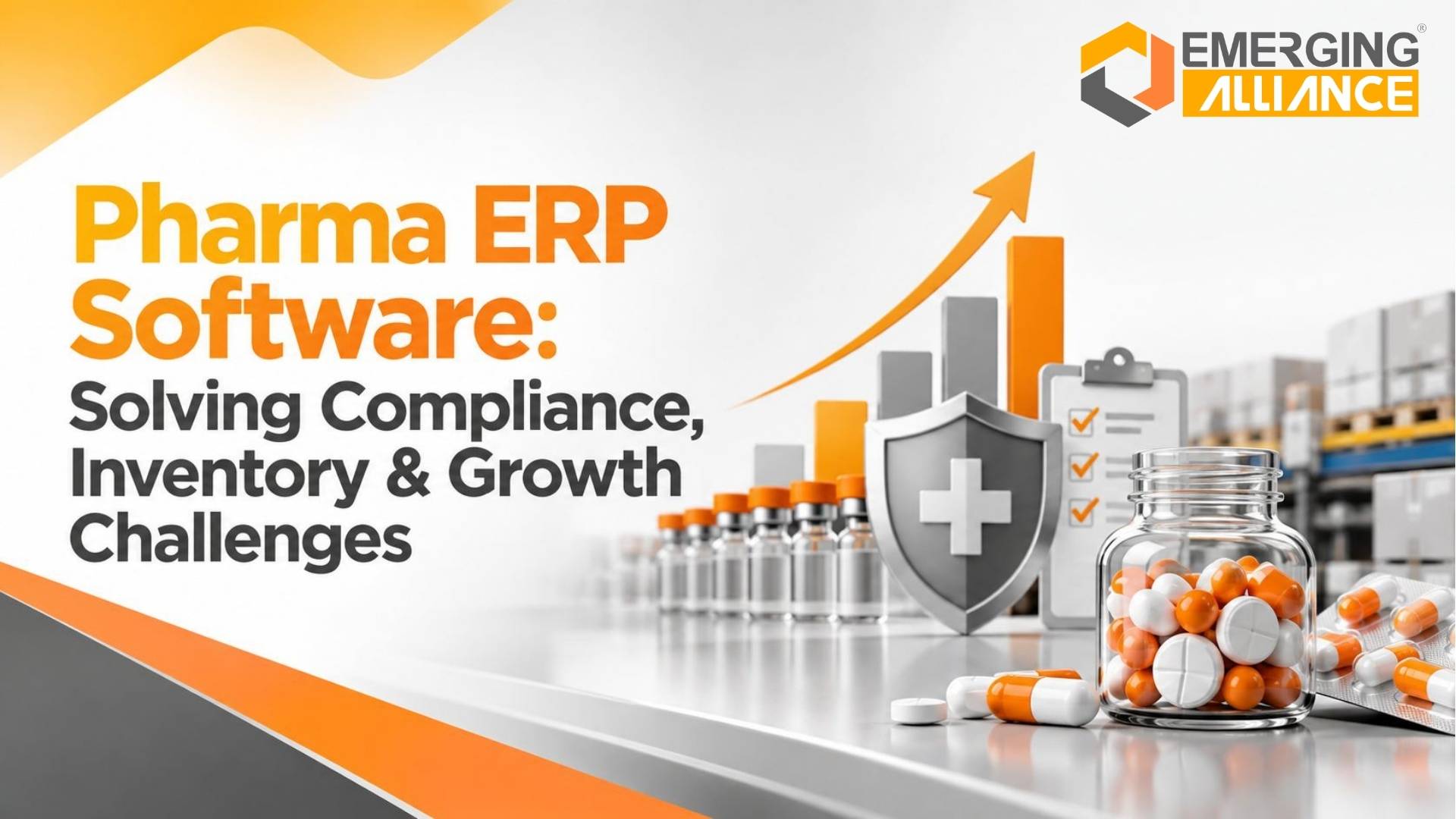
Pharma ERP Software: Solving Compliance, Inventory & Growth Challenges
Quick Answer
Pharma ERP software connects compliance controls, batch-level inventory, production, quality, finance, and reporting inside one operational system. For pharmaceutical manufacturers and distributors, the value is not simply automation. It is reducing the operational risk created when regulatory evidence, stock status, product traceability, production information, and growth decisions sit across disconnected systems.
The Cost of Delaying a Pharma ERP Decision
Pharmaceutical companies often delay ERP decisions because the business is still functioning. Orders are being processed. Production is moving. Finance is closing the books. Quality teams are maintaining records. Inventory is being tracked through ERP modules, warehouse applications, spreadsheets, and manual controls.
That apparent stability can be misleading.
The cost of delay rarely appears as one obvious failure. It accumulates across compliance, inventory, production, reporting, and management control.
A batch record that is difficult to reconcile becomes a compliance risk. A stock position that is inaccurate becomes a production-planning issue. A production delay becomes a customer-service problem. That customer-service problem eventually becomes a growth constraint.
This is why delaying a pharma ERP decision should not be viewed as postponing a software purchase. It is postponing the point at which operational risks are brought under one controlled transaction system.
For leadership teams, the important question is not whether the current process still works.
The better question is whether the current process will remain dependable as transaction volumes, product lines, warehouses, manufacturing locations, customers, distributors, and regulatory expectations increase.
The risk compounds in several ways.
First, compliance evidence becomes harder to assemble.
When batch information, quality records, inventory movements, commercial transactions, and financial documents sit in different places, employees spend increasing amounts of time proving what happened after the event.
That is very different from having the transaction history available by design.
Second, inventory becomes less trustworthy.
Pharmaceutical inventory is not simply a quantity of an item.
Every quantity may also carry a batch identity, expiry profile, warehouse location, quality status, supplier or production origin, and movement history. When these attributes are controlled through different tools, leadership may see stock on a report without having complete confidence that it can actually be used or dispatched.
Third, operational decisions slow down.
Purchasing waits for stock confirmation.
Production planning waits for material-status checks.
Quality teams verify records before release.
Finance reconciles operational reports against accounting entries.
Management waits for consolidated reporting before making decisions.
The business is operating, but a growing percentage of management effort is being spent validating information rather than acting on it.
Fourth, growth becomes more expensive.
Every additional plant, warehouse, product family, distributor, or geography adds transactions to an operating model that may already depend heavily on coordination between people.
The result is often additional spreadsheets, additional checking, additional approvals, and additional staff.
The underlying system weakness remains.
This is where ERP delay becomes strategic rather than technical.
A pharmaceutical company can continue expanding while using fragmented applications and manual controls. But each stage of growth increases the effort required to maintain visibility.
Eventually, the organization reaches a point where experienced employees are effectively acting as the integration layer between systems.
They know which spreadsheet contains the correct stock position.
They know which report requires manual adjustment.
They know which quality status must be checked before inventory can move.
They know which data must be reconciled before management receives its monthly report.
That knowledge is valuable, but it is not scalable infrastructure.
Pharma ERP software is intended to reverse this pattern.
Instead of adding another manual control whenever complexity increases, the company establishes a common transaction backbone across purchasing, inventory, production, sales, finance, approvals, reporting, and relevant quality touchpoints.
For CEOs, CTOs, COOs, and Operations Heads, the timing of that decision matters.
The right moment to evaluate ERP is not after a major compliance gap, inventory write-off, reconciliation failure, or reporting breakdown.
It is when the organization begins depending too heavily on people to keep disconnected processes synchronized.
Compliance, Inventory and Growth: The Three-Pillar Risk in Pharma

The Three-Pillar Risk in Pharma: How compliance, batch inventory control, and business growth depend on a shared transactional backbone.
Pharmaceutical operations can be viewed through three interconnected pillars: compliance, inventory, and growth.
Organizations frequently manage them as separate management priorities.
Quality teams focus on compliance.
Supply chain and warehouse teams focus on inventory.
Commercial teams and senior leadership focus on growth.
Operationally, however, the three are inseparable.
Compliance depends on accurate transaction history.
Inventory depends on accurate transaction control.
Growth depends on both.
If inventory records are incomplete, compliance evidence becomes weaker.
If quality status is disconnected from inventory status, material can appear available in the ERP while remaining unusable operationally.
If batch movements cannot be traced confidently, the organization loses both operational visibility and regulatory defensibility.
Growth exposes those weaknesses faster.
A pharmaceutical company with one operating location, a limited product portfolio, and a manageable distributor network may control complexity through experienced employees and manual processes.
The same model becomes significantly more difficult when the company expands.
More SKUs generate more batch records.
More warehouses generate more stock transfers.
More production capacity increases material-planning dependencies.
More distributors create additional pricing, order, dispatch, credit, and documentation combinations.
More countries create additional commercial, financial, distribution, and compliance considerations.
More management layers create greater demand for current reporting.
The three-pillar risk appears when business complexity grows faster than the systems supporting it.
Consider a manufacturer expanding from an India-focused operation into additional GCC distribution markets.
Sales opportunities may increase quickly, but the operational requirements also change.
Management needs clearer stock availability.
Warehouse teams need consistent batch control.
Finance requires stronger transaction visibility.
Operations needs predictable replenishment.
Distribution teams need reliable documentation.
Leadership requires reporting that does not depend on several departments compiling spreadsheets at month-end.
The same problem occurs when manufacturing capacity expands.
A company may add production lines while quality, warehouse, purchasing, and manufacturing teams still exchange critical information through emails, spreadsheets, and offline approvals.
Output capacity increases, but so does the number of points where operational data can diverge.
The purpose of pharma ERP software is to treat those pressures as one business-control problem.
It is not enough to digitize compliance separately.
It is not enough to improve inventory visibility separately.
It is not enough to automate finance while production remains disconnected.
The operating model must connect the transactions underlying all three pillars.
That distinction should shape ERP evaluation.
A strong financial system that treats batch management as a peripheral requirement can create operational gaps.
A warehouse application that provides excellent stock visibility but remains separated from production, sales, and finance creates reconciliation work elsewhere.
A specialized quality platform may manage testing or documentation effectively while still leaving inventory status disconnected unless integration has been designed properly.
The right ERP architecture connects the events that matter.
A purchase receipt should influence inventory, batch records, accounts payable, and production availability.
A production issue should affect material consumption, batch genealogy, stock, work in progress, and cost.
A quality hold should affect whether inventory can be used.
A dispatch should update customer transactions, stock, revenue, and traceability.
A return should remain connected to the relevant customer, document, batch, stock movement, and financial adjustment.
When these events share a controlled transaction structure, compliance improves because evidence is easier to retrieve.
Inventory improves because quantities and statuses become more reliable.
Growth becomes easier because additional volume enters an established control model instead of creating another workaround.
Why Pharma Compliance and Inventory Problems Are Connected
Many pharmaceutical companies treat compliance gaps and inventory problems as separate operational issues.
Frequently, they are symptoms of the same structural weakness: fragmented data.
Consider inventory first.
A conventional inventory report may answer one simple question:
How much stock is available?
Pharma operations require a much more precise answer.
Which batch is available?
Where is it located?
When does it expire?
What is its current quality status?
When was it received or manufactured?
Which transactions affected it?
Which supplier or production order is associated with it?
Which customers received material from the batch?
That is the point where inventory control becomes compliance control.
If these attributes are not consistently connected, the organization may know its total stock quantity while lacking confidence in the stock itself.
A batch can exist physically while remaining unavailable because it is on quality hold.
Another batch can technically be available but be approaching expiry.
Two warehouses can hold the same product under different batch conditions.
Returned material can re-enter physical inventory without the correct status.
A manual inventory adjustment can correct quantity while weakening the historical audit trail.
These are inventory problems because they affect availability, planning, and fulfillment.
They are compliance problems because they affect traceability and evidence.
The structural solution is not more reconciliation.
It is stronger transaction control.
ERP software for pharma should capture important batch-related movements where operational work occurs.
Procurement, goods receipt, production, stock transfer, quality status, sales, dispatch, return, and inventory adjustment should operate through connected records.
That creates a stronger chain of evidence.
For quality and compliance teams, the benefit is faster traceability.
For operations teams, the benefit is more dependable stock information.
For leadership, the benefit is reduced dependence on manual investigation before decisions can be made.
The same relationship appears in production planning.
Manufacturing plans depend on knowing whether required materials are actually usable.
A planning system that sees only quantity, but not relevant batch or status conditions, can generate a schedule that looks achievable while being operationally impossible.
Teams then compensate outside the system.
They reserve material using spreadsheets.
They call warehouse teams for confirmation.
They maintain separate lists for blocked inventory.
They track near-expiry materials manually.
They revise manufacturing schedules after discovering that apparently available stock cannot be consumed.
Every workaround solves an immediate operational problem while increasing long-term complexity.
An integrated pharma ERP system reduces those workarounds by allowing planning, stock status, inventory transactions, production activity, and financial impact to reference a common transactional base.
The importance becomes particularly clear during recalls, complaints, deviations, returns, or internal investigations.
Leadership should not need several teams to reconstruct what occurred.
Management needs to identify the affected batch.
It needs to understand which raw materials were involved.
It needs to know where inventory moved.
It needs to determine which customers received the product.
It needs to establish what quantity remains.
It needs to identify related commercial and financial transactions.
That information should come from controlled system records.
It should not depend on whether someone can locate the correct spreadsheet.
This is also where growth becomes the downstream casualty of fragmented compliance and inventory processes.
Every expansion decision assumes that operating control can be maintained at greater volume.
If inventory data must constantly be validated, growth requires more coordinators.
If traceability requires manual reconstruction, growth increases compliance workload.
If warehouse status is unreliable, the company carries larger inventory buffers.
If production and finance cannot be reconciled quickly, margin analysis becomes less dependable.
If management cannot trust current information, decision cycles become longer.
That is why compliance and inventory should be evaluated together when selecting pharma ERP software.
The organization does not need two improved silos.
It needs one operational structure capable of supporting both.
SAP Business One for Pharma: Solving Compliance, Inventory and Growth Together
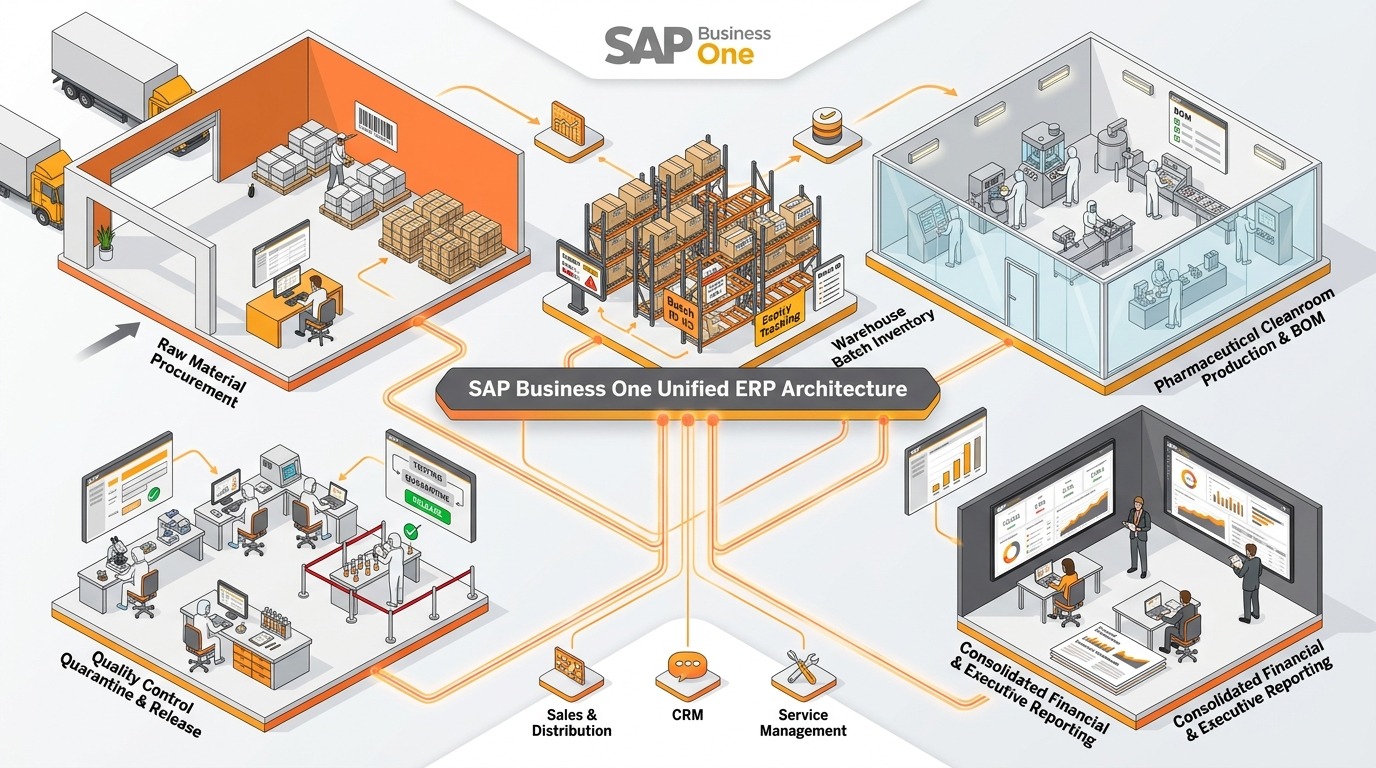
SAP Business One unified ERP architecture connecting procurement, batch inventory, cleanroom production, quality checkpoints, distribution, and financial reporting.
SAP Business One is relevant to pharmaceutical manufacturers and distributors because it brings core commercial and operational functions around a shared transaction model.
For companies evaluating ERP for pharma operations, the central value is integration.
Finance, purchasing, sales, inventory, production, business-partner records, approvals, and reporting can operate from the same ERP environment.
Pharma-specific requirements should then be designed around that core.
The evaluation should examine batch control, expiry management, production transactions, quality touchpoints, documentation, traceability, reporting requirements, integrations, and any specialist extensions required by the operation.
Start with inventory.
SAP Business One supports batch-managed items, warehouse-level inventory, purchasing, sales, goods movements, transfers, returns, and transaction histories.
For pharmaceutical businesses, these capabilities create the transaction structure needed to control batch-related stock movements.
Teams can identify where material is held, how it entered inventory, how it moved, which documents created those movements, and how related transactions affect finance.
That relationship is important.
Inventory control becomes weaker when stock transactions and financial transactions tell different stories.
An integrated ERP reduces that separation.
Production is the next major area.
Pharmaceutical manufacturers need material availability, manufacturing activity, inventory consumption, finished-goods receipts, and costs to remain connected.
SAP Business One supports bills of materials, production orders, material issues, production receipts, inventory consumption, and production-related costing.
The practical advantage is that manufacturing no longer exists as a separate information island.
Material movements can be captured as part of production rather than reconstructed afterwards.
Management gains better visibility into what was produced, which inputs were consumed, and how production activity affected inventory and cost.
Compliance depends on the discipline around those transactions.
ERP does not replace pharmaceutical quality governance.
Instead, it strengthens the operational record on which many quality and compliance processes depend.
That distinction is critical.
A pharmaceutical company may continue using specialized QMS, LIMS, laboratory, validation, scanning, serialization, document-management, or other specialist systems where those solutions are appropriate.
The ERP still needs to control the commercial and operational transactions around them.
This makes integration architecture a major part of ERP evaluation.
Consider a company where a laboratory or QMS determines whether a batch is released.
The implementation should define how that release status affects inventory availability and downstream ERP transactions.
If employees manually update both systems, the organization still carries synchronization risk.
If the connection is controlled through an integration or clearly governed process, the quality decision becomes operationally meaningful.
SAP Business One also supports authorization structures and approval processes around business transactions.
For leadership, this is important because control is not simply about recording what happened.
The system should also define which roles can perform specific actions and how exceptions are escalated.
Reporting is another major advantage of an integrated transactional model.
Pharma leadership often receives different interpretations of performance depending on the source.
Sales may report one figure.
Finance may show another.
Operations may maintain separate production reports.
Warehouse staff may adjust inventory reports before management review.
Leadership then spends time debating the numbers before discussing the business.
SAP Business One can bring those functions closer to a common reporting base.
The objective is not to eliminate every specialized report.
The objective is to ensure that operational and financial reporting begins with consistent source transactions.
That becomes increasingly important as the company grows.
Expansion creates additional warehouses, users, customers, suppliers, SKUs, currencies, production orders, transactions, and management questions.
ERP provides leverage when additional complexity can be incorporated without redesigning basic control processes each time.
For companies operating across India and GCC markets, this may involve additional warehouses, distribution structures, currencies, entities, commercial workflows, reporting requirements, and regional operating processes.
Those expectations should be considered during solution design.
An ERP configured solely around the present organization can become another constraint.
An ERP structured around expected business complexity creates more room to scale.
Historical information is another important evaluation point.
Pharma companies should not treat data migration as a basic master-data exercise.
Customers, suppliers, items, inventory, and opening balances are only part of the requirement.
Management must determine what historical batch, production, sales, quality-related, stock, and financial information needs to remain accessible after migration.
Some information may be moved into SAP Business One.
Other information may remain in a governed legacy archive.
The decision should be driven by operational and compliance requirements rather than convenience.
Integration decisions require the same discipline.
If the organization already uses QMS, LIMS, CRM, warehouse software, barcode applications, distributor platforms, or reporting tools, the project should determine which application owns each critical data element.
Without that ownership model, integration can produce duplicate sources of truth.
With clear ownership, SAP Business One can operate as the transaction backbone while specialist systems continue performing specialist functions.
This is the stronger way to evaluate SAP Business One for pharma.
Do not begin with a feature checklist.
Begin with the operating flow.
Can the proposed design give the company controlled transactions from purchasing through inventory, production, relevant quality checkpoints, sales, finance, reporting, and batch traceability?
Can status changes influence downstream activity?
Can management retrieve reliable information without reconstructing it manually?
Can additional locations and transaction volume be added without creating new offline controls?
Those questions reveal whether the ERP will genuinely connect compliance, inventory, and growth.
How Fast-Growing Pharma Companies Use ERP Differently
Fast-growing pharmaceutical companies do not necessarily use more ERP features.
They use ERP more deliberately.
The difference starts with ownership.
In a weaker operating model, ERP belongs mainly to IT.
Operations enters transactions because it has to.
Finance depends on the system for accounting.
Quality operates through separate processes.
Management receives reports compiled from several sources.
In a stronger operating model, ERP is treated as a business-control platform.
Major transactions have defined owners.
Master-data responsibilities are clear.
Approvals are designed deliberately.
Exceptions remain visible.
Integration responsibilities are documented.
Management reports trace back to controlled transactions.
This changes how expansion is managed.
When a warehouse is added, the organization does not create a separate stock process and reconcile it later.
It extends the existing inventory model.
When a new product family is introduced, the business defines item masters, units, batches, planning rules, costing, production requirements, and reporting needs before transaction volumes increase.
When a distributor is onboarded, customer records, pricing, order processes, credit control, dispatch requirements, and reporting are incorporated into the operating model.
When management requests a new KPI, the first question is whether the source transaction data is reliable enough to support it.
That is how ERP becomes infrastructure for growth.
Fast-growing organizations also treat master data as governance.
Item codes, units of measure, warehouse structures, batch conventions, customer records, supplier records, bills of materials, pricing, financial mappings, and approval logic are not allowed to evolve informally.
Poor master data creates downstream errors.
A duplicate material record can distort purchasing.
Incorrect units can affect planning.
Poor warehouse structures can weaken inventory reporting.
Inconsistent customer data can affect commercial reporting.
ERP cannot create reliable management information from unreliable master data.
Another difference is how growing companies handle exceptions.
Every pharma operation has them.
Urgent customer orders.
Quality holds.
Rejected material.
Production shortages.
Returned goods.
Damaged inventory.
Price overrides.
Credit exceptions.
Inventory corrections.
The objective is not to eliminate every exception.
The objective is to make exceptions controlled and visible.
Organizations that scale effectively use ERP to ensure deviations from the normal process are traceable rather than hidden in offline communications.
They also resist unnecessary customization.
One of the most expensive ERP mistakes is rebuilding every legacy process exactly as it operates today.
That preserves historical inefficiency inside a newer system.
A stronger implementation separates mandatory pharmaceutical controls from habits that simply developed because the old systems were limited.
Processes are standardized where standardization makes business sense.
Configuration is used where legitimate process variation exists.
Integration or specialist extensions are added where the business genuinely requires them.
The ERP core remains as manageable as possible.
For management teams, this produces a fundamentally different operating environment.
Inventory reports become more dependable because stock movements are controlled.
Production reporting becomes stronger because material consumption is recorded through the process.
Financial reporting improves because operating transactions flow into finance.
Batch investigations become faster because information does not have to be manually reconstructed from several sources.
New locations can be added without immediately creating another spreadsheet layer.
Growth becomes less dependent on individual employees remembering how disconnected processes fit together.
That is the difference between merely using an ERP and operating through one.
If your team is evaluating SAP Business One, the next useful step is not another generic feature presentation. See it applied to your data. Review your actual item structure, batch flow, inventory model, production process, quality checkpoints, approvals, integrations, and management reports against a proposed SAP Business One design.
Frequently Asked Questions About Pharma ERP Software
A pharma ERP decision should make compliance, inventory, and growth easier to control together rather than creating another system that requires reconciliation.
Book a 20-minute SAP Business One demo scoped to your compliance and inventory workflows. See how the solution can be structured around your actual batches, production processes, stock movements, quality checkpoints, integrations, and management reporting requirements.