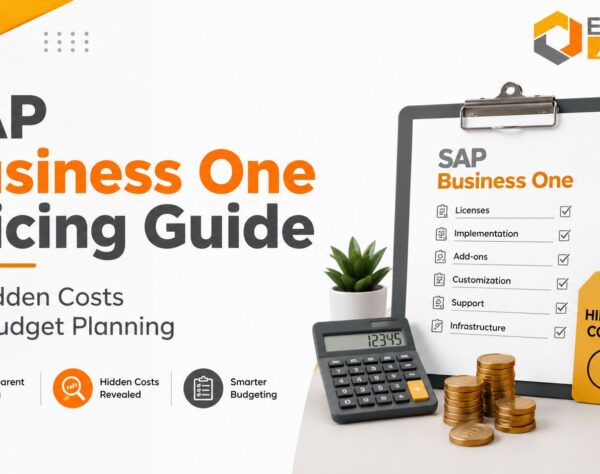

SAP Business One Pricing Breakdown: Licenses, Implementation, and Hidden Costs
SAP Business One Pricing for Better Budget Planning and Higher ROI
For many business leaders, the biggest challenge isn’t deciding whether they need an ERP system—it’s understanding what the investment actually looks like. While software licensing is often the first number discussed, it represents only one part of the overall cost. Implementation, customization, infrastructure, user adoption, and long-term support all influence the total investment. Understanding SAP Business One Pricing before starting an ERP project helps CEOs, CIOs, CFOs, and Operations Heads build realistic budgets, avoid unexpected expenses, and maximize long-term return on investment.
Whether you’re evaluating SAP B1 Pricing in India, comparing deployment options, or searching for a reliable SAP Business One Pricing Calculator, this guide explains every major pricing component and the hidden costs that many organizations overlook.
Why SAP Business One Pricing Varies Between Companies
There is no single price for SAP Business One because every organization has different operational requirements.
Several factors determine the overall investment:
- Number of users
- License type
- Industry requirements
- Business processes
- Deployment model
- Integrations
- Reporting requirements
- Future scalability
A trading company with 15 employees has vastly different ERP needs than a manufacturing organization with multiple warehouses and production planning requirements.
Instead of asking:
“What is the SAP Business One Cost?”
Executives should ask:
“What will SAP Business One cost based on our business model, growth plans, and operational complexity?”
This approach produces a far more accurate budget and prevents expensive scope changes later in the project.
The Four Major Components of SAP Business One Pricing
Most ERP investments consist of four primary cost categories rather than a single software purchase.
SAP Business One License Cost
The software license is the foundation of every SAP Business One deployment.
Organizations typically choose licenses based on employee roles and required functionality rather than purchasing identical licenses for every user.
Common license considerations include:
- Professional users
- Limited users
- CRM users
- Financial users
- Logistics users
- Warehouse personnel
- Management dashboards
Choosing the correct license mix significantly impacts overall SAP B1 License Cost without affecting productivity.
Many companies unknowingly purchase higher-tier licenses for users who require only limited functionality, increasing software costs unnecessarily.
SAP B1 Implementation Cost
Implementation is usually the largest investment after licensing.
The total SAP B1 Implementation Cost depends on factors such as:
- Business process complexity
- Number of locations
- Historical data migration
- Master data cleansing
- Report development
- Workflow configuration
- User training
- Go-live support
Organizations often underestimate implementation effort by focusing solely on software pricing instead of the resources needed to deploy ERP successfully.
A well-executed implementation generally delivers significantly greater long-term value than attempting to minimize implementation costs.
Infrastructure and Deployment
Deployment decisions also influence the overall investment.
Organizations typically choose between:
Cloud Deployment
Advantages include:
- Lower upfront investment
- Faster implementation
- Automatic infrastructure management
- Predictable monthly costs
- Easier scalability
On-Premise Deployment
Advantages include:
- Greater infrastructure control
- Internal server ownership
- Custom IT policies
- Long-term capital investment
Neither option is universally better.
The right deployment depends on:
- Security policies
- Compliance requirements
- IT resources
- Budget strategy
- Business growth plans
Ongoing Support and Optimization
ERP is not a one-time purchase.
Organizations should budget for:
- Annual maintenance
- System monitoring
- Version upgrades
- User onboarding
- Process optimization
- New feature adoption
- Performance improvements
These ongoing investments help businesses continue realizing value long after implementation.
Hidden Costs That Can Increase SAP Business One Cost
The largest ERP budget overruns rarely come from software licensing.
Instead, they originate from overlooked operational expenses.
Common hidden costs include:
Poor Master Data
Duplicate customers, inaccurate inventory records, and inconsistent item masters increase migration effort and delay implementation.
Excessive Customization
Custom developments may solve immediate problems but often increase future upgrade complexity and maintenance costs.
Organizations should first evaluate whether standard SAP Business One functionality can meet business requirements.
Integration Complexity
Integrating ERP with:
- CRM
- E-commerce
- Payroll
- Manufacturing systems
- Barcode solutions
- Banking platforms
can significantly influence project scope.
Planning integrations early reduces cost surprises later.
User Adoption Challenges
ERP success depends on people as much as technology.
Without structured training, organizations experience:
- Low adoption
- Manual workarounds
- Reporting inaccuracies
- Process inconsistencies
Training should be considered part of the investment—not an optional expense.
Business Process Redesign
Many organizations discover inefficient workflows only during implementation.
Improving these processes creates long-term operational gains but may increase initial project effort.
Ignoring process redesign often results in higher operating costs after go-live.
Budgeting Tip for Executive Teams
Before requesting implementation proposals, conduct an ERP readiness assessment covering:
- Current business processes
- Data quality
- Integration requirements
- Reporting expectations
- User roles
- Future expansion plans
A structured assessment often produces a more accurate implementation estimate than requesting quotes based only on employee count.
This early exercise also makes discussions with implementation partners more productive and reduces the likelihood of change requests later in the project.
How SAP B1 Pricing in India Is Typically Evaluated
When evaluating SAP B1 Pricing in India, decision-makers should avoid comparing vendors solely on software cost.
Instead, compare the complete project investment, including:
- Software licensing
- Implementation methodology
- Industry expertise
- Data migration approach
- Training strategy
- Support services
- Future scalability
- Upgrade roadmap
The Best SAP Business One Price in India is rarely the lowest quotation.
It is the proposal that delivers the strongest balance of implementation quality, operational efficiency, and long-term business value.
Why an SAP Business One Pricing Calculator Matters
Many organizations begin budgeting with assumptions that are either too optimistic or too conservative.
An SAP Business One Pricing Calculator provides a structured estimate by evaluating factors such as:
- Number of users
- Required licenses
- Deployment preference
- Business locations
- Industry
- Customization requirements
- Integration needs
- Reporting complexity
Rather than producing a generic software quote, a pricing calculator helps leadership teams estimate the total ERP investment required for a successful implementation.
For businesses comparing multiple ERP platforms, using a structured pricing assessment before issuing an RFP often reduces procurement time and improves budget accuracy.
Maximizing ROI from SAP Business One Pricing
The success of an ERP investment is measured by business outcomes—not by securing the lowest software price. For CEOs, CIOs, COOs, and Digital Transformation leaders, the objective should be to maximize return on investment through better visibility, process automation, and scalable operations.
Organizations that realize the highest ROI from SAP Business One Pricing focus on strategic implementation rather than simply reducing upfront costs.
Standardize Processes Before Customizing
Many businesses request custom developments to replicate existing workflows. While customization may appear convenient, it often increases implementation time, upgrade complexity, and long-term maintenance costs.
Before approving customizations, evaluate whether standard SAP Business One capabilities can support your operational requirements. Standardizing processes wherever possible reduces both implementation costs and future technical debt.
Select the Right License Mix
One of the most effective ways to optimize SAP License Cost in India is by aligning license types with employee responsibilities.
For example:
- Finance teams may require Professional licenses.
- Sales representatives may only need CRM functionality.
- Warehouse personnel may need limited operational access.
- Senior management often requires dashboard and reporting capabilities.
Assigning appropriate license types prevents overspending while ensuring every user has the functionality they need.
Invest in User Adoption
Even the best ERP implementation will underperform if employees continue using spreadsheets and manual workarounds.
Successful organizations invest in:
- Role-based user training
- Process documentation
- Executive sponsorship
- Department champions
- Ongoing refresher sessions
Higher user adoption leads to better data accuracy, improved reporting, and faster decision-making—all of which contribute directly to ERP ROI.
Plan for Future Growth
ERP platforms are long-term investments. Pricing decisions should account not only for today’s requirements but also for anticipated business expansion.
Consider questions such as:
- Will you add new manufacturing facilities?
- Are international operations planned?
- Will additional warehouses be required?
- Is eCommerce integration on the roadmap?
- Will your workforce grow over the next three to five years?
Planning for scalability during the initial implementation is significantly more cost-effective than redesigning the system later.
Measure ROI Beyond Software Costs
A successful ERP implementation generates measurable operational improvements that extend far beyond the initial investment.
Typical outcomes include:
- Faster financial closing cycles
- Reduced inventory carrying costs
- Improved production planning
- Better procurement visibility
- Higher order fulfillment accuracy
- Reduced manual data entry
- Real-time business reporting
- Stronger compliance and audit readiness
These efficiencies often deliver greater long-term value than the initial software investment itself.
Choosing the Right SAP Business One Implementation Partner
The implementation partner has a direct impact on project cost, timeline, and business outcomes.
When evaluating potential partners, consider:
- Experience within your industry
- Certified SAP Business One consultants
- Proven implementation methodology
- Data migration expertise
- Integration capabilities
- Post-go-live support model
- Customer references and case studies
- Long-term optimization services
The lowest implementation quote is not always the best value. An experienced partner can help avoid project delays, scope changes, and costly rework, resulting in a lower total cost of ownership over the life of the ERP system.
Planning an ERP investment? A tailored SAP Business One pricing assessment can identify the right licensing model, implementation approach, and deployment strategy before you commit to a budget. This helps eliminate unnecessary costs and ensures the solution aligns with your business objectives.
SAP Business One Pricing: A Strategic Investment for Long-Term Growth
SAP Business One Pricing should be viewed as a strategic business investment rather than a standalone software expense. While licensing is an important component, implementation quality, user adoption, process optimization, and long-term scalability ultimately determine the value your organization receives.
For executives evaluating ERP modernization, the goal should be to understand the complete cost structure—including licenses, implementation, infrastructure, integrations, and ongoing support—so budgets are realistic and ROI expectations are achievable.
Organizations that take this holistic approach are better positioned to reduce operational risk, improve decision-making, and build a scalable digital foundation for future growth.
Frequently Asked Questions
How is SAP Business One Pricing calculated?
SAP Business One Pricing is based on multiple factors, including the number of users, license types, deployment model (cloud or on-premise), implementation complexity, customizations, integrations, and ongoing support. A comprehensive assessment provides a more accurate estimate than a standard price list.
What is included in SAP B1 Implementation Cost?
Implementation costs generally include business process analysis, system configuration, data migration, user training, testing, integrations, go-live support, and project management. The scope varies depending on business complexity and industry requirements.
Why does SAP Business One Cost differ between businesses?
Every organization has unique operational processes, reporting needs, and growth plans. Manufacturing companies, distributors, and service organizations often require different configurations, resulting in different implementation efforts and overall investment.
How can businesses reduce SAP License Cost in India?
Businesses can optimize licensing by selecting the appropriate mix of Professional and Limited user licenses, removing unused licenses, and aligning user access with actual job responsibilities. Regular license reviews also help control costs as the organization grows.
Does cloud deployment reduce SAP Business One Pricing?
Cloud deployment often lowers upfront infrastructure expenses and simplifies ongoing IT management. However, the overall cost depends on subscription models, implementation services, support requirements, and long-term business objectives.
What hidden costs should executives consider before implementation?
Common hidden costs include poor data quality, extensive customizations, third-party integrations, user training, change management, and business process redesign. Identifying these early helps prevent budget overruns and project delays.
Should businesses use an SAP B1 Pricing Calculator before requesting proposals?
Yes. An SAP B1 Pricing Calculator provides an initial estimate based on user count, deployment preferences, and functional requirements. It helps organizations establish realistic budgets before engaging implementation partners.
How long does it take to recover the investment in SAP Business One?
ROI depends on factors such as implementation quality, user adoption, and operational improvements. Many organizations begin realizing measurable benefits within the first year through increased efficiency, reduced manual work, and improved visibility.
Is the lowest SAP Business One Price in India always the best choice?
Not necessarily. A lower initial quote may exclude implementation services, training, integrations, or post-go-live support. Decision-makers should evaluate the total cost of ownership and the implementation partner’s expertise rather than software price alone.
How can executives ensure maximum ROI from SAP Business One?
Maximizing ROI requires selecting the right licensing strategy, standardizing business processes, investing in user adoption, planning for scalability, and partnering with an experienced implementation team. These factors collectively improve operational efficiency and reduce long-term costs.
See SAP Business One Solve Your Business Challenges
Every organization has unique processes, growth goals, and ERP requirements. A personalized SAP Business One demo from Emerging Alliance shows exactly how the solution can streamline your operations, improve decision-making, and maximize your ERP investment.
During your free demo, you’ll receive:
- A live walkthrough tailored to your industry
- Guidance on the right SAP Business One licensing model
- Insights into implementation timelines and best practices
- Answers to your specific business and technical questions
- Recommendations to help maximize ROI
👉 Book Your Free SAP Business One Demo with Emerging Alliance