
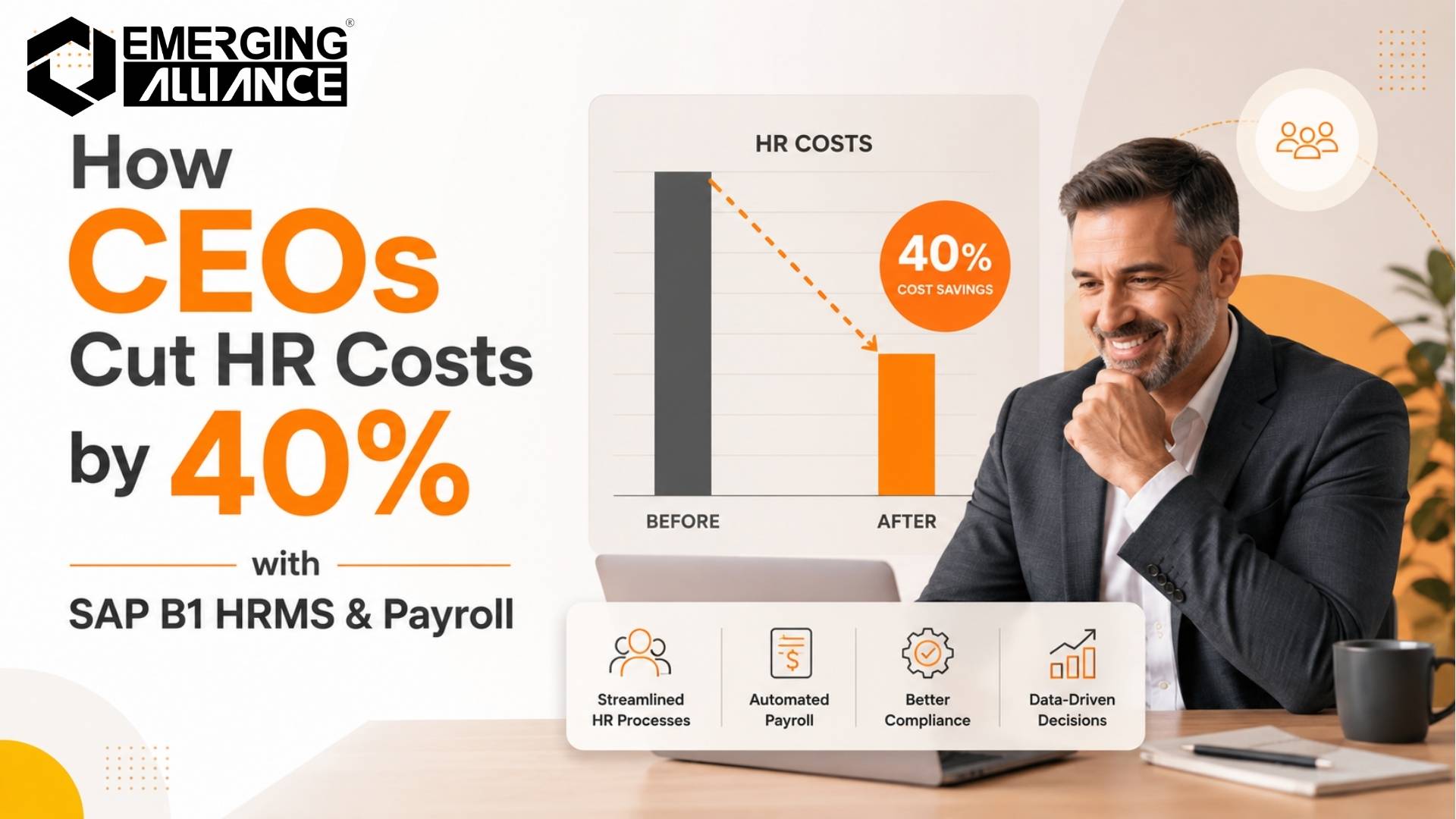
How CEOs Cut HR Costs by 40% with SAP B1 HRMS & Payroll
One Integrated SAP B1 HRMS & Payroll Rollout for Lower HR Costs
Human resources has become one of the most expensive operational functions in growing businesses. While organizations invest heavily in ERP, finance, procurement, and supply chain modernization, many still manage employee records, attendance, payroll, compliance, reimbursements, and workforce reporting through disconnected systems.
SAP B1 HRMS helps enterprises eliminate these inefficiencies by integrating workforce management, payroll processing, compliance tracking, and employee data into a single platform connected directly with SAP Business One. The challenge is no longer payroll processing. The challenge is controlling hidden HR costs, reducing administrative overhead, improving compliance visibility, and creating a scalable workforce management framework that supports business growth.
Organizations that modernize HR operations often discover significant cost reductions through automation, improved accuracy, and process standardization rather than workforce reduction.
The question is simple:
How much of your HR budget is being spent managing inefficiencies instead of enabling growth?
Why Traditional HR Operations Create Hidden Cost Centers
Most enterprises do not have an employee problem.
They have a process problem.
As organizations grow, HR teams become overwhelmed with manual activities that consume time without creating business value.
Common operational challenges include:
- Manual attendance consolidation
- Payroll calculation errors
- Multiple employee databases
- Delayed compliance reporting
- Leave management bottlenecks
- Reimbursement approval delays
- Poor workforce visibility
- Duplicate data entry across systems
These inefficiencies create hidden costs across multiple departments.
Finance teams spend time validating payroll data.
Managers spend time resolving attendance disputes.
HR teams spend time correcting payroll errors.
Executives operate without real-time workforce intelligence.
The result is slower decision-making and higher operational costs.
This is where SAP Business One HRMS creates measurable business impact.
SAP Business One HRMS Delivers Centralized Workforce Visibility
One of the biggest reasons HR costs increase is fragmented employee information.
When workforce data exists across spreadsheets, attendance software, payroll applications, and manual records, reporting becomes slow and inaccurate.
HR data with SAP Business One creates a unified employee management environment where every department works from the same source of truth.
With centralized workforce visibility, organizations gain:
Complete Employee Lifecycle Management
- Employee onboarding
- Department transfers
- Performance tracking
- Training records
- Exit management
Real-Time Workforce Analytics
- Employee headcount visibility
- Department-wise cost analysis
- Workforce utilization reporting
- Attendance analytics
- Leave trend analysis
Better Executive Decision-Making
Instead of waiting for monthly HR reports, leadership teams can access workforce insights instantly and identify operational trends before they become business problems.
For growing enterprises, visibility alone can significantly reduce administrative effort and reporting costs.
SAP B1 Payroll Management Eliminates Manual Processing Bottlenecks
Payroll errors are among the most expensive administrative problems organizations face.
A single mistake can impact employee satisfaction, compliance requirements, and financial reporting.
Many companies still rely on fragmented payroll workflows involving multiple spreadsheets, external calculations, and manual approvals.
SAP B1 payroll management transforms this process through automation and integration.
Key capabilities include:
- Automated salary processing
- Attendance-based payroll calculations
- Leave and payroll synchronization
- Tax calculations
- Reimbursement management
- Overtime calculations
- Incentive and bonus processing
With a fully integrated SAP Business One payroll module, payroll becomes a controlled business process instead of a recurring operational challenge.
The business outcome is straightforward:
Fewer errors. Faster processing. Lower administrative effort.
HR and Payroll Integration with SAP B1 Reduces Compliance Risk
Compliance failures rarely happen because organizations intentionally ignore regulations.
They happen because systems are disconnected.
When employee information, attendance records, payroll data, and statutory reporting exist in separate environments, compliance gaps become difficult to identify.
An integrated HR and Payroll administration module helps organizations maintain accurate records while simplifying reporting requirements.
Key compliance advantages include:
Automated Record Management
Employee records remain consistent across all functions.
Audit Readiness
Workforce information is available instantly during audits.
Reduced Human Error
Automation minimizes manual calculations and reporting mistakes.
Standardized Processes
Every payroll cycle follows the same approved workflow.
For regulated industries such as pharmaceuticals, manufacturing, healthcare, and services, compliance visibility becomes a strategic advantage rather than a recurring concern.
Best HRMS for SAP B1 Enables Scalable Enterprise Growth
Growth creates complexity.
More employees mean more payroll transactions, approvals, compliance requirements, and workforce reporting demands.
Many organizations discover that their existing HR systems cannot scale alongside business expansion.
The Best HRMS for SAP B1 provides a framework designed to grow with the organization.
As workforce size increases, companies can continue operating without adding proportional administrative overhead.
Enterprise scalability benefits include:
- Multi-location workforce management
- Centralized employee database
- Standardized HR workflows
- Automated approval processes
- Integrated payroll operations
- Department-wise reporting
- Executive workforce dashboards
Instead of hiring additional administrative resources to manage growth, organizations can automate repetitive processes and maintain operational efficiency.
For CEOs focused on profitability, this creates a direct link between workforce growth and operational control.
SAP B1 HRMS Implementation Creates Measurable Business ROI
Technology investments succeed when they solve business problems.
The value of SAP B1 HRMS implementation extends far beyond attendance tracking or payroll processing.
The real business impact comes from operational transformation.
Organizations typically improve performance through:
Lower Administrative Workload
HR teams spend less time on repetitive tasks.
Faster Payroll Cycles
Automation accelerates processing and approvals.
Better Workforce Visibility
Leadership gains access to real-time reporting.
Reduced Compliance Exposure
Standardized workflows improve governance.
Improved Employee Experience
Employees gain transparency through self-service capabilities.
Stronger Financial Control
Workforce costs become easier to track and optimize.
When HR becomes data-driven and automated, leadership teams gain greater control over one of the organization’s largest operating expenses.
Why HR Transformation Projects Fail Without the Right Strategy Partner
Many HR modernization initiatives fail because they focus only on software deployment while ignoring process inefficiencies, payroll complexity, compliance requirements, and long-term scalability.
The real challenge is not implementing an HRMS.
The real challenge is redesigning workforce operations to support growth, improve visibility, and reduce administrative costs.
Emerging Alliance works with business leaders to identify HR bottlenecks, streamline payroll workflows, automate approvals, and create a connected workforce management framework within SAP Business One.
Our approach focuses on:
- Eliminating manual HR and payroll processes
- Improving workforce data accuracy
- Increasing payroll processing efficiency
- Strengthening compliance and audit readiness
- Delivering real-time workforce visibility
- Supporting multi-location business growth
- Aligning HR operations with broader digital transformation goals
For CEOs and Operations Leaders, the objective is not simply deploying an HR system.
It is creating a scalable, data-driven workforce operation that reduces costs, improves control, and supports sustainable business growth.
Ready to Transform HR Costs into Strategic Business Value?
If your HR team is still managing payroll, attendance, compliance, and workforce reporting through disconnected systems, the cost of inefficiency may already be impacting profitability.
Emerging Alliance helps organizations modernize workforce operations through integrated SAP B1 HRMS, payroll automation, and enterprise-wide visibility.
FAQs
1. Why do enterprises replace standalone HR and payroll systems with SAP B1 HRMS?
As businesses grow, disconnected HR and payroll applications often create duplicate data, reporting delays, compliance risks, and higher administrative costs. SAP B1 HRMS brings employee management, payroll processing, attendance, leave management, and workforce reporting into a single integrated platform connected with SAP Business One, improving visibility and operational efficiency.
2. How does SAP Business One Payroll improve payroll accuracy?
SAP Business One Payroll automates salary calculations, leave adjustments, reimbursements, deductions, and statutory requirements, reducing manual errors and processing delays.
3. Is HR and payroll integration with SAP B1 suitable for multi-location companies?
Yes. HR and payroll integration with SAP B1 supports centralized workforce management across multiple branches, departments, and locations.
4. What industries benefit most from SAP Business One HR software?
Manufacturing, pharmaceutical, healthcare, engineering, retail, distribution, logistics, and professional service organizations commonly benefit from SAP Business One HR software.
5. How complex is SAP B1 HRMS implementation?
Implementation complexity depends on workforce size, existing systems, payroll requirements, and process maturity. A structured deployment approach significantly reduces implementation risk.
6. Can SAP B1 payroll management support statutory compliance requirements?
Yes. SAP B1 payroll management can support payroll compliance processes, reporting requirements, employee records, and audit readiness initiatives.
7. What reporting capabilities are available in SAP B1 employee management systems?
Organizations can generate workforce analytics, attendance reports, payroll summaries, employee cost reports, department-wise dashboards, and executive workforce insights.
8. How does the SAP Business One payroll add on improve operational efficiency?
The payroll add on automates repetitive calculations, integrates workforce data, accelerates approvals, and reduces manual administrative effort.
9. Can organizations migrate from existing payroll software to SAP B1 Payroll?
Yes. Businesses can migrate from standalone payroll applications and legacy HR systems into a unified SAP Business One environment with proper planning and data validation.
10. How do enterprises evaluate ROI from a SAP B1 HR module deployment?
ROI is typically measured through reduced administrative workload, faster payroll cycles, improved compliance visibility, better reporting accuracy, and enhanced workforce productivity.
Schedule a consultation today to discover how SAP Business One HRMS can streamline HR operations, improve compliance, and support scalable growth.