
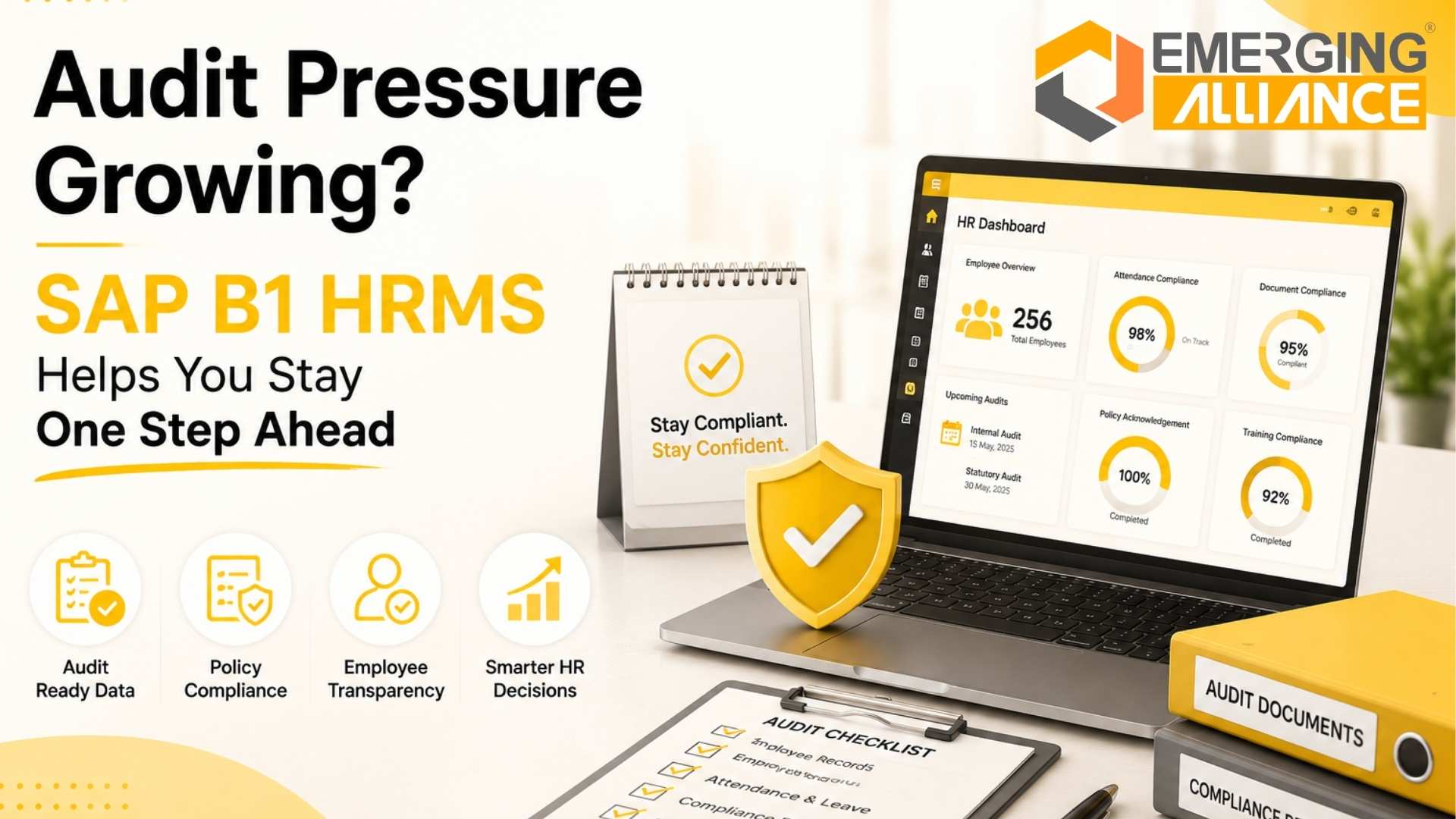
Audit Pressure Rising? SAP B1 HRMS Keeps You Audit-Ready
Streamline payroll, attendance, and compliance with intelligent SAP B1-HRMS workflows
Modern enterprises face growing pressure from payroll audits, compliance checks, and workforce reporting. Businesses still relying on disconnected HR systems, spreadsheets, or manual approvals often struggle with payroll errors, reporting gaps, and compliance risks. SAP B1 HRMS helps enterprises automate payroll, centralize employee data, improve compliance visibility, and streamline HR workflows. For CEOs, CFOs, and operations leaders, it creates stronger workforce control without increasing operational complexity.
Why HR and Payroll Gaps Become Enterprise Risks
Many organizations only recognize HR inefficiencies when audits begin, payroll disputes increase, or workforce reporting becomes unreliable. By then, operational damage is already visible.
Disconnected HR systems create hidden risks across payroll, compliance, finance, and workforce management.
Common enterprise HR challenges include:
- Payroll approvals delayed due to manual dependency
- Attendance and overtime mismatches across branches
- Inconsistent employee master data
- Compliance reporting delays
- Lack of centralized employee records
- Errors in statutory calculations
- Limited payroll visibility for finance teams
- HR workflow bottlenecks during scaling
A modern SAP Business One HRMS environment eliminates these operational blind spots by connecting HR, payroll, attendance, and finance into one integrated system.
Organizations gain:
- Real-time workforce visibility
- Faster payroll processing
- Improved compliance readiness
- Reduced payroll errors
- Better decision-making through centralized HR analytics
How SAP B1 Payroll Improves Compliance and Audit Readiness
Audit pressure increases when payroll data is fragmented across multiple tools. Manual intervention, duplicate entries, and inconsistent attendance records make compliance verification difficult.
An intelligent SAP B1 Payroll framework helps enterprises standardize and automate payroll operations while improving audit traceability.
Key capabilities include:
Centralized Payroll Processing
A unified payroll engine ensures salary structures, deductions, reimbursements, overtime, and statutory calculations remain standardized across departments and branches.
Automated Attendance and Leave Integration
Integrated attendance and leave tracking reduce manual reconciliation and improve payroll accuracy.
Compliance Workflow Automation
Organizations can automate payroll compliance workflows, approvals, and reporting processes to reduce dependency on manual HR coordination.
Real-Time Payroll Visibility
Finance and HR leaders gain access to payroll reporting and analytics dashboards for faster workforce decisions.
Employee Self-Service Portal
Employees can access payslips, leave balances, attendance records, and HR requests through a centralized employee self service portal.
For enterprises operating across multiple locations or manufacturing units, these capabilities reduce administrative overhead while improving operational control.
SAP Business One HRMS Creates Scalable Workforce Operations
As businesses expand, HR complexity grows faster than most teams anticipate. New branches, contract employees, shift structures, and compliance rules increase operational pressure on HR departments.
A scalable HRMS for SAP Business One helps enterprises manage workforce growth without increasing manual dependency.
Enterprise scenarios where automation becomes critical:
Manufacturing Operations
Manufacturing companies often struggle with shift and overtime management, attendance inconsistencies, and payroll reconciliation across plants.
A centralized payroll management for manufacturing companies workflow helps standardize operations while improving labor visibility.
Pharma and Healthcare Enterprises
Pharma businesses require accurate employee records, compliance tracking, and controlled payroll approvals.
A structured HR software for pharma industry environment improves workforce governance while reducing audit risks.
Multi-Branch Organizations
Businesses operating across regions often face fragmented employee data and inconsistent payroll practices.
An integrated multi branch payroll management structure improves standardization across locations.
Fast-Growing Enterprises
Rapidly scaling businesses need workforce automation without rebuilding HR operations every year.
A scalable cloud payroll software framework enables long-term operational flexibility.
ERP Based HRMS Solution Reduces Operational Bottlenecks
Manual HR processes slow down enterprise operations more than most organizations realize. HR teams spend excessive time on approvals, payroll corrections, attendance verification, and compliance reporting instead of workforce strategy.
A connected ERP for HR and payroll management approach transforms HR from an administrative function into an operational intelligence layer.
Business outcomes enterprises typically prioritize:
- Faster employee onboarding workflows
- Automated salary processing
- Reduced payroll disputes
- Better workforce planning visibility
- Lower dependency on spreadsheets
- Centralized employee lifecycle management
- Improved audit documentation
- Faster reporting for leadership teams
With integrated HR and payroll integration with SAP B1, enterprises can align HR operations with finance, accounting, and operational workflows.
This creates stronger process consistency across the organization.
Why SAP B1 HRMS Is More Than Just Payroll Software
Many businesses initially evaluate HR systems purely for payroll automation. But enterprise growth requires much more than salary processing.
A modern SAP B1 HR module supports:
- Employee attendance management
- Recruitment and onboarding software workflows
- Leave and shift tracking
- HR analytics dashboards
- Payroll compliance automation
- Employee lifecycle management
- Workforce reporting
- HR operations automation
- Centralized employee database management
The value comes from integration.
Instead of maintaining disconnected HR tools, enterprises gain a unified operational environment connected directly with SAP Business One accounting and business workflows.
This improves both operational efficiency and executive visibility.
Strategic Value of SAP Business One Payroll Integration
Disconnected payroll systems create reporting delays between HR and finance teams. This impacts forecasting accuracy, workforce budgeting, and compliance visibility.
A connected SAP and payroll ecosystem enables enterprises to:
- Align payroll with financial reporting
- Improve workforce cost visibility
- Reduce duplicate data entry
- Minimize reconciliation delays
- Strengthen payroll governance
- Improve operational reporting accuracy
For leadership teams, this means better control over workforce expenses and operational scalability.
For HR teams, it means less manual administration and stronger process automation.
Why Enterprises Choose Emerging Alliance for SAP B1 HRMS Implementation
Successful HR transformation is not achieved through software deployment alone. Enterprises need a partner that understands operational workflows, compliance complexity, and scalability requirements.
Emerging Alliance helps organizations align HR operations with broader digital transformation initiatives through intelligent SAP Business One solutions.
Our approach focuses on:
- Process-driven HR transformation
- Enterprise workflow optimization
- Payroll compliance automation
- Workforce visibility improvement
- Integration-led architecture
- Scalable HRMS deployment strategy
- Long-term operational efficiency
Whether your organization is managing manufacturing operations, pharma compliance, multi-branch payroll structures, or workforce scaling challenges, Emerging Alliance helps design HR ecosystems built for growth and audit readiness.
Ready to Modernize HR Operations with SAP B1 HRMS?
Audit pressure, payroll complexity, and workforce scaling challenges will continue increasing as enterprises grow.
The question is whether your HR operations are designed to scale with visibility, compliance, and control.
If your organization is still managing HR through disconnected workflows, manual approvals, or fragmented payroll systems, now is the time to evaluate a smarter operational model.
Partner with Emerging Alliance to build an intelligent, scalable, and audit-ready SAP B1 HRMS environment aligned with your business growth strategy.
FAQs SAP B1 for HRMS
1. What are the advantages of SAP B1 HRMS for enterprise payroll management?
SAP B1 HRMS centralizes payroll, attendance, employee records, and compliance workflows into one integrated system, improving operational visibility and reducing payroll errors.
2. How does HR and payroll integration with SAP B1 improve reporting?
Integrated HR and payroll workflows improve workforce cost visibility, reduce reconciliation delays, and enable real-time payroll analytics for leadership teams.
3. Is SAP Business One HRMS suitable for manufacturing companies?
Yes. Manufacturing businesses benefit from shift management, overtime tracking, attendance integration, and multi-location payroll automation.
4. Can SAP B1 payroll module support multi-branch operations?
Yes. SAP B1 payroll management supports centralized payroll operations across multiple branches while maintaining standardized workflows and reporting.
5. How does SAP Business One payroll add on improve compliance management?
The system automates payroll calculations, attendance integration, approval workflows, and statutory reporting to reduce compliance risks and audit pressure.
6. What industries benefit most from ERP based HRMS solutions?
Manufacturing, pharma, healthcare, retail, distribution, and multi-location enterprises benefit significantly from integrated HR and payroll automation.
7. How difficult is SAP B1 HRMS implementation for growing enterprises?
Implementation complexity depends on workforce structure, integrations, and process maturity. A strategic implementation partner helps simplify migration and workflow alignment.
8. Does SAP Business One HR software support employee self-service functions?
Yes. Employees can access leave requests, attendance records, payroll information, and HR services through self-service workflows.
9. How does payroll compliance automation reduce operational risk?
Automation reduces manual dependency, improves audit traceability, standardizes payroll calculations, and minimizes reporting inconsistencies.
10. Why should enterprises integrate payroll software with ERP systems?
Integrated payroll and ERP systems improve operational accuracy, workforce visibility, financial alignment, and enterprise scalability.
Speak with our experts