
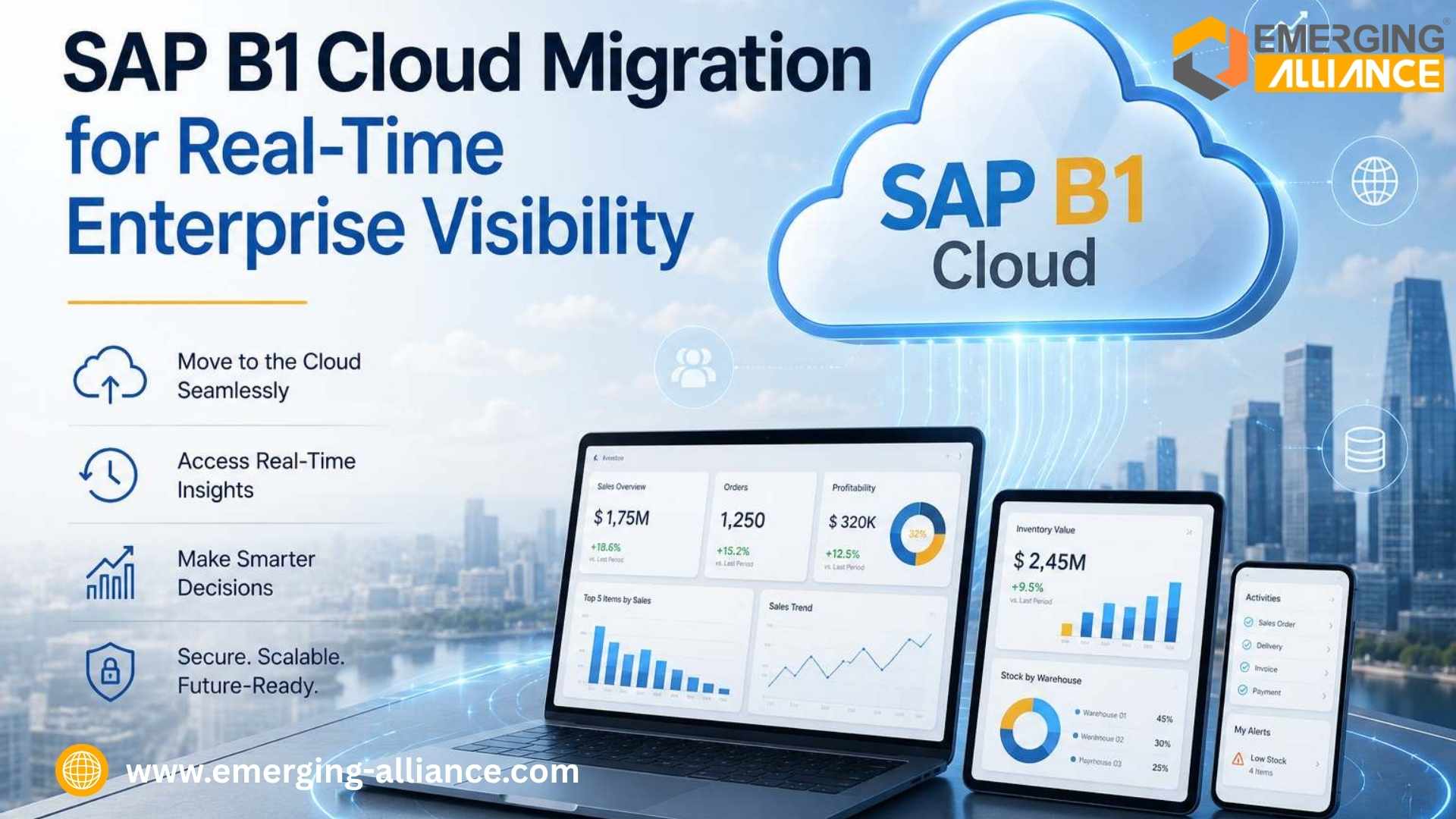
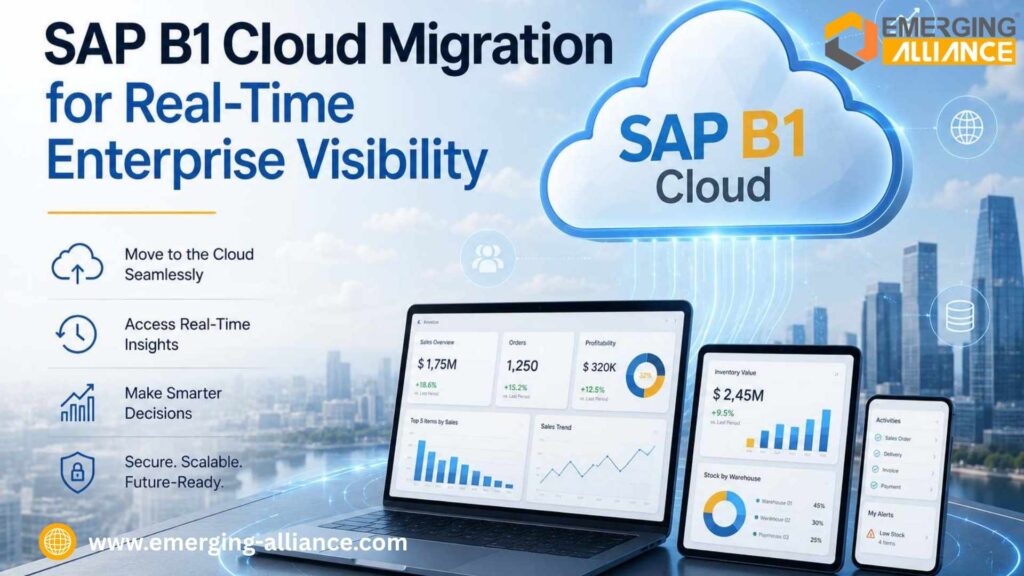
SAP B1 Cloud Migration for Real-Time Enterprise Visibility
Enable faster decisions through SAP B1 cloud migration insights
SAP B1 Cloud Migration is becoming a strategic priority for enterprises seeking faster decisions, real-time visibility, and scalable operations. Many organizations still rely on legacy ERP infrastructure that creates reporting delays, disconnected workflows, limited accessibility, and operational inefficiencies that directly impact growth and profitability.
By adopting SAP Business One Cloud, enterprises gain centralized reporting, workflow automation, secure remote access, and improved operational control. The goal is not simply moving ERP to the cloud—it is building a scalable, intelligent business environment that enables leadership teams to operate with speed, visibility, and confidence.
At Emerging Alliance, organizations are guided through ERP modernization with a business-first approach focused on scalability, governance, automation, and long-term digital transformation.
Current Industry Challenge: Visibility Delays Are Slowing Enterprise Growth
Many growing enterprises continue operating on aging ERP infrastructure where information flows are fragmented across departments, locations, and business units.
Finance teams struggle with delayed consolidations. Operations leaders lack real-time production visibility. Sales teams operate with outdated inventory data. Management reviews become dependent on manually compiled reports instead of live operational intelligence.
This problem becomes more severe when organizations scale across multiple branches, warehouses, or regions.
In many cases, businesses running SAP Business One on-premise environments face challenges such as:
- Infrastructure dependency on internal IT teams
- Delayed report generation during peak workloads
- Limited remote accessibility
- Increasing hardware maintenance costs
- Inconsistent backup and disaster recovery processes
- Scalability limitations during expansion
- Siloed operational visibility
These operational inefficiencies create decision latency across the organization.
For enterprise leadership, delayed visibility often translates into delayed action.
Hidden Operational Risks Inside Legacy ERP Environments
The operational risks associated with outdated ERP infrastructure are frequently underestimated because systems may appear stable on the surface.
However, underneath daily operations, several hidden risks continue accumulating.
Revenue Leakage Through Delayed Decision-Making
When executive dashboards are not updated in real time, pricing decisions, procurement planning, inventory allocation, and production scheduling become reactive instead of proactive.
Small reporting delays can create large downstream operational consequences.
For example, a distributor operating across multiple regions may continue replenishing inventory based on outdated demand patterns because reporting cycles lag behind live sales movement.
The result is excess inventory in one region and stock shortages in another.
Workflow Bottlenecks Reduce Enterprise Agility
Traditional ERP environments often rely heavily on localized infrastructure and manual coordination between departments.
As businesses grow, workflows become increasingly dependent on IT intervention, server availability, VPN access, and disconnected approval processes.
This creates operational friction across:
- Procurement approvals
- Financial closing
- Production planning
- Dispatch coordination
- Vendor collaboration
- Customer service workflows
Without a scalable cloud ERP solution, enterprise responsiveness begins to slow.
Compliance and Security Exposure
Modern enterprises must maintain stronger governance over data access, backups, cybersecurity, and business continuity.
Older infrastructure models frequently struggle to maintain:
- Centralized access controls
- Real-time audit visibility
- Disaster recovery readiness
- Secure remote access
- Continuous system availability
This is particularly critical for regulated industries where operational downtime or reporting inconsistencies can create compliance exposure.
Why Traditional Systems Fail Modern Enterprise Expectations
The problem is no longer whether ERP exists.
The real issue is whether the ERP environment can support modern enterprise decision velocity.
Traditional infrastructure models were designed around localized operations. Modern organizations operate across distributed teams, mobile workforces, global suppliers, and multi-location ecosystems.
As enterprise cloud adoption accelerates, organizations are realizing that infrastructure limitations directly impact business scalability.
On-Premise ERP Creates Scalability Constraints
A growing business requires systems that scale dynamically with operational demand.
However, traditional SAP Business One on-premise environments often require:
- Hardware upgrades
- Server expansion
- Manual infrastructure management
- Downtime planning
- Capacity forecasting
This increases operational complexity while slowing transformation initiatives.
Legacy Infrastructure Limits Real-Time Business Insights
Modern leadership teams require live operational intelligence.
Executives want immediate visibility into:
- Cash flow performance
- Inventory movement
- Production efficiency
- Sales trends
- Procurement risks
- Margin fluctuations
- Customer fulfillment performance
Without a modernized ERP architecture, reporting becomes historical instead of actionable.
How SAP B1 Cloud Migration Solves the Problem
A successful SAP B1 cloud migration transforms ERP from a static operational system into a dynamic enterprise visibility platform.
Rather than operating within infrastructure limitations, organizations gain flexible access to real-time business intelligence from a secure cloud environment.
Centralized Real-Time Enterprise Visibility
With cloud-based SAP Business One, organizations gain unified visibility across business operations through centralized reporting and live dashboards.
Decision-makers can monitor:
- Financial performance
- Warehouse activity
- Procurement cycles
- Sales operations
- Manufacturing workflows
- Customer fulfillment
This enables leadership teams to respond faster to operational changes.
Scalable Cloud ERP Architecture
A modern SAP Business One cloud ERP environment supports enterprise expansion without the operational disruption associated with traditional infrastructure upgrades.
Organizations can scale users, locations, and operational capacity more efficiently while maintaining centralized governance.
This becomes especially valuable during mergers, regional expansion, seasonal demand fluctuations, or multi-branch growth.
Improved Business Process Automation
A well-planned SAP B1 migration to cloud enables stronger workflow automation capabilities across departments.
Automation opportunities include:
- Approval workflows
- Inventory replenishment
- Financial reporting
- Vendor coordination
- Order processing
- Customer communication
- Audit tracking
This improves business workflow optimization while reducing manual operational dependency.
Enhanced Accessibility and Collaboration
Cloud infrastructure allows enterprise teams to securely access ERP systems from multiple locations without compromising operational continuity.
This is critical for organizations managing:
- Remote teams
- Distributed warehouses
- Multi-country operations
- Field sales teams
- Executive mobility
A properly designed SAP Business One cloud platform improves collaboration without sacrificing control.
Key Business Benefits of SAP Business One Cloud Migration
Faster Executive Decision-Making
Real-time dashboards improve visibility into operational performance, enabling faster strategic responses.
Leadership teams no longer wait for static reports or manually consolidated data.
Stronger Operational Efficiency
Cloud-enabled ERP environments reduce infrastructure dependency while improving system responsiveness and workflow continuity.
This directly supports ERP operational efficiency.
Improved Business Continuity
Modern SAP Business One cloud hosting environments improve backup reliability, disaster recovery readiness, and system availability.
Operational resilience becomes significantly stronger.
Better IT Cost Predictability
Cloud infrastructure helps organizations reduce unpredictable hardware expenditures while simplifying infrastructure management.
This improves financial planning around ERP modernization initiatives.
Enterprise-Grade Security and Governance
A secure SAP Business One cloud security framework enables centralized monitoring, controlled access management, and stronger governance standards.
For enterprises managing sensitive operational data, this becomes strategically important.
ROI and Operational Impact of ERP Cloud Migration
The ROI of SAP B1 cloud migration extends beyond infrastructure savings.
The larger business impact comes from operational acceleration and improved visibility.
Organizations often experience improvements in:
- Reporting turnaround time
- Workflow efficiency
- Cross-department coordination
- Inventory visibility
- Operational responsiveness
- Executive reporting accuracy
- IT management overhead
More importantly, leadership gains confidence in decision-making because reporting reflects live operational reality rather than delayed historical snapshots.
This creates a stronger foundation for enterprise growth.
Why Enterprises Choose Emerging Alliance
Many ERP projects fail because the focus remains too technical.
At Emerging Alliance, the focus is business transformation first.
The objective is not simply to migrate infrastructure. The goal is to align ERP modernization with operational strategy, business scalability, governance requirements, and enterprise growth objectives.
Organizations choose Emerging Alliance because of its ability to combine:
- ERP modernization expertise
- Cloud migration strategy
- Business process understanding
- Industry-specific operational knowledge
- Enterprise automation consulting
- Long-term transformation advisory
As an experienced ERP implementation partner, Emerging Alliance helps organizations design scalable ERP ecosystems that support long-term operational maturity.
Modernize Visibility Before Operational Complexity Scales Further
Most enterprises do not realize the cost of limited visibility until operational complexity begins slowing growth.
Disconnected workflows, delayed reporting, infrastructure dependency, and reactive decision-making quietly reduce enterprise agility over time.
A strategic SAP B1 cloud migration helps organizations build a scalable, intelligent, and visibility-driven operating model designed for modern enterprise demands.
If your organization is evaluating ERP modernization, cloud infrastructure transformation, or operational visibility improvements, connect with Emerging Alliance for a strategic consultation.
Discover how a modern SAP Business One Cloud environment can improve operational control, accelerate decision-making, and support long-term enterprise growth.
FAQs SAP Business One cloud migration
1. How does SAP Business One Cloud improve real-time reporting?
SAP Business One Cloud centralizes enterprise data and enables live dashboards, allowing leadership teams to access real-time business insights across finance, inventory, sales, procurement, and operations.
2. Is SAP B1 migration to cloud suitable for manufacturing companies?
Yes. Manufacturing businesses benefit from improved production visibility, inventory coordination, workflow automation, and centralized operational reporting through cloud ERP infrastructure.
3. What are the security advantages of cloud-based SAP Business One?
Modern SAP Business One cloud security frameworks provide centralized access control, secure remote connectivity, backup automation, disaster recovery readiness, and improved governance.
4. How long does SAP Business One Cloud migration usually take?
Migration timelines depend on system complexity, integrations, customization levels, data quality, and operational scope. A structured migration strategy helps minimize disruption during implementation.
5. Can SAP Business One cloud ERP integrate with third-party systems?
Yes. SAP Business One cloud ERP environments can integrate with CRM platforms, ecommerce systems, analytics tools, warehouse solutions, and other enterprise applications.
6. What are the common challenges during ERP cloud migration?
Common challenges include legacy infrastructure dependencies, data migration complexity, workflow redesign, integration alignment, and change management across departments.
7. Does SAP B1 cloud implementation support remote teams?
Yes. Cloud infrastructure allows secure ERP access for distributed teams, remote executives, field sales operations, and multi-location business environments.
8. How does SAP B1 data migration impact business continuity?
A properly managed SAP B1 data migration strategy minimizes operational disruption while ensuring data accuracy, governance continuity, and reporting reliability during transition phases.
9. Why do enterprises choose SAP Business One services for digital transformation?
Enterprises use SAP Business One services to improve automation, operational efficiency, business scalability, visibility, and enterprise-wide process standardization during digital transformation initiatives.
10. How does SAP B1 cloud migration improve enterprise scalability?
SAP B1 cloud migration enables organizations to scale users, locations, storage, and operational workloads without depending on frequent hardware upgrades or complex infrastructure expansion. This allows enterprises to support business growth more efficiently while maintaining centralized visibility and performance stability.
Ready to Modernize Enterprise Visibility?
A strategic SAP B1 Cloud Migration helps eliminate visibility gaps, automate workflows, and scale operations with confidence.
Connect with Emerging Alliance to explore how SAP Business One Cloud can accelerate enterprise growth and operational control.