
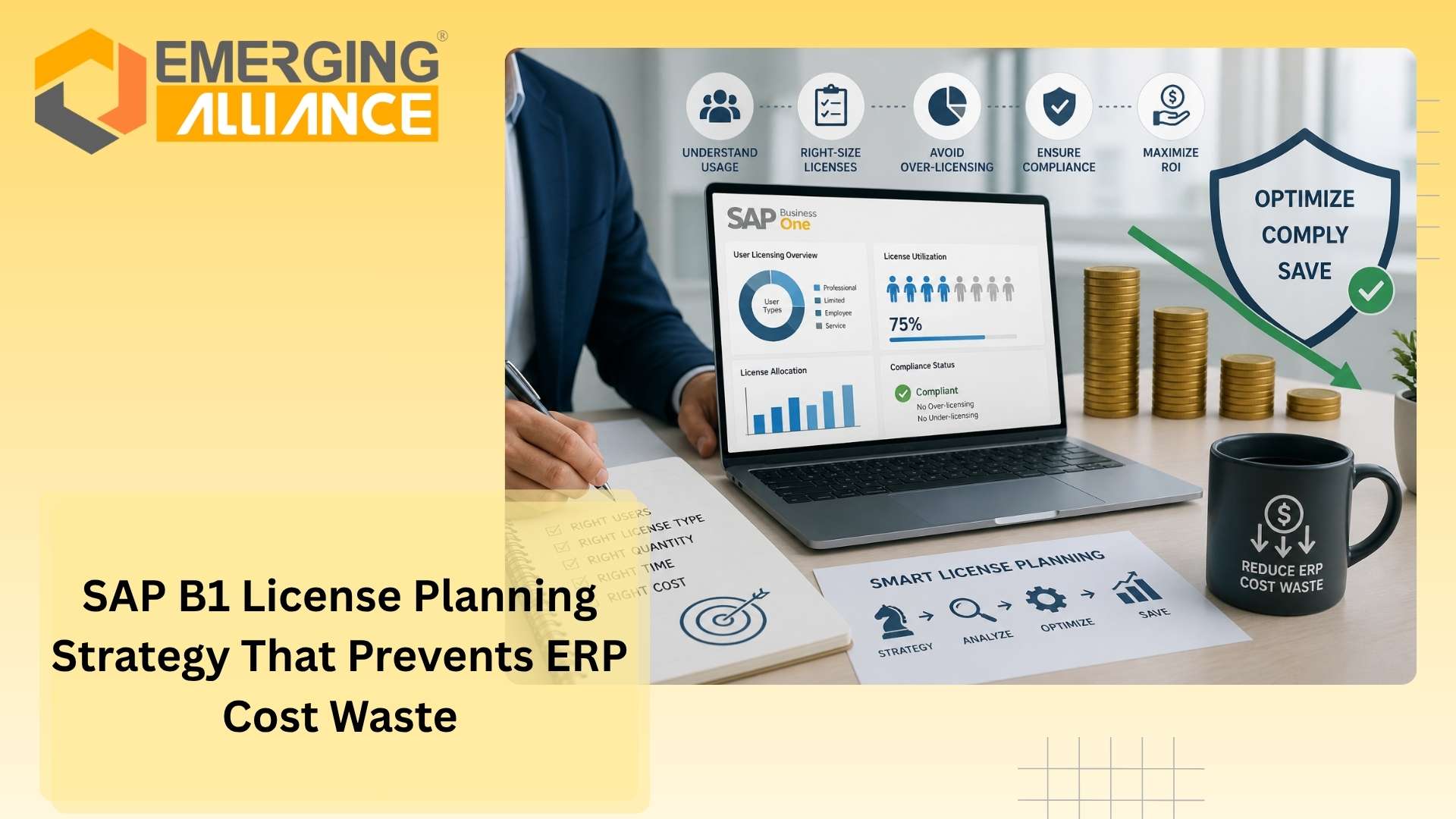
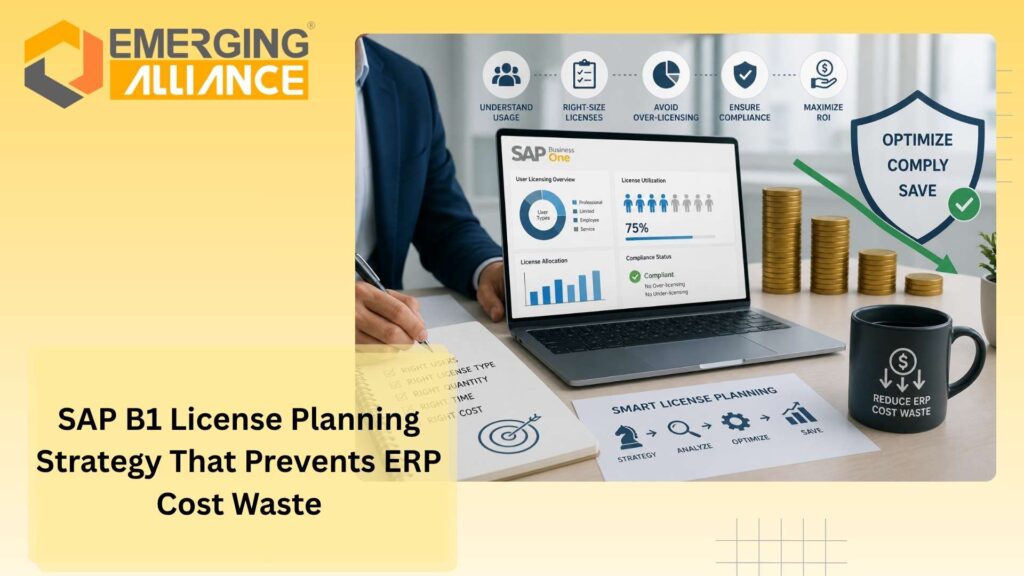
SAP B1 License Planning Strategy That Prevents ERP Cost Waste
Optimize SAP Business One licensing for growth, control, and long-term ROI without overspending
Most companies don’t overspend on ERP because the software is expensive. They overspend because their SAP B1 License strategy was never designed for scale.
Licenses are often assigned reactively:
- Everyone gets Professional access
- Departments inherit incorrect user types
- Upgrades happen without utilization reviews
- Growth adds users faster than governance evolves
Initially, this seems harmless.
But over time, it creates:
- Rising SAP Business One license cost
- Unused high-value licenses
- Compliance exposure
- Poor user adoption
- Operational inefficiency
For growing enterprises, SAP Business One Licensing is not an administrative task anymore. It directly impacts profitability, scalability, and ERP ROI.
Organizations that treat licensing strategically reduce long-term ERP costs while improving operational efficiency.
That is where a structured SAP B1 License planning model becomes critical.
Why SAP B1 License Planning Is a Strategic Business Decision
A SAP Business One License determines more than system access.
It defines:
- Who can access operational intelligence
- How efficiently departments collaborate
- Whether growth can happen without cost spikes
- How scalable your ERP architecture becomes
This is why CIOs and CFOs increasingly evaluate SAP Business One licensing as part of digital transformation governance—not procurement.
A poorly designed licensing structure silently creates:
- License inflation
- Process bottlenecks
- Duplicate workflows
- Security and compliance risks
- Low ERP utilization rates
A properly optimized SAP B1 License model ensures:
- Predictable cost control
- Efficient resource allocation
- Better adoption across teams
- Long-term scalability
Understanding SAP Business One License Types Properly
One of the biggest mistakes organizations make is misunderstanding the Types of SAP Business One Licenses.
Not every employee requires full ERP access.
The goal is to align licenses with operational responsibility.
SAP Business One Professional User License
The SAP Business One Professional User License provides complete system functionality across:
- Finance
- Sales
- CRM
- Purchasing
- Inventory
- Reporting
- Administration
This license is ideal for:
- CXOs
- Finance controllers
- ERP administrators
- Decision-makers
- Power users
However, assigning this license unnecessarily becomes one of the fastest ways to inflate SAP B1 license cost.
SAP B1 Limited User License
A SAP B1 Limited User License is role-specific and significantly more cost-efficient.
Common variants include:
Limited Financials User
Best suited for:
- Accountants
- Finance operations teams
- AP/AR staff
Limited Logistics User
Ideal for:
- Warehouse teams
- Inventory controllers
- Procurement users
Limited CRM User
Designed for:
- Sales teams
- Customer management
- Lead tracking operations
This structure allows enterprises to scale efficiently without excessive licensing costs.
SAP Business One Starter Package License
The SAP Business One Starter Package User is designed for:
- Small operational teams
- Entry-level ERP deployments
- Early-stage business functions
While cost-efficient initially, organizations must strategically plan transitions from:
- Starter Package User → Limited User
- Limited User → Professional User
Without proactive planning, growth creates disruption and licensing inconsistencies.
The Hidden Reasons SAP Business One License Costs Escalate
Most organizations underestimate how quickly SAP Business One license price structures can expand.
The problem is rarely the software itself.
The real issue is uncontrolled license governance.
Common causes include:
1. Over-Provisioning Users
Organizations frequently assign Professional User Licenses to employees who only require limited access.
This creates:
- License waste
- Higher renewal costs
- Poor utilization efficiency
2. Lack of License Audits
Without regular utilization reviews:
- Inactive licenses remain assigned
- Duplicate access accumulates
- Former employee licenses stay active
Over time, this silently increases SAP Business One Software License Cost in India.
3. Unplanned Expansion
Growth without licensing strategy creates:
- Emergency upgrades
- Budget spikes
- Infrastructure inefficiencies
Scalable ERP growth requires phased license planning.
4. Incorrect Vendor Advisory
Some providers focus only on selling licenses—not optimizing them.
A strategic SAP Business One License provider in India should help you:
- Model long-term costs
- Predict future expansion
- Optimize role allocation
- Reduce unnecessary upgrades
How to Optimize SAP B1 License Cost Without Reducing Capability
Reducing SAP B1 license cost does not mean restricting users.
It means improving alignment.
Best Practices for SAP Business One Licensing Optimization
Map licenses to workflows—not job titles
Departments often have varied operational needs within the same role.
Use Professional Licenses selectively
Reserve full-access licensing for power users only.
Review utilization quarterly
Monitor inactive or underused licenses regularly.
Plan upgrades proactively
Avoid reactive scaling decisions.
Standardize governance policies
Create internal ERP access frameworks for every department.
This creates a licensing environment where cost grows proportionally with operational value.
SAP Business One License Cost in India: What Enterprises Must Know
SAP Business One license cost in India varies significantly based on:
- User count
- License mix
- Cloud vs on-premise deployment
- Add-ons
- Industry-specific customization
- Implementation complexity
Typical pricing structures include:
| License Type | Estimated Cost Range |
| Professional User License | ₹1.5L – ₹3.5L per user |
| Limited User License | ₹60K – ₹1.2L per user |
| AMC | ~20% annually |
| Implementation | ₹8L – ₹25L+ |
However, the actual cost risk is not initial licensing.
It is long-term inefficiency caused by poor planning.
A well-optimized SAP Business One Licensing structure can significantly reduce:
- Operational waste
- ERP expansion costs
- Upgrade dependency
- Administrative complexity
When Should Enterprises Upgrade SAP Business One Licenses?
License upgrades should happen strategically—not emotionally.
Key indicators include:
Cross-Functional Operations Increase
Users begin working across finance, inventory, and reporting simultaneously.
Real-Time Analytics Become Critical
Executives require broader visibility and dashboard access.
Multi-Location Growth
Expansion introduces operational complexity that limited licenses may not support effectively.
Advanced Workflow Requirements
Automation and approvals often require broader access permissions.
A roadmap-driven upgrade model ensures scalability without financial shock.
Why Enterprises Choose Emerging Alliance for SAP Business One Licensing
At Emerging Alliance, we do not treat SAP Business One Licensing as a transactional sale.
We approach it as a long-term ERP governance strategy.
Our methodology includes:
- Operational workflow analysis
- Role-based license mapping
- Future scalability planning
- License utilization optimization
- Cost governance modeling
- ERP growth architecture planning
This helps enterprises:
- Avoid over-licensing
- Improve ERP ROI
- Scale predictably
- Reduce long-term ERP costs
As a strategic SAP Business One License provider in India, we help organizations transform ERP licensing from a cost center into a scalable operational asset.
Executive Guide to SAP Business One License Planning for Cost Control and Scale
If your organization plans to buy SAP Business One License solutions or optimize an existing deployment, the biggest risk is not underinvestment.
It is uncontrolled ERP cost expansion caused by poor licensing architecture.
Emerging Alliance helps enterprises build:
- Scalable SAP Business One Licensing frameworks
- Predictable ERP cost structures
- Efficient user access models
- Long-term digital transformation readiness
FAQs on SAP B1 License Strategy
1. What factors affect SAP Business One license cost?
User count, license type mix, deployment model, add-ons, and implementation complexity primarily influence pricing.
2. What is the difference between Professional and Limited User Licenses?
Professional Licenses provide complete ERP access, while Limited User Licenses are restricted to specific operational functions.
3. How can businesses reduce SAP B1 license cost?
By optimizing user allocation, auditing utilization, and avoiding unnecessary Professional License upgrades.
4. Is SAP Business One licensing scalable for growing enterprises?
Yes. SAP Business One Licensing is highly scalable when planned strategically with phased growth models.
5. What is the best SAP Business One license type for warehouse teams?
Limited Logistics User Licenses are typically best suited for warehouse and inventory operations.
6. Should every employee receive a Professional User License?
No. Over-assigning Professional Licenses significantly increases long-term ERP costs.
7. How often should SAP Business One licenses be reviewed?
Quarterly or during major operational expansion phases.
8. Can SAP B1 Starter Package Users be upgraded later?
Yes. Organizations commonly upgrade from Starter Package to Limited or Professional Licenses as they grow.
9. Why is license governance important in SAP Business One?
Poor governance leads to over-licensing, compliance risks, and inefficient ERP utilization.
10. How do I choose the right SAP Business One License provider in India?
Choose a partner that focuses on strategic optimization, scalability planning, and long-term ERP governance—not just license sales.
Connect with Emerging Alliance to build a future-ready SAP B1 License strategy designed for operational scale, governance, and measurable ROI.