
Are Your Business Systems Limiting Growth? Evaluate SAP B1 Modules
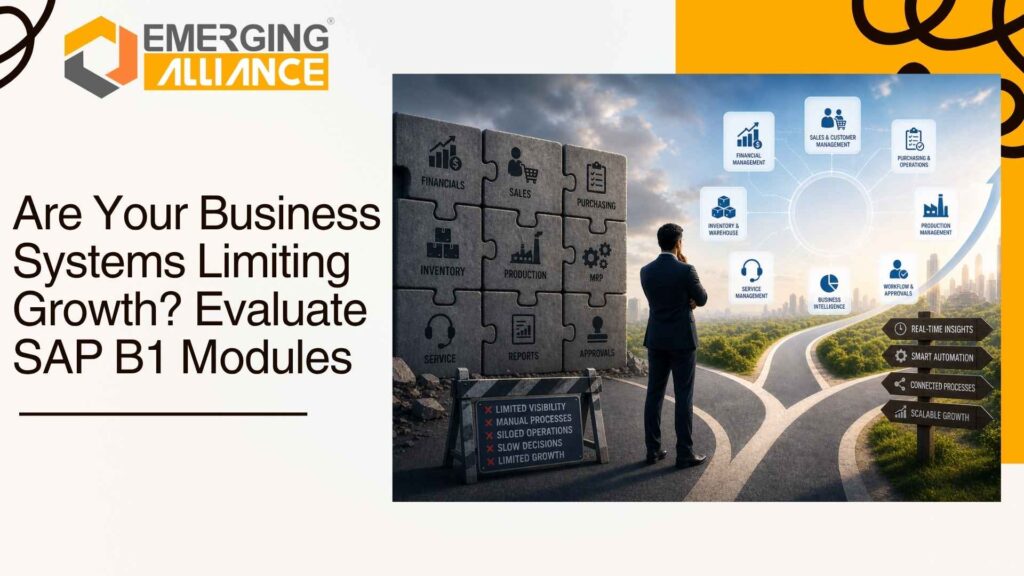
How SAP Business One system components unlock revenue scalability
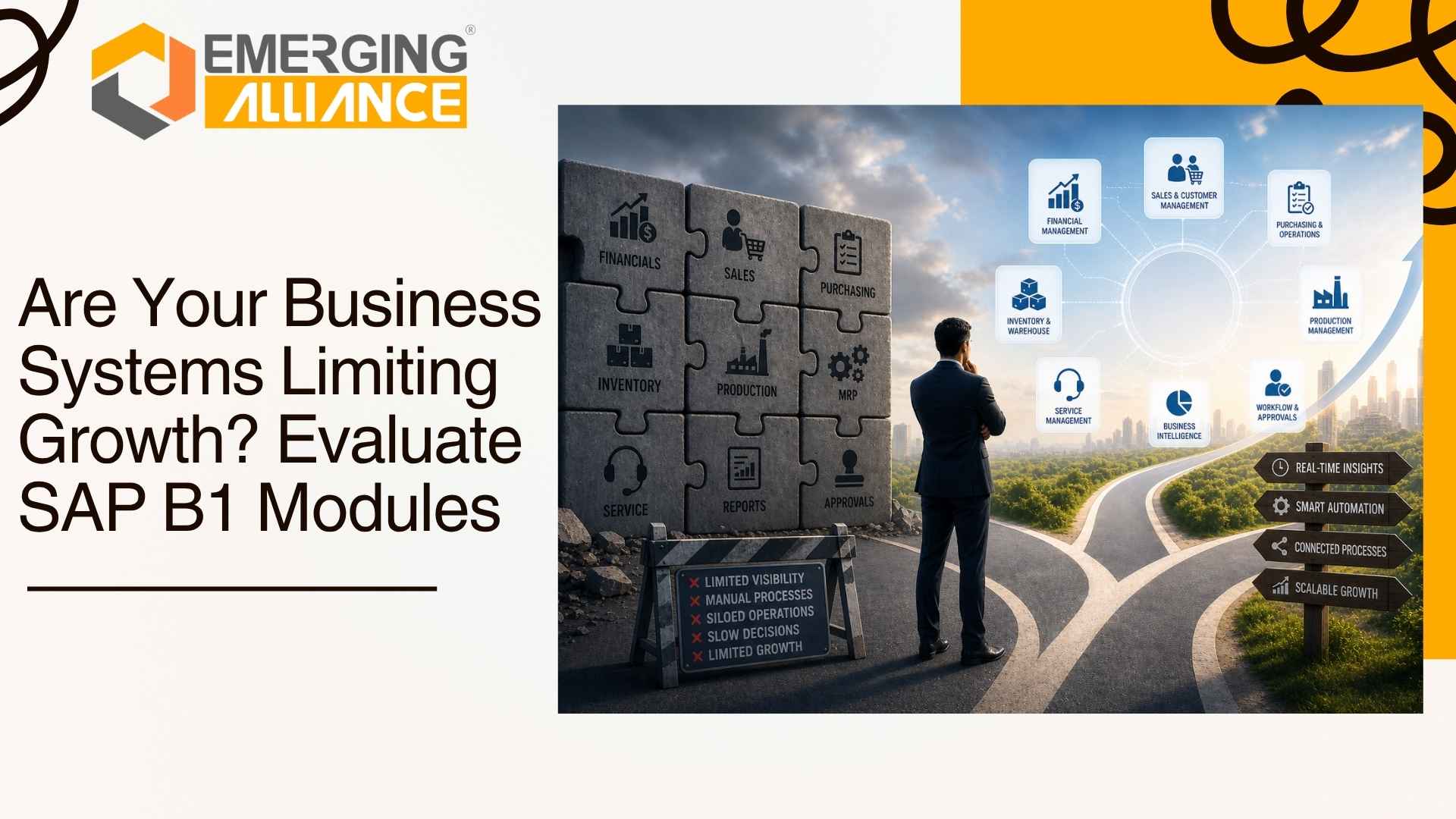
Most enterprises don’t outgrow their ERP because of size—they outgrow it because of structure. What initially works as a functional system often becomes a constraint when growth accelerates. Fragmented workflows, delayed insights, and rigid processes start to surface. At that point, the issue isn’t whether you have ERP—it’s whether your ERP modules are architected for scale. This is precisely where SAP B1 Modules demand a more strategic evaluation. The conversation should shift from “what modules are implemented” to “how effectively these modules drive revenue, efficiency, and risk control.”
Why SAP Business One modules determine growth velocity
Not all ERP systems fail visibly. Many continue running while silently limiting decision speed, operational agility, and margin optimization. The key modules of SAP Business One are designed to prevent this stagnation—if implemented with intent.
A properly structured SAP B1 ERP modules ecosystem creates:
- Real-time operational visibility
- Predictable financial reporting
- Cross-functional data synchronization
- Faster decision cycles
However, when businesses implement modules reactively instead of strategically, even the best SAP Business One modules underperform.
Evaluating SAP B1 ERP components for measurable ROI
ROI from ERP is rarely immediate—it compounds over time through process efficiency, cost control, and decision accuracy. The real question is whether your current configuration of sap business one modules is optimized for these outcomes.
High-performing enterprises typically evaluate ERP modules against three metrics:
Revenue Enablement
Does your system accelerate deal closure and customer lifecycle management? The SAP Business One sales module and integrated CRM modules should provide pipeline transparency and forecasting accuracy.
Cost Optimization
Your SAP B1 finance module should go beyond accounting. It must actively support margin tracking, cost allocation, and financial planning—key to ERP modules ROI.
Operational Efficiency
Modules such as SAP B1 inventory management and SAP B1 supply chain module should eliminate bottlenecks, not create them.
If these outcomes are inconsistent, your ERP architecture—not your business strategy—is likely the constraint.
SAP Business One modules for manufacturing scalability
Manufacturing environments expose ERP inefficiencies faster than any other industry. Complex workflows, production variability, and quality dependencies require tightly integrated systems.
The SAP Business One modules for manufacturing are built to handle this complexity. Specifically:
- The SAP B1 manufacturing module enables production planning, BOM management, and shop floor control.
- The SAP B1 quality management module ensures compliance and reduces rework risks.
- Integrated supply chain and inventory capabilities prevent material shortages and excess stock.
Organizations leveraging the best SAP Business One modules for manufacturing 2025 are not just digitizing processes—they are engineering predictability into operations.
How SAP B1 integration modules eliminate operational silos
One of the most overlooked growth barriers is system fragmentation. Disconnected applications lead to inconsistent data, manual reconciliation, and delayed insights.
This is where SAP B1 integration modules play a critical role. They unify:
- Finance and operations
- Sales and inventory
- Procurement and production
The result is a single source of truth—essential for scaling without increasing operational complexity.
Real-time visibility through SAP B1 modules for decision intelligence
Growth-stage companies often struggle with delayed reporting. By the time insights are available, decisions are already outdated.
SAP B1 modules for real-time analytics transform this dynamic. Executives gain:
- Live financial dashboards
- Inventory movement tracking
- Sales performance insights
This is not just about visibility—it’s about decision velocity. Organizations that act faster outperform those that simply analyze better.
Cloud-enabled SAP Business One modules for SME scalability
Scalability today is inseparable from flexibility. On-premise limitations often restrict expansion, especially for SMEs aiming for multi-location or global operations.
SAP B1 cloud modules for SMEs offer:
- Reduced infrastructure dependency
- Faster deployment cycles
- Remote accessibility
For businesses evaluating SAP Business One modules in India, cloud adoption is increasingly becoming a strategic necessity rather than a technical upgrade.
Types of SAP modules that matter for enterprise transformation
Not all modules contribute equally to growth. Understanding the types of sap modules that directly impact scalability is critical.
High-impact modules include:
- Financial management (via SAP B1 finance module)
- Supply chain optimization (SAP B1 supply chain module)
- Sales and customer management (SAP Business One sales module, CRM modules)
- Inventory and warehouse control (SAP B1 inventory management)
- Service operations (SAP Business One Service Manage)
The effectiveness of these modules depends on how well they are configured, integrated, and aligned with business objectives.
SAP Business One ERP modules for cost optimization and risk control
Cost leakage in growing enterprises often goes unnoticed until margins shrink. The right configuration of SAP Business One ERP modules for cost optimization addresses this at multiple levels:
- Procurement efficiency
- Inventory carrying costs
- Production waste
- Financial misreporting
Beyond cost, these modules significantly reduce operational risks—particularly in compliance, forecasting, and resource allocation.
Implementing SAP B1 modules: why execution matters more than selection
Choosing the right modules is only half the equation. The real differentiator lies in Implementing SAP B1 modules with precision.
Poor implementation leads to:
- Underutilized features
- Data inconsistencies
- User resistance
This is where working with a Certified SAP Business One Partner in India becomes critical. The right partner does not just deploy software—they align ERP architecture with business strategy.
Emerging Alliance positions itself in this space—not as a vendor, but as a transformation partner. The focus is on designing SAP Business One Modules in India that directly impact revenue, efficiency, and scalability.
Why Emerging Alliance SAP B1 modules approach is different
Most ERP implementations focus on system go-live. Emerging Alliance focuses on business outcomes.
Their approach to SAP B1 Modules includes:
- Strategic module selection based on growth stage
- Deep integration across business functions
- Continuous optimization post-implementation
- ROI-driven performance tracking
This ensures that your ERP evolves with your business—not against it.
FAQs for SAP B1 Modules
1. How do SAP Business One components improve scalability?
They integrate core business functions, enabling real-time decision-making and eliminating operational silos.
2. What are the key SAP B1 ERP modules every growing business needs?
Finance, supply chain, sales, CRM, and inventory management modules are essential for scalable operations.
3. Are SAP Business One manufacturing modules suitable for SMEs?
Yes, especially with cloud deployment, they provide enterprise-grade capabilities without heavy infrastructure costs.
4. How does the SAP B1 quality management module reduce risk?
It enforces compliance, tracks defects, and minimizes production errors.
5. What is the ROI of implementing SAP Business One modules?
ROI comes from cost optimization, faster decision-making, and improved operational efficiency.
6. How do SAP B1 integration capabilities improve business performance?
They unify data across departments, reducing manual errors and improving reporting accuracy.
7. Why is real-time data important in SAP Business One systems?
It enables faster, more accurate decisions, which directly impacts revenue and efficiency.
8. What industries benefit most from SAP Business One ERP modules?
Manufacturing, distribution, retail, and service industries see the highest impact.
9. How do cloud-enabled SAP Business One modules support growth?
They provide flexibility, scalability, and remote accessibility without infrastructure constraints.
10. Why work with a certified SAP Business One implementation partner?
A certified partner ensures proper configuration, integration, and long-term optimization aligned with business goals.
If your ERP feels operational but not strategic, it is time to reassess.
Growth does not slow down because of market conditions—it slows down because internal systems cannot keep up.
Apply for a free Demo of SAP Business One now and evaluate whether your current ERP architecture is enabling or restricting scale.
Engage with a Certified SAP Business One Partner in India who understands that ERP is not an IT project—it is a business growth engine.