

Pharma ERP Software Evaluation: Key Features for Business Growth
Quick Answer
When evaluating Pharma ERP Software, focus on how well the system supports real pharmaceutical manufacturing, quality, inventory, traceability, finance, and distribution processes. The right solution should connect these functions without creating excessive manual work, disconnected systems, or complex customization. Decision-makers should also examine integration, security, scalability, implementation capability, and total cost of ownership. The objective is to select an ERP platform that supports current operations while providing a practical foundation for future business growth.
Why Pharma ERP Software Selection Requires More Than Feature Comparison
Most ERP evaluations begin with a requirements document.
That approach is useful, but it can become misleading when hundreds of features receive the same level of attention.
A vendor may confirm:
- Batch management
- Production planning
- Quality management
- Inventory control
- Financial accounting
- Reporting
- Integration
- User permissions
On paper, the platform appears suitable.
The more important question is whether these capabilities work together in the way the pharmaceutical company actually operates.
For example, having batch management does not automatically mean the organization has strong end-to-end traceability.
Likewise, having a quality module does not prove that quarantined inventory is effectively controlled throughout manufacturing and warehouse transactions.
ERP selection therefore needs to move from feature availability to business-process capability.
The evaluation should answer three fundamental questions:
- Can the ERP support our current operating model?
- Can it improve control, visibility, and efficiency?
- Can it continue supporting the organization as complexity increases?
This approach helps decision-makers avoid selecting software that appears strong during a presentation but creates operational limitations after implementation.
Start with Pharmaceutical Business Requirements
Before comparing ERP vendors, organizations should define what the business actually needs the system to improve.
This may sound obvious, but many ERP projects begin with software functionality rather than operational problems.
The result is often an extensive requirements list without a clear connection to business outcomes.
A stronger approach begins by identifying existing challenges.
These may include:
- Poor visibility across production
- Spreadsheet-based planning
- Difficulty locating batch information
- Manual reconciliation between departments
- Expiry-related inventory challenges
- Disconnected quality processes
- Limited financial visibility
- Duplicate data entry
- Delayed management reporting
- Multiple disconnected business applications
The next step is determining how those issues affect the organization.
For example:
- A spreadsheet-based production-planning process may create material shortages or last-minute procurement activity.
- Disconnected quality and warehouse data may slow inventory-release decisions.
- Limited batch visibility may make investigations more time-consuming.
- Manual reconciliation between operations and finance may delay management reporting.
By connecting operational problems to business consequences, companies can evaluate ERP solutions against meaningful requirements rather than generic software capabilities.
Pharmaceutical Process Fit as the Foundation of ERP Selection
Pharmaceutical process fit should be one of the highest-priority evaluation areas.
The ERP needs to reflect how information and materials move through the organization.
A representative process may include:
Connected Pharmaceutical Process Flow
The objective is not necessarily to force every activity into one rigid workflow.
Instead, the system should create appropriate connections between related processes and records.
Evaluate Normal Operations and Exceptions
ERP demonstrations often show perfect transactions.
Real pharmaceutical operations are rarely perfect.
The system should also be evaluated against exceptions such as:
- Material rejection
- Quality hold
- Production changes
- Rework
- Stock shortages
- Near-expiry inventory
- Batch transfers
- Quantity differences
- Purchasing delays
- Unplanned production requirements
Exception handling is important because it shows whether the system can support real operating conditions.
If every exception requires a spreadsheet, email chain, offline tracker, or custom workaround, the ERP may increase operational complexity instead of reducing it.
A better evaluation question
Instead of asking:
Ask:
That produces much stronger evidence of actual system fit.
Batch Traceability and Product Genealogy
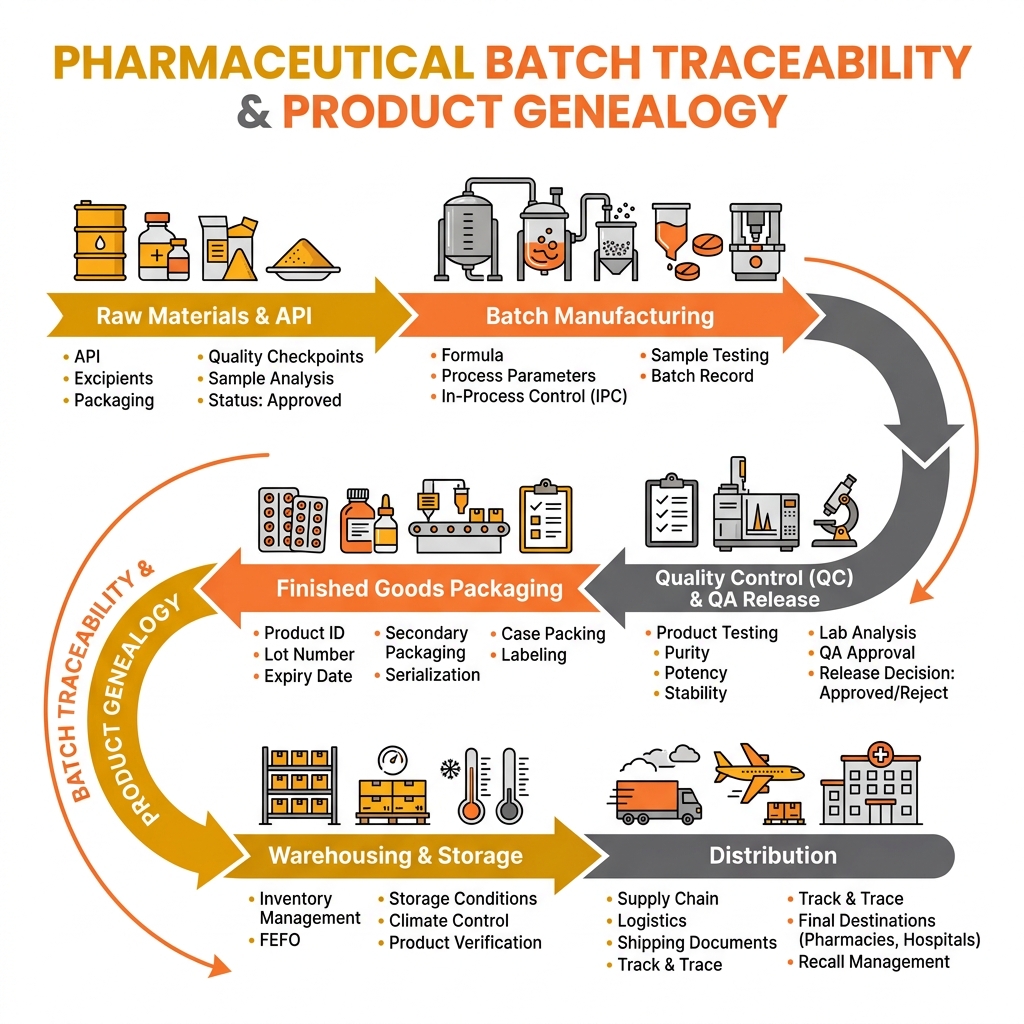
Batch and lot traceability is one of the most important capabilities to evaluate in Pharma ERP Software.
Pharmaceutical organizations need visibility into relationships between materials, production activity, inventory movements, and distribution records.
The ERP should make these relationships easier to identify.
Backward Traceability
Backward traceability helps determine what contributed to a finished batch.
Relevant information may include:
- Raw materials
- Material batches
- Suppliers
- Purchase transactions
- Production orders
- Material consumption
- Quality records
- Warehouse transactions
Forward Traceability
Forward traceability focuses on where a particular batch moved.
This may include:
- Finished products
- Warehouse locations
- Stock transfers
- Sales transactions
- Dispatch information
- Customer records
Why this matters operationally
Consider a quality investigation.
Without integrated traceability, employees may need to:
- Search purchasing records
- Locate production spreadsheets
- Review warehouse files
- Match batch references
- Identify dispatch records
- Reconstruct the transaction sequence manually
This process is slow and dependent on record accuracy.
With connected ERP records, authorized users should be able to investigate the relevant batch relationships more systematically.
This can support:
- Quality investigations
- Recall preparedness
- Warehouse accountability
- Inventory control
- Operational analysis
- Audit preparation
During ERP evaluation, decision-makers should test actual batch genealogy rather than accepting a simple confirmation that “batch tracking is available.”
Quality Management Within Everyday Operations
Quality management should not operate as an isolated layer disconnected from production and inventory.
The ERP should help quality decisions influence relevant operational activities.
For example, when inventory is awaiting quality approval, users should be able to identify its status clearly.
If material is rejected or quarantined, appropriate operational controls should apply.
Areas to examine include:
- Incoming material inspection
- Quality status
- Quarantine
- Release controls
- Rejection
- Non-conformance records
- Approval workflows
- Quality documentation
- User authorization
- Audit history
The evaluation should also examine how quality exceptions affect inventory and production.
For example:
- Can material under quarantine be selected for production?
- Who can release the material?
- Is an approval required?
- Is the status change recorded?
- Can management determine who performed the transaction?
These questions provide much more insight than simply confirming whether the software contains a quality-management function.
ERP Supports Compliance—It Does Not Create Compliance Automatically
This distinction is particularly important in pharmaceutical ERP discussions.
A properly configured ERP can support compliance-oriented processes through:
- Structured records
- Access controls
- Approval workflows
- Audit trails
- Batch traceability
- Controlled transactions
- Documentation
- Data visibility
However, software itself does not guarantee regulatory compliance.
Compliance depends on factors such as:
- Applicable regulations
- Internal procedures
- Governance
- System validation
- Employee training
- Documentation practices
- Quality policies
- Internal controls
Decision-makers should therefore be cautious when vendors use broad phrases such as “fully compliant ERP” without explaining precisely what the system supports and what remains the responsibility of the organization.
A stronger question is:
Inventory and Expiry Management
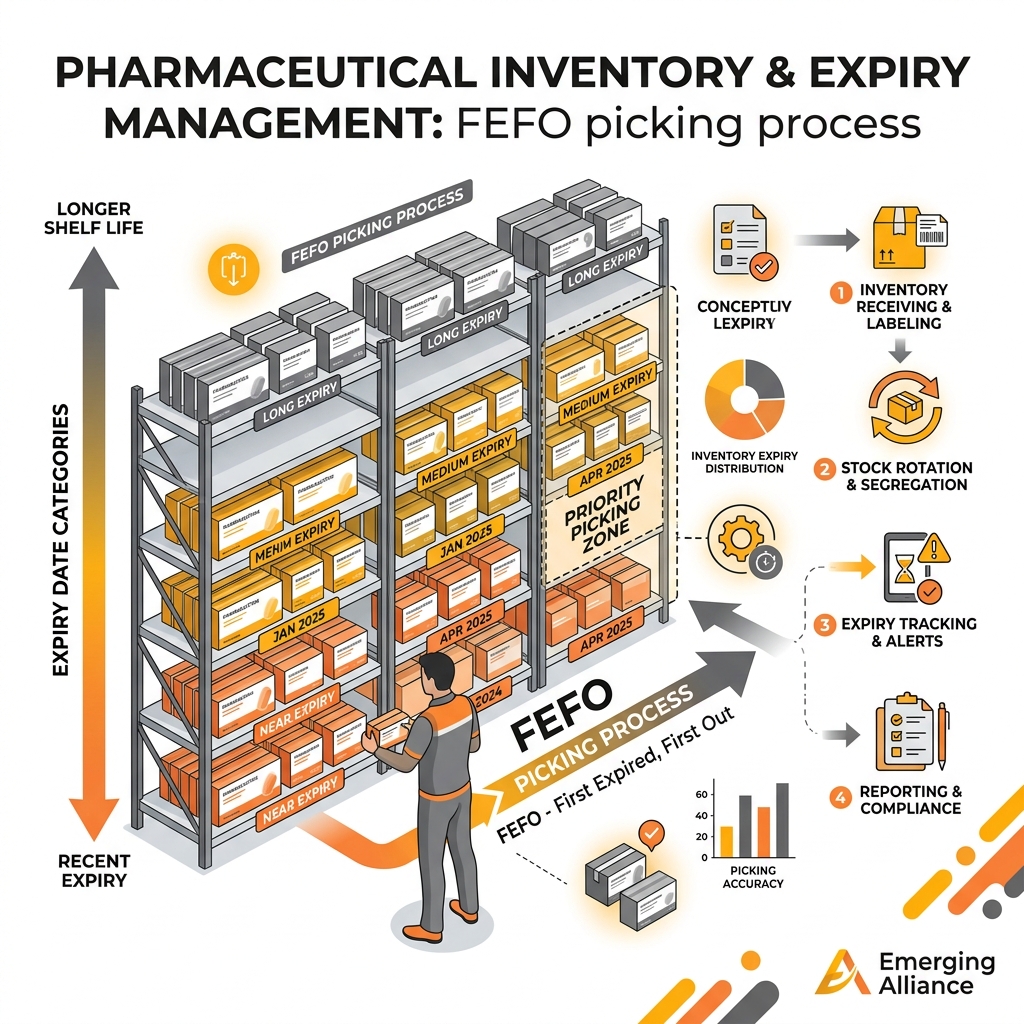
Inventory is a major working-capital and operational concern for pharmaceutical businesses.
Managing only total stock quantity is not enough.
Teams may also need visibility into:
- Batch number
- Lot number
- Expiry date
- Stock status
- Warehouse
- Storage location
- Reserved quantity
- Available quantity
- Quality status
- Transaction history
This becomes particularly important when the business manages multiple products, batches, warehouses, or distribution locations.
Near-Expiry Inventory Visibility
Near-expiry inventory can create financial and operational challenges.
If management has poor visibility, the business may discover inventory problems too late.
The ERP should make relevant expiry information accessible so teams can identify stock requiring attention.
Where appropriate, businesses may also evaluate how the software supports processes such as FEFO — First Expired, First Out.
The exact operational approach should match the organization’s product and quality requirements.
Inventory Should Connect with Other Functions
Inventory management becomes significantly more valuable when it connects with:
- Purchasing
- Quality
- Production
- Sales
- Warehouse management
- Finance
For example, production planning should consider actual material availability.
Quality status should affect whether inventory is considered usable.
Warehouse transactions should retain relevant batch information.
Financial reporting should reflect inventory values consistently.
This cross-functional connection is one of the main reasons ERP can provide more value than isolated inventory applications.
Production Planning and Material Availability
Production planning is another area where disconnected systems often create unnecessary complexity.
Manufacturing teams may maintain one planning file while procurement maintains another and warehouses operate from separate inventory data.
When these sources disagree, employees spend time reconciling information.
Pharma ERP Software should help production teams connect:
- Demand
- Production requirements
- Bills of Materials
- Material availability
- Procurement requirements
- Inventory
- Production orders
- Material consumption
- Finished goods
The goal is not simply to create production orders electronically.
The larger objective is to improve coordination between planning, procurement, inventory, and manufacturing.
Questions Production Leaders Should Explore
- Can planners see whether required materials are available?
- Can shortages be identified before manufacturing begins?
- How are changes in production requirements handled?
- Can procurement identify material demand originating from production?
- Can management compare planned and actual activity?
- How is material consumption recorded?
- How does finished production affect inventory?
Connecting Operations with Finance
ERP value becomes much stronger when operational transactions provide meaningful financial visibility.
For CEOs and CFOs, this is an important part of Pharma ERP Software evaluation.
Executives may need visibility into:
- Material costs
- Procurement expenditure
- Inventory valuation
- Product costing
- Production costs
- Sales revenue
- Gross margins
- Customer profitability
- Accounts receivable
- Accounts payable
- Cash-flow-related information
The key issue is not simply whether accounting functionality exists.
The question is whether operational activity connects naturally with financial reporting.
For example, if material prices increase, management should be able to understand how that change affects:
Similarly, inventory adjustments should not remain invisible to finance until someone reconciles spreadsheets at month-end.
Integrated ERP information can provide management with a clearer view of how operational decisions influence financial performance.
Management Reporting That Supports Decisions
Many ERP products advertise dashboards.
A dashboard is only useful when the underlying data is reliable and relevant to management decisions.
Executives should determine what information they actually require.
CEOs may need visibility into:
- Revenue
- Margins
- Inventory exposure
- Production performance
- Business growth
- Working-capital indicators
CFOs may focus on:
- Costs
- Inventory valuation
- Receivables
- Payables
- Profitability
- Financial performance
Operations leaders may require:
- Production status
- Material availability
- Warehouse activity
- Quality holds
- Inventory levels
Supply-chain teams may monitor:
- Procurement requirements
- Supplier activity
- Stock availability
- Inventory movements
- Demand
The ERP should support these requirements without forcing teams to repeatedly export data into spreadsheets to create basic management reports.
Integration Readiness in Pharma ERP Software
Modern pharmaceutical businesses often operate several specialized applications.
The ERP may therefore need to exchange data with systems such as:
- CRM
- Barcode applications
- E-invoicing platforms
- Banking systems
- Payment platforms
- Customer portals
- Supplier applications
- Business intelligence tools
- Other operational systems
Integration capability should be evaluated at an architectural level.
Simply hearing “we have APIs” is not sufficient.
Examine the Complete Data Flow
For every major integration, determine:
- What data moves?
- In which direction?
- How frequently?
- Which system owns the master record?
- How is authentication handled?
- What happens when an integration fails?
- How are errors identified?
- Who maintains the interface?
- Will customization be required?
This becomes increasingly important as the business grows.
Poorly designed integrations can create duplicate records, incorrect information, manual reconciliation, and difficult long-term maintenance.
Data Governance, Security, and User Access
ERP systems contain financially and operationally sensitive information.
Security therefore needs to be evaluated as part of the business process—not only as an IT requirement.
Review whether the proposed system can provide appropriate controls over:
- User access
- Roles
- Permissions
- Transaction approval
- Administrative privileges
- Sensitive information
- Audit history
Different roles should receive access based on business responsibility.
A warehouse employee, production planner, finance executive, and system administrator should not necessarily have the same authority.
Decision-makers should particularly examine sensitive transactions such as:
- Inventory adjustment
- Quality-status changes
- Pricing changes
- Financial postings
- Master-data changes
- Approval overrides
The system should make accountability clear while avoiding overly complicated access structures that prevent users from completing legitimate work.
Evaluating Pharma ERP Software for Future Growth
ERP selection should reflect both current requirements and realistic future plans.
A pharmaceutical company may begin with one manufacturing location and later add:
- New plants
- Warehouses
- Product lines
- Distribution channels
- Users
- Legal entities
- Geographic markets
These changes can significantly alter system requirements.
Decision-makers should explore realistic future scenarios before selecting a platform.
Scenario 1: New Warehouse
Determine what would be required to add another warehouse. Would new configuration, licensing, integrations, or reporting changes be required?
Scenario 2: Additional Manufacturing Facility
Evaluate whether production, inventory, finance, and reporting structures can accommodate another plant.
Scenario 3: Transaction Growth
Discuss how increased transaction volumes may affect performance, infrastructure, administration, or cost.
Scenario 4: Acquisition
Understand how another business entity could be incorporated into the ERP environment.
These conversations help expose long-term limitations that may not appear during a standard product demonstration.
Customization: Necessary Flexibility or Future Technical Debt?
Some customization is common in ERP implementation.
The problem begins when excessive customization becomes necessary simply to support fundamental business processes.
Every custom development can introduce additional requirements for:
- Design
- Development
- Testing
- Documentation
- Maintenance
- Support
- Future upgrades
Decision-makers should therefore distinguish between:
- Business-critical differentiation: A process genuinely requires unique functionality because it provides operational or competitive value.
- Avoidable customization: The organization attempts to replicate every legacy process even when a simpler standard ERP process could achieve the same business outcome.
The second scenario can increase cost without creating equivalent value.
When customization is proposed, ask:
- Why is it required?
- Is configuration possible instead?
- What happens during future upgrades?
- Who maintains the customization?
- What is the long-term cost?
These questions help control unnecessary technical debt.
Understanding the True Cost of Pharma ERP Software
ERP cost extends beyond the software license or subscription.
A realistic financial evaluation should consider the complete lifecycle.
Initial Costs
Potential initial investments include:
- Software
- Implementation
- Configuration
- Customization
- Data migration
- Integration
- Infrastructure
- Training
Recurring Costs
Ongoing costs may include:
- Subscription or maintenance
- Hosting
- Support
- Integration services
- Additional users
- Infrastructure
- Backup or security services
Growth-Related Costs
Future expansion may create further costs involving:
- New users
- New sites
- Additional modules
- Additional integrations
- Larger infrastructure requirements
- Increased support requirements
A lower initial quotation does not necessarily indicate a lower long-term investment.
Executives should compare total cost of ownership rather than simply comparing license prices.
Implementation Capability Can Change the ERP Outcome
ERP software alone does not deliver transformation.
Implementation quality strongly influences whether the system produces the expected business value.
A capable implementation partner should understand both technology and business processes.
Evaluate experience across:
- Pharmaceutical process discovery
- Solution architecture
- Configuration
- Data migration
- Integration
- Testing
- User acceptance testing
- Training
- Go-live preparation
- Post-go-live support
Process Discovery Deserves Special Attention
A strong implementation team should understand how the organization currently operates before configuring the ERP.
This includes identifying:
- Current workflows
- Bottlenecks
- Manual processes
- Approval requirements
- Data dependencies
- System integrations
- Reporting needs
Without proper process discovery, ERP implementation can simply digitize inefficient processes.
Data Migration as a Business Risk
Data migration is sometimes treated as a technical task that occurs near go-live.
It should be considered much earlier.
Poor-quality ERP data can undermine even a well-configured system.
Organizations may need to review:
- Customer master data
- Supplier records
- Item master data
- Bills of Materials
- Batch information
- Inventory balances
- Financial opening balances
- Pricing
- User information
Migration planning should identify:
- What information will move?
- What information should be cleaned?
- What historical data is actually required?
- Who validates migrated information?
- How will discrepancies be resolved?
Good data governance before implementation can reduce problems after go-live.
User Adoption and Operational Simplicity
A technically powerful ERP can still underperform when employees find it difficult to use.
User adoption therefore deserves consideration during evaluation.
Decision-makers should observe how many steps routine activities require.
For example:
- Receiving material
- Creating production orders
- Recording consumption
- Performing warehouse transfers
- Approving transactions
- Viewing reports
Complex workflows increase the risk that employees bypass the system or create their own tracking processes.
User experience does not mean simplifying every control.
Pharmaceutical organizations still need appropriate governance.
The objective is to create a balance between control and usability.
Converting ERP Requirements Into Business Value
Once the organization understands the required capabilities, the next step is connecting them to measurable business outcomes.
Instead of writing:
Define the problem:
Then establish the expected improvement:
The same approach can be applied across other areas.
| Current Problem | ERP Capability | Expected Business Impact |
|---|---|---|
| Manual production planning | Integrated production planning | Better coordination of materials and manufacturing |
| Limited batch visibility | Batch genealogy | Faster operational investigation |
| Spreadsheet-based inventory tracking | Integrated inventory management | Improved stock visibility |
| Disconnected quality status | Quality-integrated inventory controls | Better operational control |
| Manual financial reconciliation | Integrated finance | Faster management visibility |
| Multiple data sources | Centralized ERP information | More consistent decision-making |
This approach makes ERP requirements easier to justify to executive stakeholders.
What Should Executives Ask Before Approving Pharma ERP Software?
Before final approval, leadership should be able to answer several strategic questions.
Does the ERP Fit the Business?
The system should support important pharmaceutical workflows without excessive workarounds.
Will It Improve Operational Control?
Management should gain stronger visibility across batches, inventory, quality, production, and transactions.
Will Information Become More Connected?
Departments should rely less on isolated spreadsheets and manual reconciliation.
Can Management Make Better Decisions?
Executives should receive useful operational and financial visibility.
Can the Architecture Support Growth?
Expansion should not require complete system redesign.
Is the Implementation Approach Credible?
The project should have clear responsibilities, methodology, resources, and timelines.
Is the Long-Term Cost Acceptable?
Decision-makers should understand implementation and recurring costs, not just the initial quotation.
A weakness in one area does not automatically disqualify an ERP. However, major gaps should be understood and addressed before contractual commitment.
After reviewing these evaluation questions, executives should also identify warning signs that could indicate operational, technical, or financial risks before making a final ERP decision.
Common Warning Signs During Pharma ERP Evaluation
Several patterns deserve additional investigation.
The demonstration remains too generic
The vendor repeatedly shows standard ERP screens but does not address pharmaceutical workflows.
Critical processes require spreadsheets
Important information still needs to be maintained externally.
Customization becomes the answer to every requirement
This may indicate poor standard-process fit.
Batch genealogy cannot be clearly shown
The vendor demonstrates batch numbers but not connected traceability.
Reporting depends heavily on Excel
Management still needs substantial manual preparation before information becomes useful.
Integration explanations remain vague
The vendor confirms integrations are possible without explaining architecture or responsibility.
Costs are fragmented
Implementation, support, integrations, and recurring expenses are not presented clearly.
The implementation team lacks pharmaceutical experience
Generic ERP knowledge may not be enough for process-intensive pharmaceutical operations.
These signals should trigger deeper investigation rather than immediate rejection.
The objective is to understand the underlying risk and determine whether it can be addressed.
Conclusion: Selecting Pharma ERP Software for Sustainable Business Growth
Choosing Pharma ERP Software should not be reduced to selecting the product with the longest feature list.
The stronger approach is to determine whether the ERP can connect the pharmaceutical company’s most important business processes and improve how information moves across operations.
Decision-makers should evaluate:
- Pharmaceutical process fit
- Batch traceability
- Quality control
- Inventory and expiry management
- Production planning
- Financial visibility
- Reporting
- Integration
- Security
- Scalability
- Total cost
- Implementation capability
The right ERP should solve current operational challenges without creating unnecessary complexity and provide a credible path for future expansion.
Most importantly, the evaluation should remain connected to business outcomes.
The goal is not simply to implement new software.
The goal is to create a stronger operational foundation for control, visibility, decision-making, and sustainable pharmaceutical business growth.
Frequently Asked Questions About Pharma ERP Software
Evaluate Pharma ERP Software Against Your Actual Business Requirements
If your pharmaceutical business is evaluating ERP solutions, Emerging Alliance can help assess your manufacturing processes, inventory requirements, batch traceability, integrations, reporting needs, and implementation priorities.
Request a personalized Pharma ERP Software consultation or product demonstration to evaluate the right ERP approach for your pharmaceutical business.