
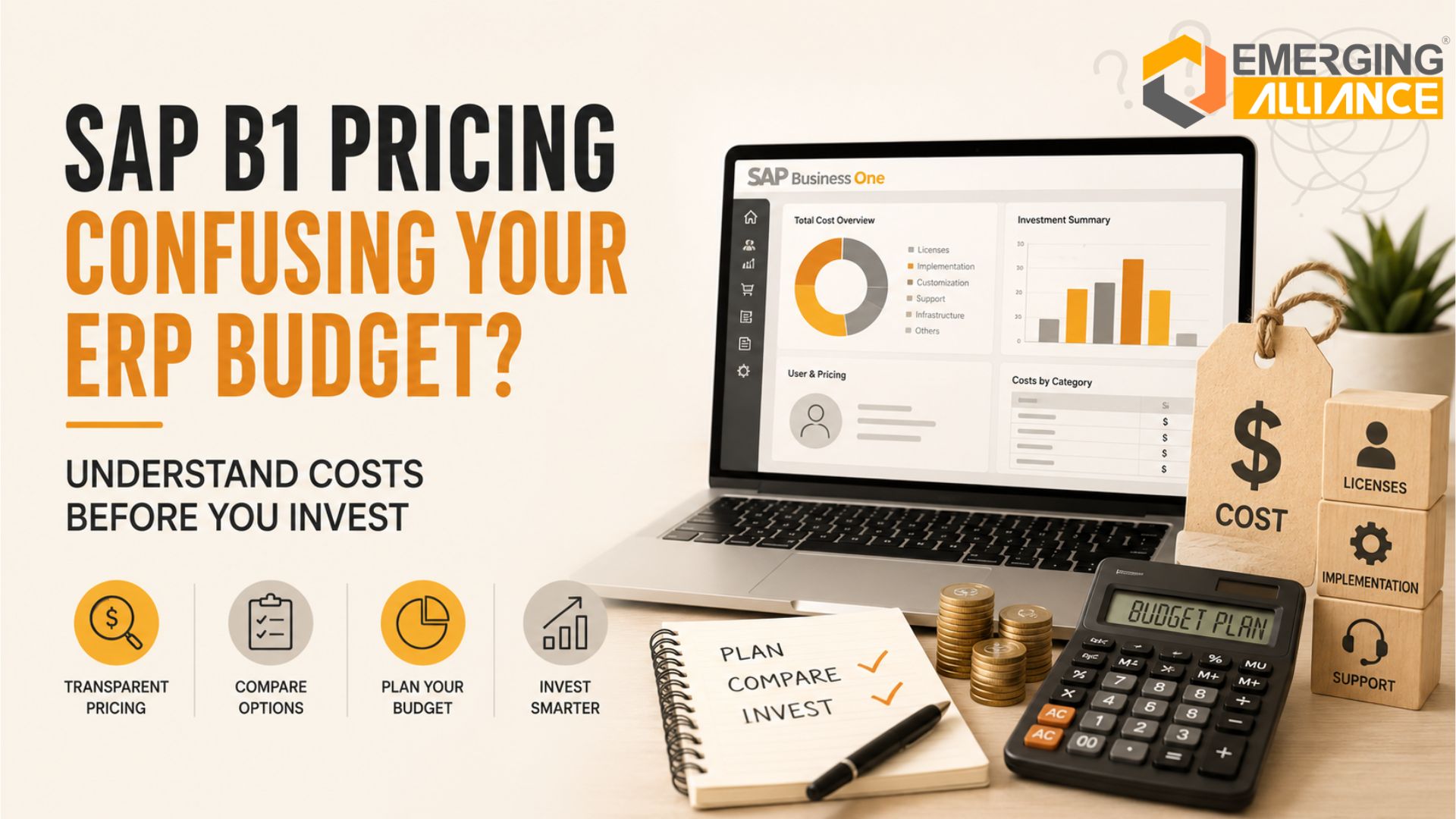
SAP B1 Pricing Confusing Your ERP Budget? Understand Costs Before You Invest
ERP Budget Planning Faces Cost Uncertainty. SAP B1 Pricing Brings Complete Cost Transparency.
Investing in an ERP system is a strategic decision that affects every aspect of business operations—from finance and supply chain to customer service and compliance. Yet for many organizations, one question delays ERP adoption more than any other: What is the actual SAP B1 Pricing?
The answer isn’t always straightforward. Unlike off-the-shelf software with fixed subscription fees, SAP Business One Pricing depends on several business-specific factors, including licensing, deployment model, implementation scope, integrations, user requirements, and long-term support. Without understanding these variables, organizations often underestimate the total investment, leading to budget overruns, project delays, or missed business objectives.
For CEOs, CIOs, CTOs, CFOs, Operations Heads, and Digital Transformation Leaders, ERP budgeting should extend beyond software costs. It should focus on long-term business value, operational efficiency, scalability, compliance, and return on investment.
This guide explains the key components that influence SAP B1 Pricing, outlines what businesses should include in their ERP budget, and provides practical insights to help decision-makers invest with confidence.
SAP B1 Pricing Breakdown
Understanding SAP B1 Pricing begins with recognizing that ERP investment is not limited to software licenses. The total cost reflects the complete journey—from planning and implementation to optimization and long-term business growth.
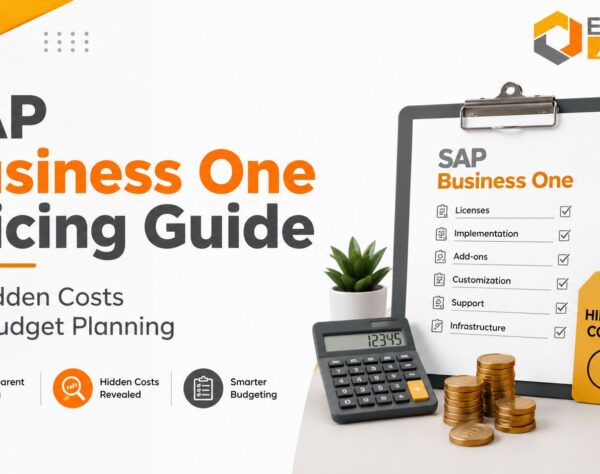
A well-planned ERP budget typically includes:
- SAP Business One licenses
- Implementation services
- Business process consulting
- Data migration
- Customization
- Third-party integrations
- User training
- Ongoing support and maintenance
- Infrastructure or cloud hosting
Evaluating these components together provides a realistic picture of the investment and helps organizations avoid unexpected expenses during implementation.
SAP B1 License Cost
Licensing is one of the most significant elements of SAP B1 Cost. The number of users, access requirements, and business functions determine the overall licensing structure.
Businesses generally choose between:
Professional User Licenses
These licenses provide full access to finance, sales, purchasing, inventory, production, CRM, reporting, and analytics. They are typically assigned to department heads, finance teams, operations managers, and senior decision-makers.
Limited User Licenses
Designed for users who require access to specific business functions, these licenses help optimize costs while ensuring employees have the tools they need for their daily responsibilities.
Selecting the right mix of license types helps businesses control costs without limiting operational productivity.
SAP B1 Implementation Cost
Software licensing is only one part of the ERP investment. SAP B1 Implementation Cost varies depending on the complexity of your business processes and project requirements.
Implementation costs commonly include:
- Business process analysis
- ERP configuration
- Data migration
- Custom development
- Third-party integrations
- Testing and quality assurance
- User training
- Go-live support
Organizations with multiple business locations, manufacturing operations, complex supply chains, or industry-specific workflows generally require a more comprehensive implementation approach.
SAP B1 Pricing in India
Businesses researching SAP B1 Pricing in India often expect a standard price list. However, ERP pricing is highly dependent on business requirements rather than geography alone.
Several factors influence SAP License Cost in India, including:
Business Size
The number of employees, operational locations, and departments directly affect licensing and implementation requirements.
Industry Requirements
Manufacturing, distribution, retail, healthcare, pharmaceuticals, engineering, and professional services often require different ERP configurations, compliance capabilities, and integrations.
User Requirements
The number of users and their functional responsibilities determine the combination of Professional and Limited User licenses.
Customization and Integrations
Businesses requiring industry-specific workflows, custom reports, dashboards, e-commerce integration, CRM connectivity, or third-party applications should include these requirements in their ERP budget.
Instead of focusing only on the initial software investment, organizations should evaluate how the ERP system supports long-term operational improvements and business growth.
SAP Business One Cost Beyond Software Pricing
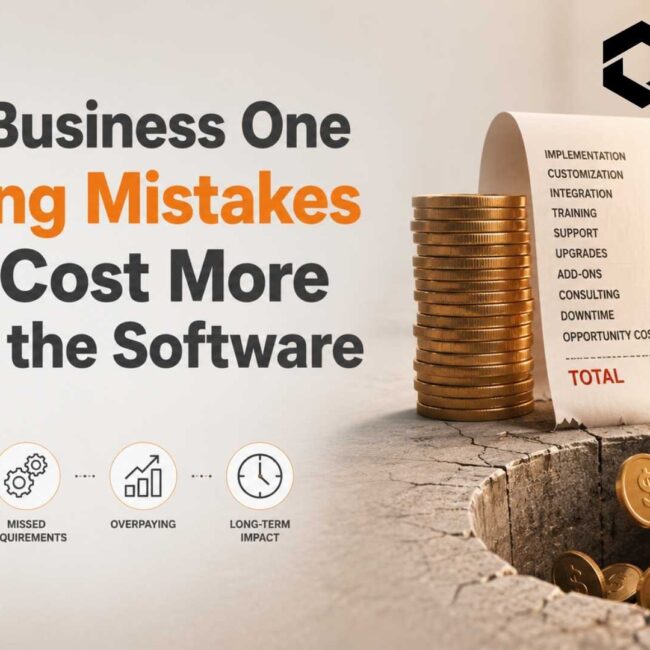
One of the most common budgeting mistakes is evaluating only the software purchase price. A successful ERP investment requires understanding the Total Cost of Ownership (TCO) over several years.
Total Cost of Ownership
An ERP budget should include:
| Investment Area | Business Impact |
| Software Licenses | ERP platform access |
| Implementation | System deployment |
| Data Migration | Business continuity |
| Training | User adoption |
| Support & Maintenance | Operational stability |
| Integrations | Connected business processes |
| Upgrades | Future scalability |
| Cloud Infrastructure | Secure and reliable operations |
Looking beyond the initial purchase helps organizations plan more accurately and reduce financial surprises.
Hidden Costs to Consider
ERP projects can become more expensive when important cost elements are overlooked. These may include:
- Additional reporting requirements
- Business process redesign
- Change management
- User adoption initiatives
- Regulatory compliance updates
- Future business expansion
- Integration enhancements
Including these factors during budget planning improves project predictability and reduces implementation risks.
Long-Term Business Value
While ERP requires a significant investment, organizations often realize measurable business outcomes through:
- Reduced manual processes
- Improved inventory accuracy
- Faster financial closing
- Better production planning
- Enhanced compliance
- Increased operational visibility
- Improved customer service
- Better executive reporting
- Lower operational costs
- More informed decision-making
The focus should always be on business value rather than software price alone.
SAP B1 Pricing Calculator and ERP Budget Planning
Many businesses search for a SAP B1 Pricing Calculator to estimate project costs before contacting an implementation partner. While online calculators provide useful starting points, they cannot account for the unique operational requirements of every organization.
Why Pricing Calculators Have Limitations
A generic calculator cannot accurately evaluate:
- Business complexity
- Existing software landscape
- Number of operational sites
- Industry compliance requirements
- Integration needs
- Future growth plans
- Process automation goals
- Reporting requirements
As a result, estimates generated through online calculators should be viewed as preliminary rather than definitive.
Building an Accurate ERP Budget
A more reliable budgeting approach includes:
- Defining business objectives
- Mapping existing processes
- Identifying operational challenges
- Determining user requirements
- Evaluating deployment options
- Planning future scalability
- Assessing integration requirements
- Consulting experienced ERP advisors
This structured approach provides greater budget accuracy and supports informed investment decisions.
SAP B1 Pricing ROI and Business Outcomes
The real value of SAP Business One Cost lies in the operational improvements it enables across the enterprise.
Operational Efficiency
Integrated business processes eliminate duplicate data entry, reduce manual work, and improve productivity across departments.
Enterprise Visibility
Real-time dashboards and centralized reporting provide executives with accurate insights for faster and more confident decision-making.
Workflow Automation
Automated approvals, purchasing, inventory management, financial processes, and reporting reduce operational bottlenecks and improve process consistency.
Compliance and Risk Management
Centralized financial controls and standardized workflows help organizations strengthen governance and support regulatory compliance.
Scalability for Growth
As businesses expand into new markets, add product lines, or increase operational complexity, SAP Business One supports scalable growth without requiring disconnected systems.
When organizations evaluate ERP investments through measurable business outcomes instead of upfront costs alone, the return on investment becomes significantly clearer.
Choosing the Right SAP Business One Partner
Selecting an ERP platform is only part of the transformation journey. The expertise of your implementation partner often determines how quickly your organization realizes business value.
A strategic ERP partner should help organizations:
- Align ERP strategy with business objectives
- Optimize end-to-end business processes
- Identify automation opportunities
- Reduce implementation risks
- Support organizational change
- Maximize user adoption
- Improve long-term system performance
This is where Emerging Alliance delivers value beyond implementation.
As a trusted digital transformation and enterprise solutions partner, Emerging Alliance works closely with organizations to design ERP strategies that improve operational efficiency, increase visibility, strengthen compliance, and enable sustainable business growth.
From ERP consulting and implementation to workflow automation, integrations, analytics, and continuous optimization, Emerging Alliance helps enterprises maximize the value of their technology investments while preparing for future growth.
Frequently Asked Questions
1. What factors influence SAP B1 Pricing the most?
The biggest factors include user licenses, deployment model, implementation scope, integrations, customization, training, and ongoing support requirements.
2. How is SAP Business One Pricing different from standard software pricing?
Unlike subscription software with fixed pricing, SAP Business One pricing is tailored to each organization’s business processes, user requirements, and implementation scope.
3. Does SAP B1 Pricing in India vary across industries?
Yes. Manufacturing, retail, wholesale distribution, pharmaceuticals, and professional services often require different ERP configurations and implementation efforts.
4. What is included in SAP B1 Implementation Cost?
Implementation typically includes business process consulting, configuration, data migration, testing, integrations, user training, and go-live support.
5. Is SAP B1 Cloud Pricing suitable for growing businesses?
Cloud deployment offers scalability, lower infrastructure costs, remote accessibility, predictable operating expenses, and simplified system management.
6. Can a SAP B1 Pricing Calculator provide an accurate project estimate?
Pricing calculators provide an initial estimate, but a detailed business assessment delivers a more accurate investment projection.
7. How can businesses optimize SAP Business One License Cost?
Organizations can optimize costs by selecting the right combination of Professional and Limited User licenses based on employee responsibilities.
8. What should businesses evaluate beyond SAP software price?
Decision-makers should consider implementation, integrations, support, training, scalability, upgrades, and total cost of ownership.
9. Why is Total Cost of Ownership important when evaluating SAP Business One Cost?
TCO helps businesses understand both initial and long-term ERP investments, enabling better financial planning and improved ROI measurement.
10. Why should organizations partner with Emerging Alliance for SAP Business One?
Emerging Alliance combines ERP expertise with digital transformation consulting, helping organizations align technology investments with business strategy, operational excellence, and long-term growth.
Plan Your SAP B1 Investment with Confidence
Choosing an ERP solution is a strategic investment that should deliver measurable business value—not financial uncertainty. Understanding SAP B1 Pricing allows organizations to build realistic budgets, evaluate long-term costs, and select the right licensing, deployment, and implementation approach for their business goals.
At Emerging Alliance, we go beyond software implementation. We help organizations transform operations through strategic ERP consulting, process optimization, automation, analytics, and scalable digital transformation solutions.
Whether you’re evaluating SAP Business One Pricing, planning your ERP roadmap, or comparing deployment options, our experts are ready to guide you through every stage of your transformation journey.
Schedule a consultation today, request a personalized SAP B1 pricing assessment, or book a live demonstration to discover how Emerging Alliance can help you maximize ROI and build a future-ready enterprise.