

SAP B1 Modules Explained How Integrated ERP Drives Business Performance
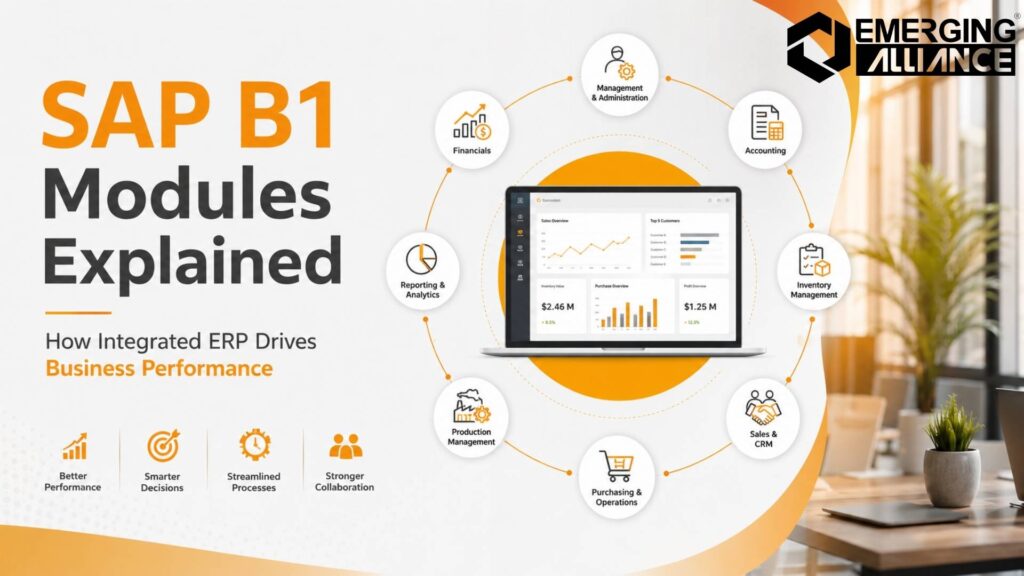
SAP B1 Modules Help Organizations Improve Visibility, Efficiency, and Operational Performance
SAP B1 Modules have become increasingly important as organizations seek greater operational visibility, process efficiency, and business agility. While many businesses focus on optimizing individual departments such as finance, sales, procurement, or inventory, sustainable business performance depends on how effectively these functions work together.
Disconnected systems, fragmented data, and manual workflows often create bottlenecks that slow decision-making, increase operational costs, and limit scalability. As organizations grow, leadership teams require real-time access to accurate information across the business to manage performance, reduce risk, and respond quickly to changing market conditions.
This shift has accelerated the adoption of integrated business management platforms that connect processes, data, and people within a single environment. By bringing critical business functions together, SAP Business One helps organizations improve visibility, automate operations, strengthen governance, and create a scalable foundation for growth. The value of SAP B1 Modules extends beyond process automation—they enable data-driven decision-making that directly supports business performance and digital transformation.
Why Business Performance Depends on More Than Individual Departments
Today’s organizations operate in an environment where speed, visibility, and agility directly influence competitiveness. Yet many businesses continue to manage finance, sales, inventory, procurement, and operations through disconnected systems and fragmented workflows.
As organizations grow, these silos create visibility gaps that make it difficult for leadership teams to access accurate information, respond to changing business conditions, and make informed decisions.
Modern enterprises increasingly recognize that business performance is no longer driven by individual departments operating independently. Instead, success depends on how effectively information flows across the organization.
Technology plays a critical role in enabling this shift. Integrated business management platforms help organizations connect processes, standardize operations, and create the visibility needed to support sustainable growth.
Key Business Drivers Behind Integrated Operations
- Faster decision-making
- Improved operational efficiency
- Greater financial visibility
- Better customer responsiveness
- Enhanced scalability
- Stronger governance and compliance
This is where SAP Business One Modules become valuable. Rather than functioning as isolated tools, they work together to create a connected business environment that supports enterprise-wide performance.
The Business Impact of Disconnected Processes and Data
Many operational challenges originate from fragmented systems rather than business strategy.
When finance, sales, procurement, inventory, and operations operate in isolation, organizations often struggle to maintain control, visibility, and efficiency.
Inefficient Workflows
Manual handoffs between departments slow execution, increase administrative effort, and create unnecessary delays across business operations.
Delayed Access to Business Information
Leadership teams frequently rely on reports that are already outdated by the time they are reviewed, limiting their ability to make proactive decisions.
Weak Forecasting and Planning
Without accurate cross-functional data, forecasting becomes reactive instead of strategic, increasing planning risks.
Increased Operational Costs
Duplicate data entry, manual reconciliations, and process inefficiencies consume valuable resources and reduce productivity.
Reduced Customer Satisfaction
Disconnected information often leads to fulfillment delays, inventory inaccuracies, service issues, and inconsistent customer experiences.
Over time, these challenges affect profitability, growth initiatives, operational agility, and overall business performance. Organizations that fail to address fragmented operations often struggle to scale efficiently.
How High-Performing Organizations Build a Connected Business Environment
Leading organizations take a different approach to operational excellence.
Rather than focusing solely on departmental improvements, they build integrated business environments where data, workflows, and decisions are connected.
Creating a Single Source of Truth
Centralized business data improves accuracy, transparency, reporting consistency, and executive decision-making.
Automating Core Business Processes
Automation reduces manual effort while improving operational efficiency, process consistency, and employee productivity.
Enabling Real-Time Reporting
Executives gain access to current performance insights rather than relying on historical reports and delayed information.
Improving Cross-Functional Collaboration
Teams work from shared information, reducing communication gaps and accelerating business execution.
Building for Future Growth
Scalable business systems enable organizations to expand operations without significantly increasing complexity or administrative overhead.
Organizations pursuing digital transformation increasingly view ERP platforms as strategic growth enablers rather than back-office systems.
How SAP B1 Modules Support End-to-End Business Performance
The strength of SAP Business One Modules lies in their ability to connect critical business functions within a unified platform.
Instead of managing multiple disconnected applications, organizations gain real-time visibility across their entire operation.
Financial Management Module
The SAP B1 Finance Module helps organizations strengthen financial control through:
- General ledger management
- Accounts payable and receivable
- Budget management
- Financial reporting
- Cash flow monitoring
- Tax and compliance management
By centralizing financial operations, organizations improve governance, reduce risk, and support faster financial decision-making.
Sales and Customer Management Module
The SAP Business One Sales Module and CRM capabilities support:
- Lead management
- Opportunity tracking
- Customer relationship management
- Sales forecasting
- Quotation management
- Order processing
- Customer service visibility
This enables organizations to improve customer engagement while maintaining greater control over revenue-generating activities.
Purchasing and Procurement Module
The SAP Business One Purchasing Module helps procurement teams streamline sourcing through:
- Purchase request automation
- Supplier management
- Procurement tracking
- Vendor performance monitoring
- Approval workflow management
Organizations can improve purchasing efficiency while reducing delays and operational disruption.
Inventory and Warehouse Management Module
SAP B1 Inventory Management capabilities provide:
- Real-time inventory visibility
- Warehouse management
- Stock transfer management
- Inventory optimization
- Batch and serial number tracking
- Goods receipt and issue processing
These capabilities help organizations reduce stock-related disruptions, improve inventory accuracy, and optimize working capital.
Production, Quality, Service, and Reporting Modules
For manufacturers and service-oriented businesses, the SAP B1 Manufacturing Module and SAP B1 Quality Management Module provide:
- Production planning
- Bill of Materials (BOM) management
- Resource allocation
- Capacity planning
- Quality control processes
- Service management
- Operational analytics
- Performance reporting
These capabilities help organizations improve consistency, operational efficiency, quality standards, and process control.
The true value of SAP B1 Modules emerges when all functions work together, enabling leadership teams to make informed decisions using real-time operational insights.
What Business Leaders Should Consider When Evaluating SAP B1 Modules
Business leaders should evaluate SAP B1 Modules based on measurable business outcomes rather than software features alone. The objective should be to identify modules that address operational bottlenecks, improve visibility, reduce risk, and support long-term growth.
Which Business Processes Require the Most Improvement?
Identify areas where inefficiencies create delays, increase costs, or limit business performance.
How Well Do Current Systems Support Growth?
Assess whether existing tools can support increasing operational complexity, transaction volumes, and future expansion.
What Level of Visibility Is Required?
Leadership teams need timely access to accurate business information to support strategic and operational decisions.
Which SAP B1 Modules Deliver the Highest Business Impact?
Prioritize modules that directly improve:
- Financial control
- Operational efficiency
- Inventory visibility
- Customer management
- Procurement performance
How Will Integrated Modules Support Long-Term Growth?
Scalability should remain a key evaluation criterion when selecting ERP capabilities.
How Can Organizations Maximize ERP ROI?
Successful ERP initiatives typically include:
- Process standardization
- User adoption planning
- Data governance
- Workflow automation
- Continuous optimization
Organizations that align ERP investments with strategic business objectives are more likely to achieve long-term value from SAP Business One.
Conclusion
Business performance is increasingly determined by how effectively organizations connect people, processes, and information. Fragmented systems create visibility gaps, operational inefficiencies, and scalability challenges that can limit growth and profitability.
SAP B1 Modules provide a connected framework that helps organizations improve financial control, streamline operations, optimize inventory, strengthen customer management, and support data-driven decision-making.
For organizations evaluating ERP modernization initiatives, the goal should not simply be software implementation. The objective should be building a scalable, integrated business environment capable of supporting long-term growth, operational excellence, and business resilience.
Organizations that treat ERP as a strategic business platform rather than a technology project are better positioned to improve agility, profitability, and long-term competitiveness.
Ready to Identify the Right SAP B1 Modules for Your Business?
Emerging Alliance helps organizations evaluate operational challenges, align ERP strategy with business goals, and implement SAP Business One solutions that deliver measurable business outcomes.
Our SAP Business One specialists can help you:
- Assess operational bottlenecks
- Identify high-impact ERP opportunities
- Improve visibility across business functions
- Strengthen compliance and governance
- Build a scalable roadmap for future growth
Frequently Asked Questions
1. How do organizations determine which SAP B1 Modules to implement first?
Organizations should prioritize SAP B1 Modules based on operational bottlenecks, reporting challenges, growth objectives, and areas where inefficiencies are affecting business performance.
2. Can SAP Business One modules be implemented in phases?
Yes. Many organizations begin with core modules such as Finance, Sales, Purchasing, and Inventory Management before expanding into Manufacturing, Quality Management, Service Management, and advanced reporting capabilities.
3. Which industries benefit most from SAP Business One Modules?
SAP Business One is widely used across manufacturing, distribution, retail, healthcare, pharmaceuticals, engineering, food processing, professional services, and trading organizations that require integrated business management.
4. How customizable are SAP Business One Modules?
SAP Business One offers extensive customization capabilities, allowing organizations to adapt workflows, reports, dashboards, approvals, and business processes to meet specific operational requirements.
5. How long does SAP Business One module implementation typically take?
Implementation timelines depend on business complexity, the number of modules deployed, data migration requirements, and integration needs. Most projects are completed in phases to accelerate adoption and reduce implementation risk.
6. How does SAP B1 Inventory Management improve operational efficiency?
SAP B1 Inventory Management provides real-time stock visibility, warehouse control, inventory optimization, and traceability features that help reduce stock shortages, excess inventory, and manual inventory processes.
7. What role does the SAP B1 Finance Module play in business performance?
The SAP B1 Finance Module improves financial visibility, reporting accuracy, cash flow management, compliance, and governance, enabling faster and more informed financial decision-making.
8. Can SAP Business One support multi-location operations?
Yes. SAP Business One helps organizations manage multiple branches, warehouses, plants, and business units through a centralized platform with consolidated visibility and reporting.
9. How do SAP Business One Modules support digital transformation initiatives?
By integrating business processes, automating workflows, and providing real-time data access, SAP Business One helps organizations modernize operations and build a scalable foundation for digital transformation.
10. Why are SAP B1 Modules considered a strategic investment?
SAP B1 Modules improve operational efficiency, strengthen governance, increase business visibility, reduce risk, and create the infrastructure required to support sustainable growth and long-term competitiveness.
Contact Emerging Alliance today to explore how SAP Business One can support your next phase of business transformation.