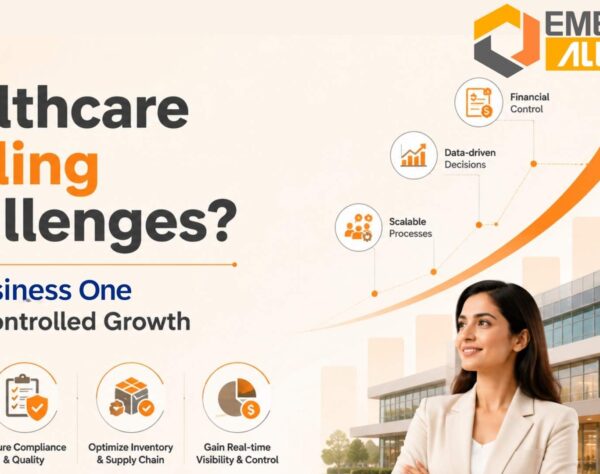

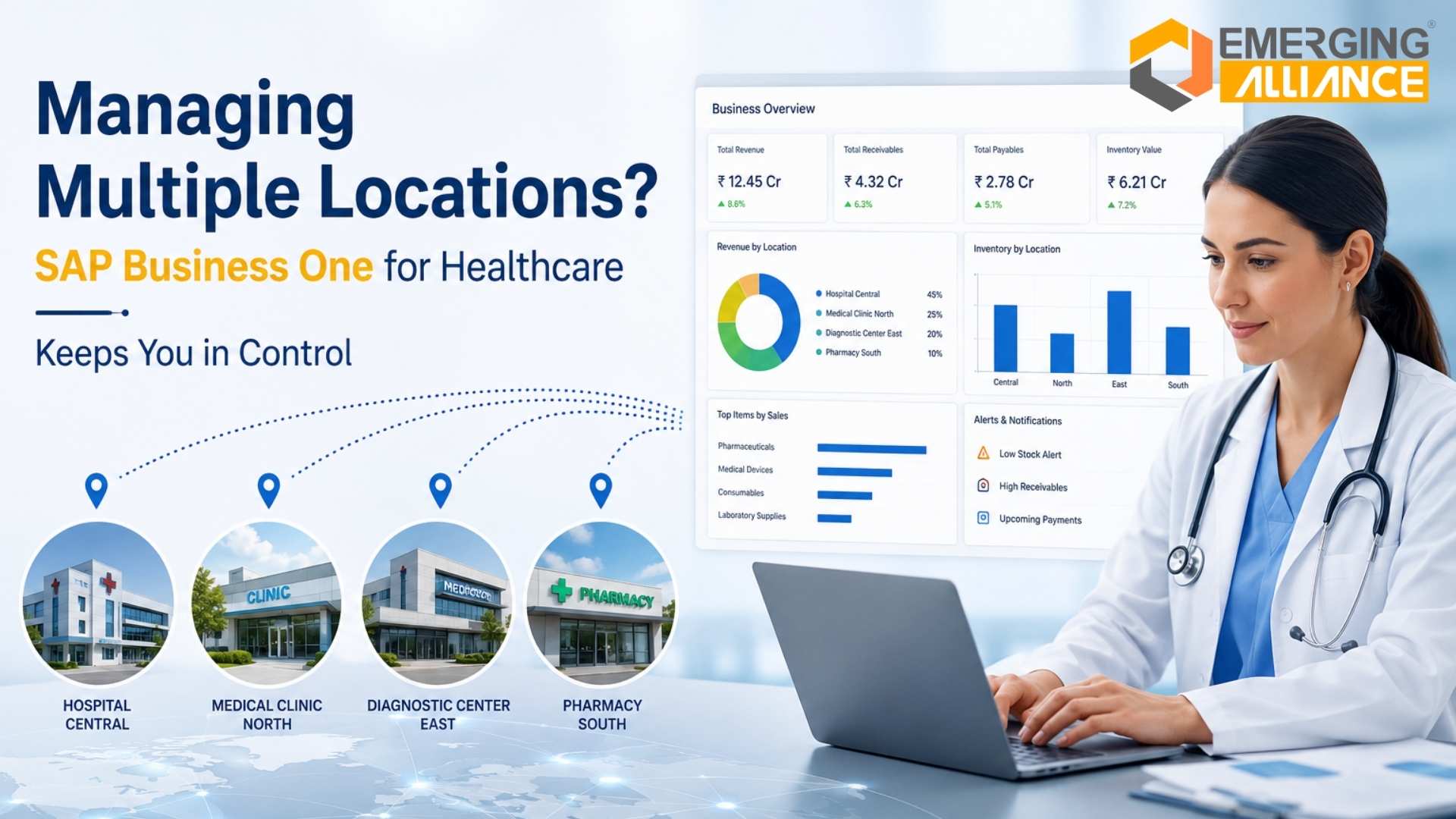
Managing Multiple Locations? SAP Business One for Healthcare Keeps You in Control
SAP Business One for Healthcare centralizes operations and financial visibility across all locations
Healthcare organizations managing multiple clinics, pharmacies, and diagnostic centers often struggle with fragmented operations, delayed reporting, inventory gaps, and disconnected workflows. As expansion increases, operational complexity impacts profitability, compliance, and decision-making. SAP Business One for Healthcare centralizes finance, inventory, procurement, and operational visibility across all locations through a unified healthcare ERP solution. Instead of just implementing software, healthcare enterprises gain a scalable digital foundation built for automation, control, and long-term growth.
Why Multi-Location Healthcare Operations Become Difficult to Scale
Healthcare organizations often expand faster than their operational infrastructure. New branches, diagnostic units, pharmacies, and outpatient facilities introduce additional layers of complexity that legacy systems cannot manage effectively.
Disconnected clinic management software and standalone accounting platforms create operational silos that affect enterprise performance.
Common challenges include:
- Delayed financial consolidation across locations
- Inconsistent inventory tracking between facilities
- Revenue leakage caused by manual billing workflows
- Procurement inefficiencies and duplicate vendor spending
- Lack of centralized healthcare accounting software
- Compliance risks from fragmented medical data systems
- Limited visibility into branch-level profitability
- Poor coordination between departments and facilities
- Inaccurate forecasting due to disconnected reporting
Without integrated healthcare workflow automation, leadership teams spend more time reacting to operational issues than focusing on growth strategy.
How SAP Business One Healthcare Modules Centralize Enterprise Operations
Modern healthcare enterprises require more than basic ERP functionality. They need operational intelligence that connects every location through standardized processes and real-time visibility.
SAP Business One Healthcare Modules help organizations unify core healthcare functions within a centralized ecosystem.
Centralized Financial Management Across All Locations
Healthcare finance leaders often struggle with inconsistent reporting structures between branches. Consolidating data manually increases delays and reduces decision-making accuracy.
With SAP B1 Healthcare, organizations can:
- Monitor branch-wise revenue performance in real time
- Standardize accounting processes across facilities
- Automate intercompany financial workflows
- Improve healthcare financial management visibility
- Reduce reconciliation delays and manual reporting dependency
- Generate faster executive-level financial insights
This creates stronger financial governance while improving operational agility.
Smarter Inventory and Procurement Control
Inventory inefficiencies directly impact patient care and profitability. Many healthcare providers lose visibility into pharmaceutical inventory movement, stock availability, and procurement utilization across locations.
An integrated healthcare ERP solution improves:
- Hospital inventory management
- Pharmaceutical inventory management
- Batch and expiry tracking
- Automated replenishment workflows
- Centralized vendor management
- Procurement standardization across facilities
This reduces wastage, prevents stock shortages, and improves supply chain accountability.
Unified Patient and Operational Workflows
Disconnected patient management system platforms often create duplicate records, communication gaps, and operational bottlenecks.
With Healthcare ERP integration, organizations can align operational workflows between departments while improving coordination across locations.
Capabilities include:
- Integrated patient data management
- Appointment workflow coordination
- Billing synchronization
- Operational dashboard visibility
- Automated workflow approvals
- Faster reporting accuracy
This enables healthcare providers to improve operational consistency without increasing administrative overhead.
SAP Business One Healthcare Solution Improves Enterprise Visibility
One of the biggest risks in healthcare expansion is losing operational visibility. Leadership teams cannot scale efficiently when they rely on delayed spreadsheets and fragmented reporting systems.
A cloud-based healthcare ERP platform enables centralized monitoring across all business functions.
Healthcare executives gain access to:
- Real-time healthcare analytics
- Branch-wise operational KPIs
- Financial performance dashboards
- Procurement monitoring
- Inventory movement tracking
- Compliance reporting visibility
- Enterprise-wide workflow insights
This allows CEOs, CIOs, and Operations Heads to make faster strategic decisions based on accurate enterprise-wide data.
For example, a healthcare group operating five diagnostic centers may discover that inventory carrying costs vary significantly between locations. Without centralized reporting, identifying the root cause becomes difficult. With SAP Business One healthcare solution capabilities, leadership teams can quickly compare procurement patterns, stock movement, and operational efficiency between facilities.
The result is better cost optimization and stronger operational control.
Healthcare ERP Integration Reduces Compliance and Operational Risk
Healthcare enterprises operate in highly regulated environments where operational inconsistencies can create serious compliance exposure.
Manual processes increase the risk of:
- Incomplete audit trails
- Inaccurate financial reporting
- Data duplication
- Unauthorized inventory movement
- Delayed compliance reporting
- Security and governance issues
Healthcare digital transformation requires systems that support accountability, traceability, and standardized governance structures.
SAP Business One implementation healthcare strategies help organizations strengthen operational control through:
- Role-based access management
- Centralized document tracking
- Workflow approvals
- Audit-ready reporting
- Data standardization
- Automated process governance
This becomes increasingly critical for healthcare groups expanding into multiple regions or managing distributed operational teams.
Why Healthcare Enterprises Need More Than Software Implementation
ERP success in healthcare is rarely about software alone. Many projects fail because organizations approach implementation as a technical deployment instead of an operational transformation initiative.
Healthcare enterprises need a partner that understands:
- Multi-location healthcare operations
- Process optimization
- Enterprise scalability
- Change management
- Workflow restructuring
- Industry-specific operational challenges
- Long-term digital transformation strategy
This is where Emerging Alliance positions itself differently.
Emerging Alliance helps healthcare organizations align technology investments with operational and business outcomes. Instead of focusing only on deployment, the approach centers around process visibility, workflow efficiency, scalability, and measurable enterprise performance improvement.
From healthcare accounting software modernization to enterprise-wide healthcare workflow automation, the focus remains on building scalable operational ecosystems that support long-term growth.
SAP B1 Healthcare Creates Measurable Operational Impact
Healthcare enterprises adopting integrated ERP environments typically focus on several strategic business outcomes:
- Faster financial consolidation
- Improved branch-level visibility
- Reduced operational bottlenecks
- Better procurement control
- Lower inventory wastage
- Stronger compliance readiness
- Improved operational scalability
- Faster executive reporting
- Better cross-location coordination
The real advantage is not just automation. It is enterprise-wide operational alignment.
As healthcare organizations continue expanding, fragmented systems become a direct barrier to growth. Centralized ERP infrastructure helps leadership teams maintain control without increasing operational complexity.
The Future of Healthcare Operations Requires Centralized Intelligence
Healthcare organizations can no longer rely on disconnected systems while managing multi-location growth. Operational scalability now depends on real-time visibility, automation, centralized governance, and integrated decision-making.
SAP Business One for Healthcare enables healthcare enterprises to create a connected operational framework that supports sustainable expansion while improving financial control and operational efficiency.
For healthcare leaders evaluating digital transformation initiatives, the focus should not only be on replacing systems. The priority should be building a scalable operational architecture capable of supporting future growth, compliance, and enterprise agility.
Transform Healthcare Operations with Emerging Alliance
Emerging Alliance helps healthcare enterprises modernize operations through strategic ERP transformation initiatives powered by SAP Business One healthcare solution capabilities.
Whether you are managing hospitals, specialty clinics, pharmacies, diagnostic networks, or multi-location healthcare facilities, Emerging Alliance helps align technology with operational outcomes.
Connect with Emerging Alliance to:
- Evaluate operational inefficiencies
- Assess healthcare ERP readiness
- Centralize financial visibility
- Improve inventory and procurement control
- Enable healthcare workflow automation
- Build a scalable healthcare digital transformation roadmap
FAQs
1. How does SAP Business One for Healthcare help manage multiple healthcare locations?
SAP Business One centralizes finance, inventory, procurement, reporting, and operational workflows across all healthcare facilities through a unified ERP environment.
2. What SAP Business One Healthcare Modules are most useful for hospitals?
Healthcare organizations commonly use modules for financial management, inventory control, procurement, workflow automation, reporting, and operational visibility.
3. Can SAP B1 Healthcare integrate with existing patient management systems?
Yes. Healthcare ERP integration allows SAP B1 Healthcare to connect with patient management system platforms, billing tools, and operational applications.
4. Is SAP Business One healthcare solution suitable for growing clinic networks?
Yes. It is designed to support scalability for multi-location clinics, hospitals, diagnostic centers, and healthcare service groups.
5. How does healthcare accounting software improve financial visibility?
Healthcare accounting software centralizes branch-level financial reporting, automates reconciliation, and provides real-time access to enterprise-wide financial performance.
6. What compliance advantages does a healthcare ERP solution provide?
A healthcare ERP solution supports audit readiness, workflow approvals, data standardization, document tracking, and controlled user access management.
7. Can SAP Business One implementation healthcare projects support cloud deployment?
Yes. Many organizations adopt cloud-based healthcare ERP deployment models to improve accessibility, scalability, and centralized operational management.
8. How does healthcare workflow automation improve operational efficiency?
Automation reduces manual approvals, reporting delays, inventory errors, and administrative bottlenecks while improving process consistency across locations.
9. What challenges are common during Healthcare ERP integration?
Typical challenges include legacy system migration, process standardization, data consolidation, workflow redesign, and user adoption management.
10. What ROI can healthcare enterprises expect from SAP Business One for Healthcare?
Organizations typically focus on operational efficiency gains, improved financial visibility, reduced inventory wastage, stronger compliance management, and scalable growth enablement.
Schedule a strategic consultation with Emerging Alliance and discover how SAP Business One implementation healthcare strategies can help your organization scale with greater operational control and enterprise visibility.