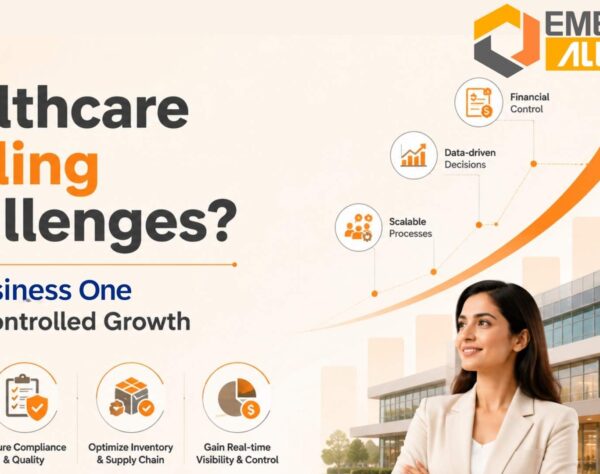

10 Healthcare Challenges to Solve in 2026 with SAP Business One
Healthcare organizations are under increasing pressure to reduce operational costs, improve patient outcomes, maintain compliance, and scale services without increasing administrative complexity. For many providers, disconnected systems, manual processes, inventory inefficiencies, and reporting delays continue to create hidden costs and operational risks. SAP business one for Healthcare Industry provides a unified platform that helps healthcare organizations gain control over operations, finance, inventory, procurement, and compliance from a single system.
Whether you manage hospitals, diagnostic centers, medical distributors, specialty clinics, or healthcare service organizations, the challenge is no longer collecting data—it is transforming data into actionable decisions.
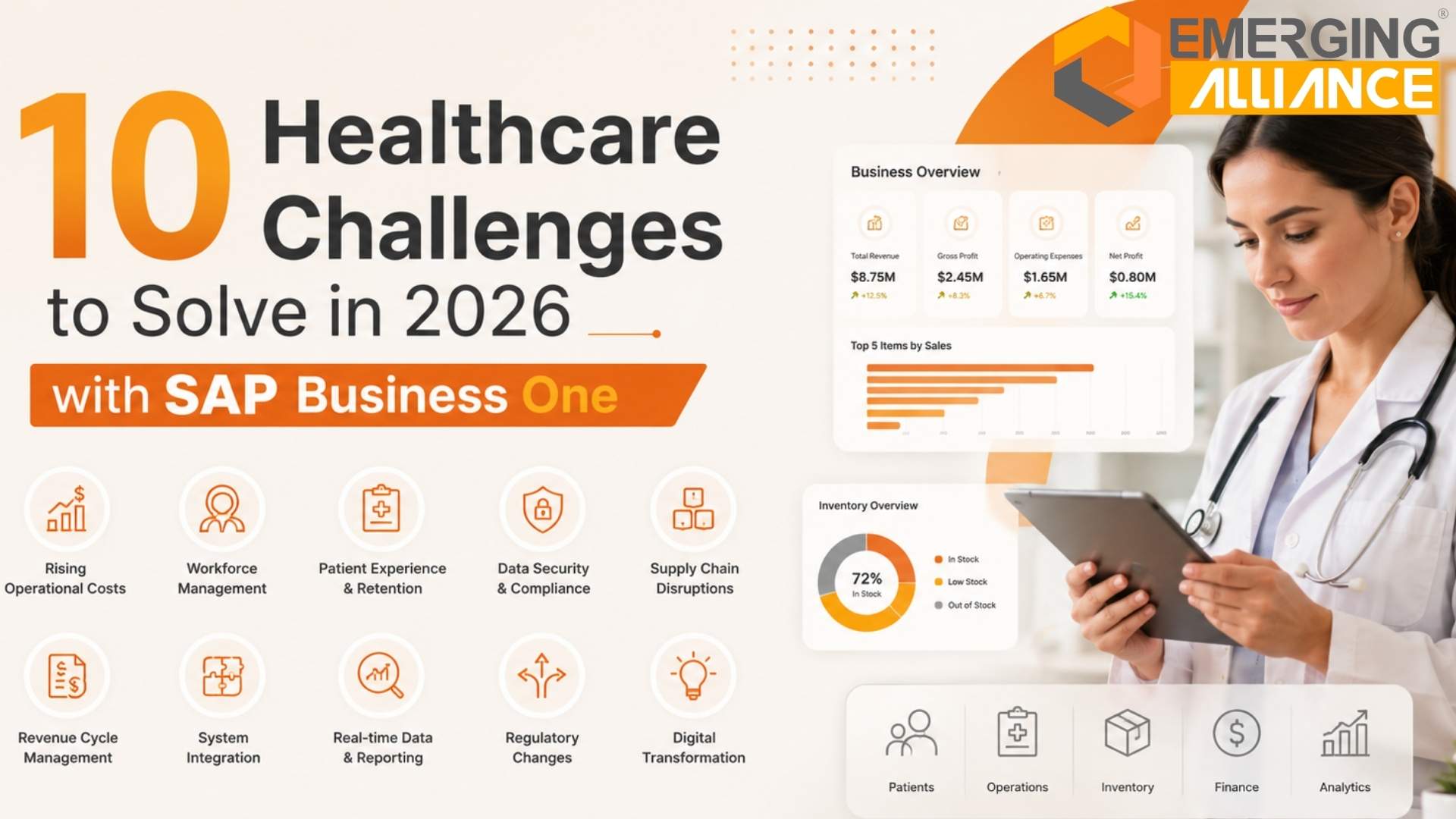
Let’s examine the ten critical healthcare challenges organizations must solve in 2026 and how SAP Business One helps address them.
Challenge 1: Limited Visibility Across Healthcare Operations
Many healthcare organizations operate with separate systems for finance, procurement, inventory, and administration.
This creates:
- Delayed decision-making
- Data inconsistencies
- Operational blind spots
- Reporting delays
With SAP business one ERP for Healthcare Industry, leadership gains real-time visibility into operational and financial performance through centralized dashboards and analytics.
Decision-makers no longer need to wait for multiple departments to compile reports.
Challenge 2: Rising Medical Inventory Costs and Stock Inefficiencies
Healthcare inventory is one of the largest cost centers.
Common issues include:
- Overstocking expensive supplies
- Critical stock shortages
- Expired inventory
- Poor demand forecasting
Effective Inventory and supply chain for hospitals requires accurate tracking and automated replenishment processes.
Using SAP Business One healthcare software solutions, organizations can monitor inventory movement, batch details, expiry dates, procurement cycles, and supplier performance from a single platform.
This reduces waste while improving service availability.
Challenge 3: Revenue Leakage from Manual Financial Processes
Many healthcare providers still rely on disconnected accounting workflows.
This often leads to:
- Billing errors
- Delayed collections
- Duplicate transactions
- Inaccurate financial reporting
SAP B1 for healthcare accounting streamlines financial management through integrated accounting, receivables, payables, budgeting, and cash flow monitoring.
Finance teams gain better control while executives obtain a clearer picture of organizational profitability.
Challenge 4: Compliance and Audit Readiness Challenges
Healthcare regulations continue to evolve.
Organizations must maintain:
- Accurate financial records
- Procurement traceability
- Approval workflows
- Audit-ready documentation
Without centralized systems, compliance becomes increasingly difficult.
Healthcare Enterprise Resource Planning (ERP) enables organizations to establish controlled workflows, document management standards, and approval structures that improve governance while reducing compliance risks.
Challenge 5: Disconnected Procurement and Supply Chain Processes
Procurement delays can directly affect patient care and operational continuity.
Healthcare organizations often struggle with:
- Multiple vendors
- Poor purchasing visibility
- Manual approvals
- Slow procurement cycles
Modern Medical supply chain management software helps automate purchasing workflows while improving supplier collaboration.
With SAP Business One, procurement teams gain complete visibility into purchasing activity, vendor performance, and inventory requirements.
How SAP Business One Healthcare Modules Drive Operational Excellence
Healthcare leaders require more than basic ERP functionality.
They need specialized capabilities that support operational efficiency and growth.
SAP Business One Healthcare Modules help organizations:
- Automate procurement workflows
- Improve inventory visibility
- Strengthen financial control
- Streamline reporting
- Enhance compliance management
- Improve resource utilization
Combined with healthcare-specific extensions, these capabilities create a scalable digital foundation for future growth.
Challenge 6: Inconsistent Reporting and Slow Decision-Making
Healthcare leaders require immediate access to operational intelligence.
However, many organizations still depend on:
- Spreadsheet-based reporting
- Manual data consolidation
- Delayed performance reviews
Using Data analytics in healthcare ERP, organizations gain real-time access to:
- Financial performance
- Procurement metrics
- Inventory status
- Operational KPIs
- Department-level reporting
This enables faster, more confident decision-making.
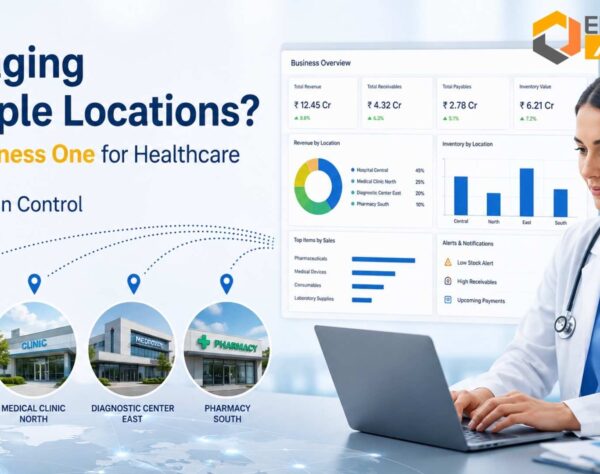
Challenge 7: Difficulty Scaling Across Multiple Locations
As healthcare organizations expand, operational complexity increases.
Challenges often include:
- Multiple facilities
- Decentralized procurement
- Inconsistent processes
- Fragmented reporting
SAP Business One ERP for healthcare providers supports multi-location operations while maintaining centralized visibility and governance.
Leadership gains a unified view across all facilities without sacrificing operational flexibility.
Challenge 8: Excessive Administrative Workloads
Administrative teams spend significant time managing repetitive tasks.
Examples include:
- Purchase approvals
- Vendor communications
- Financial reconciliations
- Reporting activities
Healthcare organizations looking to automate healthcare workflows can significantly reduce manual effort through automated processes and workflow approvals.
The result is improved productivity and reduced operational overhead.
Challenge 9: Technology Limitations Restricting Growth
Many legacy systems cannot support modern healthcare requirements.
Organizations often experience:
- Limited integration capabilities
- Reporting limitations
- Scalability concerns
- High maintenance costs
SAP Business One cloud for healthcare offers a scalable foundation that supports growth while enabling integration with specialized healthcare applications.
This allows organizations to modernize without disrupting operations.
Challenge 10: Lack of Strategic Digital Transformation Roadmaps
Technology alone does not solve business problems.
Many healthcare organizations struggle because they focus on software deployment rather than transformation outcomes.
Successful ERP initiatives require:
- Process optimization
- Change management
- Data governance
- Scalability planning
- Long-term digital strategy
This is where implementation partners make the difference.
Organizations working with experienced SAP B1 consultants for healthcare industry can align ERP investments with broader operational and growth objectives.
Why Healthcare Organizations Are Choosing SAP Business One in 2026
The future of the Healthcare Industry with SAP Business One is centered around visibility, automation, scalability, and data-driven decision-making.
Healthcare providers increasingly require:
- Unified operational visibility
- Financial transparency
- Inventory optimization
- Compliance readiness
- Workflow automation
- Scalable technology platforms
SAP Business One delivers these capabilities through an integrated business management platform designed for growing organizations.
Transform Healthcare Operations with Emerging Alliance
Technology investments should generate measurable business outcomes.
At Emerging Alliance, we help healthcare organizations move beyond traditional ERP implementation by creating transformation roadmaps focused on operational efficiency, visibility, compliance, and growth.
From solution design and implementation to optimization and long-term digital transformation planning, our team helps healthcare organizations maximize the value of SAP Business One.
If your organization is facing operational bottlenecks, inventory challenges, compliance risks, or growth limitations, now is the time to evaluate a smarter healthcare ERP strategy.
Frequently Asked Questions
1. How is SAP Business One different from traditional healthcare ERP solutions?
SAP Business One provides integrated finance, inventory, procurement, reporting, and operational management capabilities in a single platform designed for growing healthcare organizations.
2. Can SAP Business One support multi-location hospitals and healthcare groups?
Yes. SAP Business One supports centralized visibility and management across multiple facilities, branches, and operational units.
3. What is the typical SAP B1 implementation timeline for medical institutions?
Implementation timelines vary based on complexity, integrations, and business requirements but are generally faster than large enterprise ERP projects.
4. How does SAP Business One improve healthcare financial management?
It automates accounting processes, improves cash flow visibility, enhances budgeting, and supports accurate financial reporting.
5. Can SAP Business One integrate with existing healthcare applications?
Yes. SAP Business One supports integration with third-party systems, specialized healthcare applications, and reporting platforms.
6. What healthcare-specific SAP Business One modules are available?
Organizations can extend functionality using healthcare-focused modules for inventory control, procurement, compliance management, reporting, and operational automation.
7. Is SAP Business One suitable for small and medium-sized healthcare organizations?
Yes. It is widely used by growing healthcare providers seeking enterprise-grade capabilities without enterprise-level complexity.
8. How does SAP Business One help automate healthcare workflows?
It automates approvals, procurement, inventory management, financial processes, reporting, and operational workflows.
9. What reporting capabilities are available in SAP B1 Healthcare solutions?
Users gain access to real-time dashboards, financial reports, inventory analytics, procurement insights, and executive-level performance reporting.
10. What ROI can healthcare organizations expect from SAP Business One implementation?
Organizations typically achieve improvements in operational efficiency, inventory control, financial visibility, compliance readiness, and decision-making capabilities.
Speak with Emerging Alliance today to discover how SAP business one for Healthcare Industry can help reduce costs, improve visibility, and support sustainable growth.