
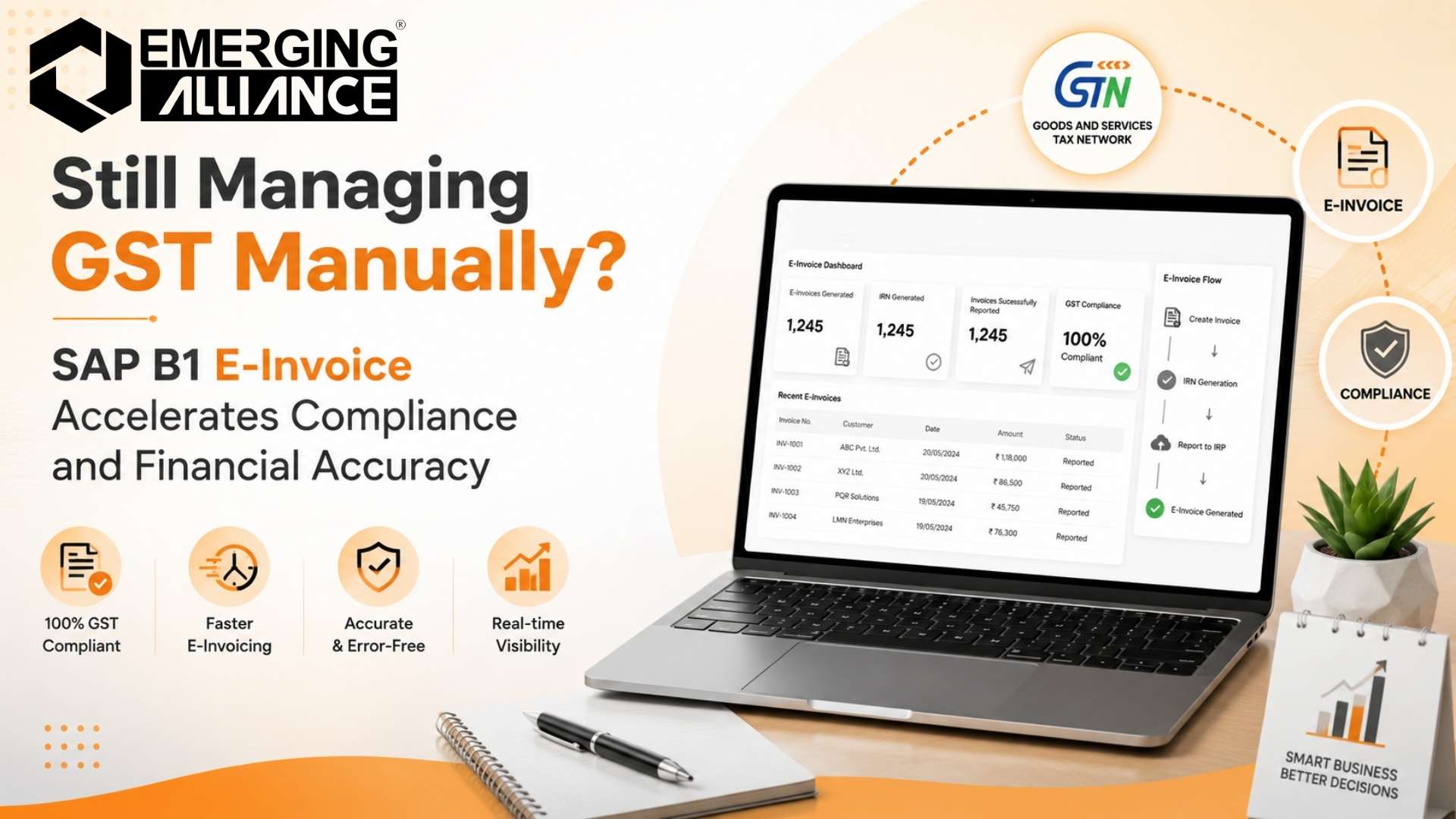
Still Managing GST Manually? SAP B1 E-Invoice Accelerates Compliance and Financial Accuracy
SAP B1 E-Invoice Streamlines IRP Reporting, Invoice Validation, and GST Compliance Without Manual Reconciliation
Managing GST compliance has become increasingly complex as businesses handle larger transaction volumes, operate across multiple locations, and adapt to evolving regulatory requirements. Every invoice generated today must not only reflect accurate financial data but also meet strict compliance standards before it reaches customers or government portals.
Despite this, many organizations continue to depend on manual invoicing processes, spreadsheets, and disconnected finance systems. While these methods may have worked when invoice volumes were lower, they often struggle to support growing businesses. Finance teams spend valuable time validating invoices, correcting errors, reconciling GST data, and ensuring submissions comply with regulatory guidelines.
These manual processes create more than operational inconvenience. Invoice errors delay payments, reconciliation consumes additional resources, and compliance mistakes expose businesses to audits, penalties, and reputational risks. As organizations scale, the administrative effort required to manage GST manually grows significantly, making it difficult to maintain both efficiency and financial accuracy.
For business leaders focused on operational excellence and digital transformation, the challenge is no longer simply generating invoices. The real objective is creating a finance process that is accurate, automated, and capable of supporting long-term business growth.
But what exactly makes manual GST management so challenging? Before exploring the solution, it’s important to understand the operational and financial issues businesses face with traditional processes.
Why Manual GST Processes Are No Longer Sustainable
Digital business growth has significantly increased the number of invoices organizations generate every day. At the same time, GST regulations demand greater accuracy, faster reporting, and complete transaction transparency. Unfortunately, manual processes struggle to keep pace with these evolving requirements.
What initially appears to be a manageable finance process gradually becomes a source of delays, errors, and compliance challenges.
Time-Consuming Invoice Processing and GST Calculations
Preparing GST-compliant invoices manually requires finance teams to perform multiple repetitive tasks. Every invoice must be reviewed for customer information, GST rates, tax calculations, HSN or SAC codes, and mandatory compliance fields before submission.
For organizations processing hundreds or thousands of invoices each month, these activities consume considerable time and increase operational costs.
Common challenges include:
- Manual preparation of GST invoices
- Repetitive tax calculations
- Duplicate data entry across systems
- Spreadsheet-based invoice tracking
- Delayed invoice approvals
- Increased dependency on finance personnel
As invoice volumes grow, these manual activities create bottlenecks that slow the entire billing cycle.
Compliance Risks, Filing Delays, and Financial Errors
Manual invoicing also increases the likelihood of human error. Even minor inaccuracies can affect GST compliance and delay invoice acceptance.
Businesses frequently encounter:
- Incorrect GSTIN information
- Invoice mismatches during reconciliation
- Duplicate invoice entries
- Missing mandatory invoice details
- Filing delays caused by repeated corrections
- Greater exposure to compliance penalties
Beyond regulatory concerns, these issues affect cash flow, customer satisfaction, and management reporting. Finance teams spend more time fixing problems than supporting strategic business initiatives.
Manual processes may work for smaller operations, but as businesses scale, they become a barrier to efficiency and compliance. This is where SAP Business One E-Invoice provides a smarter approach
Why SAP Business One E-Invoice Is the Right Approach to GST Automation
As GST compliance requirements continue to evolve, businesses need more than digital invoice generation. They need an integrated system that connects invoicing, taxation, compliance, and financial reporting within a single workflow.
This is exactly where SAP B1 E-Invoice delivers value.
Rather than relying on disconnected applications or manual intervention, SAP Business One automates the complete e-invoicing lifecycle, allowing businesses to generate, validate, submit, and track GST-compliant invoices directly from their ERP environment.
The result is a faster, more accurate, and more controlled invoicing process.
What Is SAP B1 E-Invoice?
SAP B1 E-Invoice is an integrated e-invoicing solution designed for SAP Business One that helps organizations automate GST-compliant invoice generation and reporting.
Instead of manually preparing invoices and submitting them separately for validation, businesses can complete the entire process from within their ERP system.
The solution supports:
- Automated GST-compliant invoice creation
- Invoice Registration Portal (IRP) integration
- Automatic Invoice Reference Number (IRN) generation
- QR code generation
- Digital invoice validation
- Secure invoice record management
By reducing manual intervention, businesses improve consistency while minimizing compliance risks.
How SAP Business One Supports GST-Compliant Digital Invoicing
SAP Business One centralizes financial and compliance processes, ensuring invoice data remains consistent throughout the organization.
When integrated with an e-invoicing solution, the ERP automatically validates invoice information before submission, reducing errors that typically occur during manual processing.
Instead of switching between multiple applications, finance teams manage invoicing through one connected platform, improving efficiency and providing greater visibility into invoice status, compliance reporting, and financial transactions.
This integrated approach also simplifies month-end reconciliation by ensuring invoice data remains synchronized across finance and compliance processes.
Understanding the solution is only the beginning. The real advantage comes from how SAP B1 E-Invoice simplifies day-to-day finance operations.
How SAP B1 E-Invoice Simplifies GST Compliance
One of the biggest advantages of SAP B1 E-Invoice is that it transforms GST compliance from a manual, repetitive activity into an automated business process.
Rather than asking finance teams to validate every invoice individually, the system performs many compliance activities automatically, allowing employees to focus on higher-value financial tasks.
Automated Invoice Validation, IRN Generation, and QR Code Creation
Automation begins the moment an invoice is created.
Instead of manually reviewing invoice information before submission, SAP Business One validates required data, communicates with the Invoice Registration Portal, and completes several compliance activities automatically.
These include:
- Automated invoice validation
- IRN generation
- QR code creation
- GST-ready invoice formatting
- Error detection before submission
- Reduced manual corrections
By automating these tasks, organizations significantly reduce invoice processing time while improving compliance accuracy.
Real-Time GST Compliance, Reconciliation, and Audit Readiness
Compliance extends beyond invoice generation. Businesses must also maintain accurate financial records, prepare for audits, and reconcile transactions efficiently.
SAP B1 E-Invoice supports these objectives by providing:
- Real-time invoice status tracking
- Faster GST reconciliation
- Digital audit trails
- Accurate compliance records
- Better reporting visibility
- Simplified document management
Because invoice information is maintained within a single ERP environment, finance teams spend less time searching for records and more time analyzing business performance.
While compliance is a major advantage, automation delivers benefits that extend far beyond regulatory requirements. It also improves financial operations, productivity, and overall business performance.
Key Business Benefits of SAP Business One E-Invoice
By automating invoice generation and GST compliance, SAP Business One E-Invoice delivers value that extends beyond regulatory requirements. It helps organizations optimize financial processes, improve operational efficiency, and build a scalable finance function that supports business growth.
Instead of allocating significant resources to repetitive compliance activities, finance teams can focus on financial planning, cash flow management, and strategic decision-making.
Faster Financial Operations and Improved Productivity
Manual invoicing often creates bottlenecks throughout the finance cycle. Delays in invoice preparation, validation, and reconciliation slow customer billing and increase administrative workload.
With SAP B1 E-Invoice, many of these repetitive tasks are automated, enabling finance teams to complete invoice processing faster and with greater consistency.
Key operational improvements include:
- Faster invoice creation and approval
- Reduced manual data entry
- Shorter invoice processing cycles
- Less time spent on GST reconciliation
- Higher productivity across finance teams
- Improved collaboration between finance and operations
As routine tasks become automated, employees can dedicate more time to activities that contribute directly to business performance.
Better Financial Accuracy, Compliance, and Decision-Making
Accurate financial data is essential for maintaining compliance and making informed business decisions. Manual processes often result in inconsistent records, duplicate entries, and reporting delays that affect financial visibility.
SAP Business One E-Invoice helps improve data accuracy by maintaining invoice information within a centralized ERP environment.
Business benefits include:
- Improved GST compliance accuracy
- Lower risk of filing errors and penalties
- Better financial reporting
- Greater visibility into invoice status
- Consistent audit-ready records
- Stronger financial governance
Reliable financial information allows business leaders to make faster, more confident decisions while reducing compliance-related risks.
While these benefits are valuable across many industries, organizations with large transaction volumes often experience the greatest operational improvements.
Industries That Benefit Most from SAP B1 E-Invoice
Although every GST-registered business can benefit from automated invoicing, some industries face greater compliance complexity due to higher transaction volumes, multiple business locations, or extensive supplier and customer networks.
For these organizations, SAP B1 E-Invoice becomes an essential part of improving efficiency and maintaining regulatory compliance.
Manufacturing, Wholesale, and Distribution
Manufacturers and distributors process a large number of invoices involving suppliers, dealers, warehouses, and customers. Managing these transactions manually can quickly become inefficient.
SAP Business One E-Invoice helps these businesses by:
- Automating high-volume invoice processing
- Improving invoice accuracy across multiple locations
- Simplifying GST reporting
- Supporting faster order-to-cash cycles
- Reducing manual reconciliation efforts
The result is a more efficient finance process that supports operational continuity and business growth.
Retail, Export, Multi-Location Businesses, and SMEs
Retailers, exporters, and businesses operating across multiple branches often deal with frequent invoice generation and changing compliance requirements.
Automated e-invoicing enables these organizations to:
- Generate GST-compliant invoices consistently
- Improve billing speed during high transaction periods
- Maintain centralized financial records
- Reduce compliance risks across multiple business units
- Improve customer billing accuracy
For growing SMEs, automation also creates a scalable finance process that can support future expansion without proportionally increasing administrative effort.
Successfully achieving these benefits depends not only on selecting the right technology but also on implementing it with a clear strategy and well-defined processes.
Best Practices for a Successful SAP B1 E-Invoice Implementation
Technology alone does not guarantee successful GST automation. Organizations should prepare their finance processes, data, and users before implementation to maximize long-term value.
A structured implementation approach reduces disruption while improving user adoption and compliance outcomes.
Preparing Your Business for GST Automation
Before implementing SAP Business One E-Invoice, businesses should evaluate their existing invoicing workflows and identify opportunities for improvement.
Recommended preparation activities include:
- Review current GST processes
- Identify manual workflow bottlenecks
- Standardize invoice approval procedures
- Clean customer and vendor master data
- Validate GST-related information
- Define compliance responsibilities
Preparing accurate master data significantly reduces implementation challenges and improves invoice quality after deployment.
Why GST Automation Is Becoming a Business Imperative
GST automation is no longer viewed as a technology upgrade. It has become an important component of modern finance operations.
As businesses expand, transaction volumes increase, and compliance expectations continue to evolve, manual processes become increasingly difficult to sustain.
Organizations are investing in digital finance initiatives to improve operational efficiency, strengthen compliance, and create better visibility across financial operations.
Key factors driving this shift include:
- Increasing GST compliance requirements
- Growing transaction volumes
- Greater demand for real-time financial information
- Enterprise-wide digital transformation initiatives
- Improved operational efficiency through automation
- Better governance and audit readiness
Businesses that modernize their invoicing processes today are better prepared to respond to regulatory changes, support future growth, and improve overall financial performance.
Rather than treating GST compliance as an administrative obligation, leading organizations are integrating it into broader business transformation strategies that enhance agility, transparency, and long-term competitiveness.
Conclusion
Manual GST management may appear manageable in the short term, but as businesses grow, it often leads to higher operational costs, increased compliance risks, delayed financial processes, and limited visibility into business performance.
SAP B1 E-Invoice addresses these challenges by automating invoice validation, IRP reporting, GST compliance, and financial record management within a unified ERP environment.
By replacing manual workflows with intelligent automation, organizations can improve financial accuracy, reduce administrative effort, accelerate invoice processing, and strengthen compliance without increasing operational complexity.
For businesses pursuing digital transformation, automated e-invoicing is more than a compliance initiative—it is a strategic investment that supports operational excellence, financial control, and sustainable growth.
Frequently Asked Questions
1. How does SAP B1 E-Invoice improve GST compliance?
SAP B1 E-Invoice automates invoice validation, IRN generation, QR code creation, and GST-compliant reporting, reducing manual effort and improving compliance accuracy.
2. Can SAP Business One E-Invoice integrate directly with the Invoice Registration Portal (IRP)?
Yes. SAP Business One E-Invoice integrates with the IRP to validate invoices, generate Invoice Reference Numbers (IRNs), and return authenticated invoice details within the ERP workflow.
3. How does SAP B1 E-Invoice reduce manual reconciliation?
By maintaining invoice data within a single ERP environment, the solution minimizes duplicate entries and simplifies reconciliation between invoices, accounting records, and GST reporting.
4. What business challenges does SAP B1 E-Invoice solve?
It addresses manual invoice processing, GST calculation errors, delayed reporting, reconciliation issues, compliance risks, and inefficient finance workflows.
5. Is SAP Business One E-Invoice suitable for businesses with multiple branches?
Yes. It helps standardize invoicing and compliance processes across multiple branches, making it easier to manage GST reporting from a centralized ERP platform.
6. How does SAP B1 E-Invoice improve financial reporting?
Since invoice information is automatically captured and validated within SAP Business One, businesses benefit from more accurate financial records, improved reporting, and better visibility into transactions.
7. Which industries gain the greatest value from SAP B1 E-Invoice?
Manufacturing, wholesale distribution, retail, export businesses, logistics providers, and organizations with high invoice volumes typically achieve the greatest operational benefits.
8. What should businesses prepare before implementing SAP Business One E-Invoice?
Organizations should review existing GST workflows, clean master data, validate tax information, train finance users, test invoice processes, and define internal compliance procedures.
9. How does SAP B1 E-Invoice support audit readiness?
The solution creates a digital audit trail by securely storing validated invoice information and maintaining consistent financial records, making audits more efficient.
10. Why should businesses work with an experienced SAP Business One implementation partner?
An experienced partner helps align the solution with business processes, ensures smooth integration, reduces implementation risks, and supports long-term optimization as compliance requirements evolve.
Connect with an Emerging Alliance expert today and discover how SAP B1 E-Invoice can simplify GST compliance while building a more efficient and scalable finance function.