
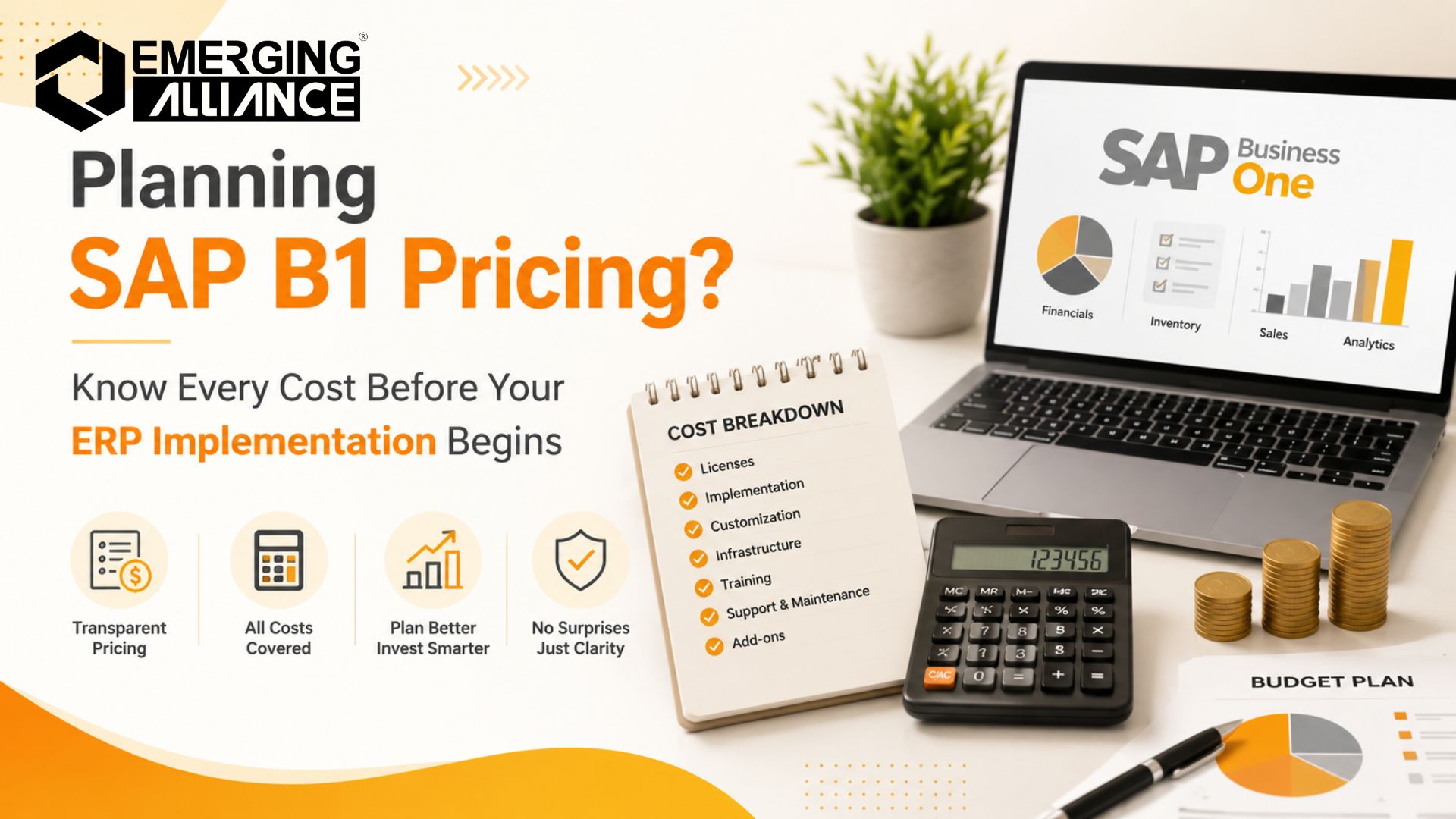
Planning SAP B1 Pricing? Know Every Cost Before Your ERP Implementation Begins
ERP Investment Decisions Require Cost Clarity. SAP B1 Pricing Simplifies Licenses and Implementation Costs.
Investing in an Enterprise Resource Planning (ERP) solution is one of the most important strategic decisions a growing business can make. While technology leaders often focus on software capabilities, the real challenge lies in understanding the complete financial commitment behind an ERP implementation. Many organizations underestimate implementation services, customization, user adoption, and ongoing support, leading to budget overruns and delayed returns on investment. When evaluating SAP B1 Pricing, decision-makers should look beyond the initial software quote. The total investment includes licensing, deployment, implementation, integration, training, and long-term optimization. Understanding these cost components enables organizations to build realistic budgets, reduce project risks, and maximize business value.
Whether you’re a CEO planning digital transformation, a CIO modernizing legacy systems, or an Operations Head seeking greater process visibility, knowing the complete SAP Business One Pricing structure helps you make informed ERP investment decisions.
SAP B1 Pricing Components and Total ERP Investment Breakdown
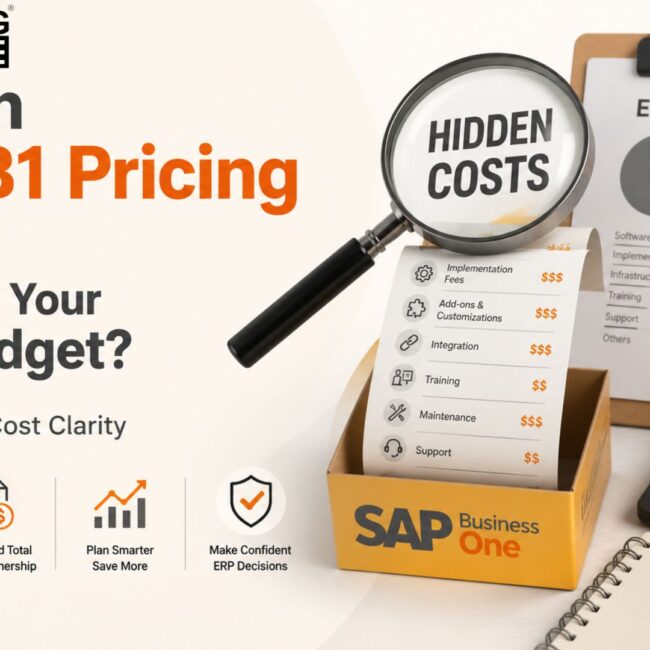
The total SAP B1 Cost extends beyond purchasing software licenses. Every ERP project includes multiple investment areas that collectively determine the Total Cost of Ownership (TCO).
Key cost components include:
- SAP Business One user licenses
- Cloud or on-premise deployment
- ERP implementation services
- Business process consulting
- Data migration
- Third-party integrations
- Customization and workflow automation
- User training
- Annual support and maintenance
- Future upgrades and optimization
Organizations that evaluate these elements upfront are better positioned to avoid unexpected expenses and maintain implementation timelines.
SAP Business One License Cost and User Licensing Models
Licensing is one of the first considerations when estimating SAP Business One License Cost, but selecting the right license mix is equally important.
SAP B1 Professional User License Cost
Professional licenses provide complete access across finance, inventory, purchasing, sales, CRM, production, reporting, and administration.
They are ideal for:
- Finance Managers
- Operations Leaders
- ERP Administrators
- Department Heads
SAP B1 Limited User License Pricing
Limited licenses are designed for employees who require access to specific business functions.
Common users include:
- Sales Executives
- Procurement Teams
- Warehouse Staff
- Customer Service Representatives
Choosing the appropriate combination of Professional and Limited licenses helps optimize SAP B1 User License Cost while ensuring employees have access to the tools they need.
SAP B1 Pricing in India and Business Factors Affecting ERP Costs
Businesses researching SAP B1 Pricing in India often expect a fixed price. In reality, ERP investment varies depending on organizational requirements and implementation complexity.
The primary factors influencing pricing include:
Organization Size
Larger businesses typically require additional users, advanced workflows, and multiple business locations.
Industry Requirements
Manufacturing, pharmaceuticals, retail, engineering, food processing, and wholesale distribution often require industry-specific configurations and compliance features.
Deployment Preference
Cloud and on-premise deployments involve different infrastructure and maintenance costs.
Business Process Complexity
Organizations requiring advanced approvals, production planning, quality control, or multi-company operations generally require greater implementation effort.
Evaluating these factors helps organizations build more accurate ERP budgets.
SAP B1 Cloud Pricing Compared with On-Premise ERP Investment
Deployment strategy plays a significant role in determining SAP B1 Cloud Pricing and long-term operating costs.
SAP Business One Cloud Cost
Cloud deployment offers:
- Lower infrastructure investment
- Remote accessibility
- Faster implementation
- Automatic software updates
- Improved scalability
- Reduced IT maintenance
On-Premise ERP Investment
On-premise deployment may suit organizations requiring greater infrastructure control, but it often involves additional costs for:
- Servers
- Hardware
- Database management
- Security
- System maintenance
- Internal IT resources
Organizations should compare both short-term implementation costs and long-term operational expenses before selecting a deployment model.
SAP B1 Implementation Cost Across Every Project Phase
The SAP B1 Implementation Cost often represents the largest portion of an ERP investment because it determines how effectively the solution supports business operations.
Business Process Assessment
A successful implementation begins with understanding existing workflows, operational bottlenecks, reporting requirements, and future growth plans.
ERP Configuration
SAP Business One should be configured to support business objectives rather than forcing unnecessary process changes.
Data Migration
Accurate migration of financial records, inventory, customer data, vendors, products, and historical transactions ensures business continuity after deployment.
Third-Party Integration
Many organizations integrate SAP Business One with:
- CRM platforms
- E-commerce solutions
- HR systems
- Banking platforms
- Warehouse Management Systems
- Manufacturing Execution Systems
- Business Intelligence platforms
User Training and Change Management
Technology adoption depends on people. Comprehensive user training accelerates productivity while minimizing implementation risks.
SAP Software Price Versus Total Cost of ERP Ownership
Comparing only the SAP software price provides an incomplete picture of ERP investment.
Decision-makers should evaluate Total Cost of Ownership (TCO), which includes:
- Software licensing
- Implementation services
- Infrastructure
- Cloud subscriptions
- Integrations
- Maintenance
- User support
- Future upgrades
- Business process optimization
An ERP solution that appears less expensive initially may require higher long-term maintenance or additional customization costs.
A strategic investment focuses on sustainable business outcomes rather than the lowest purchase price.
SAP B1 Pricing Calculator for ERP Budget Planning
A SAP B1 Pricing Calculator provides an initial estimate of ERP investment based on organizational requirements.
Typical inputs include:
- Number of users
- License types
- Industry
- Deployment model
- Number of business locations
- Required modules
- Integration requirements
- Customization needs
- Reporting requirements
While pricing calculators are useful during early planning, a detailed business assessment provides significantly greater budgeting accuracy.
SAP Business One Cost Drivers That Influence Long-Term ROI
Several operational factors directly influence SAP Business One Cost and long-term return on investment.
Business Growth Plans
Organizations planning expansion should implement scalable ERP architecture from the beginning.
Automation Requirements
Workflow automation reduces manual processes, minimizes errors, and improves operational efficiency.
Regulatory Compliance
Businesses operating in regulated industries often require additional controls, reporting, and audit capabilities.
Real-Time Business Visibility
Integrated dashboards provide executives with better operational insights, enabling faster decision-making.
Process Standardization
Standardized workflows improve consistency across finance, procurement, inventory, sales, and manufacturing operations.
Investing strategically in these capabilities often delivers measurable business value far beyond the initial implementation cost.
Business Value Beyond SAP B1 Price
The real value of SAP Business One lies in its ability to transform business operations rather than simply replacing legacy software.
Organizations implementing SAP Business One commonly achieve:
- Improved operational visibility
- Faster financial reporting
- Reduced manual data entry
- Better inventory control
- Enhanced customer service
- Improved procurement efficiency
- Stronger compliance
- Greater decision-making accuracy
- Better resource utilization
- Scalable business operations
Industry analysts consistently identify ERP as a key enabler of operational standardization, automation, and data-driven decision-making. However, these outcomes depend on aligning technology implementation with business strategy, executive sponsorship, and effective change management.
Emerging Alliance as Your Digital Transformation and SAP Business One Partner
Selecting an ERP solution is only one part of a successful transformation journey. The implementation partner determines how effectively technology aligns with business objectives.
Emerging Alliance goes beyond software deployment by helping organizations modernize operations, optimize business processes, and build scalable digital transformation roadmaps.
Our approach includes:
- ERP strategy and consulting
- Business process assessment
- Digital transformation planning
- SAP Business One implementation
- Workflow automation
- Data migration
- System integration
- Change management
- User enablement
- Continuous optimization
Rather than functioning solely as an implementation company, Emerging Alliance works as a long-term technology advisor focused on measurable business outcomes, operational excellence, and sustainable enterprise growth.
Conclusion
Understanding SAP B1 Pricing is essential for organizations planning a successful ERP implementation. Looking beyond software licensing to evaluate deployment models, implementation services, integrations, training, and ongoing support enables better budgeting, lower project risk, and stronger long-term returns.
The right ERP investment should improve operational efficiency, strengthen compliance, automate business processes, eliminate visibility gaps, and support sustainable enterprise growth. By focusing on Total Cost of Ownership rather than upfront software price alone, business leaders can make strategic decisions that deliver measurable value for years to come.
Frequently Asked Questions About SAP B1 Pricing, Licensing, and Implementation
1. What factors influence SAP B1 Pricing the most?
User licenses, implementation scope, deployment model, integrations, customization, and business complexity have the greatest impact on total ERP investment.
2. How does SAP B1 Pricing in India differ between businesses?
Pricing varies based on industry, organization size, user count, deployment preference, compliance requirements, and implementation scope.
3. What is included in SAP Business One License Cost?
License costs typically depend on the type of user access required, such as Professional or Limited User licenses.
4. Is SAP B1 Cloud Pricing more cost-effective than on-premise deployment?
Cloud deployment often reduces infrastructure and maintenance expenses while improving scalability and accessibility.
5. What determines SAP B1 Implementation Cost?
Implementation costs are influenced by consulting, configuration, data migration, integrations, customization, testing, training, and post-go-live support.
6. Can a SAP B1 Pricing Calculator provide an accurate budget?
Pricing calculators provide useful estimates, but detailed business assessments deliver more accurate project budgets.
7. How can businesses optimize SAP B1 User License Cost?
Assigning the appropriate license type to each employee helps control licensing expenses without limiting productivity.
8. Does SAP Business One Cost include annual maintenance?
Annual maintenance and support are separate considerations and should be evaluated as part of the total ERP investment.
9. Which industries benefit most from SAP Business One?
Manufacturing, retail, wholesale distribution, engineering, pharmaceuticals, healthcare, food processing, and professional services commonly implement SAP Business One.
10. Why should organizations evaluate Total Cost of Ownership instead of only SAP software price?
A comprehensive cost analysis includes licensing, implementation, support, upgrades, integrations, and long-term operational value, enabling better investment decisions.