
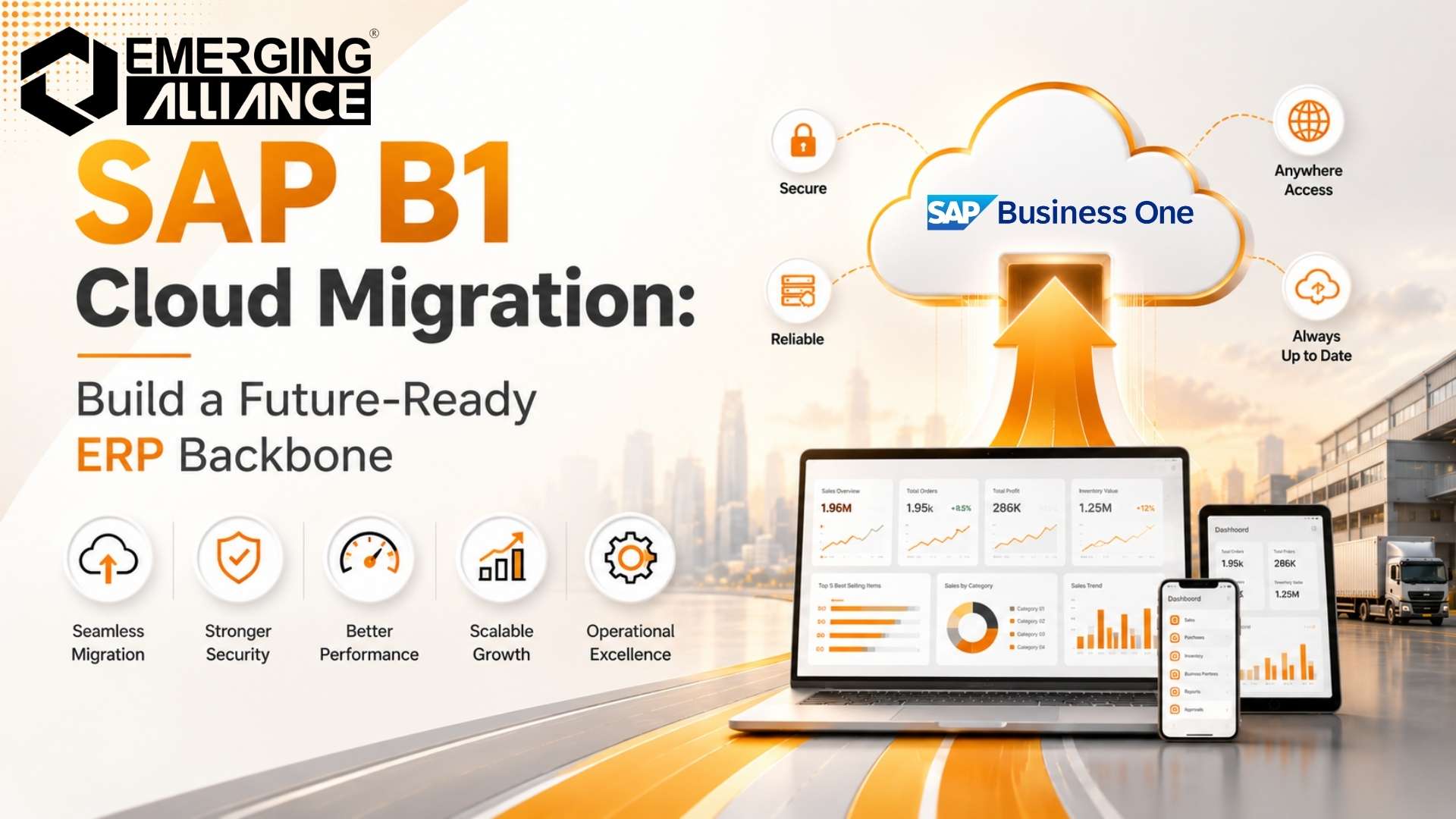
SAP B1 Cloud Migration: Build a Future-Ready ERP Backbone
Scale Operations Seamlessly with SAP B1 Cloud Migration
Modern enterprises are under constant pressure to scale operations, improve visibility, control costs, and respond faster to market changes. Yet many organizations still rely on aging infrastructure and an on-premise SAP Business One ERP environment that limits flexibility and increases operational complexity. As businesses expand across locations, users, and business models, traditional ERP environments often create bottlenecks. IT teams spend valuable time managing infrastructure, upgrades become disruptive, remote accessibility remains limited, and business leaders struggle to gain real-time visibility across the organization.v This is where SAP B1 cloud migration becomes a strategic business initiative rather than a technology upgrade. Moving to a cloud-based SAP Business One solution helps organizations improve agility, simplify management, strengthen business continuity, and create a scalable foundation for growth.
The question is no longer whether cloud adoption is necessary. The real question is whether the current ERP environment can support future growth without becoming a business constraint.
Why On-Premise SAP Business One Environments Eventually Limit Growth
Many organizations initially deploy an on-premise SAP B1 solution because it aligns with their operational needs at a specific stage of growth. However, as the business evolves, the limitations become increasingly visible.
Common challenges include:
- Increasing infrastructure maintenance costs
- Limited remote accessibility
- Complex upgrade management
- Business continuity risks
- Data backup and recovery concerns
- Reduced scalability during growth phases
- Longer deployment timelines for new users and locations
A growing manufacturing company, for example, may add multiple warehouses and sales offices across regions. If ERP access depends heavily on local infrastructure, delays in information flow can directly affect inventory decisions, customer service, and operational efficiency.
The issue is not the ERP itself. The challenge often lies in the environment supporting it.
How SAP Business One Cloud Solutions Improve Enterprise Agility
A modern SAP Business One Cloud solution creates a more flexible operating model by removing infrastructure constraints and enabling secure access to business information from anywhere.
With a cloud-based SAP Business One solution, organizations gain:
Improved Accessibility
Employees, managers, and executives can securely access business information regardless of location.
Faster Scalability
New users, branches, and operational units can be added with significantly less infrastructure dependency.
Reduced IT Complexity
Internal teams spend less time managing servers, backups, hardware upgrades, and maintenance activities.
Better Business Continuity
Cloud environments provide stronger disaster recovery capabilities and improved operational resilience.
Enhanced Collaboration
Teams across finance, procurement, inventory, sales, and operations can work from a unified platform without information silos.
The result is a more agile organization capable of responding quickly to changing business conditions.
SAP B1 Cloud Migration Helps Eliminate Visibility Gaps Across the Enterprise
One of the most significant challenges faced by growing businesses is fragmented visibility.
When decision-makers cannot access accurate information in real time, organizations often experience:
- Delayed reporting
- Inventory imbalances
- Procurement inefficiencies
- Revenue leakage
- Customer service challenges
- Poor forecasting accuracy
A successful SAP Business One Cloud migration helps create a connected business environment where information is available in real time across departments.
Business leaders gain visibility into:
- Financial performance
- Inventory levels
- Procurement activity
- Sales pipeline
- Customer transactions
- Operational KPIs
Instead of waiting for reports, leadership teams can make decisions using current business data.
This shift from reactive management to proactive decision-making often becomes one of the most valuable outcomes of cloud transformation.
Building a Scalable Cloud-Based SAP Business One Environment for Future Growth
Growth often introduces complexity.
More customers.
More suppliers.
More products.
More locations.
More transactions.
Without a scalable ERP foundation, operational efficiency begins to decline as complexity increases.
A properly designed cloud-based SAP B1 solution enables businesses to support expansion without continually investing in infrastructure.
Key scalability advantages include:
Multi-Location Operations
Support distributed operations through a centralized ERP environment.
Faster User Expansion
Add users and departments without significant hardware investments.
Flexible Resource Management
Scale infrastructure capacity based on business demand.
Simplified Upgrades
Reduce disruption associated with software updates and enhancements.
Global Accessibility
Enable management teams to access business information across regions.
Organizations pursuing acquisitions, regional expansion, or digital transformation initiatives often find cloud deployment essential for maintaining operational consistency.
SAP Business One Cloud Migration Is More Than a Hosting Decision
Many companies mistakenly view migration as simply moving servers from one location to another.
Successful transformation requires a broader business strategy.
A well-executed SAP Business One Cloud migration should evaluate:
- Current business processes
- Future growth plans
- Security requirements
- Compliance obligations
- Integration architecture
- Data governance policies
- Reporting requirements
- User adoption strategies
This is where many projects succeed or fail.
Technology alone does not create business value.
The real value comes from aligning ERP modernization with long-term business objectives.
Organizations that approach migration strategically often achieve:
- Higher operational efficiency
- Improved decision-making
- Reduced business risk
- Stronger governance
- Better user adoption
- Faster ROI realization
This is why cloud transformation should be guided by business outcomes, not infrastructure requirements alone.
Why Enterprise Leaders Choose Emerging Alliance for SAP B1 Cloud Migration
Cloud migration impacts technology, operations, finance, governance, and future growth.
At Emerging Alliance, we help organizations approach ERP modernization through a business transformation lens.
Our role extends beyond technical deployment.
We help enterprises:
- Assess migration readiness
- Evaluate business risks
- Design future-state ERP architecture
- Improve process efficiency
- Strengthen operational visibility
- Align ERP strategy with growth objectives
- Maximize long-term return on investment
As a digital transformation and enterprise solutions partner, Emerging Alliance works with leadership teams to ensure cloud migration supports measurable business outcomes rather than simply changing infrastructure.
Build a Future-Ready ERP Foundation with SAP B1 Cloud Migration
The most successful organizations continuously remove barriers that slow growth.
If infrastructure limitations, visibility gaps, operational inefficiencies, or scalability concerns are preventing your business from reaching its next stage of growth, now may be the right time to evaluate SAP B1 cloud migration.
Emerging Alliance can help you assess your current ERP environment, identify opportunities for modernization, and build a scalable cloud strategy aligned with your business objectives.
Top 10 FAQs About SAP B1 for Cloud Migration
1. What business risks should leaders assess before starting SAP B1 cloud migration?
Leaders should evaluate infrastructure dependency, downtime risks, security requirements, integration complexity, data governance, and the ability of the current ERP environment to support future growth.
2. How does SAP Business One Cloud migration improve decision-making?
By providing real-time access to operational, financial, inventory, and customer data, cloud environments help leadership teams make faster and more informed decisions.
3. When is the right time to move from an on-premise SAP B1 environment to the cloud?
Common triggers include business expansion, remote workforce requirements, rising infrastructure costs, limited system performance, and increasing demands for operational visibility.
4. How can SAP Business One Cloud support digital transformation initiatives?
Cloud deployment creates a flexible foundation for automation, analytics, integrations, mobile access, and future technology adoption across the enterprise.
5. What operational bottlenecks can SAP Business One Cloud help eliminate?
Organizations often reduce delays caused by manual reporting, infrastructure limitations, disconnected teams, data silos, and slow access to business-critical information.
6. How does cloud migration impact ERP performance across multiple business locations?
A centralized cloud-based environment enables consistent processes, shared data access, and improved collaboration across branches, warehouses, and regional offices.
7. What should CFOs consider when evaluating SAP Business One Cloud hosting solutions?
Finance leaders should assess total cost of ownership, infrastructure savings, business continuity capabilities, scalability, compliance support, and long-term ROI.
8. How does SAP Business One Cloud help support enterprise growth strategies?
The cloud enables businesses to scale users, locations, transactions, and workloads without repeatedly investing in additional hardware and infrastructure.
9. Can SAP B1 cloud migration help improve compliance and governance?
Yes. Centralized controls, improved audit visibility, automated backups, controlled access, and standardized processes help strengthen governance and reduce compliance risks.
10. What makes a successful SAP Business One Cloud migration project?
Success depends on business process alignment, migration planning, data quality, user adoption, integration readiness, and having an experienced transformation partner guiding the initiative.
Connect with our ERP experts to assess your needs and plan your next stage of growth.