
Struggling to Scale Your Medical Equipment Business? SAP B1 Simplifies It
Gain better control over sales, customer service, and follow-ups with an intelligent ERP solution
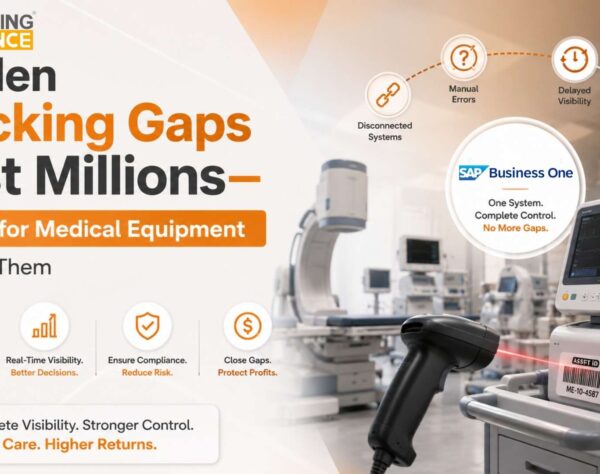
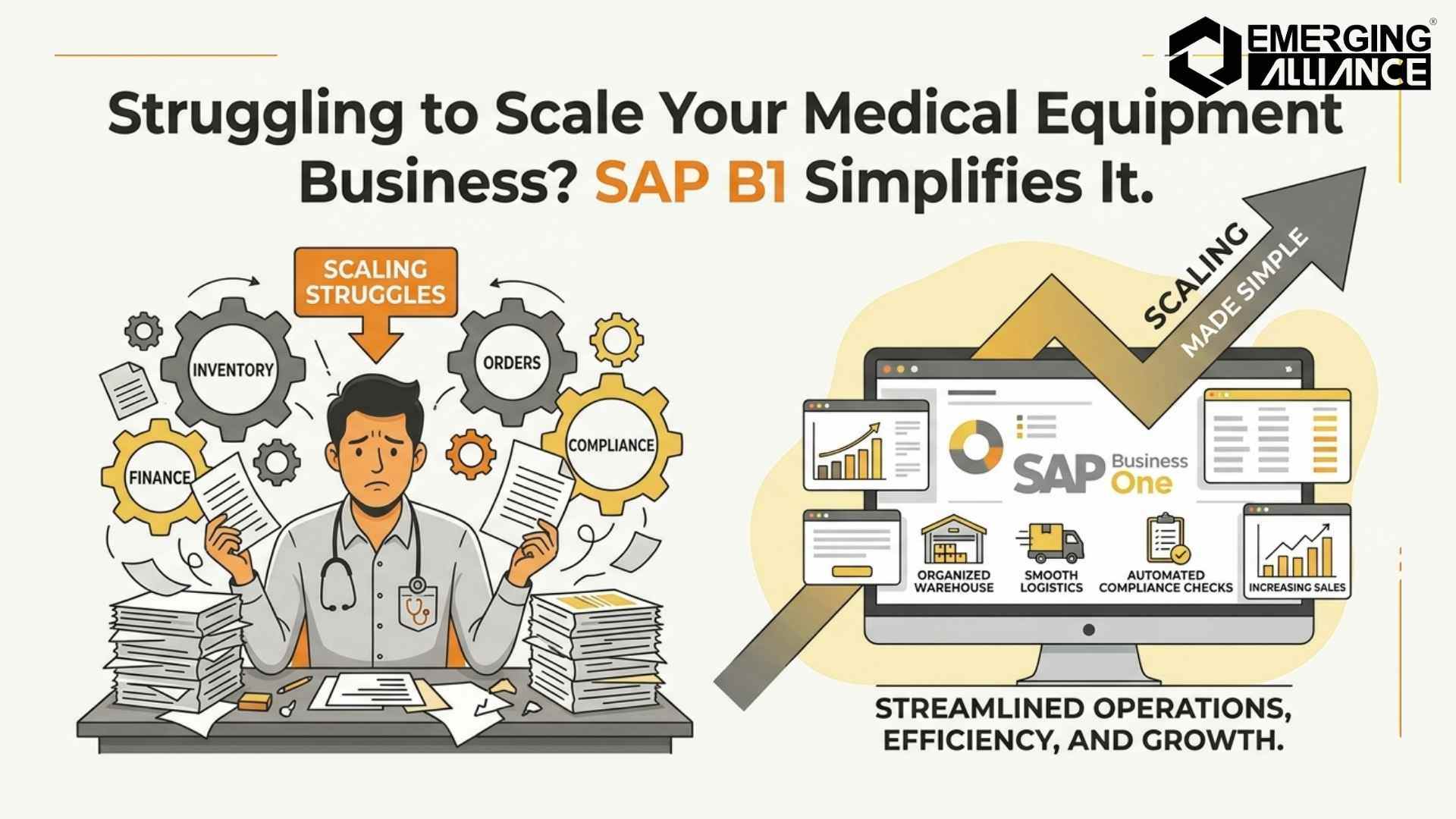
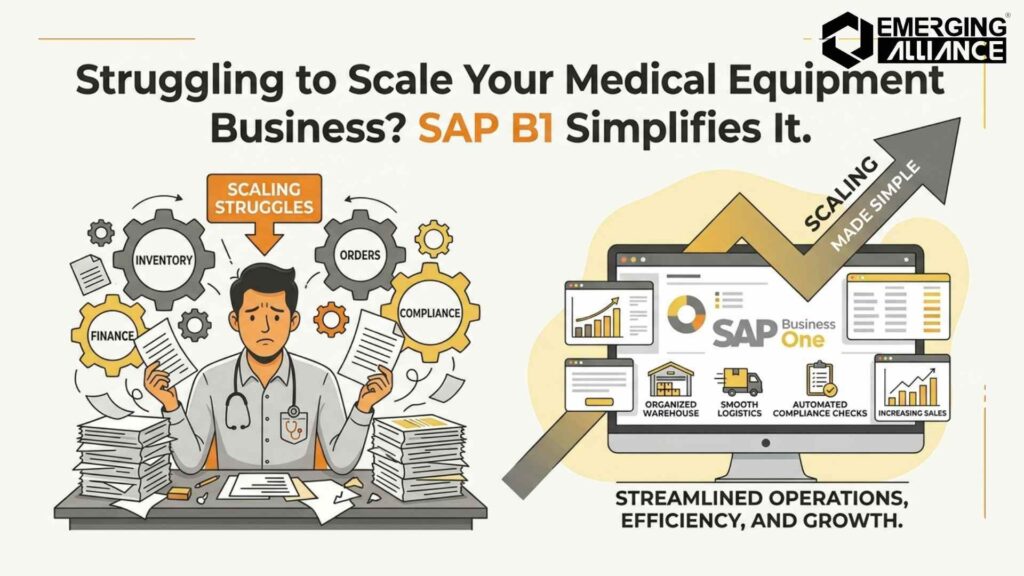
The medical equipment industry is evolving faster than many businesses can operationally adapt. Distributors, manufacturers, and healthcare equipment providers are under increasing pressure to manage complex inventories, ensure compliance, improve service response times, and scale operations without losing visibility. For many growing companies, disconnected systems become the biggest obstacle to growth. Sales teams operate separately from finance. Inventory data lacks accuracy. Customer service requests are manually tracked. Medical Equipment with SAP B1 maintenance schedules are missed. As operations expand, inefficiencies compound into revenue leakage and customer dissatisfaction.
This is where SAP B1 Medical equipment solutions create measurable operational value.
Modern enterprises require more than basic software implementation. They need a connected digital ecosystem that enables scalability, process intelligence, automation, and real-time decision-making. Emerging Alliance helps medical equipment businesses build that foundation with strategic ERP transformation tailored for operational growth.
Why ERP for Medical Devices Industry Is Becoming a Strategic Necessity
Medical equipment businesses deal with highly complex operational workflows. Product lifecycle tracking, compliance requirements, installation scheduling, maintenance contracts, and delivery coordination demand centralized visibility.
Without a unified ERP platform, organizations often face:
- Delayed order fulfillment
- Inventory inaccuracies across warehouses
- Inconsistent billing processes
- Manual service coordination
- Poor customer follow-up tracking
- Compliance risks
- Revenue leakage from missed service opportunities
- Limited operational forecasting
An intelligent ERP for medical devices industry operations enables leadership teams to gain enterprise-wide visibility while automating repetitive workflows.
SAP Business One helps organizations streamline operational processes across finance, sales, procurement, inventory, customer service, and field operations from a single platform.
For CEOs and operations leaders, this means faster decision-making and scalable business control.
How SAP B1 Medical Equipment Management Improves Operational Efficiency
Medical equipment providers operate in an environment where downtime directly impacts healthcare delivery. Delays in service, missing parts, or inaccurate stock levels can damage customer trust and operational performance.
SAP B1 medical equipment management capabilities centralize critical workflows and reduce process fragmentation.
Unified Inventory and Equipment Visibility
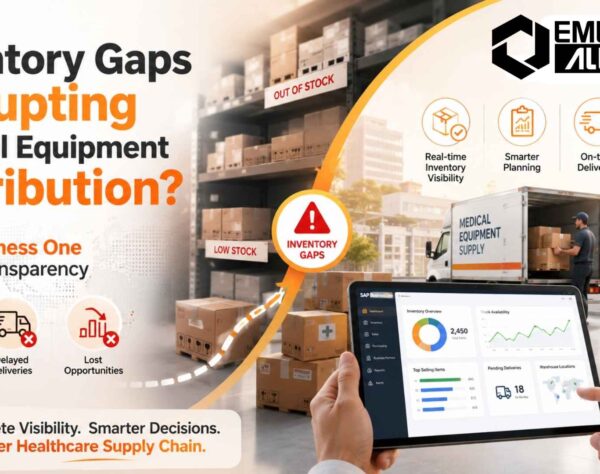
A fragmented medical device inventory system creates procurement inefficiencies and stock inconsistencies. SAP Business One improves inventory accuracy with real-time visibility across locations, warehouses, and service teams.
Key operational advantages include:
- Real-time stock management healthcare operations require
- Automated reorder workflows
- Batch and serial number tracking
- Equipment availability monitoring
- Multi-location inventory visibility
- Faster dispatch coordination
- Reduced stock obsolescence
For distributors handling large product catalogs and field inventory, this level of visibility significantly improves operational responsiveness.
Better Service and Preventive Maintenance Coordination
Medical equipment preventive maintenance is critical for maintaining customer trust and regulatory alignment. Manual scheduling often results in delayed servicing and missed follow-ups.
With SAP B1 workflow automation medical equipment processes become structured and traceable.
Organizations can:
- Schedule preventive maintenance automatically
- Track warranty periods
- Manage service contracts centrally
- Monitor technician assignments
- Improve service response timelines
- Reduce equipment downtime
- Maintain complete service histories
This creates stronger customer retention while improving post-sales service profitability.
ERP for Medical Device Manufacturers Requires End-to-End Process Control
Manufacturers face additional complexity across procurement, production planning, compliance documentation, and delivery management.
Disconnected systems limit scalability because operational leaders cannot access real-time production and financial data simultaneously.
SAP Business One enables medical device manufacturers to connect operations across departments while improving business intelligence.
Production and Cost Visibility
Growing manufacturers often struggle with:
- Inaccurate production costing
- Delayed procurement cycles
- Material planning inefficiencies
- Limited profitability tracking
- Manual reporting delays
Medical equipment ERP systems built on SAP Business One provide:
- Production planning visibility
- Raw material tracking
- Cost tracking medical equipment ERP workflows
- Procurement automation
- Margin analysis
- Financial consolidation
- Automated approval workflows
Leadership teams gain greater operational control without increasing administrative overhead.
Compliance and Traceability Support
Compliance failures can create operational and reputational risks for healthcare suppliers and manufacturers.
SAP B1 supports:
- Serial number traceability
- Audit-ready reporting
- Document management
- Product movement tracking
- Medical equipment compliance management
- Delivery validation workflows
This level of operational transparency is increasingly important for enterprises scaling across regions and healthcare networks.
SAP B1 Cloud ERP for Healthcare Enables Scalable Enterprise Growth
As medical equipment companies expand geographically, operational complexity increases exponentially.
Cloud-enabled ERP infrastructure allows organizations to scale faster while improving collaboration between branches, warehouses, service teams, and leadership stakeholders.
SAP B1 cloud ERP for healthcare environments supports:
- Remote operational access
- Centralized reporting
- Faster data synchronization
- Multi-branch scalability
- Enterprise-wide workflow standardization
- Improved customer response coordination
For growing distributors and healthcare equipment providers, cloud ERP reduces dependency on disconnected spreadsheets and legacy systems.
More importantly, it creates a digital operating model that supports long-term expansion.
Real-World Operational Scenario
Consider a growing medical equipment distributor managing multiple warehouses, installation teams, and hospital contracts.
Without integrated systems:
- Sales teams cannot access accurate stock levels
- Service teams miss maintenance timelines
- Finance teams manually reconcile invoices
- Procurement delays affect customer deliveries
- Leadership lacks operational forecasting visibility
After implementing SAP Business One through a strategic transformation approach:
- Inventory updates become real-time
- Delivery tracking improves
- Billing and invoicing medical devices workflows become automated
- Service scheduling becomes centralized
- Customer response times improve
- Reporting becomes decision-oriented instead of reactive
This operational alignment creates scalability without increasing process complexity.
Why Emerging Alliance Delivers More Than ERP Implementation
Technology alone does not solve operational inefficiencies. Enterprises require a transformation partner that understands process optimization, scalability planning, automation strategy, and long-term business alignment.
Emerging Alliance positions ERP initiatives as enterprise transformation programs rather than software deployment projects.
The focus is not simply system configuration. The focus is operational modernization.
Emerging Alliance helps organizations:
- Align ERP with business growth goals
- Optimize medical supply chain management
- Automate enterprise workflows
- Improve cross-functional visibility
- Reduce operational bottlenecks
- Strengthen reporting intelligence
- Enable scalable digital infrastructure
- Improve customer lifecycle management
For enterprise decision-makers, this strategic approach reduces implementation friction while accelerating measurable operational outcomes.
Key Strategic Outcomes Enterprises Achieve
Organizations adopting SAP B1 for distributors of medical devices often experience improvements across:
- Inventory accuracy
- Customer service responsiveness
- Sales process visibility
- Service revenue tracking
- Equipment lifecycle management ERP processes
- Workflow automation
- Financial reporting efficiency
- Operational scalability
These improvements directly support enterprise growth while reducing operational risk exposure.
Conclusion: SAP B1 Medical Equipment Solutions Create Scalable Business Control
Scaling a medical equipment business requires more than adding new customers or expanding product lines. Sustainable growth depends on operational visibility, process automation, service efficiency, and enterprise-wide coordination.
SAP B1 Medical equipment solutions help organizations simplify complexity while improving agility across sales, inventory, finance, service, and compliance operations.
For enterprises seeking long-term digital transformation, the right implementation strategy matters as much as the technology itself.
Emerging Alliance helps medical equipment businesses modernize operations with a strategic ERP roadmap focused on scalability, automation, and measurable business outcomes.
If your organization is struggling with disconnected workflows, inventory inefficiencies, or service management challenges, now is the time to evaluate how SAP Business One can transform operational performance.
Ready to Modernize Your Medical Equipment Operations?
Emerging Alliance partners with medical equipment manufacturers, distributors, and healthcare enterprises to build scalable ERP ecosystems using SAP Business One.
Frequently Asked Questions
1. How does SAP Business One help medical equipment companies improve operations?
SAP Business One centralizes inventory, sales, finance, service management, and procurement workflows to improve visibility, automation, and operational efficiency.
2. Is SAP B1 suitable for distributors of medical devices with multiple warehouses?
Yes. SAP B1 supports multi-warehouse inventory visibility, stock transfers, delivery coordination, and real-time inventory management for growing distribution networks.
3. Can medical device ERP software automate preventive maintenance workflows?
Yes. SAP Business One can automate maintenance schedules, service reminders, warranty tracking, technician assignments, and service history management.
4. What are the advantages of SAP B1 cloud ERP for healthcare businesses?
Cloud ERP improves remote accessibility, centralized reporting, operational scalability, branch coordination, and enterprise-wide workflow standardization.
5. Does SAP Business One support medical equipment compliance management?
SAP B1 supports audit-ready reporting, serial number traceability, document management, and compliance-related workflow tracking.
6. How difficult is ERP implementation for medical device manufacturers?
Implementation complexity depends on operational processes, integrations, and data migration requirements. A strategic partner like Emerging Alliance helps reduce disruption through phased transformation planning.
7. Can SAP B1 integrate with CRM, accounting, and third-party healthcare systems?
Yes. SAP Business One supports integrations with CRM platforms, finance systems, reporting tools, eCommerce platforms, and industry-specific applications.
8. How does a medical device inventory system improve revenue performance?
Accurate inventory visibility reduces stockouts, improves delivery timelines, minimizes excess inventory costs, and prevents revenue leakage caused by fulfillment delays.
9. What reporting capabilities does SAP B1 provide for medical equipment ERP operations?
SAP Business One provides real-time dashboards, financial analytics, inventory reporting, procurement insights, profitability analysis, and operational performance tracking.
10. What should enterprises evaluate before migrating to SAP B1 medical equipment solutions?
Organizations should assess operational bottlenecks, workflow inefficiencies, scalability goals, integration requirements, compliance needs, and reporting visibility before migration planning.
Connect with Emerging Alliance today to discover how SAP Business One can simplify growth and improve operational control across your business.