
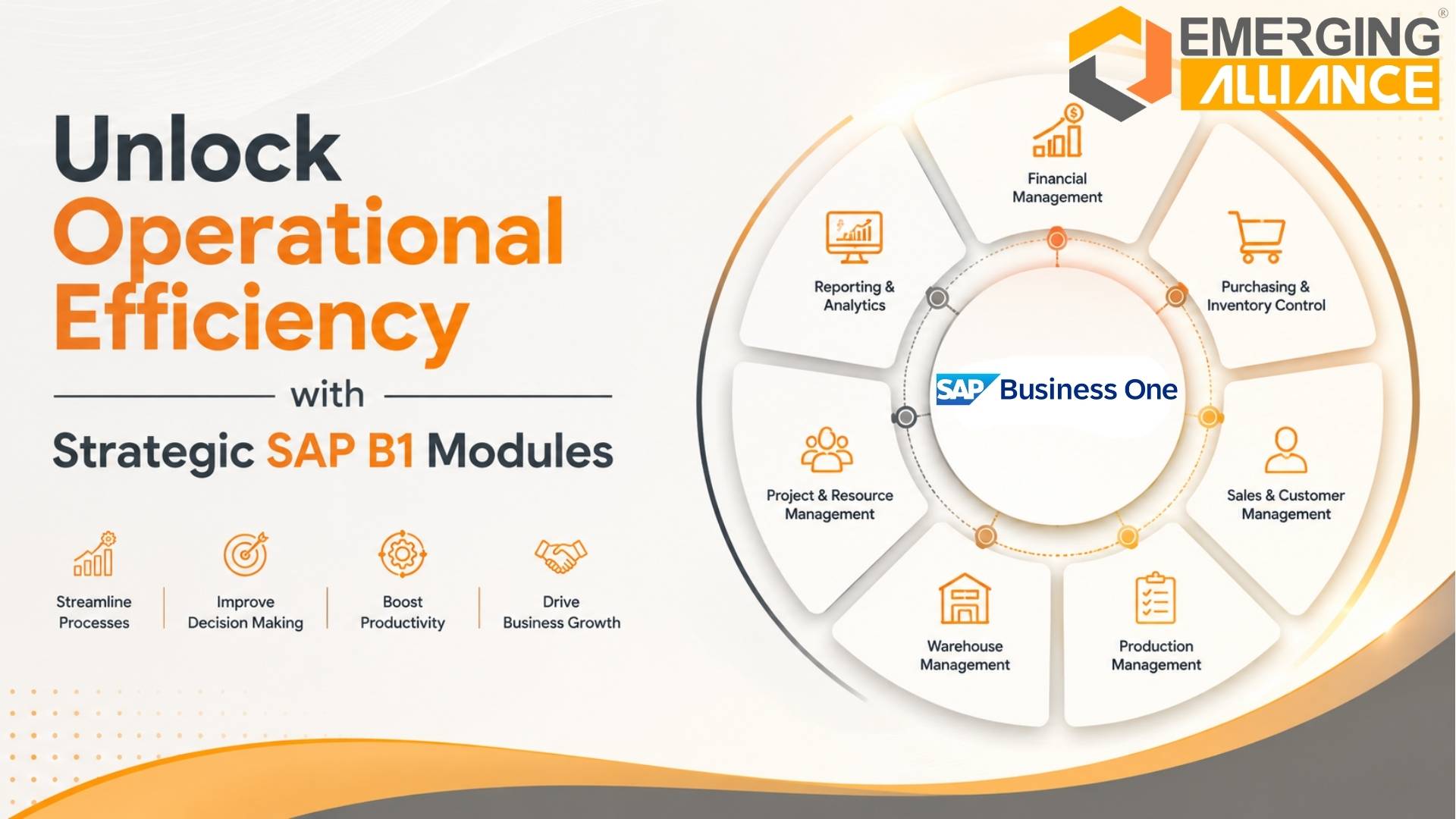
Unlock Operational Efficiency with Strategic SAP B1 Modules
How CTOs Leverage SAP B1 Finance Module and System Modules to Drive Faster Decisions and Cost Control
Modern enterprises rarely struggle because of a lack of data. They struggle because their data, processes, and decisions operate in silos. SAP B1 Modules help organizations eliminate visibility gaps, automate workflows, and create a connected operating environment where finance, sales, inventory, procurement, and manufacturing work as one system.
For CEOs, CTOs, CFOs, and Operations Leaders, the challenge is no longer managing growth—it is managing complexity. Disconnected applications create reporting delays, compliance risks, inventory inaccuracies, operational bottlenecks, and hidden revenue leakage.
The right ERP architecture is not simply software deployment. It is a business transformation strategy.
This is where strategic deployment of SAP Business One modules helps enterprises gain operational control, improve agility, and support scalable growth.
Why SAP B1 Modules Matter More Than Ever
Enterprise growth creates operational challenges that spreadsheets and disconnected systems cannot solve.
As organizations expand across locations, product lines, and customer segments, leaders need real-time visibility into business performance without waiting for multiple reports from different departments.
Strategically implemented SAP B1 ERP modules create a unified environment where data flows automatically across the organization.
Key business outcomes include:
- Faster decision-making
- Improved financial control
- Reduced manual processes
- Better compliance management
- Higher operational visibility
- Reduced inventory carrying costs
- Improved forecasting accuracy
- Stronger enterprise scalability
Instead of managing departments independently, organizations gain a connected business operating model.
SAP B1 Finance Module Creates Enterprise-Wide Financial Control
For most organizations, financial management is the foundation of operational efficiency.
The SAP B1 finance module provides centralized control over accounting, cash flow, budgeting, financial reporting, taxation, and compliance requirements.
Without integrated financial management, businesses often face:
- Delayed financial reporting
- Revenue recognition issues
- Cash flow visibility challenges
- Compliance risks
- Manual reconciliation efforts
When finance is integrated with sales, procurement, inventory, and production, leadership gains real-time visibility into business performance.
Business Scenario
A manufacturing company receives large customer orders while raw material prices fluctuate rapidly.
Without ERP integration:
- Procurement lacks financial visibility
- Production planning becomes reactive
- Profitability calculations are delayed
With SAP Business One:
- Costs update automatically
- Financial impact is visible immediately
- Margin analysis becomes real-time
- Decision-making accelerates
This level of financial management automation enables proactive business management rather than reactive reporting.
How Key Modules of SAP Business One Eliminate Workflow Bottlenecks
Many enterprises invest heavily in technology but continue operating through manual approvals, spreadsheets, and fragmented workflows.
The true value of the key modules of SAP Business One comes from business process integration.
SAP Business One Sales Module
The SAP Business One sales module helps organizations manage the complete customer lifecycle.
Benefits include:
- Lead-to-order visibility
- Automated sales workflows
- Real-time customer information
- Improved quotation management
- Better revenue forecasting
Sales teams gain access to inventory availability, customer history, and financial information from a single platform.
CRM Modules for Customer Growth
Integrated CRM modules help businesses:
- Track customer interactions
- Improve sales forecasting
- Strengthen customer retention
- Increase cross-selling opportunities
This creates a connected customer experience while improving sales productivity.
Inventory Management in SAP B1
Inventory visibility remains one of the biggest operational challenges for growing businesses.
Integrated inventory management provides:
- Real-time stock visibility
- Automated replenishment
- Warehouse control
- Batch and serial tracking
- Reduced stock-outs
This improves working capital utilization while reducing inventory-related risks.
SAP B1 Supply Chain Module Improves Visibility Across Operations
Supply chain disruptions continue to impact enterprise performance across industries.
The SAP B1 supply chain module helps organizations improve planning, procurement, inventory movement, and supplier collaboration through real-time visibility.
Instead of relying on isolated purchasing systems, businesses gain end-to-end supply chain transparency.
Key Business Advantages
- Better supplier performance monitoring
- Improved procurement planning
- Reduced excess inventory
- Faster order fulfillment
- Improved demand forecasting
- Enhanced supply chain visibility
Real-World Scenario
A distributor managing multiple warehouses often struggles with inventory balancing.
Without integrated systems:
- One warehouse experiences shortages
- Another carries excess inventory
With SAP Business One:
- Inventory visibility becomes centralized
- Transfers are optimized
- Procurement decisions improve
- Customer service levels increase
The result is reduced operational friction and improved profitability.
SAP B1 Manufacturing Module Drives Production Efficiency
Manufacturing organizations face increasing pressure to improve productivity while controlling costs.
The SAP B1 manufacturing module provides real-time control over production planning, resource allocation, material consumption, and operational performance.
For manufacturers, visibility is critical.
Without it:
- Production delays increase
- Material wastage rises
- Capacity planning becomes inaccurate
- Quality issues go unnoticed
How SAP Business One Modules for Manufacturing Help
- Bill of Materials (BOM) management
- Production planning and control
- Capacity management
- Material requirements planning
- Shop floor visibility
- Cost tracking
Manufacturing Process Optimization in Action
A growing industrial manufacturer operates multiple production lines.
Before ERP integration:
- Production schedules were manually managed
- Material shortages disrupted output
- Cost tracking was delayed
After implementing SAP Business One manufacturing capabilities:
- Production schedules became automated
- Material availability improved
- Operational costs became transparent
- Output predictability increased
This directly contributes to higher operational efficiency and profitability.
SAP B1 Quality Management Module Reduces Compliance and Operational Risk
As regulatory requirements become stricter, quality management is no longer optional.
The SAP B1 quality management module helps organizations maintain consistency across operations while supporting compliance requirements.
Key capabilities include:
- Quality inspections
- Audit tracking
- Batch traceability
- Defect management
- Process standardization
- Compliance reporting
Organizations operating in manufacturing, healthcare, pharmaceuticals, food processing, and regulated industries particularly benefit from integrated quality controls.
When quality management is connected to inventory, production, procurement, and finance, compliance becomes part of daily operations rather than a reactive process.
Real-Time Reporting Turns Data into Executive Decisions
Most leadership teams are overwhelmed with reports but still lack actionable insights.
Integrated SAP Business One modules provide:
- Real-time business reporting
- Executive dashboards
- Financial performance visibility
- Inventory analytics
- Operational KPIs
- Supply chain performance metrics
Instead of waiting for weekly reports, decision-makers gain immediate access to business intelligence.
This allows faster response to:
- Revenue fluctuations
- Cost increases
- Production issues
- Supply chain disruptions
- Customer demand changes
Real-time visibility becomes a competitive advantage.
Why Strategic Module Selection Matters
Many ERP projects underperform because organizations focus on software features rather than business outcomes.
Successful enterprises align SAP modules with strategic objectives such as:
- Cost optimization
- Growth enablement
- Process automation
- Compliance management
- Customer experience improvement
- Operational scalability
At Emerging Alliance, we help organizations evaluate business challenges, identify operational gaps, and design SAP Business One environments aligned with long-term transformation goals.
Our approach goes beyond implementation.
We focus on creating an ERP-driven operating model that supports enterprise growth, governance, and measurable ROI.
Transform SAP Business One into a Competitive Advantage
The value of SAP B1 Modules is not found in individual features. It comes from how finance, sales, supply chain, manufacturing, quality, and reporting work together to create a connected enterprise.
Organizations that continue operating with fragmented systems often face growing inefficiencies, visibility gaps, and rising operational costs.
Organizations that strategically deploy SAP Business One gain:
- Faster decisions
- Greater operational control
- Better compliance
- Improved profitability
- Scalable business processes
Frequently Asked Questions
1. Which SAP B1 ERP modules are most important for growing enterprises?
Finance, sales, inventory, procurement, manufacturing, and reporting modules are typically the most critical for improving operational efficiency and business visibility.
2. How does the SAP B1 finance module improve decision-making?
It provides real-time financial reporting, automated accounting processes, budgeting visibility, and cash flow insights that help leaders make faster business decisions.
3. Can SAP Business One modules be implemented gradually?
Yes. Organizations can deploy modules in phases based on business priorities, operational requirements, and budget considerations.
4. What industries benefit most from SAP Business One modules for manufacturing?
Manufacturing, pharmaceuticals, food processing, engineering, electronics, medical devices, and industrial production companies commonly benefit from manufacturing-focused capabilities.
5. How does the SAP B1 supply chain module improve inventory control?
It provides real-time inventory visibility, procurement automation, warehouse management, and demand planning capabilities.
6. What is the typical ROI from SAP Business One implementation?
ROI varies by organization but is commonly driven by reduced manual effort, improved inventory management, faster reporting, and stronger operational control.
7. Can SAP Business One integrate with CRM systems and third-party applications?
Yes. SAP Business One supports integrations with CRM platforms, e-commerce systems, business intelligence tools, and industry-specific applications.
8. How does SAP Business One support compliance and audit readiness?
Integrated financial controls, traceability, approval workflows, audit trails, and reporting capabilities help organizations maintain regulatory compliance.
9. What challenges should businesses prepare for during ERP migration?
Data quality issues, process standardization requirements, user adoption, and change management planning are common factors that require attention.
10. How does real-time business reporting improve executive performance?
Real-time reporting enables leaders to identify issues earlier, monitor KPIs continuously, and make informed decisions based on current business conditions rather than historical reports.
Talk to Emerging Alliance today and discover how SAP Business One can become the foundation for scalable enterprise growth.