
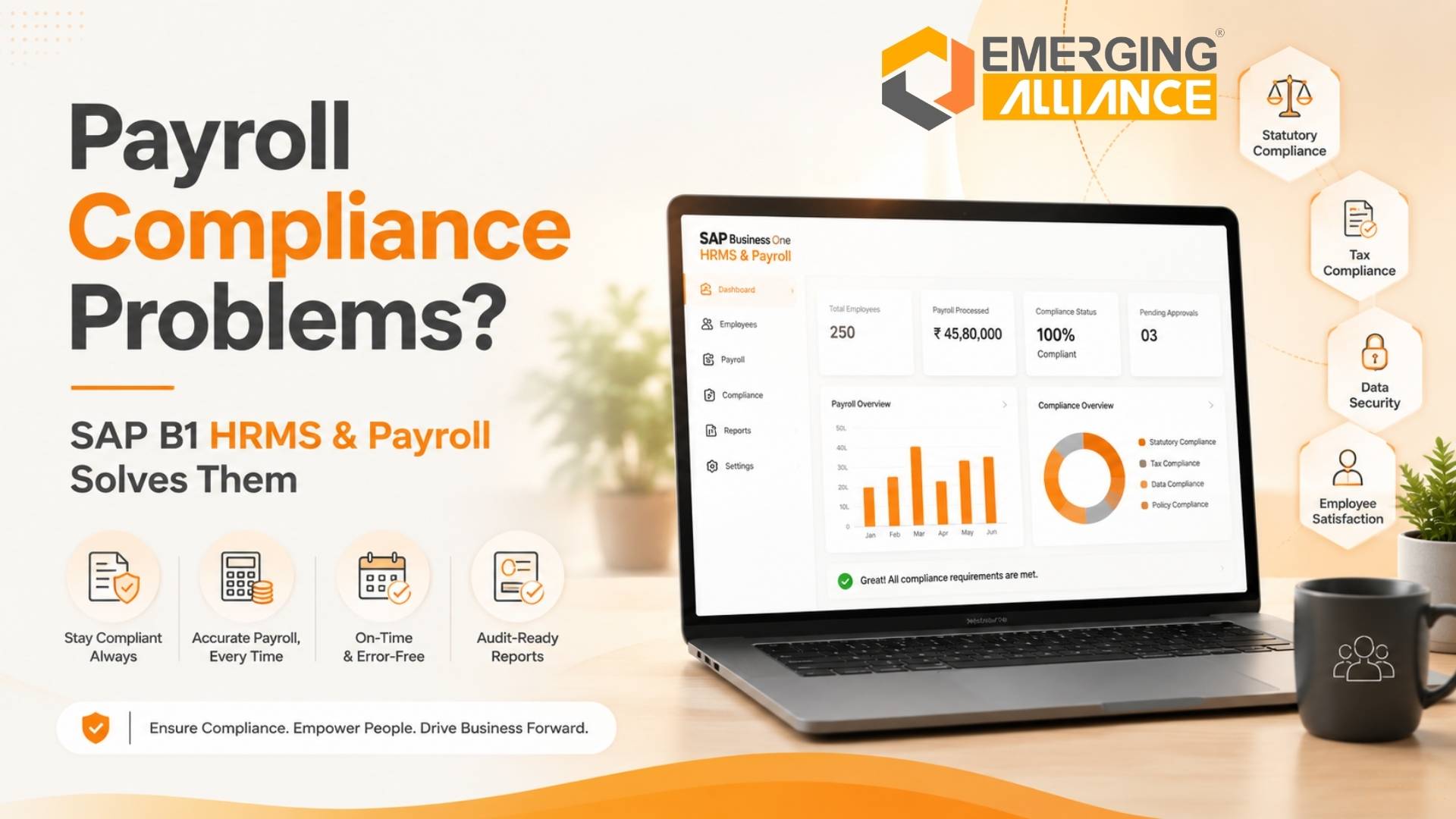
Payroll Compliance Problems? SAP B1 HRMS & Payroll Solves Them
Automate PF, ESI, taxes, and statutory reporting with SAP Business One HRMS
Payroll errors rarely start in payroll. They begin with disconnected attendance records, manual leave tracking, spreadsheet-based calculations, delayed approvals, and fragmented employee data. As organizations grow, these gaps create compliance risks, payroll inaccuracies, audit concerns, and unnecessary administrative workload. SAP B1 HRMS provides a unified platform for workforce management, payroll processing, compliance reporting, and employee administration directly integrated with SAP Business One. Instead of managing HR and finance operations separately, businesses gain a centralized system that improves accuracy, visibility, and operational control.
For CEOs, CFOs, CIOs, and Operations Leaders, the challenge is not simply processing salaries. It is building a scalable workforce management framework that supports growth without increasing compliance exposure or administrative complexity.
Why Payroll Compliance Becomes a Growth Challenge for Enterprises
Most organizations can manage payroll manually when employee counts are low. Problems emerge when the business expands across departments, locations, shifts, and statutory requirements.
Payroll teams often struggle with:
- Manual PF, ESI, and tax calculations
- Inaccurate attendance and overtime records
- Delayed payroll processing cycles
- Compliance reporting bottlenecks
- Lack of employee data visibility
- Duplicate data entry between HR and finance teams
- Audit preparation challenges
- Difficulty managing workforce growth
The result is more than administrative inefficiency.
It can lead to payroll disputes, compliance penalties, delayed decision-making, and increased operational costs.
Modern enterprises need a workforce management solution that automates compliance while maintaining complete visibility across HR and finance operations.
SAP Business One HRMS Creates a Single Source of Workforce Truth
A disconnected HR environment creates reporting gaps and process delays.
SAP Business One HRMS centralizes employee information, attendance records, payroll data, leave management, and compliance documentation into a unified platform.
This enables organizations to eliminate fragmented systems and create a reliable workforce database.
Key Business Advantages
- Centralized employee master data
- Automated employee lifecycle management
- Digital document management
- Employee self-service capabilities
- Real-time workforce visibility
- Reduced administrative workload
When HR data becomes structured and accessible, leadership gains better visibility into workforce costs, productivity, and compliance status.
Instead of reacting to payroll issues, businesses can proactively manage workforce operations.
SAP B1 Payroll Automation Eliminates Compliance Bottlenecks
Payroll processing should not consume days of manual effort every month.
The SAP B1 Payroll module automates salary calculations, deductions, reimbursements, statutory contributions, and reporting requirements.
This significantly reduces dependency on spreadsheets and manual verification processes.
Compliance Areas Commonly Automated
- Provident Fund (PF)
- Employee State Insurance (ESI)
- Professional Tax
- Income Tax deductions
- Loan management
- Salary revisions
- Bonus calculations
- Overtime management
- Statutory reporting
Enterprise Scenario
A manufacturing company operating multiple shifts often faces payroll complexity due to attendance variations, overtime calculations, and shift-based allowances.
With payroll automation software integrated into SAP Business One, payroll calculations are generated automatically based on approved attendance and leave records.
The result is:
- Faster payroll processing
- Reduced human error
- Improved compliance accuracy
- Better audit readiness
Organizations gain confidence that payroll remains consistent regardless of workforce scale.
HR and Payroll Integration with SAP B1 Improves Financial Control
One of the biggest challenges in workforce management is the disconnect between HR and finance systems.
When payroll data must be manually transferred into accounting systems, businesses face delays, reconciliation issues, and reporting inconsistencies.
HR and payroll integration with SAP B1 connects workforce management directly with financial operations.
This integration enables:
- Automatic payroll journal entries
- Real-time salary cost visibility
- Department-wise workforce cost tracking
- Improved budgeting accuracy
- Faster financial closing cycles
- Better cash flow planning
For finance leaders, workforce expenses become visible in real time rather than after month-end reconciliation.
This improves forecasting accuracy and enables stronger financial governance.
Employee Attendance, Leave, and Shift Management Without Manual Tracking
Attendance inaccuracies are among the largest contributors to payroll disputes.
Manual attendance systems often create challenges in:
- Leave approvals
- Shift scheduling
- Overtime calculations
- Employee productivity tracking
- Workforce planning
A modern SAP B1 employee management system integrates attendance, leave, payroll, and employee records into a single workflow.
Core Workforce Automation Features
- Biometric integration
- Attendance management
- Leave and holiday management
- Shift scheduling
- Overtime tracking
- Employee self-service portal
- Approval workflows
- Workforce analytics
Employees gain greater transparency while HR teams spend less time managing routine requests.
This creates a more efficient workforce management process while reducing payroll dependencies.
Best HRMS for SAP B1 Supports Enterprise Scalability
Growth often exposes weaknesses in HR infrastructure.
Organizations expanding across regions, departments, or business units require workforce systems that scale without increasing administrative complexity.
The Best HRMS for SAP B1 provides the flexibility to support:
- Multi-location operations
- Large workforce management
- Compliance reporting requirements
- Organizational restructuring
- Workforce analytics
- Expansion initiatives
As workforce size grows, leaders need access to reliable workforce intelligence.
With centralized HR data management and payroll automation, businesses can make faster decisions based on accurate information rather than fragmented reports.
The result is a stronger foundation for sustainable growth.
Why Enterprises Choose Emerging Alliance
Technology implementation alone does not solve workforce challenges.
Success depends on aligning people, processes, compliance requirements, and business objectives.
Emerging Alliance helps organizations transform workforce operations through:
- SAP Business One HRMS consulting
- Payroll automation strategy
- Compliance workflow design
- Workforce process optimization
- SAP Business One integration services
- Digital transformation advisory
- Post-implementation support
Rather than deploying software in isolation, Emerging Alliance helps organizations build scalable workforce management frameworks that support long-term growth.
Ready to Eliminate Payroll Compliance Risks?
Payroll should not be a monthly compliance challenge.
With SAP B1 HRMS, organizations can automate payroll processing, streamline attendance management, improve statutory compliance, and gain complete workforce visibility.
Whether you are managing workforce expansion, compliance complexity, or operational inefficiencies, Emerging Alliance can help design a scalable HR and payroll framework aligned with your business objectives.
FAQs
1. How does SAP B1 HRMS improve payroll compliance management?
SAP B1 HRMS automates statutory calculations, compliance reporting, payroll processing, and workforce data management, reducing manual errors and compliance risks.
2. What is included in the SAP B1 payroll module?
The SAP B1 payroll module includes salary processing, PF, ESI, tax deductions, overtime management, reimbursements, bonus calculations, and payroll reporting.
3. Can SAP Business One HRMS integrate with attendance devices?
Yes. The solution can integrate with biometric systems and attendance devices to automate employee attendance management and payroll calculations.
4. Is payroll software for SAP Business One suitable for multi-location organizations?
Yes. It supports centralized workforce management across multiple branches, locations, and business units while maintaining compliance consistency.
5. How does HR and payroll integration with SAP B1 benefit finance teams?
Integration eliminates duplicate data entry, automates journal postings, improves cost visibility, and accelerates financial reporting cycles.
6. What reporting capabilities are available in SAP Business One HRMS?
Organizations can generate payroll reports, compliance reports, attendance reports, workforce analytics, leave summaries, and department-wise employee cost reports.
7. Can SAP Business One payroll add-on support industry-specific requirements?
Yes. The solution can be configured to address workforce requirements across manufacturing, distribution, healthcare, retail, services, and other industries.
8. What is the expected ROI from implementing workforce automation software?
ROI is typically achieved through reduced administrative effort, lower compliance risk, improved payroll accuracy, faster processing cycles, and better workforce visibility.
9. What challenges should organizations prepare for during HRMS migration?
Common challenges include employee data cleansing, attendance integration, workflow alignment, payroll validation, and change management. Proper planning minimizes disruption.
10. Why is SAP B1 HRMS considered one of the best HRMS solutions for SAP Business One users?
Because it combines employee management, payroll automation, compliance management, attendance tracking, reporting, and financial integration within a unified SAP Business One environment.
Talk to Emerging Alliance today and build a smarter workforce management strategy