
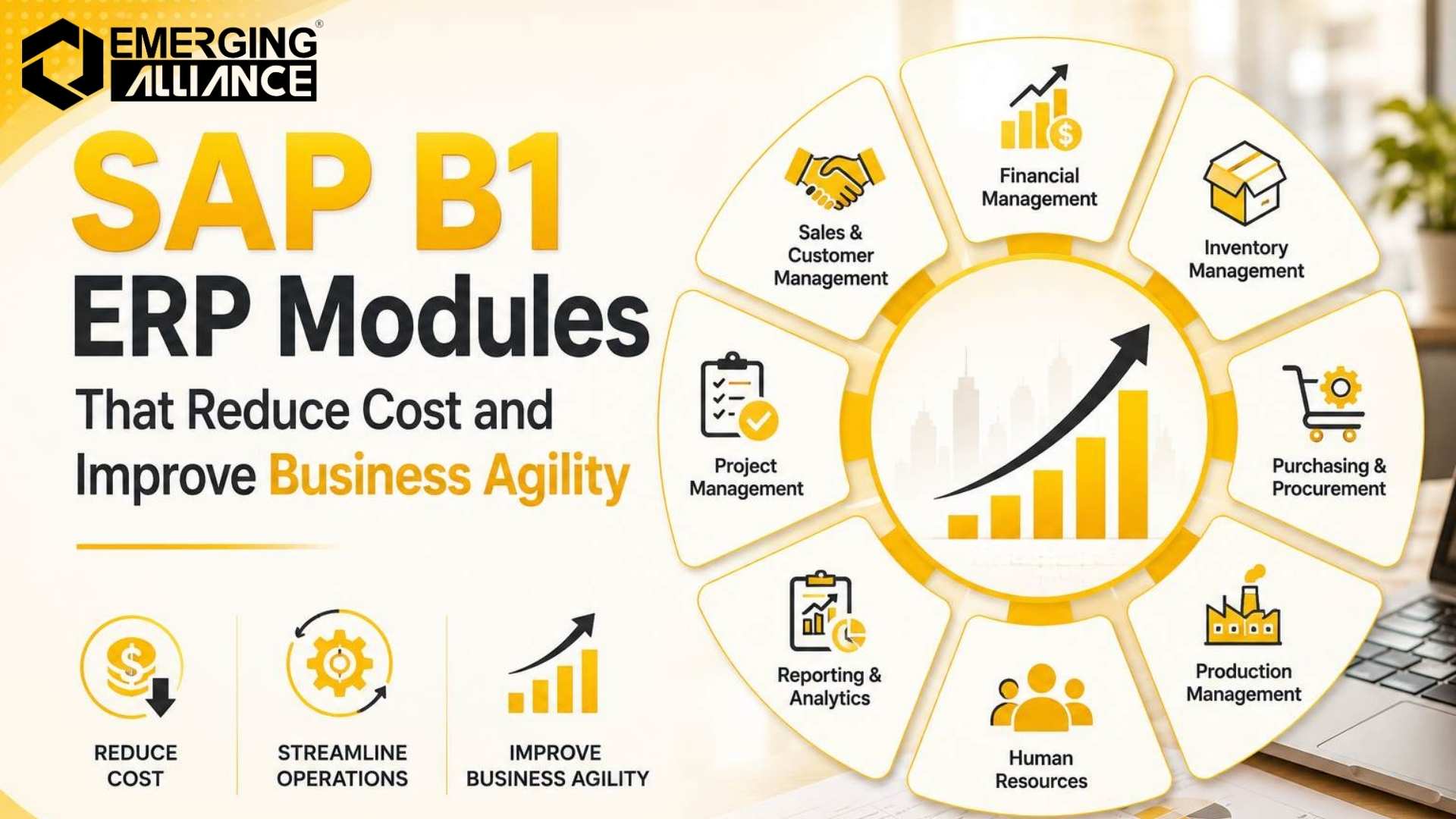
SAP B1 ERP Modules That Reduce Cost and Improve Business Agility
How SAP B1 modules streamline finance, operations, and reporting across growing enterprises
SAP B1 modules help growing enterprises improve operational efficiency, reduce unnecessary costs, and respond faster to changing market demands. However, many organizations still operate with disconnected systems, manual workflows, fragmented reporting structures, and limited real-time visibility across departments. As businesses expand across multiple branches, warehouses, dealer networks, and operational units, managing finance, inventory, procurement, sales, and reporting becomes significantly more complex. Delayed reporting, workflow bottlenecks, inventory mismatches, and communication gaps often prevent leadership teams from making fast, data-driven decisions.
Instead of operating as standalone business applications, SAP Business One modules unify core business functions into a centralized ERP ecosystem that improves automation, operational visibility, compliance management, and enterprise scalability. Combined with the right ERP add-ons, SAP Business One Extensions, and industry-specific implementation strategies, organizations can build agile operational frameworks that support long-term growth.
At Emerging Alliance, the focus extends beyond ERP implementation. The objective is to help enterprises modernize operations through scalable digital transformation strategies that align technology, processes, analytics, and business performance goals.
Current Industry Challenge: Growth Is Outpacing Operational Control
Many enterprises experience a common challenge during expansion: operational growth begins to outpace system maturity.
As organizations scale, they often encounter:
- Manual dealer processes causing delays and inaccuracies
- Lack of centralized dealer operations
- Disconnected finance and inventory systems
- Multi-branch coordination challenges
- Limited supply chain visibility
- Workflow bottlenecks affecting productivity
- Dealer communication gaps impacting customer experience
- Revenue leakage due to poor reporting accuracy
- Compliance risks from inconsistent data handling
Traditional operational structures may function adequately at smaller scales, but they become increasingly unstable as transaction volumes, customer demands, and reporting requirements grow.
In sectors such as manufacturing, distribution, retail, automotive, pharmaceuticals, and industrial trading, fragmented systems create operational blind spots that directly affect profitability and decision-making speed.
Without integrated ERP infrastructure, enterprises struggle to achieve channel efficiency, enterprise scalability, and data-driven decision making.
Hidden Operational Risks Enterprises Often Overlook
Operational inefficiencies rarely appear as a single visible problem. Instead, they emerge through accumulated friction across departments.
Revenue Leakage Through Disconnected Operations
When finance, procurement, inventory, and sales systems operate independently, enterprises lose transactional visibility. Duplicate entries, pricing inconsistencies, delayed invoicing, and inventory mismatches create hidden financial losses over time.
Inventory Synchronization Failures
Organizations operating across multiple warehouses or distribution centers frequently experience inventory discrepancies caused by delayed updates and manual reconciliation processes.
This directly affects:
- Order management accuracy
- Customer fulfillment timelines
- Working capital efficiency
- Dealer visibility
- Distributor tracking
Compliance and Audit Exposure
Manual workflows increase the risk of incomplete documentation, inaccurate tax reporting, and inconsistent approval processes. Regulatory requirements continue to evolve, making centralized reporting and automated audit trails essential.
Leadership Visibility Gaps
Executives require real-time analytics to make strategic decisions quickly. However, many enterprises still depend on static reports generated days or weeks after operational activity occurs.
This delays response times and weakens enterprise agility.
Why Traditional Systems Fail Growing Enterprises
Legacy operational environments were not designed for modern enterprise demands.
Standalone accounting systems, disconnected CRM tools, spreadsheets, and siloed databases create fragmented operational ecosystems that restrict scalability.
Key limitations include:
Limited Workflow Automation
Traditional systems rely heavily on manual approvals, data entry, and cross-department coordination. This slows execution and increases dependency on individual teams.
Poor Integration Capabilities
Many businesses struggle to connect finance, procurement, inventory, payroll, CRM, and dealer management systems into a unified platform.
Without effective SAP Business One Integration strategies, enterprises face operational duplication and inconsistent reporting.
Inability to Scale Efficiently
As businesses expand into new regions, branches, or product categories, operational complexity multiplies. Legacy systems often lack the flexibility required for enterprise scalability.
Weak Reporting Infrastructure
Leadership teams require centralized dashboards and real-time analytics to monitor operational performance, channel profitability, and dealer lifecycle management. Traditional systems rarely provide unified visibility.
How SAP B1 Modules Solve the Problem
SAP Business One provides an integrated ERP framework that connects core business functions into a centralized operational environment.
The true strength of SAP B1 Modules lies in their ability to unify finance, operations, inventory, procurement, sales, reporting, and automation into a single intelligent business platform.
Financial Management Modules Improve Cost Control
Finance leaders require accurate, real-time visibility into cash flow, profitability, receivables, payables, and compliance reporting.
SAP B1 modules help organizations:
- Automate financial workflows
- Improve audit readiness
- Reduce reporting delays
- Strengthen cost governance
- Enable real-time financial visibility
Combined with SAP B1 business intelligence add-ons, finance teams can generate actionable operational insights faster.
Inventory and Supply Chain Modules Increase Operational Efficiency
Modern enterprises require synchronized inventory visibility across branches, warehouses, and dealer networks.
SAP Business One Inventory Add-on capabilities support:
- Inventory synchronization
- Automated stock movement tracking
- Supply chain visibility
- Demand planning
- Procurement optimization
This significantly reduces operational bottlenecks while improving order fulfillment accuracy.
CRM and Sales Automation Modules Strengthen Customer Engagement
Customer experience and sales responsiveness directly influence enterprise growth.
SAP Business One CRM Add-on functionality enables:
- Sales automation
- Customer interaction tracking
- Dealer performance tracking
- Lead visibility
- Faster quotation management
Integrated CRM workflows improve collaboration between sales, finance, and operations teams.
Workflow Automation Reduces Manual Dependency
Enterprises aiming for sustainable scalability require intelligent workflow automation.
SAP Business One add-on provides automation capabilities for:
- Purchase approvals
- Invoice processing
- Alerts and notifications
- Reporting workflows
- Distributor tracking
- Dealer lifecycle management
This reduces manual intervention and accelerates operational execution.
Advanced Reporting Enables Strategic Decision Making
Modern enterprises cannot operate effectively without real-time analytics.
SAP Business One Plugins and SAP Business One Extensions support:
- Executive dashboards
- Operational KPI tracking
- Multi-branch reporting
- Profitability analysis
- Forecasting visibility
These insights help leadership teams make faster, data-driven decisions.
SAP Business One Add-ons and Customization for Enterprise Agility
Every enterprise operates differently. This is why SAP Business One Customization plays a crucial role in long-term ERP success.
Organizations often require:
- SAP B1 Custom Development
- Custom SAP Business One Add-on creation
- Industry-specific ERP add-ons
- SAP Business One Partner Solutions
- SAP Business One hosted add-ons
- SAP Business One Cloud add-ons
- SAP Business One AI add-ons
The right SAP B1 Solutions framework allows enterprises to align ERP infrastructure with operational realities instead of forcing rigid processes.
For example:
- Manufacturing companies may prioritize production planning automation
- Distribution businesses may require advanced inventory and dealer visibility
- Service enterprises may focus on CRM and resource management
- Retail organizations may require centralized multi-location reporting
This flexibility is essential for enterprise scalability and long-term operational resilience.
Key Business Benefits of SAP B1 Modules
Improved Operational Visibility
Unified dashboards provide real-time insights across finance, inventory, procurement, sales, and operations.
Reduced Operational Costs
Automation eliminates redundant manual work, reduces reporting delays, and minimizes process inefficiencies.
Faster Decision Making
Real-time analytics improve executive responsiveness and operational agility.
Better Multi-Branch Coordination
Centralized systems improve communication, inventory synchronization, and process standardization across locations.
Stronger Compliance and Governance
Automated documentation, approval workflows, and audit trails improve compliance readiness.
Enhanced Channel Efficiency
Integrated dealer and distributor tracking improves partner collaboration and channel profitability.
ROI and Operational Impact
ERP investments are no longer evaluated solely on software functionality. Leadership teams increasingly assess ERP success based on measurable operational outcomes.
Organizations implementing SAP B1 Modules with strategic transformation planning often experience:
- Faster operational reporting cycles
- Improved inventory accuracy
- Reduced workflow delays
- Better financial visibility
- Stronger cross-functional collaboration
- Reduced revenue leakage
- Improved dealer communication
- More scalable operational infrastructure
The long-term value comes from operational consistency, automation maturity, and strategic visibility—not merely system deployment.
Why Enterprises Choose Emerging Alliance
Emerging Alliance works with enterprises seeking more than basic ERP implementation services.
The focus is on building transformation-led operational ecosystems that support long-term growth, automation, and enterprise scalability.
The approach combines:
- SAP Business One Implementation Services
- Enterprise workflow optimization
- SAP Business One Integration strategies
- SAP B1 Software Add-ons
- Industry-focused ERP consulting
Rather than treating ERP as a standalone IT initiative, Emerging Alliance positions digital transformation as a business growth strategy.
This allows enterprises to modernize operations while improving agility, visibility, governance, and profitability.
FAQs About SAP B1 modules
1. What are SAP B1 modules used for in enterprises?
SAP B1 modules help enterprises manage finance, inventory, procurement, CRM, reporting, and operations within a centralized ERP environment.
2. How do SAP Business One add-ons improve operational efficiency?
SAP Business One add-ons extend ERP functionality by enabling workflow automation, advanced reporting, inventory optimization, and industry-specific operational capabilities.
3. Can SAP Business One Integration connect multiple business systems?
Yes. SAP Business One Integration supports connectivity across CRM platforms, payroll systems, eCommerce platforms, third-party applications, and operational databases.
4. Are SAP B1 add-ons suitable for multi-branch businesses?
Yes. SAP B1 add-ons for small businesses and growing enterprises can support multi-branch coordination, inventory synchronization, and centralized reporting.
5. What industries benefit most from SAP Business One Extensions?
Manufacturing, retail, distribution, pharmaceuticals, automotive, logistics, industrial trading, and professional services frequently benefit from SAP Business One Extensions.
6. How does SAP Business One Customization support scalability?
SAP Business One Customization allows enterprises to align ERP workflows, reports, dashboards, and operational processes with specific business requirements.
7. What should enterprises consider before implementing ERP add-ons?
Organizations should evaluate operational gaps, reporting requirements, scalability goals, integration needs, and workflow automation priorities before implementing add-ons.
8. How do SAP B1 business intelligence add-ons improve reporting?
These add-ons provide real-time analytics, executive dashboards, KPI monitoring, forecasting insights, and centralized business intelligence capabilities.
9. What affects SAP Business One add-ons pricing?
SAP Business One add-ons pricing depends on functionality scope, customization requirements, deployment architecture, integration complexity, and support models.
10. Why is SAP Business One Implementation Services important for ROI?
Strategic implementation services ensure process alignment, integration accuracy, workflow optimization, user adoption, and long-term operational scalability.
Disconnected systems and workflow inefficiencies can slow enterprise growth.
Emerging Alliance helps businesses implement scalable SAP Business One solutions for better visibility, automation, and operational efficiency.
Connect with our experts to get started.