
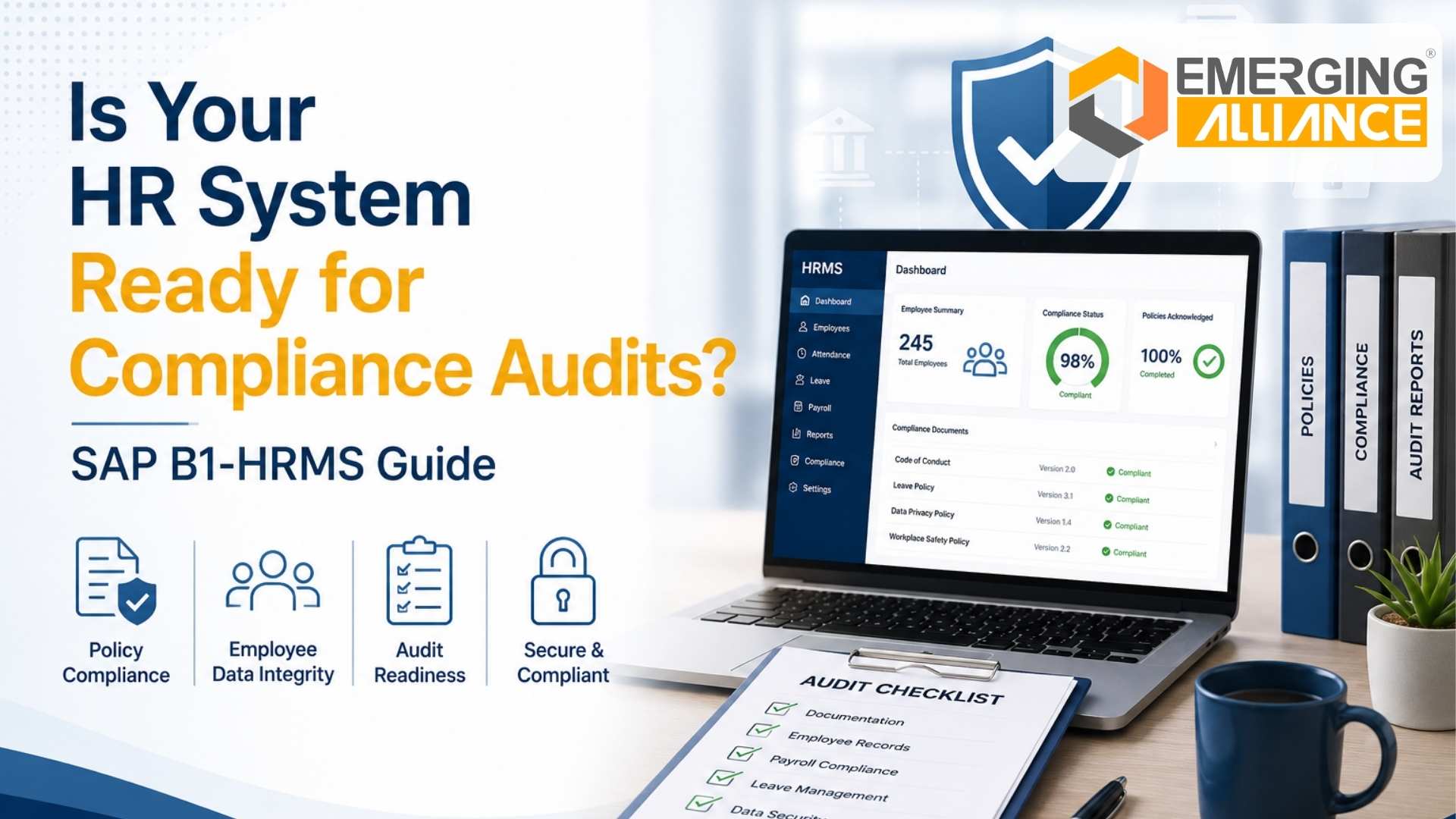
Is Your HR System Ready for Compliance Audits? SAP B1-HRMS Guide
Streamline statutory audits with automated payroll and compliance workflows using SAP B1-HRMS
Most organizations believe compliance risk exists in finance, taxation, or operations.
But in reality, one of the largest hidden audit exposures sits inside HR and payroll processes.
Disconnected employee records, spreadsheet-based payroll calculations, inconsistent attendance mapping, delayed approvals, and fragmented statutory documentation create silent operational vulnerabilities that only become visible during compliance audits, labor inspections, or financial reviews.
As businesses scale across locations, departments, and workforce structures, traditional HR processes become increasingly difficult to govern.
This is why modern enterprises are shifting toward integrated SAP B1-HRMS environments that unify workforce management, payroll governance, compliance reporting, and employee lifecycle control within a centralized ERP ecosystem.
At Emerging Alliance, we help organizations modernize HR operations using intelligent SAP Business One HRMS solutions designed for audit readiness, workforce visibility, payroll automation, and long-term operational scalability.
Why Traditional HR Systems Become Compliance Risks
Many growing organizations still operate HR functions through disconnected tools that evolved over time rather than through structured governance planning.
Attendance may exist in one platform. Payroll calculations may happen in spreadsheets. Employee records may sit across departments. Approval workflows may rely on email coordination instead of system-driven accountability.
Initially, these gaps appear manageable.
But as workforce complexity increases, the operational consequences become serious.
Organizations begin facing:
- Payroll discrepancies
- Delayed statutory submissions
- Audit documentation challenges
- Inconsistent employee records
- Approval bottlenecks
- Compliance visibility gaps
- High dependency on manual coordination
This creates operational instability precisely when businesses need stronger governance.
An integrated SAP HRMS software environment helps organizations replace fragmented HR administration with centralized workforce governance aligned directly with finance and enterprise operations.
Why SAP Business One HRMS Is Becoming Critical for Audit-Ready Workforce Governance
Modern compliance audits demand more than salary reports and attendance registers.
Organizations must now demonstrate:
- Payroll traceability
- Approval accountability
- Employee lifecycle documentation
- Statutory transparency
- Data security controls
- Historical payroll records
- Workforce reporting accuracy
This requires a connected ERP-driven HR ecosystem rather than standalone payroll software.
A modern SAP Business One HRMS solution enables organizations to create a unified workforce management structure where HR operations, payroll processing, approvals, and compliance reporting work together within a centralized system.
The result is stronger operational control, faster audit preparation, and improved executive visibility into workforce-related governance.
How SAP B1 Payroll Automation Reduces Compliance Exposure
Manual payroll processing creates significant audit and financial risks for growing businesses.
Even small payroll inconsistencies can trigger:
- employee disputes
- compliance penalties
- taxation discrepancies
- reporting delays
- reconciliation challenges
An intelligent SAP Payroll Software framework helps organizations automate payroll governance while improving operational consistency.
With SAP B1 Payroll automation, businesses can streamline:
- Salary processing
- Statutory deductions
- Shift-based calculations
- Leave encashment
- Incentive structures
- Reimbursements
- Attendance-linked payroll rules
This reduces manual dependency while improving payroll transparency across HR and finance operations.
For CFOs and CIOs, payroll automation becomes a governance advantage rather than simply an HR upgrade.
Centralized Employee Governance Improves Workforce Visibility
One of the largest operational problems in disconnected HR environments is inconsistent employee data.
Different departments often maintain different versions of workforce records, creating confusion during audits, payroll processing, and compliance reporting.
A centralized SAP Business One HR Module helps organizations unify:
- Employee profiles
- Attendance records
- Department structures
- Leave management
- Compensation details
- Reporting hierarchies
- Employee lifecycle tracking
This improves data consistency while reducing administrative inefficiencies across departments.
More importantly, it creates a reliable workforce governance framework capable of supporting long-term business growth.
Why Finance and HR Integration Matters for Executive Leadership
Disconnected payroll systems create major reconciliation challenges between finance and HR departments.
Payroll expenses may not align with accounting records. Workforce liabilities become difficult to track. Budget forecasting loses accuracy. Leadership teams struggle to understand workforce-related operational costs.
An integrated SAP Business One Payroll structure connects HR operations directly with financial management systems.
This improves:
- Payroll cost visibility
- Financial reconciliation accuracy
- Workforce expense reporting
- Department-level budgeting
- Audit preparation efficiency
- Executive decision-making visibility
Organizations implementing SAP Payroll Compliance strategies gain stronger operational transparency across workforce governance and financial reporting.
For executive leadership, this creates better control over operational risk exposure.
Why Industry-Specific HRMS Configuration Matters
Payroll complexity varies significantly across industries.
Manufacturing companies often require shift-based payroll and overtime governance. Pharmaceutical organizations require workforce traceability and compliance-ready employee documentation. Distribution businesses manage multi-location attendance structures and contract workforce tracking.
This is why configurable HRMS for Manufacturing and regulated industries has become increasingly important.
A scalable SAP Business One HRMS environment allows organizations to adapt workforce governance models without rebuilding their ERP infrastructure.
This flexibility becomes essential for businesses preparing for expansion, compliance audits, or operational restructuring.
Key Features Leaders Should Evaluate in an SAP B1-HRMS Platform
Leadership teams evaluating workforce modernization initiatives should focus on governance scalability rather than isolated payroll automation capabilities.
Critical evaluation areas include:
Workforce Data Centralization
Organizations need unified employee management ERP environments that eliminate departmental silos and improve reporting accuracy.
Payroll Governance Automation
Modern HR Payroll Automation Software should support configurable payroll rules, statutory workflows, reimbursement approvals, and attendance-linked salary processing.
Finance-HR Synchronization
Integrated SAP Business One payroll environments improve visibility into workforce costs, liabilities, and reconciliation accuracy.
Audit Readiness
The best SAP Business One HR software should maintain audit logs, approval histories, payroll documentation, and employee lifecycle records.
Scalability
Organizations should evaluate whether the HRMS can support:
- Multi-branch operations
- Remote workforce models
- Future compliance requirements
- Workforce expansion
- Industry-specific payroll rules
Why Businesses Are Moving Toward Cloud-Based Payroll Governance
Modern organizations increasingly prefer software as a service payroll environments to improve operational flexibility and reduce infrastructure dependency.
Cloud-enabled payroll ecosystems help organizations:
- Improve remote accessibility
- Simplify compliance updates
- Reduce server dependency
- Strengthen data security
- Improve disaster recovery readiness
- Accelerate scalability
When integrated with a SAP Business One Payroll Add-On strategy, cloud-enabled HR systems create a future-ready workforce governance framework capable of supporting enterprise growth.
How Emerging Alliance Helps Organizations Build Audit-Ready HR Operations
At Emerging Alliance, we help organizations transform workforce operations through integrated SAP B1-HRMS implementation strategies focused on governance, compliance, and operational scalability.
Our approach helps businesses:
- Centralize workforce governance
- Improve payroll accuracy
- Align HR with finance operations
- Reduce manual dependency
- Improve audit readiness
- Streamline compliance workflows
- Strengthen workforce reporting visibility
We position workforce modernization as part of broader enterprise transformation — not merely HR digitization.
By integrating SAP Business One HRMS solutions into core business operations, organizations gain stronger operational resilience and long-term governance control.
Audit Risks Usually Begin Before the Audit
Most compliance failures do not begin during audits.
They begin months earlier through disconnected payroll systems, fragmented employee records, delayed approvals, and poor workforce visibility.
If your organization is still managing payroll and compliance operations through spreadsheets or disconnected HR tools, the operational risk exposure may already be larger than expected.
Emerging Alliance helps organizations implement intelligent SAP B1-HRMS environments that improve workforce governance, payroll transparency, compliance readiness, and executive visibility across growing operations.
Connect with Emerging Alliance to evaluate whether your HR and payroll ecosystem is truly audit-ready before compliance risks escalate.
FAQs About SAP B1-HRMS
1. What makes SAP B1-HRMS suitable for compliance audits?
SAP B1-HRMS centralizes payroll records, employee documentation, approval workflows, and statutory reporting into a structured ERP-driven environment that improves audit readiness.
2. How does SAP Payroll Software improve payroll accuracy?
SAP Payroll Software automates salary processing, statutory deductions, attendance-linked calculations, and reimbursement workflows to reduce manual errors.
3. Why is SAP Business One HRMS important for growing businesses?
SAP Business One HRMS improves workforce visibility, payroll governance, compliance management, and operational scalability across expanding business operations.
4. Can SAP B1 Payroll support multi-location workforce operations?
Yes. SAP B1 Payroll can support multi-branch payroll governance, attendance tracking, shift-based payroll processing, and centralized workforce reporting.
5. What industries benefit most from SAP HRMS software?
Manufacturing, pharma, logistics, retail, healthcare, and professional services organizations often benefit significantly from integrated SAP HRMS software environments.
6. How does SAP Payroll Compliance improve governance?
SAP Payroll Compliance improves payroll traceability, approval accountability, statutory reporting accuracy, and workforce-related financial visibility.
7. Why do organizations prefer ERP-connected HRMS platforms?
ERP-connected HRMS platforms improve synchronization between HR, payroll, finance, and operational reporting while reducing manual coordination.
8. What should businesses evaluate before HRMS modernization?
Organizations should evaluate scalability, compliance readiness, workflow automation, reporting visibility, audit tracking, and finance integration capabilities.
9. How does SAP Business One HRMS help reduce operational risk?
SAP Business One HRMS helps organizations reduce operational risk by centralizing employee data, automating payroll governance, improving approval visibility, and maintaining audit-ready workforce documentation across departments.
10. Why is integrated HR and payroll management becoming a strategic investment?
Integrated HR and payroll management improves workforce transparency, strengthens compliance control, enhances financial reconciliation accuracy, and supports scalable enterprise governance as businesses expand across locations and workforce structures.