
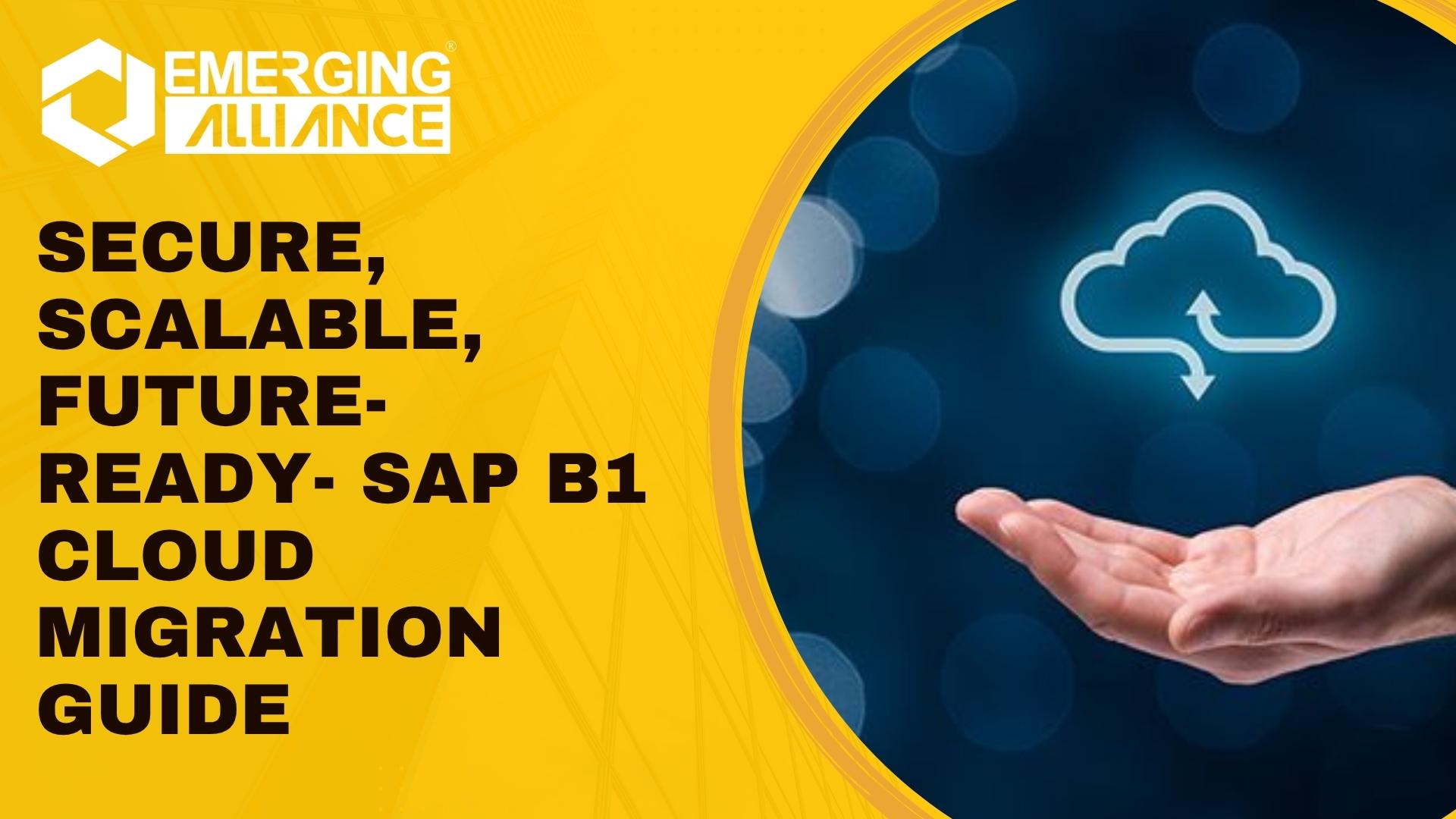
Secure, Scalable, Future-Ready- SAP B1 Cloud Migration Guide
De-Risk Operations with SAP Business One Cloud Transformation
For many businesses, SAP B1 Cloud Migration only becomes a priority after ERP infrastructure limitations begin affecting growth and operational stability.
The real challenges begin when organizations expand into multiple locations, enable remote operations, integrate new business units, undergo compliance audits, or face cybersecurity threats. Suddenly, legacy ERP infrastructure becomes more than a technical limitation. It becomes an operational risk.
This is why enterprises are rapidly accelerating their transition toward secure, cloud-based SAP Business One environments.
Today, CIOs, CTOs, and business leaders are no longer viewing cloud migration as a simple IT modernization initiative. They are evaluating ERP infrastructure through the lens of operational continuity, cybersecurity resilience, scalability, governance, and long-term business agility.
A strategic SAP Business One Cloud Migration initiative is now directly tied to how resilient and scalable a business can become over the next decade.
At Emerging Alliance, we help organizations modernize SAP Business One through secure, business-focused cloud transformation strategies designed to reduce operational risk while improving scalability and ERP performance.
Why Legacy ERP Infrastructure Becomes a Business Risk
Many organizations continue operating SAP Business One on traditional on-premise infrastructure that was designed years ago for a completely different business environment.
While these systems may still function operationally, they often introduce hidden vulnerabilities that become dangerous as businesses scale.
Server dependency, limited remote access, rising infrastructure maintenance costs, backup failures, cybersecurity exposure, and disaster recovery gaps can all impact business continuity.
The problem is not simply that the infrastructure is old.
The problem is that modern businesses now require ERP systems capable of supporting distributed operations, remote decision-making, real-time visibility, and continuous accessibility without operational interruption.
This is where SAP Business One Cloud solutions become strategically critical.
Why Businesses Are Accelerating SAP B1 Cloud Migration
Organizations are increasingly moving toward cloud-based SAP Business One environments because the cloud fundamentally changes how ERP supports business operations.
Instead of maintaining physical infrastructure internally, businesses gain a more scalable and resilient operating model that supports expansion without major hardware reinvestment.
Cloud-enabled SAP B1 environments improve accessibility across locations, simplify infrastructure management, strengthen disaster recovery readiness, and create better operational continuity frameworks.
For executives, the cloud conversation is no longer about servers.
It is about ensuring the business can continue operating securely and efficiently regardless of disruption.
The Hidden Operational Risks of Delaying ERP Modernization
Many ERP modernization projects are delayed because existing systems appear “stable enough.”
However, the biggest risks often remain hidden until failure occurs.
A ransomware incident, server outage, failed backup, infrastructure crash, or compliance audit can expose how dependent the organization still is on aging ERP architecture.
Businesses operating on legacy ERP infrastructure often face challenges such as:
- Delayed system recovery during outages
- Limited scalability during rapid growth
- Inconsistent remote accessibility
- Security patching gaps
- Infrastructure bottlenecks
- High downtime exposure
- Increasing maintenance complexity
The cost of ERP disruption is rarely limited to IT.
It impacts finance operations, procurement, warehousing, customer service, manufacturing visibility, and executive reporting simultaneously.
SAP Business One Cloud vs On-Premise: What Changes?
A traditional SAP Business One on-premise environment requires businesses to manage infrastructure internally, including servers, backups, upgrades, monitoring, and disaster recovery.
In contrast, a professionally managed SAP Business One Cloud Hosting environment creates a far more agile ERP operating model.
Cloud infrastructure enables organizations to scale resources faster, improve accessibility, simplify upgrade cycles, and strengthen operational resilience without depending heavily on internal infrastructure management.
The biggest transformation is not where SAP B1 is hosted.
The biggest transformation is how quickly the business can adapt, scale, recover, and operate securely.
How SAP Business One Cloud Hosting Improves Business Continuity
Business continuity is one of the most important drivers behind SAP B1 cloud transformation initiatives.
Unexpected ERP downtime can disrupt inventory operations, procurement cycles, finance approvals, manufacturing coordination, and customer fulfillment processes.
A properly designed SAP Business One Cloud environment helps reduce these risks through:
- Automated backup frameworks
- Disaster recovery architecture
- Infrastructure redundancy
- High availability systems
- Secure remote accessibility
- Centralized monitoring
For businesses operating across multiple locations or countries, these capabilities become critical for maintaining uninterrupted operations.
SAP B1 Cloud Migration and Cybersecurity Readiness
Cybersecurity has become one of the biggest concerns for ERP-driven organizations.
Many legacy ERP environments still depend on outdated infrastructure, inconsistent patching processes, weak access governance, or fragmented backup management.
A secure SAP Business One Cloud Migration strategy helps organizations modernize their ERP security posture through:
- Multi-factor authentication
- Access governance controls
- Encryption frameworks
- Security monitoring
- Backup validation
- Centralized compliance management
Cloud transformation should never be treated as infrastructure relocation alone.
It must also improve operational governance and security resilience.
Scalability Advantages of SAP Business One Cloud ERP
As organizations grow, ERP demands increase significantly.
Transaction volumes expand. User counts rise. Warehousing complexity increases. Reporting becomes more data-intensive. Integrations multiply.
Traditional infrastructure often struggles to scale efficiently under these conditions.
A cloud-based SAP Business One ERP environment allows businesses to scale infrastructure dynamically without major hardware investments or operational disruption.
This becomes especially important for organizations planning:
- Multi-location expansion
- International operations
- Acquisition-driven growth
- Hybrid workforce models
- AI and analytics adoption
- E-commerce integration
Cloud ERP creates the flexibility required for long-term scalability.
Common SAP B1 Migration Challenges Businesses Must Prepare For
Not every ERP migration succeeds.
Poor planning can create operational downtime, reporting failures, data inconsistencies, or security gaps.
One of the biggest mistakes organizations make is underestimating the complexity of their existing SAP Business One environment.
Customizations, third-party integrations, reporting dependencies, add-ons, and database structures all require careful evaluation before migration begins.
Successful SAP B1 Cloud Migration projects require:
- Infrastructure assessment
- Database validation
- ERP dependency mapping
- Data cleansing
- Migration testing
- Rollback planning
- User acceptance validation
- Post-migration performance monitoring
ERP migration is not simply a technical transfer.
It is an operational continuity project.
Cost Optimization Beyond Infrastructure Savings
Many organizations initially evaluate SAP B1 cloud migration through infrastructure cost reduction alone.
However, the larger financial impact often comes from reduced operational risk and improved efficiency.
Cloud-based ERP environments can help organizations reduce:
- Infrastructure maintenance costs
- Hardware refresh expenses
- Downtime-related business losses
- Internal IT operational burden
- Disaster recovery investments
- Upgrade complexity costs
More importantly, cloud infrastructure creates a more predictable ERP operating model that simplifies long-term financial planning.
Choosing the Right SAP Business One Cloud Migration Partner
Technology alone does not guarantee migration success.
The migration partner plays a critical role in determining how smoothly the organization transitions without operational disruption.
A strategic SAP Business One migration partner should understand not only infrastructure—but also business process continuity, governance, security architecture, scalability planning, and long-term ERP optimization.
At Emerging Alliance, we help businesses modernize SAP Business One environments through secure, scalable, and risk-managed cloud transformation strategies.
Our services include:
- SAP B1 Cloud Migration
- SAP Business One Cloud Hosting
- SAP B1 Infrastructure Modernization
- SAP B1 AWS Hosting
- ERP Security Optimization
- Disaster Recovery Planning
- SAP Business One Performance Optimization
- Cloud Governance and Support
We focus on helping organizations modernize ERP infrastructure without disrupting business operations.
Future-Proofing ERP Operations with SAP Business One Cloud
Modern ERP systems must support far more than transaction processing.
Businesses now require ERP platforms capable of enabling:
- Real-time operational visibility
- Remote decision-making
- Distributed workforce collaboration
- Faster reporting cycles
- AI-driven analytics
- Scalable infrastructure growth
- Strong cybersecurity resilience
Organizations delaying ERP modernization often experience increasing infrastructure risks, operational inefficiencies, and scalability limitations over time.
The question is no longer whether cloud ERP is necessary.
The question is whether the current ERP infrastructure can support future growth securely and efficiently.
Future-Proof Your SAP Business One Infrastructure
If your organization is still operating SAP Business One on legacy infrastructure, now is the right time to assess whether your ERP environment is prepared for future operational demands.
A strategic SAP B1 Cloud Migration initiative can improve scalability, strengthen cybersecurity readiness, reduce infrastructure complexity, and create a more resilient digital operating model for long-term business growth.
FAQs for SAP Business One Cloud Migration
1. How does SAP Business One Cloud Migration reduce operational risk?
SAP Business One Cloud Migration helps businesses reduce infrastructure dependency, improve disaster recovery readiness, strengthen cybersecurity controls, and enable secure remote ERP accessibility. By moving SAP B1 to a scalable cloud environment, organizations can improve operational continuity, minimize downtime exposure, and support future business expansion more efficiently.
2. Is SAP Business One Cloud Hosting secure?
Yes. A professionally managed SAP Business One Cloud Hosting environment includes security controls such as encryption, backup management, multi-factor authentication, monitoring frameworks, and disaster recovery architecture.
3. What are the biggest risks during SAP B1 migration?
The most common risks include poor data validation, integration failures, downtime exposure, customization conflicts, and weak migration planning. A structured migration framework helps reduce these risks.
4. How does SAP B1 Cloud ERP improve remote accessibility?
Cloud-based SAP Business One environments allow authorized users to securely access ERP systems from multiple locations without depending on local office infrastructure.
5. Can SAP Business One Cloud support business expansion?
Yes. SAP B1 Cloud infrastructure allows organizations to scale users, storage, integrations, and operational workloads more efficiently during business growth.
6. How long does SAP Business One Cloud Migration take?
Migration timelines vary depending on ERP complexity, database size, integrations, customizations, and operational requirements. Proper planning significantly reduces disruption.
7. Why should businesses modernize SAP B1 infrastructure now?
Businesses modernize ERP infrastructure to reduce operational risk, improve scalability, strengthen cybersecurity, simplify remote operations, and future-proof business continuity strategies.
8. How does SAP Business One Cloud improve disaster recovery readiness?
SAP Business One Cloud environments improve disaster recovery readiness through automated backups, infrastructure redundancy, centralized monitoring, and faster system recovery capabilities. This helps businesses reduce downtime risks and maintain operational continuity during unexpected disruptions.
9. Can SAP Business One Cloud support multi-location business operations?
Yes. SAP Business One Cloud enables centralized ERP access across multiple branches, warehouses, manufacturing units, and remote teams. This improves real-time visibility, operational coordination, and decision-making across distributed business environments.
10. Why is SAP B1 Cloud Migration important for long-term scalability?
SAP B1 Cloud Migration allows businesses to scale ERP resources more efficiently as transaction volumes, users, integrations, and operational complexity increase. A cloud-based ERP architecture supports future growth without requiring major infrastructure reinvestment.
Fill Out the Form to Start Your SAP B1 Cloud Transformation