
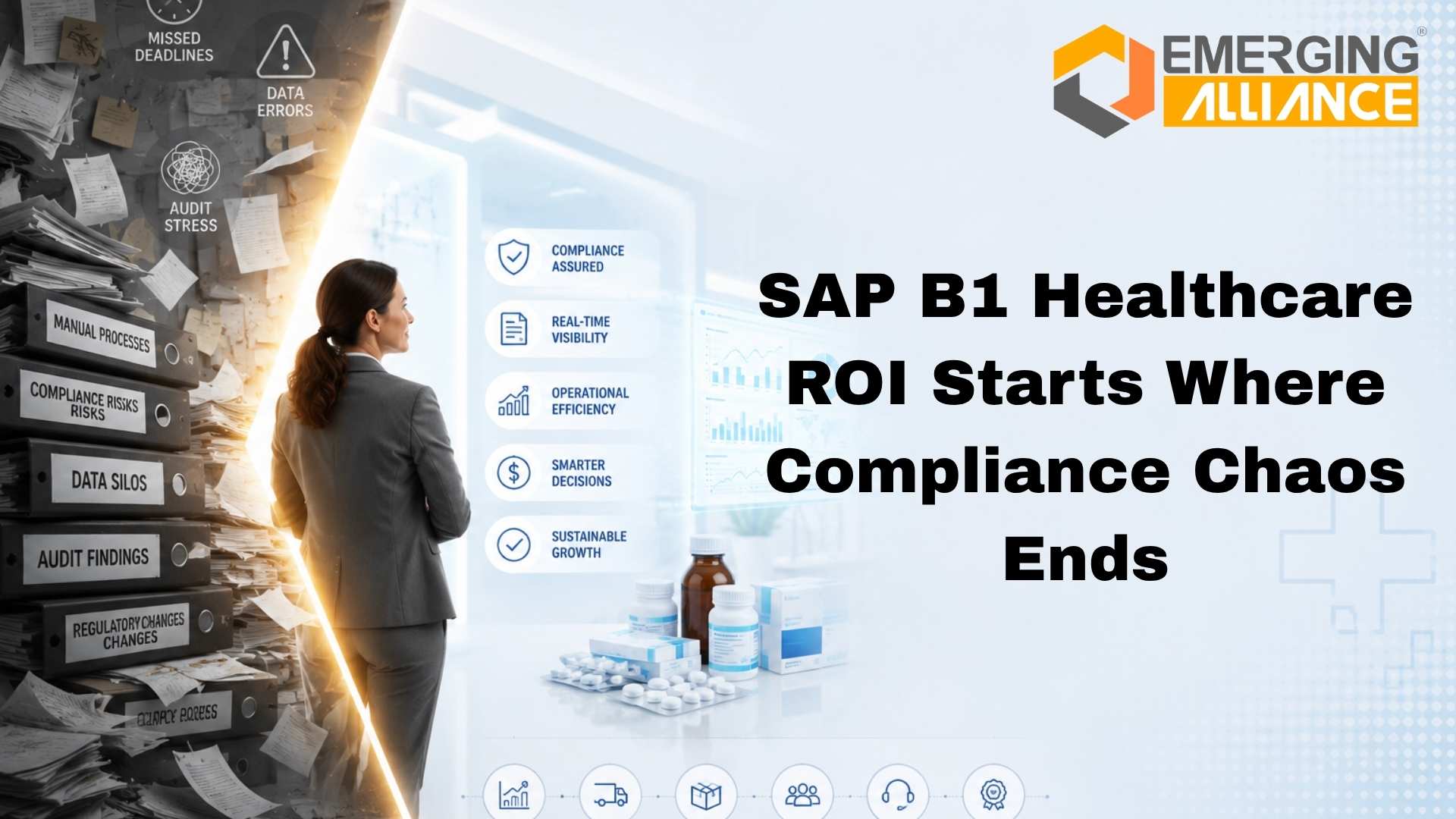
SAP B1 Healthcare ROI Starts Where Compliance Chaos Ends
Reduce Compliance Costs, Accelerate Audits, Gain Real-Time Control with SAP B1 Healthcare
SAP B1 healthcare is becoming a critical foundation for healthcare organizations facing rising regulatory complexity while being pushed to improve margins, efficiency, and patient outcomes.
Audits are increasing in frequency. Financial reporting expectations are tightening. Documentation requirements continue to expand across procurement, pharmacy operations, billing, inventory tracking, and overall governance.
Despite this, many hospitals, clinics, and diagnostic centers still operate on fragmented systems, spreadsheets, and manual workflows to manage compliance.
This is not just inefficient. It is structurally risky.
When compliance remains disconnected from core operations:
- Audit preparation becomes slow and resource-intensive
- Financial visibility lacks consistency and accuracy
- Inventory traceability becomes unreliable
- Reporting cycles are delayed
- Revenue leakage continues unnoticed
The underlying issue is not a lack of tools. It is the lack of integrated operational control.
SAP B1 healthcare addresses this gap by embedding compliance directly into financial management, procurement workflows, inventory tracking, reporting frameworks, and governance structures.
The outcome extends beyond compliance efficiency.
It delivers measurable operational ROI.
Why Compliance Costs Are Quietly Destroying Healthcare Margins
Most healthcare organizations underestimate the true financial cost of compliance inefficiency.
The visible costs are obvious:
- Audit preparation manpower
- Regulatory reporting
- Documentation management
- Financial reconciliation efforts
But the hidden costs are far more damaging.
Disconnected systems often create:
- Duplicate data entry across departments
- Delayed insurance reconciliation
- Inventory mismatches
- Billing inconsistencies
- Procurement approval delays
- Untracked compliance gaps
Over time, these inefficiencies compound into operational instability.
This is why modern healthcare leadership teams are shifting toward healthcare compliance automation using integrated ERP environments.
With SAP Business One ERP for healthcare, organizations gain a centralized operational structure where financial transactions, procurement records, inventory activity, vendor documentation, and reporting workflows are connected inside a single ecosystem.
Instead of chasing information across multiple systems, healthcare teams gain real-time operational visibility from one platform.
This dramatically reduces the cost of governance.
SAP Business One Healthcare Improves Audit Readiness Without Operational Disruption
Audits become difficult when data is fragmented.
In many healthcare organizations, audit preparation still depends on manually collecting records from finance teams, inventory departments, procurement units, and operational systems. This slows reporting cycles and increases the probability of inconsistencies.
A modern SAP ERP for healthcare providers changes this completely.
Every operational transaction inside the system becomes traceable, time-stamped, and audit-linked. Financial records, approval histories, inventory movement, procurement workflows, and compliance documentation are automatically connected within the ERP environment.
This creates a major shift in audit operations.
Instead of building reports manually during audit periods, healthcare organizations can generate structured audit-ready reports instantly.
With SAP Business One healthcare modules, healthcare providers can:
- Accelerate audit preparation cycles
- Improve regulatory reporting accuracy
- Reduce manual reconciliation work
- Strengthen financial governance
- Improve operational accountability across departments
The operational impact is significant because compliance no longer slows business operations.
Compliance becomes embedded into the workflow itself.
How SAP B1 Healthcare Creates Real ROI for Hospitals and Healthcare Providers
Many ERP discussions focus heavily on technology features.
Healthcare leadership teams care about outcomes.
The real value of SAP B1 healthcare comes from its ability to improve operational efficiency while simultaneously reducing compliance risk.
The strongest ROI drivers typically include:
Reduced Compliance Management Costs
Manual compliance processes consume large amounts of administrative time. By automating workflows, reporting structures, and approval systems, organizations reduce dependency on repetitive manual effort.
Faster Financial Reporting
Healthcare organizations often struggle with delayed visibility into operational performance. With centralized financial management, leadership teams gain real-time access to:
- Revenue performance
- Procurement costs
- Operational spending
- Inventory valuation
- Departmental profitability
Improved Inventory Traceability
Healthcare inventory environments are highly sensitive. Pharmaceuticals, medical supplies, consumables, and critical stock movement require continuous monitoring.
Using SAP Business One’s inventory management module, healthcare providers gain:
- Batch tracking
- Expiry visibility
- Automated stock monitoring
- Procurement synchronization
- Inventory accountability
Better Operational Governance
When departments operate in disconnected environments, leadership loses visibility.
A centralized Healthcare Enterprise Resource Planning (ERP) system creates standardized governance structures across finance, procurement, inventory, administration, and reporting functions.
This improves organizational control at scale.
Why Healthcare ERP Implementation Often Fails
Many ERP projects fail not because the software is weak, but because implementation lacks operational alignment.
Healthcare environments are structurally complex. Compliance workflows vary across departments, reporting structures differ across facilities, and operational dependencies are deeply interconnected.
A poorly designed ERP deployment often creates:
- Low system adoption
- Compliance gaps
- Reporting inconsistencies
- Workflow bottlenecks
- Duplicate operational processes
This is why successful healthcare ERP implementation requires more than technical deployment.
It requires strategic process engineering.
A properly executed SAP B1 implementation in healthcare should align:
- Compliance workflows
- Financial governance
- Procurement structures
- Inventory traceability
- Reporting frameworks
- Multi-location operational visibility
This is where implementation quality directly impacts ROI.
Cloud-Based Healthcare ERP Enables Scalable Operational Control
Healthcare organizations are scaling faster than traditional infrastructure can support.
Multi-location hospitals, diagnostic chains, specialty clinics, and healthcare networks require centralized operational visibility without increasing system complexity.
This is where cloud-based healthcare ERP becomes operationally valuable.
Using SAP Business One ERP for healthcare industry, organizations can standardize compliance and governance across multiple facilities while maintaining centralized reporting and operational control.
Cloud deployment enables:
- Real-time access across locations
- Faster system scalability
- Reduced infrastructure dependency
- Continuous regulatory updates
- Simplified operational management
For medium-sized healthcare organizations planning expansion, this becomes critical.
Growth without operational standardization increases compliance exposure.
Cloud ERP helps maintain control while scaling operations.
Real-Time Healthcare Analytics Improves Executive Decision-Making
Traditional reporting systems are reactive.
Modern healthcare leadership requires predictive operational visibility.
With real-time analytics for hospitals, executives gain immediate visibility into:
- Financial performance
- Operational inefficiencies
- Compliance exceptions
- Procurement trends
- Inventory risk
- Department-level performance
This allows leadership teams to identify risks before they become operational problems.
Using integrated healthcare reporting tools, healthcare providers move from delayed reporting cycles toward continuous operational intelligence.
This changes the role of compliance entirely.
Compliance becomes a strategic decision-support framework rather than an administrative burden.
SAP Business One Healthcare Modules Standardize Operational Efficiency
Operational inconsistency is one of the biggest hidden risks in healthcare.
Different departments often follow different processes for approvals, reporting, procurement, and documentation. Over time, this creates governance fragmentation.
Using SAP Business One healthcare modules, organizations can standardize operations across:
- Finance
- Procurement
- Inventory
- Billing
- Vendor management
- Operational reporting
This creates process consistency across the organization.
More importantly, it reduces operational dependency on individuals.
The system itself becomes the control structure.
The Future of Healthcare ERP Is Built on Automation and Intelligence
Healthcare compliance complexity will continue increasing.
Manual operational governance models will become increasingly unsustainable as reporting standards evolve and healthcare organizations scale.
The future of healthcare ERP solutions will be defined by:
- Automation
- Real-time intelligence
- AI-assisted decision-making
- Predictive compliance monitoring
- Continuous operational visibility
Organizations adopting SAP Business One healthcare software solutions today are positioning themselves for long-term operational resilience.
This is no longer just an ERP investment.
It is a governance transformation strategy.
Why Emerging Alliance for SAP B1 Healthcare
Many ERP vendors focus only on deployment.
Emerging Alliance focuses on operational transformation.
Our approach combines:
- Healthcare-specific ERP expertise
- Compliance-focused implementation frameworks
- Financial governance alignment
- Operational scalability planning
- Long-term optimization strategies
We help healthcare organizations transform fragmented operational environments into integrated, audit-ready ecosystems using SAP Business One healthcare modules.
The goal is not simply software implementation.
The goal is measurable operational control, scalability, and ROI.
Transform Compliance into a Scalable Control System for Healthcare Leadership
If compliance management is consuming excessive operational time, audit preparation effort, and leadership attention, the problem is no longer administrative.
It is structural.
Healthcare organizations that continue relying on fragmented systems will face increasing operational pressure, rising compliance costs, and reduced financial visibility.
Now is the time to modernize governance infrastructure using SAP B1 healthcare.
Connect with Emerging Alliance to:
- Identify compliance cost leakage
- Evaluate healthcare ERP readiness
- Improve operational visibility
- Build a scalable compliance automation roadmap
- Accelerate healthcare ERP ROI
Move from compliance pressure to operational control with SAP Business One healthcare solutions.
FAQs
1. How does SAP B1 healthcare improve compliance automation?
SAP B1 healthcare automates reporting workflows, approval structures, audit documentation, and operational traceability to reduce manual compliance effort.
2. Why is SAP Business One suitable for healthcare organizations?
SAP Business One healthcare solutions provide centralized operational visibility across finance, inventory, procurement, reporting, and compliance management.
3. Can SAP Business One reduce healthcare audit preparation time?
Yes. SAP Business One healthcare modules generate structured audit-ready reports and improve traceability across operational transactions.
4. How does healthcare ERP improve financial control?
Healthcare ERP solutions centralize financial reporting, automate reconciliation processes, and provide real-time visibility into operational costs and revenue performance.
5. What are the benefits of cloud-based healthcare ERP?
Cloud ERP enables scalability, centralized governance, real-time access across locations, and simplified infrastructure management.
6. How does SAP Business One improve healthcare inventory management?
It provides batch tracking, expiry monitoring, procurement synchronization, inventory accountability, and real-time stock visibility.
7. Why do healthcare ERP implementations fail?
Most failures occur due to poor workflow alignment, weak process mapping, low user adoption, and disconnected operational planning.
8. Can SAP B1 healthcare support multi-location healthcare organizations?
Yes. SAP Business One supports centralized reporting and operational governance across multiple healthcare facilities.
9. How do real-time analytics help healthcare leadership teams?
Real-time analytics provide continuous visibility into compliance risk, operational inefficiencies, procurement trends, and financial performance.
10. Why should healthcare providers choose Emerging Alliance for SAP implementation?
Emerging Alliance combines healthcare operational expertise, compliance-focused ERP implementation, and long-term scalability planning to deliver measurable business outcomes.
Fill out the form to connect with our experts now