
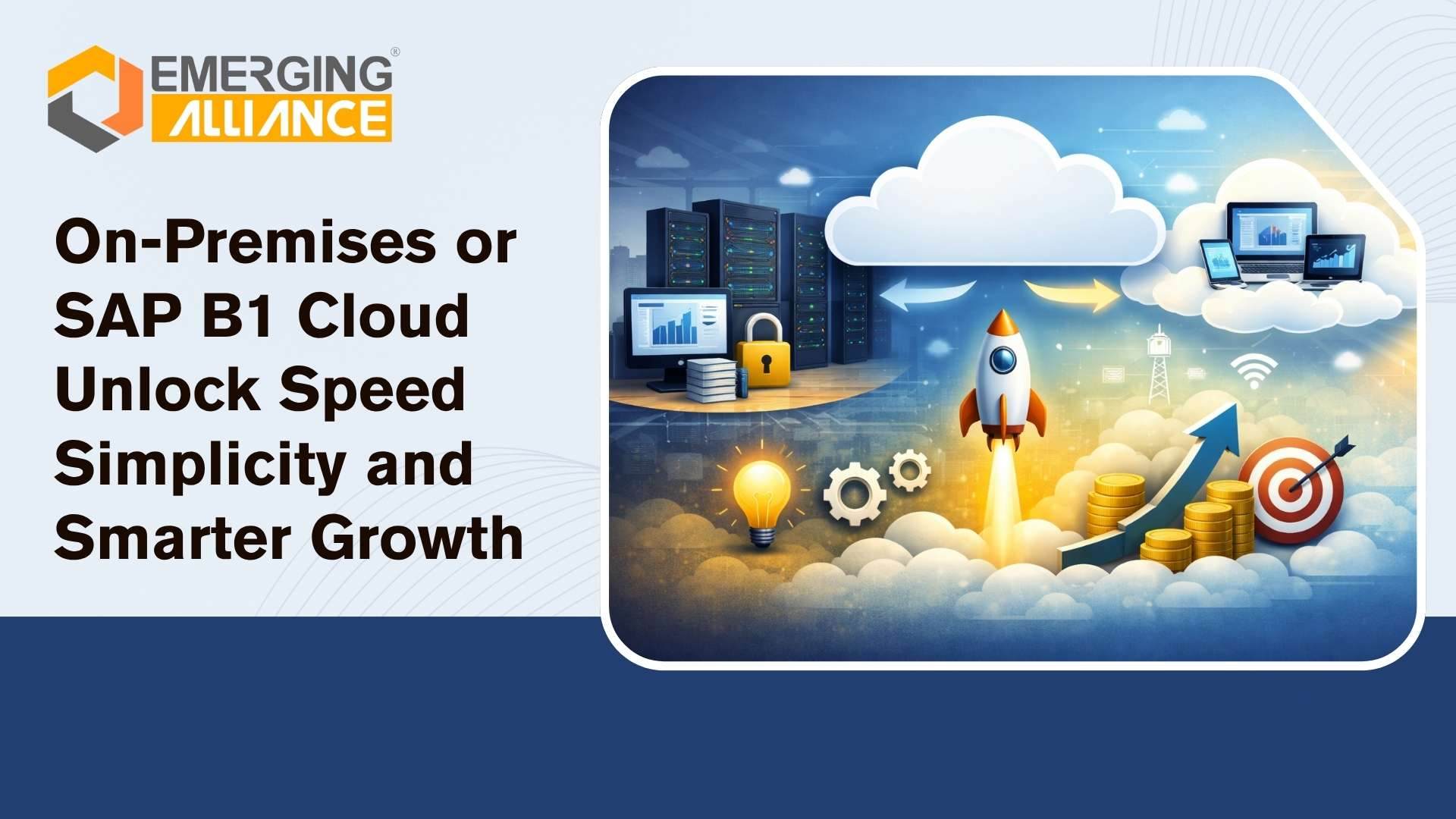
On-Premises or SAP B1 Cloud Unlock Speed Simplicity and Smarter Growth
Compare deployment agility, upgrade speed, and responsiveness with SAP Business One cloud ERP
ERP is no longer evaluated on functionality alone it is judged by how quickly it enables decisions, execution, and scale. The real challenge is not selecting an ERP system but ensuring that the system can keep pace with business demands without increasing operational burden. This is where the choice between on-premises SAP Business One and SAP Business One Cloud ERP becomes a critical strategic decision.
- One prioritizes control, infrastructure ownership, and deep customization
- The other prioritizes speed, agility, and simplified management
The risk is not choosing the wrong technology.The risk is choosing a deployment model that limits responsiveness, delays insights, and constrains growth.
SAP Business One Cloud vs On-Premises A Strategic Comparison
Cloud doesn’t just change where ERP runs it transforms how fast your business operates and adapts.
| Parameter | On-Premise SAP B1 | SAP Business One Cloud ERP |
| Deployment Speed | Weeks to months | Rapid deployment (days/weeks) |
| Infrastructure Management | Internal IT responsibility | Managed by cloud provider |
| Upgrade Speed | Manual, often delayed | Automated and faster |
| Scalability | Limited, hardware dependent | On-demand scaling |
| Performance Optimization | Requires tuning & IT effort | Optimized by hosting environment |
| Disaster Recovery | Complex, costly setup | Built-in redundancy |
| Accessibility | Location-restricted | Anywhere, anytime access |
| Cost Structure | High upfront CAPEX | Predictable OPEX |
| Security Management | Internal responsibility | Enterprise-grade cloud security |
| Complexity Level | High | Low to moderate |
Where On-Premises ERP Starts Slowing Down Growth
Many enterprises still rely on on-premise SAP Business One solutions assuming control equals efficiency.
But in reality, several hidden constraints emerge:
1. Performance Bottlenecks During Growth
As transaction volumes increase, system latency rises, impacting operations, reporting, and decision cycles.
2. High IT Dependency
Routine activities such as patching, backups, and upgrades require internal resources, increasing operational overhead.
3. Upgrade Delays = Innovation Delays
Businesses postpone upgrades due to complexity, resulting in outdated capabilities and security risks.
4. Disaster Recovery Risks
Without enterprise-grade infrastructure, downtime risks become a board-level concern.
5. Limited Scalability
Scaling requires new hardware investments slow, expensive, and reactive.
Why SAP Business One Cloud Migration Is Gaining Executive Attention
The shift toward SAP Business One Cloud Migration is not driven by trends it’s driven by business velocity requirements.
Faster Deployment Without Infrastructure Complexity
With SAP B1 cloud implementation, infrastructure provisioning is eliminated, allowing faster go-live timelines.
Real-Time Performance at Scale
Cloud environments are optimized for high-performance workloads, ensuring consistent system responsiveness.
Seamless Upgrades and Continuous Innovation
With SAP B1 cloud upgrade capabilities, businesses stay current without operational disruption.
Built-In Disaster Recovery and Business Continuity
Cloud-based SAP Business One ensures data redundancy, failover, and uptime assurance.
Cost Optimization Through OPEX Model
Instead of large capital investments, SAP B1 cloud cost optimization enables predictable, scalable spending.
Aligning ERP Deployment with Business Objectives
Choosing between on-premise SAP Business One ERP and SAP Business One cloud solutions depends on strategic priorities.
If Your Priority Is Control and Customization
On-premise may be suitable for:
- Highly customized environments
- Strict internal IT governance
- Legacy system dependencies
If Your Priority Is Speed, Agility, and Scalability
Cloud becomes the clear choice:
- Faster decision cycles
- Reduced IT complexity
- Real-time data access
- Scalable growth without disruption
Modern enterprises are prioritizing agility over control, because speed is now a competitive advantage.
The Real Cost Conversation CAPEX vs Business Agility
Traditional ERP discussions focus on cost.
Executive-level discussions focus on cost of delay and inefficiency.
On-Premise Hidden Costs
- Infrastructure upgrades
- IT manpower
- Downtime risks
- Delayed insights
SAP Business One Cloud Value Drivers
- Faster ROI realization
- Reduced operational overhead
- Continuous system optimization
- Lower risk exposure
Cloud is not just a cost decision it’s a business acceleration strategy.
SAP Business One Cloud Migration Done Right
A poorly executed SAP B1 migration to cloud can create disruption.A strategically managed migration can unlock immediate business value.
Key Elements of a Successful SAP Business One Cloud Migration Process
- Environment Assessment – Evaluate current SAP B1 environment and dependencies
- Data Migration Strategy – Ensure clean, secure SAP B1 data migration
- Performance Benchmarking – Optimize system responsiveness
- Security & Compliance Planning – Address SAP Business One cloud security requirements
- User Enablement – Training and change management
This is where working with an experienced SAP Business One cloud hosting provider becomes critical.
Our Approach Beyond Implementation
We don’t just deploy systems we architect business outcomes.
What We Deliver
- SAP Business One Cloud hosting solutions tailored for performance
- On-premise SAP B1 optimization for existing environments
- End-to-end SAP Business One cloud migration consulting
- SAP B1 cloud risk management and performance tuning
- Continuous support, upgrades, and user enablement
We act as a strategic transformation partner ensuring your ERP aligns with long-term business goals not just short-term deployment.
The Decision Is Not Cloud vs On-Premises It’s Speed vs Complexity
The real question is:
Do you want an ERP that supports your business… or one that slows it down?
If your organization is:
- Scaling operations
- Expanding geographically
- Seeking faster insights
- Reducing IT complexity
Then SAP Business One Cloud ERP is not an option it’s a strategic necessity.
Request a Strategic SAP B1 Deployment Assessment
If you’re evaluating SAP Business One cloud migration or looking to optimize your current ERP environment, now is the time to take a structured, outcome-driven approach.
Get a tailored recommendation aligned with your business model, growth trajectory, and risk profile.
FAQs About SAP B1 for Cloud
1. What is the difference between SAP Business One Cloud and on-premise deployment?
SAP Business One Cloud runs on a managed cloud environment, while on-premise is hosted on local servers managed internally.
2. How does SAP Business One Cloud migration improve performance?
Cloud environments provide optimized infrastructure, reducing latency and improving system responsiveness.
3. Is SAP B1 cloud migration secure for enterprise data?
Yes, SAP Business One cloud security includes encryption, access control, and enterprise-grade compliance standards.
4. What is the typical SAP B1 cloud migration process?
It includes assessment, data migration, system configuration, testing, and user training.
5. Can existing SAP B1 on-premise systems be migrated to cloud easily?
Yes, with proper planning and expert support, SAP B1 on-premise to cloud migration can be seamless.
6. How does SAP Business One cloud hosting reduce IT costs?
It eliminates infrastructure management, reduces IT workload, and shifts costs to a predictable subscription model.
7. What industries benefit most from SAP Business One cloud ERP?
Manufacturing, pharma, healthcare, trading, and multi-location businesses benefit significantly.
8. Does SAP B1 cloud support remote access?
Yes, users can securely access the system from anywhere, enabling remote operations.
9. How often are upgrades performed in SAP Business One Cloud?
Upgrades are managed centrally and deployed faster compared to on-premise environments.
10. What should businesses consider before choosing SAP B1 deployment?
Key factors include scalability needs, IT capabilities, budget model, and growth strategy.
Fill the form below to connect with Emerging Alliance and take the next step toward a more scalable and efficient SAP Business One deployment.