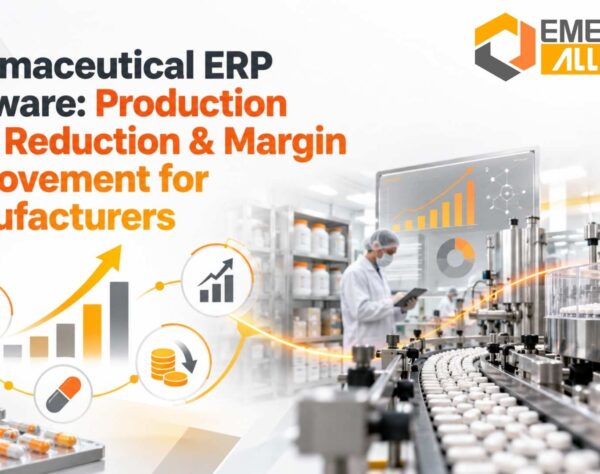


SAP Business One Pharma Helps Maximize Margins with Better Inventory Control

Enhance efficiency and unlock higher returns with SAP B1 for Pharma insights
As the pharmaceutical landscape becomes more complex, margins are no longer driven by sales alone—they are determined by how efficiently inventory is controlled, tracked, and optimized. This is where SAP Business One Pharma shifts from being an operational system to a strategic profit engine.
For many pharma organizations, inventory is the single largest balance sheet risk. Expiry losses, excess stock, and demand mismatches silently erode profitability. Without a modern pharmaceutical ERP software, these inefficiencies remain invisible until they impact financial outcomes.
With SAP Business One Pharma Software, leaders gain the ability to convert inventory into a controlled, data-driven margin lever—backed by real-time intelligence, batch-level traceability, and predictive insights.
Where Margins Leak Without Intelligent Inventory Control
Most pharma organizations don’t lose margins in one big event—they lose it gradually across fragmented processes.
The absence of a unified SAP B1 Inventory Management Pharma framework creates systemic inefficiencies:
- Expired and near-expiry stock leading to direct revenue loss
- Overstocking of low-moving SKUs locking working capital
- Stockouts of high-margin products impacting revenue opportunities
- Manual inventory tracking causing data inconsistencies
- Limited visibility across multi-warehouse operations
- Weak SAP B1 Batch Tracking and traceability increasing compliance risk
- Poor demand planning due to lack of pharma real-time reporting
Without a centralized SAP Business One pharma solution, these issues remain disconnected—making it impossible for CXOs to quantify or control the financial impact.
From Inventory Chaos to Margin Control with SAP Business One Pharma
The transformation begins when inventory is no longer treated as a static asset but as a dynamic, intelligence-driven system.
SAP Business One for Pharmaceutical Industry enables:
- Real-time inventory visibility across warehouses and distribution networks
- Automated batch and expiry tracking with SAP B1 Batch Management Pharma
- Integrated compliance workflows through SAP B1 pharma validation
- Demand-driven replenishment using SAP B1 Production Planning Pharma
- Unified operations through SAP B1 Supply Chain Pharma
Instead of reacting to inventory issues, organizations can proactively optimize stock levels, reduce wastage, and improve turnover ratios.
This is where SAP B1 pharma manufacturing becomes critical—not just for production efficiency, but for ensuring that every unit produced contributes to margin growth.
How SAP B1 Pharma Drives Measurable ROI in Inventory Management
For decision-makers, the key question is not “What does ERP do?” but “How does it improve margins?”
With SAP B1 Pharma Implementation, ROI is realized across multiple dimensions:
- Reduced expiry losses through FEFO-driven inventory control
- Improved inventory turnover by aligning demand with supply
- Lower working capital requirements via optimized stock levels
- Better pricing decisions using real-time cost visibility
- Enhanced compliance through SAP B1 Quality Management Pharma and audit-ready traceability
The integration layer also plays a crucial role. With SAP B1 pharma integration and SAP B1 pharma API integration, organizations can connect manufacturing, distribution, and regulatory systems—eliminating data silos.
For enterprises evaluating SAP B1 Pharma Cost, the real value lies not in initial investment, but in long-term margin improvement and risk reduction.
Strategic Implementation: Turning SAP B1 Pharma into a Competitive Advantage
Technology alone does not deliver transformation—execution does.
A successful SAP B1 Pharma Implementation in India or global markets requires:
- Industry-specific configuration for batch, expiry, and compliance
- Tailored dashboards for executive-level decision-making
- Seamless SAP B1 pharma API integration with supply chain ecosystems
- Scalable cloud architecture for multi-location operations
- Continuous optimization post go-live
Working with an experienced SAP B1 Pharma Partner and SAP B1 Pharma Consultant ensures that the system is aligned with business outcomes—not just technical requirements.
This is where organizations move beyond software deployment to strategic transformation.
The Shift From Inventory as Cost to Inventory as Profit Driver
Forward-looking pharma leaders are redefining inventory management as a core profitability lever.
With SAP Pharma ERP, organizations can:
- Gain complete control over stock movement and valuation
- Enable predictive planning with SAP B1 Production Planning Pharma
- Strengthen compliance with end-to-end SAP B1 Batch Management Pharma
- Improve decision-making through real-time dashboards
- Build a scalable, future-ready SAP Business One Pharma Software ecosystem
This is not just about operational efficiency—it’s about building a resilient, margin-focused enterprise.
Ready to Maximize Margins with SAP Business One Pharma?
If your organization is still relying on fragmented systems or manual inventory processes, the cost is already impacting your margins.
Visit our website to access high-value insights, practical resources, and expert content designed to support informed decision-making and business growth.
FAQs About SAP Business One Pharma
1. How does SAP Business One Pharma reduce expiry losses in pharmaceutical inventory?
It uses FEFO (First Expiry First Out) logic with batch tracking to ensure near-expiry stock is prioritized for dispatch, minimizing write-offs.
2. What makes SAP B1 suitable for pharmaceutical manufacturing environments?
It supports batch traceability, quality control, compliance workflows, and integrates production with inventory and finance.
3. Can SAP B1 Pharma integrate with existing supply chain systems?
Yes, through SAP B1 pharma API integration, it connects with logistics, distributors, and external compliance systems.
4. How does SAP B1 improve inventory turnover in pharma companies?
By aligning demand forecasting with real-time stock data, enabling optimized replenishment and reduced overstocking.
5. Is SAP B1 Pharma compliant with regulatory requirements?
Yes, it supports audit trails, batch traceability, and validation processes required for pharma compliance.
6. What is the typical ROI timeline for SAP B1 Pharma implementation?
Most organizations start seeing measurable improvements in inventory efficiency and margin within 12–24 months.
7. How does SAP B1 handle multi-warehouse inventory visibility?
It provides centralized dashboards with real-time tracking across all locations and distribution channels.
8. What role does SAP B1 play in pharma quality management?
It integrates quality checks into production and inventory processes, ensuring compliance and product consistency.
9. Is SAP B1 Pharma suitable for growing mid-sized pharma companies?
Yes, it is designed for scalability, making it ideal for both mid-market and enterprise-level organizations.
10. What should companies consider before implementing SAP B1 Pharma?
They should evaluate inventory complexity, compliance requirements, integration needs, and partner expertise to ensure successful deployment.
Want to speak to an expert? Fill in the form below, and we will be in touch with you shortly!