
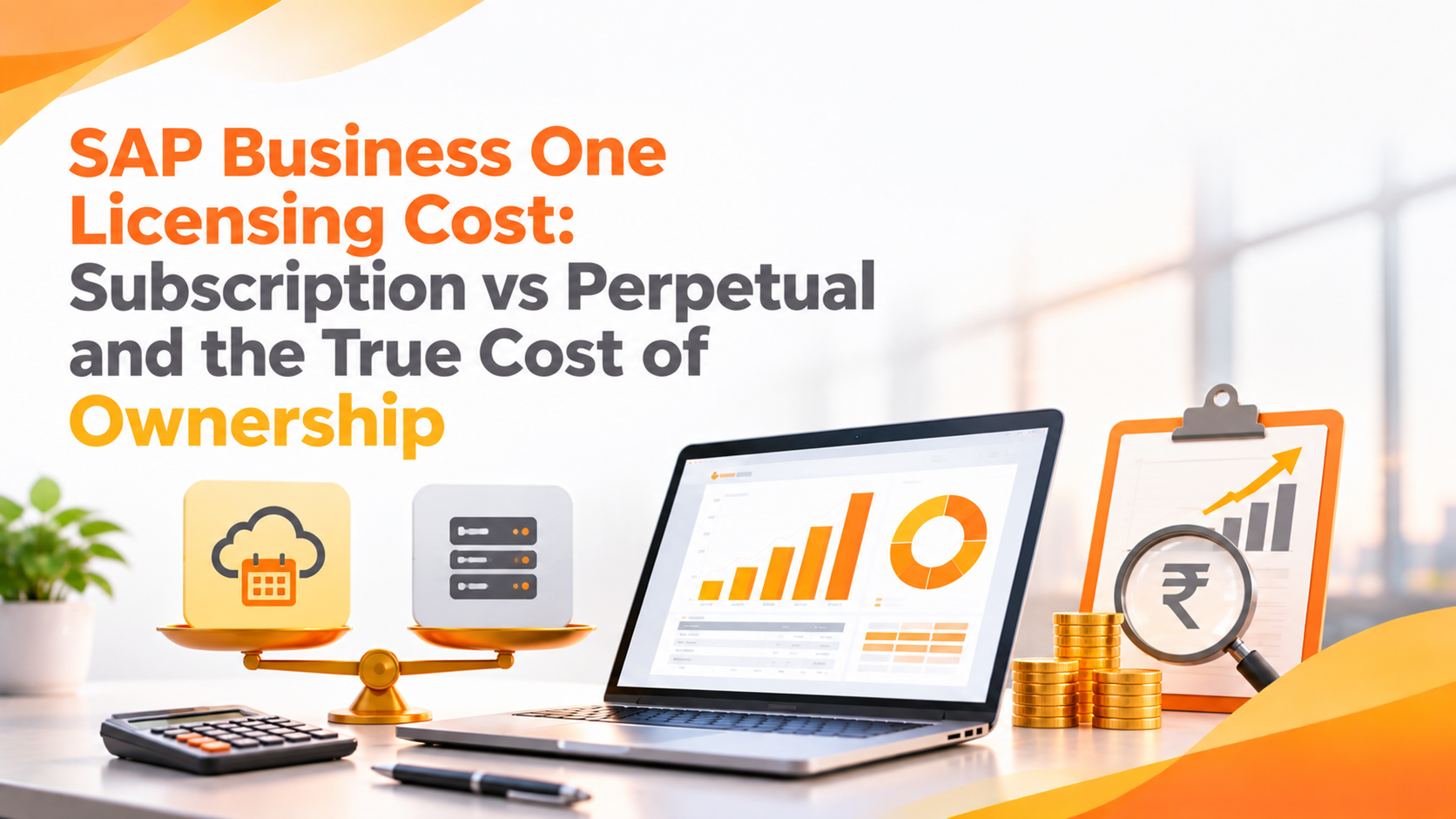
SAP Business One Licensing Cost: Subscription vs Perpetual and the True Cost of Ownership
Quick Answer
SAP Business One licensing cost depends on the licensing model, number and type of users, deployment environment, implementation scope, database requirements, integrations and ongoing support. Subscription licensing spreads costs across recurring payments, while perpetual licensing involves an upfront software investment and applicable maintenance expenses. The right choice depends on long-term ownership costs, cash flow and business requirements.
Understanding SAP Business One Licensing Models and Their Cost Implications
Choosing an ERP system is a significant financial decision for a growing business. However, evaluating SAP Business One licensing cost only by comparing the initial licence price can lead to an incomplete investment decision.
The licensing model determines how a business pays for software usage, but it does not represent the entire cost of implementing and operating an ERP environment. Implementation services, infrastructure, database requirements, customisation, integrations, maintenance and future expansion also influence the total investment.
SAP Business One is built around a named-user licensing approach. Each authorised user requires an appropriate licence based on their access and responsibilities. SAP’s licensing documentation explains that licences are assigned to specific named users rather than being freely shared between employees.
This makes user planning an important part of the initial cost assessment. A business with finance, procurement, inventory, sales and production teams must identify what each employee needs to access before selecting the required licence types.
Businesses generally evaluate two commercial approaches:
- Perpetual licensing: The organisation purchases software usage rights through an upfront licence investment, subject to the applicable agreement and maintenance arrangements.
- Subscription licensing: The organisation pays recurring fees for the agreed subscription term, under the commercial and service conditions defined in its agreement.
Neither model is automatically more economical. The decision should consider the expected operating period, available capital, infrastructure strategy, maintenance requirements and the cost of scaling the system.
SAP Business One Subscription vs Perpetual Licensing: Key Financial Differences
The main difference between subscription and perpetual licensing is how the software investment is structured over time.
With perpetual licensing, the organisation makes a larger initial software investment. It then accounts for applicable annual maintenance or support arrangements, infrastructure, implementation and other operational expenses.
With subscription licensing, the software cost is distributed across recurring payments. Depending on the agreement, the subscription may also include specified hosting or infrastructure services. These inclusions must be verified rather than assumed.
| Cost consideration | Perpetual licensing | Subscription licensing |
|---|---|---|
| Initial software investment | Generally higher upfront licence expenditure | Generally lower initial licence expenditure |
| Payment structure | One-time licence purchase, plus applicable recurring costs | Recurring subscription payments |
| Maintenance | Applicable maintenance or support charges | Depends on subscription agreement |
| Infrastructure | Customer-managed or separately arranged, depending on deployment | May be included or separately charged |
| Long-term expenditure | Depends on maintenance, infrastructure and upgrade arrangements | Depends on recurring fees and contract terms |
| Budget planning | Requires upfront capital planning | Requires recurring operating budget planning |
| Expansion | Additional licences and services may require further investment | Additional subscription users or capacity may change recurring fees |
The table describes common commercial patterns, not universal contractual terms. Businesses should obtain a written quotation that identifies exactly what is included in each proposal.
When Subscription Licensing May Be Suitable
Subscription licensing may be appropriate for businesses that prefer predictable recurring expenditure over a larger initial software purchase.
It can also suit organisations that want a partner-managed hosting arrangement, provided the subscription agreement clearly defines infrastructure, backups, availability, support responsibilities and service levels.
For a growing business, subscription payments may make initial budgeting easier. However, decision-makers must assess the cumulative cost over the expected ERP usage period.
When Perpetual Licensing May Be Suitable
Perpetual licensing may be appropriate for organisations with available capital that prefer an upfront software investment and a separately managed infrastructure strategy.
Businesses with established IT teams and existing infrastructure may want to evaluate whether this model aligns with their operational approach.
However, purchasing a perpetual licence does not mean the organisation has no future ERP expenses. Maintenance, support, infrastructure, upgrades, customisation and additional users can continue to create costs.
The correct comparison is therefore not simply one-time payment versus monthly payment. It is the total financial commitment under each model.
Initial Investment and Recurring Costs Across Both Licensing Models
An SAP Business One investment includes several cost categories beyond the software licence. Separating these expenses helps management understand what the organisation will pay before implementation, during deployment and throughout ongoing operations.
Software Licence Costs
The software licence cost depends on the number of users, the licence types required and the commercial terms offered by the authorised SAP Business One partner.
For example, a finance manager may require broader access than an employee who only performs limited operational tasks. Assigning the correct licence type to each role helps prevent unnecessary expenditure and access mismatches.
Businesses should prepare a user-role matrix before requesting a quotation. This should identify departments, responsibilities, required functions and expected user growth.
Implementation and Configuration Costs
Implementation is a separate investment that covers the work required to make SAP Business One suitable for the organisation.
Depending on the project scope, this may include:
- Business process assessment and requirement documentation.
- Financial and operational configuration.
- Chart of accounts and master data preparation.
- Inventory, purchasing and sales process setup.
- Production and material planning configuration.
- Data migration and validation.
- User acceptance testing.
- Employee training and go-live support.
Implementation costs depend on process complexity, data quality, number of locations, reporting requirements and the level of business process changes required.
A quotation that focuses only on software licences may therefore underestimate the actual ERP investment.
Infrastructure and Database Costs
Infrastructure requirements depend on the deployment model and technical architecture.
An on-premises environment may require servers, storage, networking, backup systems, security controls and ongoing IT administration. A hosted environment may involve recurring infrastructure or managed hosting charges.
Database requirements must also be evaluated. SAP Business One environments may use supported database platforms such as Microsoft SQL Server or SAP HANA, subject to the applicable product version and deployment requirements.
The organisation should confirm database licensing, infrastructure sizing, maintenance responsibilities and backup arrangements before approving the project.
Annual Maintenance and Support Expenses
Perpetual licensing arrangements may involve annual maintenance or support charges under the relevant agreement. Subscription arrangements may have different support inclusions and exclusions.
Businesses should not assume that every support activity is included in either model.
The commercial proposal should identify software maintenance, technical support, issue resolution, upgrades, infrastructure support and any separately chargeable services.
The Hidden Costs That Influence SAP Business One Total Ownership
The largest budgeting mistakes often occur when organisations evaluate only the visible software and implementation charges.
Additional requirements can emerge during deployment or after the system goes live. These expenses may not be obvious during an initial licence comparison.
Customisation and Business-Specific Requirements
Standard ERP functionality may not cover every business process. Organisations with specialised approval workflows, production methods, reporting formats or industry-specific requirements may need additional configuration or custom development.
Customisation can increase the initial implementation budget and create future responsibilities for testing, documentation, compatibility and maintenance.
Before approving custom development, management should determine whether the requirement can be addressed through standard configuration, an existing add-on or a controlled extension.
Third-Party Integrations
SAP Business One may need to exchange information with external applications such as CRM platforms, e-commerce systems, payroll software, warehouse solutions, banking platforms or regulatory systems.
Integration costs can include connector licences, API development, middleware, testing, monitoring and ongoing maintenance.
The business should also consider what happens when an external application changes its API or data format. Integration ownership and support responsibilities must be clearly documented.
Data Migration and Data Quality
Moving data from spreadsheets, legacy ERP systems or disconnected applications requires more than importing records.
Customer information, supplier details, item masters, opening balances, inventory records and historical transactions must be reviewed and validated.
Poor data quality can create reconciliation problems, reporting inaccuracies and operational delays after go-live.
A realistic budget should include data cleansing, mapping, migration testing and business validation.
Training and Change Management
Employees need to understand how their responsibilities change when the organisation moves to a centralised ERP environment.
Training costs depend on the number of users, business functions, process complexity and training approach.
Insufficient training can lead to incorrect transactions, inconsistent data entry and avoidable support requests. The cost assessment should therefore include role-based training and post-implementation assistance.
Upgrade and Compatibility Requirements
Businesses should consider the effort involved in maintaining compatibility across the ERP application, database, operating environment, add-ons and integrations.
SAP publishes maintenance information for SAP Business One release families. Its current maintenance guidance states that SAP Business One 10.0 is in mainstream maintenance until December 31, 2028, subject to change. This is a release-specific maintenance statement, not a guarantee that every customer-specific component or third-party add-on will remain compatible indefinitely.
Organisations should plan upgrades and verify the support status of their complete solution landscape.
How Implementation, Hosting and Customisation Affect ERP Investment
The same SAP Business One licence model can produce different total costs for two businesses because their implementation requirements may be very different.
A company operating from one location with standard finance, sales and inventory processes may require a different project scope from a manufacturer managing multiple warehouses, production stages, quality checks and external integrations.
Three areas deserve particular attention.
Implementation Scope
The implementation partner should document the processes included in the project, the deliverables, the responsibilities of both parties and the acceptance criteria.
A low initial quotation may exclude activities that become necessary later. Management should check whether the proposal includes data migration, reports, training, testing, go-live support and post-implementation assistance.
Hosting and Deployment
The business should compare the full cost of operating the proposed environment.
For on-premises deployment, this includes hardware, software prerequisites, security, backup, disaster recovery and internal administration.
For hosted deployment, it includes recurring hosting fees, storage, backup, availability commitments, data access, security responsibilities and exit arrangements.
A hosting proposal should explain the service scope instead of presenting only a monthly price.
Customisation and Integration Governance
Every customisation or integration should have a documented business purpose, owner and maintenance plan.
Without governance, organisations can accumulate overlapping extensions, unsupported interfaces and unnecessary development expenditure.
A structured solution design helps distinguish essential business requirements from features that can be addressed through standard SAP Business One functionality.
Three-Year and Five-Year SAP Business One Cost Comparison
A short-term price comparison can favour one licensing model without showing its long-term financial impact.
For a meaningful decision, businesses should compare the total cost over at least three years and, where appropriate, five years.
The calculation should include all expected expenses under the same business scope.
Total Cost of Ownership Formula
A practical SAP Business One total cost of ownership calculation is:
Total Cost of Ownership = Software Licence or Subscription + Implementation + Infrastructure and Database + Maintenance and Support + Hosting + Customisation + Integrations + Training + Upgrade Costs + Internal Administration
The organisation should calculate each category for the same period under both licensing models.
For example, a subscription proposal may have a lower initial payment but higher cumulative recurring expenditure over five years. A perpetual proposal may require a larger upfront investment but have a different maintenance and infrastructure cost profile.
The actual result depends on the quoted amounts and contractual inclusions.
Build a Three-Year Comparison
A three-year model helps businesses understand the initial investment and the cost of operating the system through the early stages of adoption.
The comparison should include:
- Initial licence or subscription expenditure.
- Implementation and data migration.
- Hosting or infrastructure.
- Annual maintenance or recurring support.
- Integration and customisation.
- Training and operational support.
- Additional users expected during the period.
Extend the Model to Five Years
A five-year model is useful when the organisation expects to retain SAP Business One as a core operational system over a longer period.
It should account for user growth, infrastructure changes, additional integrations, upgrades and support requirements.
Management should also test different scenarios. A business that grows from 20 users to 40 users may experience a different cost pattern from one that maintains a stable user base.
The purpose is not to predict every future expense precisely. It is to identify which licensing model remains financially suitable under realistic business conditions.
Choosing the Right Licensing Model for Your Business Size and Growth
The most suitable SAP Business One licensing model depends on the organisation’s financial position, IT capabilities, operating requirements and expected growth.
Startups and Smaller Businesses
A smaller organisation may prioritise lower initial expenditure and straightforward budget planning.
Subscription licensing may be worth evaluating if recurring expenditure aligns with cash flow and the proposed service includes the infrastructure support the business needs.
However, the organisation should still assess the cumulative cost over its expected usage period.
Growing and Mid-Sized Businesses
Growing businesses should evaluate how licensing costs change as departments, users and locations expand.
The assessment should include additional user requirements, warehouse operations, reporting needs, integrations and the possibility of new business entities.
A licensing model that works for the current team may not remain the most economical option as the organisation scales.
Established Businesses with Internal IT Teams
Organisations with established infrastructure and technical resources may want to compare perpetual licensing with their existing IT operating model.
They should assess server capacity, database administration, security, backup, disaster recovery and upgrade responsibilities.
The decision should be based on the full operating cost rather than the assumption that internal infrastructure is free.
Businesses with Multiple Locations
Multi-location organisations should evaluate user access, data consolidation, warehouse processes, intercompany requirements, reporting and integration needs.
The number of locations alone does not determine licensing expenditure. The required functionality, users, deployment architecture and implementation scope are more relevant.
Financial and Operational Risks of Selecting the Wrong ERP Licensing Model
Selecting a licensing model without evaluating the full cost structure can create financial and operational problems.
Underestimating the Total Budget
When the initial licence quotation becomes the main decision factor, organisations may overlook implementation, infrastructure, data migration, integrations and training.
This can result in budget overruns or reduced project scope.
Paying for Unnecessary User Access
Without a clear user-role assessment, businesses may purchase more extensive licences than employees require.
A structured access review helps align licence selection with actual job responsibilities.
Ignoring Future Expansion
A licensing decision based only on the current user count may not reflect future business requirements.
Management should model additional users, locations, modules, integrations and operational complexity before committing.
Overlooking Contractual Inclusions
Subscription proposals may differ in hosting, backup, support and service coverage. Perpetual arrangements may also differ in maintenance and support terms.
The organisation should request a detailed written breakdown of inclusions, exclusions, renewal conditions and additional charges.
Failing to Plan for Ongoing Support
ERP ownership continues after go-live. Businesses need a defined approach for technical support, user assistance, issue resolution, upgrades and integration maintenance.
These responsibilities should be included in the long-term financial assessment.
What Business Leaders Should Evaluate Before Investing in SAP Business One
Before approving an SAP Business One investment, decision-makers should review the commercial proposal and the operational requirements together.
The following checklist helps structure the evaluation.
1. User and Licence Requirements
Identify every department, employee role and required access level. Confirm the appropriate licence types and the process for adding users.
2. Business Process Scope
Document finance, sales, purchasing, inventory, production, service and reporting requirements. Separate standard functionality from custom development.
3. Deployment and Infrastructure
Compare on-premises and hosted arrangements. Review database requirements, server capacity, security, backup and disaster recovery.
4. Implementation Deliverables
Confirm the scope of configuration, data migration, testing, training, documentation and go-live support.
5. Integration Requirements
List every external system that must exchange information with SAP Business One. Confirm ownership, maintenance and support arrangements.
6. Three-Year and Five-Year Cost
Compare the cumulative cost of subscription and perpetual licensing using the same assumptions, user numbers and implementation scope.
7. Contract and Support Terms
Review maintenance, support coverage, renewal conditions, hosting responsibilities, upgrade arrangements and termination or transition provisions.
8. Business Growth Requirements
Estimate future users, locations, transaction volumes and operational changes. Confirm how the proposed solution can accommodate those requirements.
This assessment gives management a clearer view of the financial commitment and reduces the risk of selecting a licensing model that does not match the organisation’s needs.
How an SAP Business One Partner Helps Assess Licensing and Implementation Costs
An SAP Business One partner can help organisations translate business requirements into a practical licensing and implementation proposal.
The assessment should begin with business processes rather than a licence count alone. Finance, sales, procurement, inventory, production and management reporting requirements must be understood before the solution scope is finalised.
A structured evaluation can help identify:
- The number and type of user licences required.
- The appropriate deployment and database architecture.
- Standard configuration versus customisation requirements.
- Integration and third-party application dependencies.
- Data migration and validation effort.
- Hosting, maintenance and support responsibilities.
- Expected expenditure over three and five years.
Emerging Alliance supports businesses evaluating and implementing SAP Business One through implementation, customisation, integration, cloud hosting and ongoing support services.
The objective is to help decision-makers understand the complete ERP investment before committing to a licensing model. A documented assessment can also identify requirements that may otherwise appear as additional costs during implementation.
Make the SAP Business One Licensing Decision with a Clear Cost Assessment
Choosing between subscription and perpetual licensing should be a business investment decision, not simply a comparison of payment frequency.
The right model depends on the organisation’s available capital, user requirements, infrastructure strategy, implementation complexity, support expectations and growth plans.
A detailed total cost of ownership assessment helps management understand the initial investment, recurring expenditure and potential future costs under both options.
Before selecting a licensing model, evaluate the complete solution scope and compare the three-year and five-year financial commitment. This provides a stronger basis for budgeting, implementation planning and long-term ERP ownership.
Frequently Asked Questions
Evaluate Your SAP Business One Investment Before You Commit
Choosing the right licensing model requires more than comparing subscription fees with an upfront licence purchase. Emerging Alliance can help assess your user requirements, implementation scope, deployment options, integrations and long-term ownership costs.
Get a clearer view of the investment required to implement and operate SAP Business One.
Request an SAP Business One Consultation