
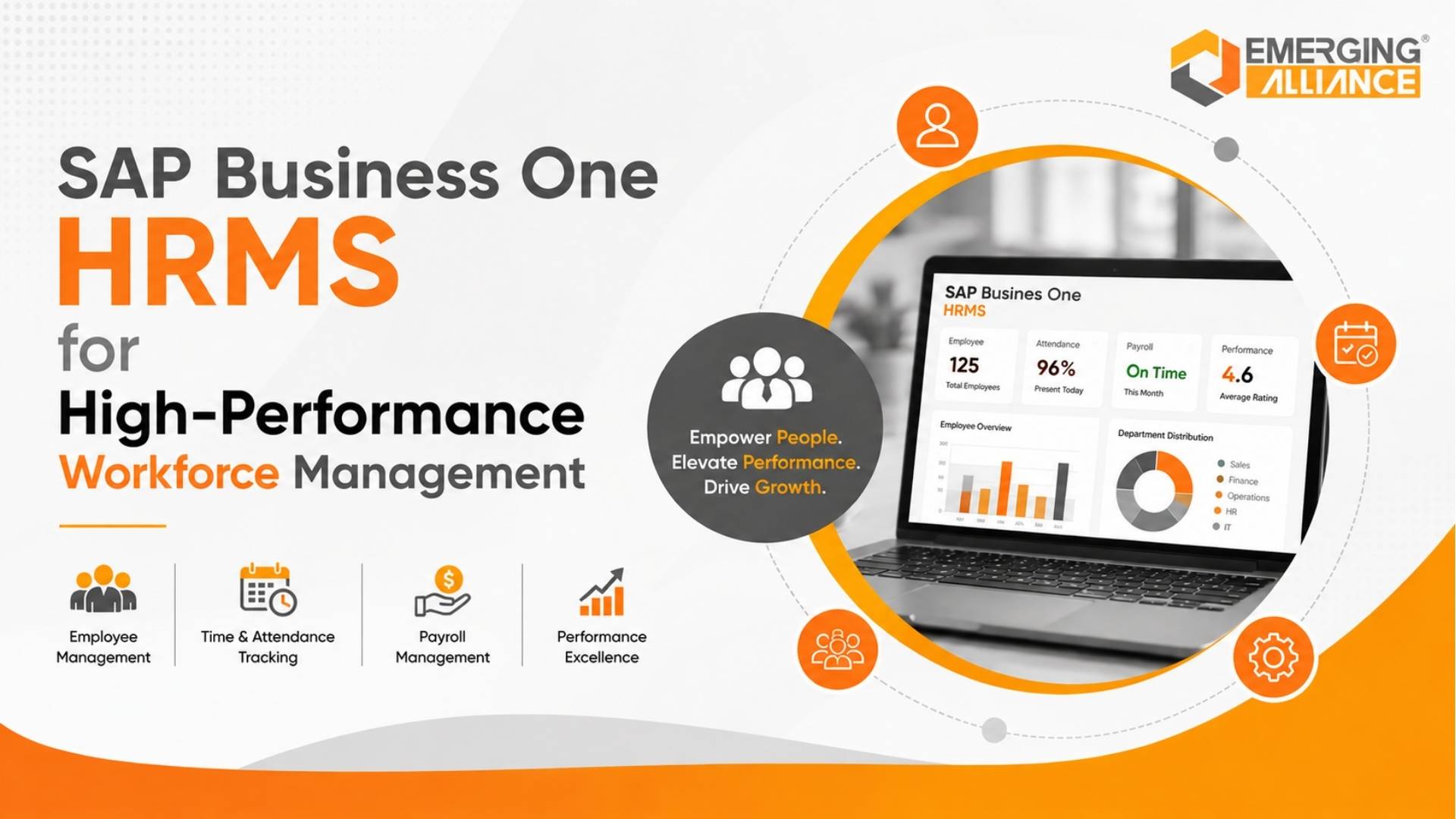
SAP Business One HRMS for High-Performance Workforce Management
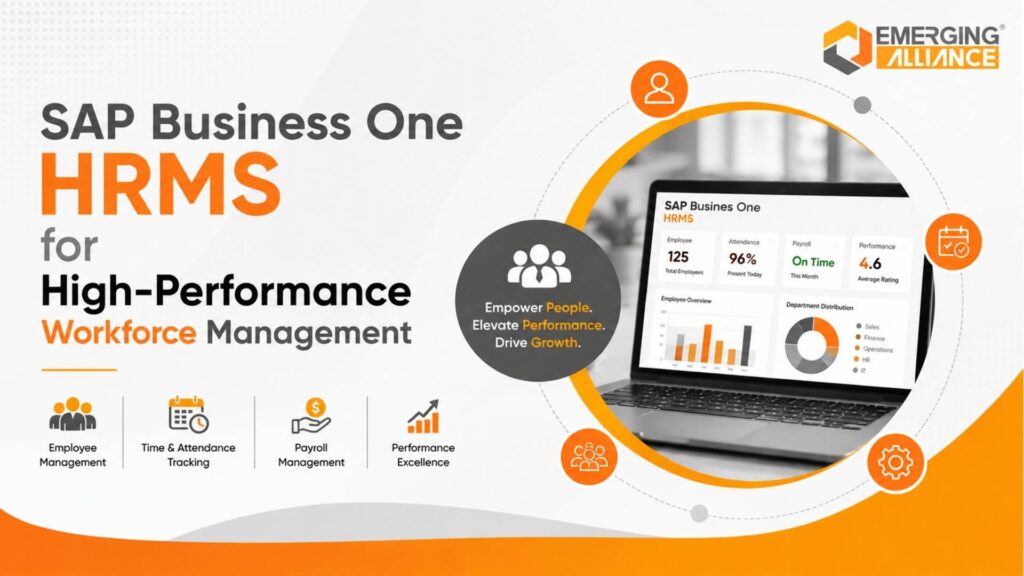
SAP Business One HRMS enhancing employee productivity and business growth
Managing people has become one of the most critical responsibilities for growing businesses. As organizations expand across locations, departments, and shifts, human resource teams must handle increasing volumes of employee data, payroll processing, attendance tracking, leave approvals, compliance requirements, and performance management. When these processes rely on spreadsheets, disconnected software, or manual paperwork, errors become more frequent, reporting becomes slower, and strategic workforce planning becomes increasingly difficult.
Many businesses continue to spend significant time on repetitive administrative tasks instead of focusing on employee development and organizational growth. Payroll discrepancies can reduce employee trust, inaccurate attendance records can affect operational planning, and delayed HR approvals can create unnecessary bottlenecks across departments. At the same time, changing labor regulations require organizations to maintain accurate records and ensure compliance, adding further pressure on HR teams.
As companies adopt digital transformation initiatives across finance, procurement, inventory, and operations, human resource management can no longer remain isolated. Decision-makers need real-time workforce insights that connect employee information with overall business performance. SAP Business One HRMS addresses these challenges by integrating human resource operations into the broader ERP environment. Instead of managing employee information across multiple systems, organizations gain a centralized platform that automates HR processes, improves workforce visibility, enhances compliance, and supports informed business decisions. The result is a more productive workforce, streamlined operations, and a stronger foundation for sustainable business growth.
What Is SAP Business One HRMS?
SAP Business One HRMS is an integrated human resource management solution designed for organizations using SAP Business One. It centralizes employee information, automates payroll, attendance, leave, recruitment, performance management, and HR reporting while connecting workforce data with finance and business operations. It is ideal for growing SMEs, manufacturers, distributors, retailers, healthcare providers, and service organizations seeking to improve workforce productivity, strengthen compliance, reduce administrative effort, and make better business decisions through integrated HR management.
Why Businesses Need SAP Business One HRMS
Workforce management has evolved far beyond maintaining employee records and processing monthly salaries. Modern organizations require HR teams to support strategic business objectives by improving employee productivity, ensuring regulatory compliance, optimizing workforce planning, and providing accurate insights for executive decision-making.
As businesses grow, HR complexity increases significantly. New hires, multiple office locations, diverse work schedules, shift-based operations, and evolving labor regulations create administrative challenges that manual systems cannot efficiently manage.
A centralized SAP Business One HRMS enables organizations to manage every stage of the employee lifecycle through a single integrated platform. HR managers no longer need to maintain duplicate records across multiple applications or manually reconcile information between departments.
The growing emphasis on digital transformation has also changed executive expectations. Leadership teams expect instant access to workforce analytics, department-wise employee costs, absenteeism trends, overtime reports, and productivity metrics. Without an integrated HR solution, generating these insights often requires manual data collection and spreadsheet analysis.
Business scalability is another important factor. As employee numbers increase, HR activities grow exponentially. Manual recruitment tracking, attendance monitoring, payroll calculations, leave approvals, and compliance reporting consume valuable time that could otherwise support talent development and strategic initiatives.
By integrating HR processes with SAP Business One, organizations create a unified ecosystem where employee information flows seamlessly across departments. Finance gains accurate payroll data, operations receive better workforce visibility, managers can make informed staffing decisions, and executives gain reliable reporting to support long-term business planning.
Instead of functioning as an administrative department, HR becomes a strategic contributor to organizational efficiency and sustainable growth.
Common Workforce Management Challenges
Manual Employee Records
Many organizations continue to maintain employee information across spreadsheets, paper files, and disconnected software applications. Updating employee records manually increases the likelihood of duplicate information, outdated records, and data inconsistencies. HR professionals spend valuable time searching for documents instead of focusing on employee engagement and workforce planning.
Attendance Tracking Problems
Tracking attendance manually or through standalone systems often creates discrepancies between actual working hours and recorded data. Missing attendance entries, inaccurate overtime calculations, and delayed updates affect payroll accuracy while making workforce planning more difficult for managers.
Payroll Inaccuracies
Payroll processing involves salaries, overtime, incentives, deductions, reimbursements, taxes, and statutory compliance. Even small calculation errors can lead to delayed salary payments, employee dissatisfaction, compliance risks, and increased administrative effort to resolve disputes.
Leave Management Delays
Without automated approval workflows, leave requests often move through lengthy email chains or paper-based approvals. Managers may lack visibility into team availability, creating scheduling conflicts and reducing operational efficiency during peak business periods.
HR Compliance Difficulties
Employment regulations continue to evolve across industries and regions. Maintaining accurate employee records, payroll documentation, statutory deductions, and audit-ready reports manually increases compliance risks and exposes organizations to potential penalties.
Recruitment Inefficiencies
Recruitment involves multiple stakeholders, candidate evaluations, interview scheduling, document verification, and onboarding activities. Managing these processes through separate tools often slows hiring cycles and limits visibility into recruitment progress.
Limited Reporting and Analytics
Business leaders require timely workforce insights to make informed decisions. However, manually compiling reports from different systems consumes significant time and often produces outdated information. This limits the organization’s ability to identify workforce trends and respond proactively.
Limited Employee Performance Visibility
Without structured performance management, organizations struggle to evaluate employee contributions consistently. Managers may rely on subjective assessments rather than measurable performance indicators, making talent development and succession planning more challenging.
Department Communication Gaps
Disconnected HR systems often create information silos between HR, finance, operations, and departmental managers. Delays in sharing employee updates, payroll information, or staffing changes can affect operational planning and overall organizational coordination.
Growing Administrative Workload
As employee numbers increase, routine HR tasks multiply rapidly. Processing attendance, updating employee records, generating payroll reports, handling leave requests, and maintaining compliance documentation consume significant administrative resources. This leaves HR teams with less time to focus on employee development, engagement initiatives, leadership planning, and organizational improvement.
Organizations that continue relying on manual HR processes often experience slower decision-making, higher operating costs, reduced workforce visibility, and limited scalability. Addressing these challenges requires more than automating individual tasks—it requires an integrated HR platform that aligns workforce management with broader business objectives.
Core Features of SAP Business One HRMS
An effective HRMS should do more than digitize paperwork. It should connect every stage of the employee lifecycle, automate routine activities, and provide business leaders with actionable workforce insights. SAP Business One HRMS delivers these capabilities through an integrated platform that improves operational efficiency while supporting informed decision-making.
Employee Information Management
Employee records are the foundation of every HR process. SAP Business One HRMS centralizes personal details, employment history, qualifications, department assignments, salary structures, certifications, and emergency contacts within a secure database.
Having a single source of truth eliminates duplicate records and ensures that HR, finance, and department managers work with consistent, up-to-date information. It also simplifies employee onboarding, transfers, promotions, and offboarding while reducing administrative effort.
Attendance Management
Accurate attendance data directly affects payroll, workforce planning, and operational efficiency. SAP Business One HRMS captures attendance from biometric devices, access control systems, or digital check-in methods, ensuring reliable employee time records.
Managers can monitor attendance trends, overtime, absenteeism, and late arrivals through real-time dashboards. Automated attendance tracking minimizes manual corrections, improves payroll accuracy, and provides greater visibility into workforce utilization.
Leave Management
Managing leave manually often creates unnecessary delays and communication gaps. SAP Business One HRMS automates leave requests, approval workflows, leave balances, and holiday calendars.
Employees can submit requests electronically, while managers receive instant notifications for approval. HR teams gain complete visibility into employee availability, helping departments maintain adequate staffing levels and avoid scheduling conflicts.
Payroll Automation
Payroll is one of the most sensitive HR functions, where even minor errors can affect employee confidence and compliance.
SAP Business One HRMS automates salary calculations, overtime, incentives, statutory deductions, reimbursements, bonuses, and payroll processing. Integration with attendance and leave records reduces manual intervention while ensuring accurate salary computation.
This automation shortens payroll cycles, minimizes errors, and enables finance teams to process payroll more efficiently.
Shift Scheduling
Organizations operating multiple shifts require careful workforce planning to maintain productivity.
SAP Business One HRMS allows HR managers to define shift schedules, assign employees, rotate shifts, and manage overtime efficiently. Automated scheduling helps optimize workforce allocation while reducing conflicts and ensuring operational continuity.
This capability is especially valuable for manufacturing, healthcare, logistics, and retail organizations with round-the-clock operations.
Recruitment Management
Recruiting qualified talent requires coordination across HR teams, department heads, and management.
SAP Business One HRMS streamlines recruitment by managing job openings, candidate applications, interview scheduling, evaluation processes, and onboarding activities within a centralized workflow.
Recruitment teams can track hiring progress, reduce administrative delays, and improve candidate experiences while maintaining complete visibility into every recruitment stage.
Employee Self-Service
Routine HR requests often consume valuable administrative time.
The Employee Self-Service Portal empowers employees to access payslips, update personal information, apply for leave, review attendance, download documents, and monitor leave balances independently.
This reduces HR workload while improving employee convenience, transparency, and engagement.
Performance Management
Employee performance directly influences business success.
SAP Business One HRMS supports structured performance evaluations through goal setting, appraisal cycles, competency tracking, manager feedback, and performance reviews.
Organizations gain measurable insights into employee development, identify high performers, and create objective evaluation processes that support career growth and succession planning.
Training Management
Continuous learning helps organizations remain competitive.
SAP Business One HRMS enables HR teams to schedule training programs, monitor participation, record certifications, and evaluate learning outcomes.
Managers can identify skill gaps, plan future development initiatives, and ensure employees possess the competencies required to support organizational growth.
HR Compliance
Employment regulations require organizations to maintain accurate records and support audit readiness.
SAP Business One HRMS helps businesses manage statutory documentation, employee contracts, payroll records, compliance reports, and policy acknowledgments through centralized record management.
Automated documentation improves regulatory compliance while reducing the administrative burden associated with audits.
Document Management
Employee documents often exist across multiple folders and physical files.
SAP Business One HRMS securely stores employment contracts, identification documents, educational certificates, performance records, policy acknowledgments, and compliance documentation in a centralized digital repository.
This improves document accessibility, strengthens security, and reduces the risk of misplaced records.
HR Dashboards
Executives and HR managers require immediate visibility into workforce performance.
SAP Business One HRMS provides interactive dashboards displaying employee headcount, attendance statistics, turnover rates, recruitment progress, leave utilization, overtime trends, payroll summaries, and departmental workforce metrics.
Real-time dashboards enable faster decision-making and support proactive workforce management.
Analytics and Reporting
Modern organizations depend on data-driven decisions.
SAP Business One HRMS generates comprehensive reports covering workforce costs, employee productivity, absenteeism, recruitment efficiency, payroll expenses, compliance status, and performance indicators.
Rather than manually consolidating spreadsheets, leadership teams gain timely insights that improve planning and resource allocation.
Mobile Accessibility
Today’s workforce expects flexibility beyond traditional office environments.
SAP Business One HRMS supports secure mobile access, allowing employees and managers to review attendance, approve leave requests, access HR information, and monitor workforce activities from virtually anywhere.
Mobile accessibility improves responsiveness while supporting hybrid and distributed work environments.
Business Benefits of SAP Business One HRMS
Implementing an integrated HRMS delivers measurable value beyond process automation. It enables organizations to strengthen workforce management while supporting broader business objectives.
Higher Employee Productivity
Automation removes repetitive administrative tasks, allowing HR teams to focus on strategic initiatives such as talent development, employee engagement, and workforce planning.
Employees also spend less time following up on routine requests because they can access HR services through self-service capabilities.
Reduced Administrative Work
Manual paperwork, spreadsheet updates, and repetitive data entry consume valuable time.
SAP Business One HRMS automates these activities, reducing operational workload and enabling HR professionals to support higher-value business initiatives.
Better Workforce Planning
Real-time workforce visibility helps managers understand staffing requirements, employee availability, overtime trends, and department workloads.
For example, a manufacturing company can identify recurring absenteeism during peak production periods and proactively adjust shift schedules to maintain output without excessive overtime costs.
Faster HR Decision-Making
Centralized employee information allows HR managers to respond quickly to recruitment needs, performance evaluations, promotions, and workforce planning decisions.
Instead of waiting for manually compiled reports, decision-makers gain immediate access to accurate workforce insights.
Accurate Payroll Processing
Payroll accuracy improves employee confidence while reducing administrative corrections.
By integrating attendance, leave, overtime, and payroll calculations, SAP Business One HRMS minimizes manual intervention and supports timely salary processing.
Improved Compliance
Automated record management and standardized HR processes help organizations maintain compliance with employment regulations and internal policies.
Audit preparation becomes significantly easier because required documentation is stored securely within the system.
Lower Operational Costs
Reducing manual HR activities decreases administrative overhead, minimizes payroll errors, and lowers the cost of managing employee information.
Organizations also reduce expenses associated with paper-based processes and duplicate data management.
Better Employee Satisfaction
Employees value transparency and timely HR services.
Self-service access, faster approvals, accurate payroll, and improved communication contribute to a better employee experience, supporting retention and long-term engagement.
Increased Organizational Transparency
Executives gain visibility into workforce costs, departmental staffing, productivity trends, and employee performance through centralized dashboards and reports.
This transparency supports better governance and more informed business planning.
Stronger Management Reporting
Comprehensive HR analytics help leadership teams evaluate workforce performance using measurable indicators rather than assumptions.
Managers can compare departments, monitor hiring efficiency, assess turnover trends, and identify opportunities for operational improvement.
Improved Business Agility
Organizations can respond more quickly to workforce changes, business expansion, seasonal demand, or organizational restructuring because employee information is readily available and HR processes are standardized.
Better Executive Visibility
Consider a distribution company expanding into two new regions. Without integrated HR reporting, executives struggle to understand hiring progress, workforce costs, overtime expenses, and staffing gaps across locations.
With SAP Business One HRMS integrated into the ERP environment, leadership can monitor these metrics through a single dashboard, enabling faster decisions on recruitment, budgeting, and resource allocation while supporting sustainable business growth.
Why ERP and HR Integration Creates Better Business Decisions
Human resource management should not operate independently from finance and business operations. When HR systems remain disconnected, executives often struggle to understand the relationship between workforce investments and overall business performance. Integrating SAP Business One HRMS with SAP Business One creates a unified business environment where employee information supports organization-wide decision-making.
Finance teams gain accurate payroll information without manual reconciliation, improving financial reporting and budget planning. Department managers receive better visibility into staffing costs, overtime expenses, employee availability, and workforce productivity.
Integrated cost center reporting enables leadership to analyze employee expenses across departments, projects, branches, or business units. This visibility supports more accurate budgeting and helps organizations identify opportunities to optimize workforce costs.
Resource planning also becomes significantly more effective. Managers can align hiring decisions with business demand, monitor workforce capacity, and forecast future staffingrequirements using reliable operational data.
Executive dashboards combine HR metrics with financial and operational information, allowing leadership teams to evaluate employee productivity alongside revenue, profitability, production output, and business performance.
For example, a growing manufacturing company planning to open a new production facility can use integrated workforce data to estimate hiring requirements, payroll costs, department budgets, training needs, and resource availability before expansion begins. These insights reduce uncertainty and support more confident strategic decisions.
By connecting HR with ERP, organizations move beyond administrative reporting and gain meaningful business intelligence that supports long-term growth.
Best Practices for Successful HRMS Implementation
Technology alone does not guarantee success. Organizations achieve the greatest return from SAP Business One HRMS by combining the right solution with well-defined implementation practices.
Define Clear HR Objectives
Identify measurable business goals before implementation begins. Objectives may include reducing payroll processing time, improving attendance accuracy, increasing employee engagement, or strengthening compliance.
Standardize HR Processes
Review existing HR procedures and eliminate unnecessary manual activities before automation. Standardized processes improve system consistency and simplify future growth.
Clean Employee Data
Accurate employee records are essential for successful implementation. Validate employee information, payroll details, leave balances, and historical records before migrating data into the new system.
Train HR Teams
Comprehensive training helps HR professionals use system capabilities effectively while increasing confidence during the transition.
Encourage Employee Adoption
Communicate the benefits of the new HRMS early. Demonstrating self-service capabilities, faster approvals, and improved transparency encourages employees to embrace the system.
Automate Approval Workflows
Digital approval processes reduce delays, improve accountability, and create consistent HR operations across departments.
Monitor Key Performance Indicators
Track metrics such as payroll accuracy, leave processing time, employee turnover, attendance trends, recruitment efficiency, and workforce productivity to evaluate implementation success.
Optimize Continuously
As business requirements evolve, regularly review HR processes, reports, and workflows to maximize long-term value.
Choose an Experienced SAP Implementation Partner
Implementation expertise is just as important as software functionality. An experienced SAP Business One partner understands business processes, industry requirements, integration strategies, and user adoption best practices, helping organizations achieve faster implementation and stronger long-term outcomes.
Why Choose Emerging Alliance for SAP Business One HRMS
Selecting the right implementation partner plays a significant role in realizing the full value of an HRMS solution.
Emerging Alliance combines extensive SAP Business One expertise with practical business consulting to help organizations modernize workforce management while aligning HR operations with broader business objectives.
Our consultants work closely with business leaders to understand existing HR processes, identify improvement opportunities, and recommend solutions that support operational efficiency rather than simply replacing existing systems.
Beyond implementation, Emerging Alliance assists organizations with solution customization, ERP integration, user training, process optimization, and ongoing support. This collaborative approach helps employees adopt the system more confidently while enabling management to achieve measurable business outcomes.
With experience across manufacturing, distribution, healthcare, retail, pharmaceuticals, engineering, and other industries, Emerging Alliance delivers solutions designed to support both current operational requirements and future business growth.
Rather than focusing solely on software deployment, our objective is to help organizations build a scalable digital HR ecosystem that improves workforce productivity, strengthens compliance, and supports informed executive decision-making.
Conclusion
As organizations expand, workforce management becomes increasingly complex. Manual HR processes, disconnected systems, payroll inaccuracies, compliance challenges, and limited workforce visibility not only reduce productivity but also prevent leadership teams from making timely, informed business decisions.
SAP Business One HRMS addresses these challenges by bringing employee information, attendance, leave management, payroll, performance, recruitment, compliance, and analytics together within a single integrated platform. By automating routine HR activities and connecting workforce data with SAP Business One, businesses gain greater operational efficiency, improved reporting accuracy, and stronger organizational transparency.
More importantly, HR evolves from a purely administrative function into a strategic contributor that supports workforce planning, financial management, and long-term business growth. Managers gain better visibility into employee performance, executives receive reliable workforce insights, and employees benefit from faster, more transparent HR services.
Investing in SAP Business One HRMS is not simply about replacing manual HR processes. It is about creating a scalable workforce management framework that supports productivity, strengthens compliance, improves employee engagement, and enables confident, data-driven decision-making as the business continues to grow.
Frequently Asked Questions
How does SAP Business One HRMS improve workforce management?
SAP Business One HRMS streamlines workforce management by automating routine HR tasks, maintaining centralized employee records, tracking attendance, managing leave requests, processing payroll accurately, and providing real-time workforce insights. This helps HR teams reduce administrative effort while improving employee productivity and decision-making.
Can SAP Business One HRMS automate payroll?
Yes. SAP Business One HRMS automates payroll calculations by integrating salary structures, attendance, overtime, leave, statutory deductions, reimbursements, and bonuses into a single process. This reduces manual calculations, improves payroll accuracy, and supports timely salary processing.
Does SAP Business One HRMS support attendance tracking?
Yes. The solution supports employee attendance management through biometric devices, access control systems, digital check-ins, and integrated attendance records. HR teams can monitor working hours, overtime, absenteeism, late arrivals, and attendance trends in real time.
Is SAP Business One HRMS suitable for SMEs?
Absolutely. SAP Business One HRMS is designed for growing small and medium-sized businesses that need scalable HR automation without the complexity of large enterprise HR systems. It helps SMEs improve operational efficiency while supporting future business growth.
How does HRMS improve employee productivity?
By automating repetitive HR activities, reducing paperwork, simplifying leave approvals, enabling employee self-service, and providing managers with workforce insights, HRMS allows employees and HR teams to spend more time on productive, value-added activities rather than administrative work.
Can SAP Business One HRMS integrate with SAP Business One Finance?
Yes. SAP Business One HRMS integrates with SAP Business One Finance to synchronize payroll expenses, employee costs, department budgets, cost center allocations, and financial reporting. This integration improves budgeting accuracy and supports organization-wide decision-making.
Does SAP Business One HRMS include an employee self-service portal?
Yes. Employees can securely access their attendance records, payslips, leave balances, leave applications, personal information, and HR documents through a self-service portal. This improves transparency while reducing routine HR enquiries.
How does SAP Business One HRMS help organizations maintain compliance?
SAP Business One HRMS maintains centralized employee records, payroll documentation, statutory reports, contracts, policy acknowledgements, and compliance-related information. Automated record management simplifies audits, supports regulatory compliance, and reduces the risk of documentation errors.
Why choose Emerging Alliance for SAP Business One HRMS implementation?
Emerging Alliance combines SAP Business One expertise with business process consulting, industry experience, solution customization, user training, ERP integration, and long-term support. The team focuses on aligning HR automation with business objectives, ensuring organizations achieve measurable productivity improvements and sustainable growth.
Speak with the SAP Business One specialists at Emerging Alliance to understand how an integrated HRMS can align with your business objectives. Schedule a personalized demonstration, explore practical automation opportunities, and discover how a modern HR solution can help you build a more efficient, compliant, and scalable workforce for long-term success.