

Choosing the Right SAP Business One Partner: Types, Services & Selection Guide
Quick Answer
Choosing the right SAP Business One partner involves more than comparing implementation prices or checking whether a company sells SAP Business One. Businesses should evaluate the partner’s implementation experience, industry knowledge, customization capabilities, integration expertise, migration approach, cloud and hosting services, post-go-live support, and ability to support long-term growth.
SAP Business One partners can differ significantly in their service scope and technical capabilities. Some may focus primarily on licensing and implementation, while others provide broader services covering customization, third-party integrations, add-ons, data migration, cloud deployment, reporting, upgrades and ongoing support.
For a growing business, the right partner should align SAP Business One with actual operational requirements rather than simply deploying the software. The selection process should therefore consider the partner’s implementation methodology, relevant industry experience, technical resources, support model, project governance, and ability to handle future requirements.
The most suitable partner is ultimately the one whose services, experience, implementation approach and support capabilities match the organization’s ERP requirements and growth plans.
Why the SAP Business One Partner Matters Beyond Implementation
An SAP Business One implementation affects more than the initial ERP deployment.
The partner can influence how business processes are mapped, how master data is structured, how integrations are designed, how users are trained, how customizations are handled and how the system is supported after go-live.
This makes partner selection an important part of the ERP investment decision.
A business may have the right ERP platform but still experience implementation difficulties when requirements are poorly understood, integrations are inadequately planned or customizations are introduced without sufficient governance.
The partner should therefore be evaluated as a long-term ERP services provider, not simply as a company responsible for installing software.
The 3 Main Types of SAP Business One Partners
The original article’s three-part concept can be retained, but it should be expanded beyond a basic classification.
In practice, businesses may encounter different types of SAP Business One providers based on their role and service model.
SAP Business One Resellers
A reseller primarily operates around SAP Business One licensing and sales, often alongside implementation services.
The important consideration is whether the reseller has sufficient technical and consulting capability for the complexity of the business.
For straightforward requirements, a reseller with implementation resources may be sufficient. More complex environments involving integrations, custom workflows, industry requirements or multiple entities may require broader expertise.
SAP Business One Implementation Partners
An implementation partner focuses on configuring and deploying SAP Business One around business processes.
Typical responsibilities can include:
✔ Process mapping
✔ SAP Business One configuration
✔ Data migration
✔ User training
✔ Testing
✔ Go-live planning
✔ Post-implementation support
The quality of the implementation methodology matters because ERP implementation involves business-process decisions, not simply software configuration.
SAP Business One Solution and Consulting Partners
A broader solution partner can support businesses that need more than a standard implementation.
Depending on the provider, services may include:
⚙ Customization
⚙ Industry-specific solutions
⚙ Third-party integrations
⚙ Reporting and analytics
⚙ Cloud hosting
⚙ HANA migration
⚙ Mobile and web extensions
⚙ Support and maintenance
This model can be particularly relevant when the ERP environment needs to evolve as the business grows.
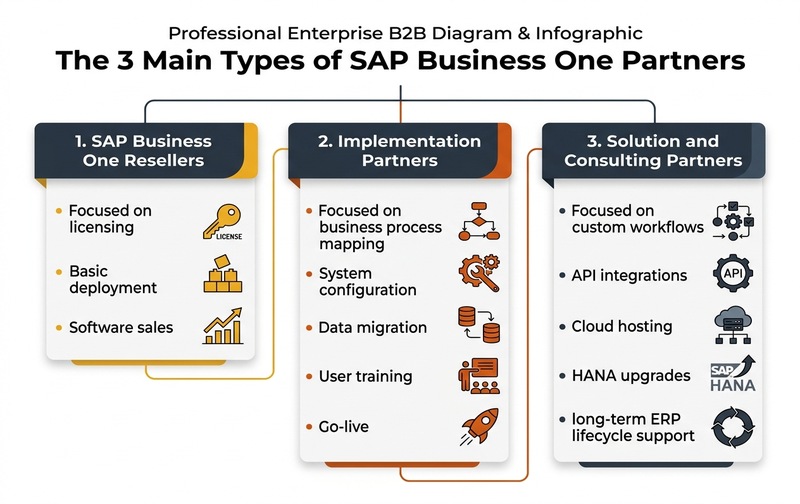
Comparison of the three primary types of SAP Business One partners—resellers, implementation partners, and solution consulting partners—showing their typical service scope and ERP lifecycle roles.
SAP Business One Partner Services to Evaluate
Comparing partners only by implementation scope can leave important differences hidden.
A better evaluation considers the complete service lifecycle.
SAP Business One Implementation Services
Implementation should begin with understanding the organization’s current processes and future requirements.
A capable partner should be able to translate business requirements into an implementation plan covering configuration, data, integrations, testing, training and deployment.
Ask whether the proposed implementation methodology clearly defines:
📌 Business requirements
📌 Implementation phases
📌 Responsibilities
📌 Testing
📌 Training
📌 Data migration
📌 Go-live activities
📌 Post-go-live support
A clearly defined methodology makes it easier to understand what the implementation actually includes.
SAP Business One Customization and Add-On Services
Not every business process will necessarily fit a standard ERP configuration.
Where customization or add-ons are required, the partner should explain why they are necessary and whether the requirement can instead be addressed through standard functionality or configuration.
This distinction matters because excessive customization can increase complexity and affect future maintenance.
The evaluation should cover:
⚙ Industry add-ons
⚙ Forms and reports
⚙ User-specific requirements
⚙ Approval processes
⚙ Extensions
⚙ Integration-driven customizations
The objective should be to close genuine business-process gaps without unnecessarily complicating the ERP environment.
SAP Business One Integration Capabilities
Modern ERP environments rarely operate in isolation.
SAP Business One may need to exchange information with applications such as:
🔗 E-commerce systems
🔗 Banking applications
🔗 Manufacturing systems
🔗 Warehouse systems
🔗 Payroll or HR applications
🔗 Tax and e-invoicing platforms
🔗 Business intelligence tools
A partner should therefore be able to explain its approach to API integration, data synchronization, error handling and integration monitoring where applicable.
Integration capability becomes especially important when an organization is replacing disconnected systems with a more connected operating environment.
SAP Business One Data Migration
Data migration is one of the areas that can materially affect implementation quality.
The partner should establish:
- Which historical data will be migrated
- Which master data needs cleansing
- How duplicates will be handled
- How opening balances will be validated
- How data will be tested
- Who owns migration validation
Migrating inaccurate legacy data into a new ERP does not solve the underlying data problem.
SAP Business One Cloud and Hosting Services
Businesses considering cloud deployment should evaluate more than whether a partner offers hosting.
Important areas include:
☁ Backup procedures
☁ Security controls
☁ User access
☁ System monitoring
☁ Disaster recovery
☁ Scalability
☁ Support responsibilities
The commercial model and technical responsibilities should be clearly documented before deployment.
SAP Business One Support After Go-Live
The ERP relationship does not end when users start operating the system.
Post-go-live support may involve:
🛠 Configuration changes
🛠 Report modifications
🛠 Integration troubleshooting
🛠 System upgrades
🛠 Performance-related issues
🛠 New business requirements
🛠 Ongoing user assistance
Businesses should understand the partner’s support model before signing the implementation agreement.
Ask about response processes, escalation procedures, support coverage and how enhancement requests are handled.
SAP Business One Partner vs Reseller: What Is the Difference?
The terms can overlap, but they should not automatically be treated as equivalent.
A reseller may focus heavily on licensing and sales, while an implementation or solution partner may provide a broader combination of consulting, implementation, customization, integration and support.
The important question is not simply what the provider calls itself.
Instead, evaluate the actual services, technical capabilities, implementation experience and post-go-live support included in the engagement.
The exact service scope should always be confirmed with the individual provider rather than assumed from its partner classification.
How to Evaluate an SAP Business One Implementation Partner
Partner selection should move beyond brand recognition and implementation pricing.
Evaluate the provider against several practical criteria.
Industry and Business-Process Experience
A partner that understands the organization’s industry can potentially identify process requirements more effectively.
For example, manufacturing businesses may need deeper discussion around production planning, inventory, procurement, quality processes and traceability.
Distribution businesses may place greater emphasis on inventory, sales, purchasing, warehouse operations and logistics.
The relevant question is therefore:
Has the partner implemented SAP Business One in businesses with requirements similar to yours?
SAP Business One Technical Capability
Review the partner’s ability to handle the technical environment surrounding the ERP.
This can include:
💻 APIs
💻 Database technologies
💻 Reporting
💻 Add-ons
💻 Customization
💻 Cloud environments
💻 Data migration
💻 Extensions
Technical capability becomes increasingly important as the ERP ecosystem becomes more connected.
Implementation Methodology
Ask the partner to explain the implementation process before the project begins.
A credible plan should show how the project moves from requirements through configuration, testing, training and go-live.
Avoid evaluating implementation proposals solely by price.
A lower initial quotation may not represent a lower total project cost if important services are excluded and added later.
Project Team and Resources
Find out who will actually work on the project.
Consider:
👥 Functional consultants
👥 Technical consultants
👥 Integration specialists
👥 Data migration resources
👥 Support team
The sales team and implementation team may not be the same people.
References and Relevant Experience
Request relevant implementation examples rather than only a list of company logos.
Useful questions include:
- What industries have you implemented SAP Business One for?
- What similar business processes have you handled?
- What integrations have you delivered?
- What type of customization was required?
- How do you support customers after go-live?
Specific examples provide more useful evidence than general claims about experience.
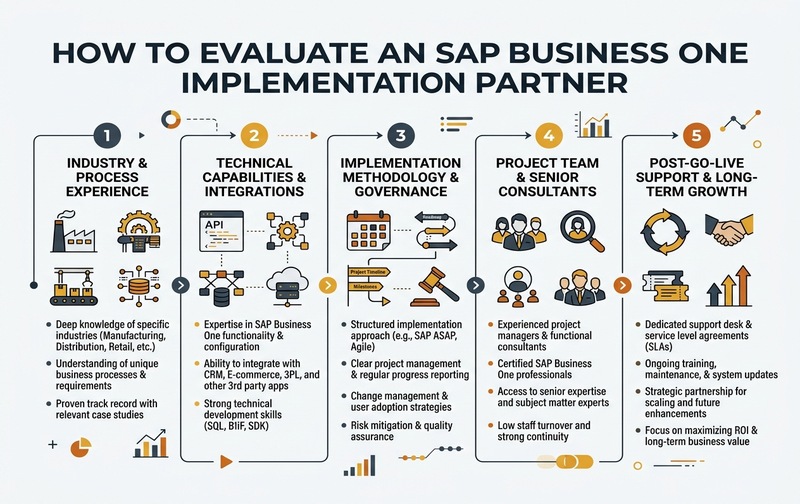
Strategic evaluation framework for selecting an SAP Business One partner across industry experience, technical capabilities, structured methodology, consulting team resources, and long-term support.
When a Business Needs More Than a Basic SAP Business One Reseller
A basic reseller model may not address every organization’s requirements.
Businesses with multiple integrations, complex operational processes, industry-specific requirements, significant data migration needs or long-term ERP transformation plans may need a partner with broader consulting and technical capabilities.
This is particularly relevant when SAP Business One is expected to become a central business system rather than simply another application within the technology stack.
The partner should be able to discuss both the immediate implementation and how the environment can evolve.
Choosing an SAP Business One Partner for Long-Term Growth
The ERP partner selected today may remain involved for years.
Future requirements can include:
📈 Additional users
📈 New locations
📈 Process automation
📈 New integrations
📈 Reporting requirements
📈 Mobile access
📈 Cloud changes
📈 Regulatory requirements
📈 Additional industry functionality
This makes scalability an important partner-selection criterion.
A useful evaluation question is:
Can this partner support the business after the original implementation scope is complete?
The answer should be based on demonstrated services, resources and support processes rather than promises alone.
Common SAP Business One Partner Selection Mistakes
Several mistakes can make partner selection more difficult.
Choosing Primarily on Implementation Price
Price matters, but comparing only the initial implementation quotation can hide differences in scope.
Two proposals with different prices may include substantially different levels of consulting, migration, customization, training and support.
Selecting a Partner Without Checking Industry Experience
ERP requirements vary significantly between industries.
A partner should be able to demonstrate how it has addressed relevant operational processes.
Treating Customization as the Default Solution
Customization should solve a clearly defined business requirement.
The partner should first establish whether standard SAP Business One functionality, configuration or an existing supported add-on can address the requirement.
Ignoring Post-Go-Live Support
Implementation is only one stage of the ERP lifecycle.
Support arrangements should be evaluated before the contract is finalized.
Failing to Define Integration Requirements Early
Late discovery of integration requirements can affect scope, timelines and project complexity.
Integration dependencies should therefore be identified during requirements analysis.
SAP Business One Partner Selection Checklist
Before making a final decision, evaluate whether the partner can demonstrate:
The objective is not to select the provider with the longest service list. It is to identify the partner whose capabilities align with the organization’s actual ERP requirements.
Why SAP Business One Partner Experience Matters for ERP Projects
ERP implementation combines software, business processes, data and people.
The technology platform is only one component of the project.
A partner with relevant experience can contribute to requirements analysis, process mapping, configuration, integration planning, migration, testing and user adoption.
For business leaders, the evaluation should therefore consider the complete implementation ecosystem rather than viewing SAP Business One as a standalone software purchase.
Conclusion
Selecting an SAP Business One partner should be treated as a business and technology decision rather than simply a software procurement exercise.
The right evaluation considers the complete lifecycle: requirements, implementation, data migration, customization, integration, deployment, training and post-go-live support.
Instead of comparing partners only on implementation cost, businesses should examine how closely each provider’s experience, technical capabilities and service model align with their current operations and future requirements.
For organizations evaluating SAP Business One, the next step is to translate business requirements into a practical implementation and support approach.
Frequently Asked Questions
Discuss Your SAP Business One Requirements With Our Team
If you are evaluating SAP Business One and need to understand the right implementation, customization, integration or support approach for your business, Emerging Alliance can help assess your requirements and discuss an ERP approach aligned with your operational and growth plans.
Talk to our SAP Business One team about your requirements and explore the right partner-led approach for your business.