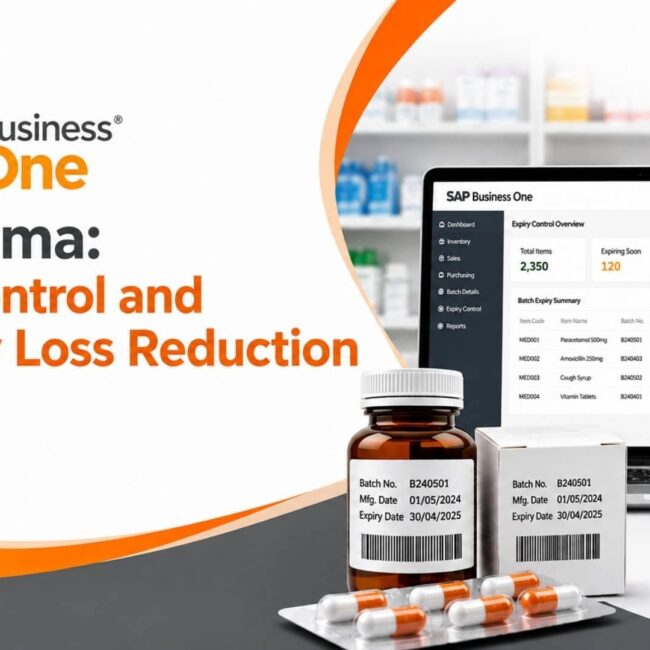


SAP Business One for Pharmaceutical Manufacturing: Optimizing Production Planning for Business Growth
Quick Answer:
SAP Business One for Pharmaceutical Manufacturing can improve production planning by connecting customer demand, material requirements, inventory, procurement, production orders, batch information, warehouse activities, sales, and financial data within one ERP environment.
Using capabilities such as Material Requirements Planning (MRP), Bills of Materials, production orders, inventory management, and batch tracking, pharmaceutical manufacturers can identify material requirements earlier, improve inventory utilization, coordinate procurement with production demand, and strengthen operational visibility.
For growing pharmaceutical manufacturers, this connected approach can support:
- Better production planning
- Improved material availability
- Reduced spreadsheet dependency
- Stronger inventory control
- Better batch traceability
- Improved procurement coordination
- Greater working-capital visibility
- Faster management decisions
- More scalable manufacturing operations
The key advantage is not simply automating production activities. It is giving production, purchasing, warehouse, sales, and finance teams access to a more consistent source of operational information.
Production Planning Challenges in Pharmaceutical Manufacturing
Production planning becomes more complicated as pharmaceutical manufacturers expand their product portfolios, production volumes, supplier networks, customer base, and warehouse operations.
A production decision cannot be made only by checking available manufacturing capacity.
Planners may also need to consider:
- Raw-material availability
- Packaging materials
- Bills of Materials
- Inventory levels
- Batch-controlled stock
- Shelf-life considerations
- Procurement lead times
- Customer demand
- Warehouse availability
- Production requirements
- Quality-related activities
- Financial implications
When this information exists across spreadsheets, emails, individual systems, and manual records, production planning becomes increasingly difficult to coordinate.
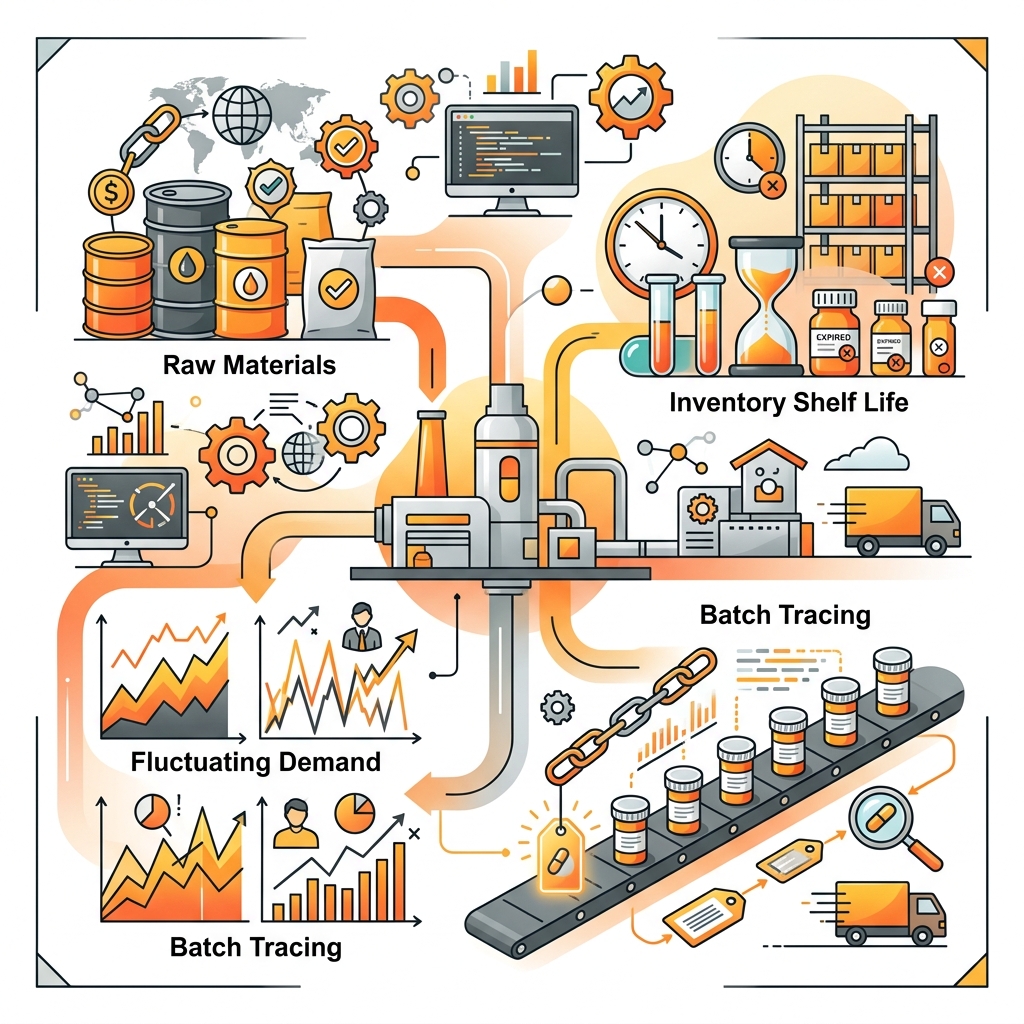
Production planning challenges in pharmaceutical manufacturing span raw materials, shelf-life, and demand coordination.
Demand Fluctuations
Demand may change across:
- Products
- Customers
- Distributors
- Markets
- Sales periods
- Geographic regions
When customer requirements are disconnected from production planning, manufacturers can produce too much of one product while struggling to fulfill demand for another.
This can result in excess stock, shortages, production rescheduling, and working-capital pressure.
Production Scheduling Complexity
Pharmaceutical manufacturers may need to coordinate multiple:
- Product formulations
- Bills of Materials
- Components
- Packaging requirements
- Production orders
- Resources
- Material requirements
Poor coordination can contribute to:
- Production delays
- Idle production capacity
- Rush purchasing
- Excess work-in-progress
- Missed customer commitments
As production complexity increases, spreadsheet-based scheduling becomes increasingly difficult to manage accurately.
Raw-Material Availability
A production plan may look achievable until planners discover that a critical ingredient, component, or packaging material is unavailable.
Manual planning can make it difficult to understand:
- Current stock
- Committed quantities
- Incoming purchases
- Planned consumption
- Future requirements
Without this visibility, production teams can discover shortages too late.
Batch and Shelf-Life Complexity
Batch management is particularly important in pharmaceutical manufacturing.
Businesses may need to identify and track specific batches through relevant inventory movements and business processes.
Shelf life adds another planning consideration.
Buying or manufacturing excessive quantities can increase the risk of inventory becoming:
- Slow-moving
- Obsolete
- Unsuitable for planned consumption
- Expired before sale or use
Production planning therefore needs to consider both availability and inventory quality.
Inventory and Working-Capital Pressure
Production teams require enough inventory to maintain manufacturing continuity.
Finance teams, however, need to avoid unnecessary stock accumulation.
Purchasing too early can tie up working capital.
Purchasing too late can interrupt production.
The challenge is finding the right balance using accurate and connected information.
Quality and Traceability Requirements
Pharmaceutical businesses often operate with additional quality, documentation, traceability, and validation requirements.
SAP Business One can support operational records, inventory transactions, and batch traceability.
However, SAP Business One should not automatically be considered a complete pharmaceutical quality-management or regulatory-compliance system.
Depending on specific business and regulatory requirements, companies may require:
- Additional configuration
- Industry-specific add-ons
- Third-party integrations
- Validation procedures
- Specialized quality systems
- Laboratory or manufacturing systems
The Business Impact of Poor Pharmaceutical Production Planning
Production-planning problems rarely remain limited to the factory floor.
They can influence inventory, cash flow, procurement, customer service, margins, and management decision-making.
| Production Planning Problem | Operational Impact | Business Impact |
|---|---|---|
| Material shortages | Production interruptions | Delayed customer fulfillment |
| Excess purchasing | High inventory | Working capital tied up |
| Poor demand visibility | Overproduction or shortages | Higher carrying costs |
| Disconnected batch records | Difficult traceability | Increased operational risk |
| Spreadsheet planning | Repeated reconciliation | Slower decisions |
| Poor stock visibility | Unnecessary purchases | Higher inventory levels |
| Production delays | Missed schedules | Customer dissatisfaction |
| Department silos | More manual communication | Higher administrative effort |
For CEOs and CFOs, production planning is therefore a business-management issue.
It can directly affect:
- Cash flow
- Working capital
- Inventory carrying costs
- Customer fulfillment
- Production utilization
- Margins
- Operational scalability
SAP Business One for Pharmaceutical Manufacturing and Production Planning
SAP Business One provides an integrated ERP foundation connecting production, inventory, purchasing, warehouse activities, sales, and financial information.
This integration is important because most production problems are interconnected.
For example:
Material shortage → Production delay → Customer fulfillment issue → Revenue impact
Or:
Excess purchasing → Higher inventory → Working capital pressure → Increased carrying costs
A connected ERP environment helps management understand these relationships instead of evaluating each department separately.
Bill of Materials for Structured Production Planning
Production planning begins with understanding what materials are required to manufacture each product.
SAP Business One supports Bills of Materials, enabling manufacturers to define the components associated with manufactured products.
Instead of managing product structures only through spreadsheets, production teams can maintain structured product information within the ERP environment.
How Bills of Materials Support Pharmaceutical Manufacturing
Accurate BOM information can support:
- Material planning
- Procurement decisions
- Inventory requirements
- Production execution
- Production costing
- Working-capital planning
When planners know what components are required for planned output, they can evaluate material availability more effectively before production begins.
Production Orders for Controlled Manufacturing Execution
A production plan is only useful when execution can be tracked effectively.
SAP Business One supports production orders, allowing manufacturers to manage planned and released manufacturing activities and record relevant material movements and finished output.
Production teams can gain better visibility into:
- Planned production
- Material requirements
- Material consumption
- Production status
- Finished quantities
This creates a stronger connection between planning and manufacturing execution.
For operations managers, improved production-order visibility can help identify potential bottlenecks earlier.
SAP Business One MRP for Pharmaceutical Production Planning
Material shortages often happen because demand, inventory, purchasing, and production requirements are reviewed separately.
SAP Business One includes Material Requirements Planning (MRP) functionality.
MRP can evaluate relevant supply and demand information according to the planning parameters maintained within the system.
It can help planners understand:
- What materials may be required
- What stock is already available
- What future requirements exist
- Which components may need purchasing
- Which requirements may need production
This allows teams to identify potential shortages before production begins.
Reactive Purchasing vs MRP-Based Planning
Without connected planning:
Production Requirement → Material Missing → Emergency Purchase → Possible Delay
With MRP-supported planning:
Demand → Inventory Review → MRP → Requirement Identification → Procurement → Production
This creates a more structured planning process.
It can also help procurement teams avoid purchasing based only on assumptions or urgent requests.
Pharmaceutical Inventory Management and Production Visibility
Reliable production planning depends on reliable inventory information.
If planners do not know what stock is available, even a well-designed production schedule can fail.
SAP Business One inventory management provides centralized visibility into inventory quantities and movements across relevant warehouse structures.
This can help planners understand:
- What inventory exists
- Where it is located
- What quantities are available
- What quantities are committed
- What additional requirements may be needed
Business Benefits of Better Inventory Visibility
Improved inventory visibility can support:
- Material availability checks
- Reduced duplicate purchasing
- Better warehouse coordination
- Improved procurement planning
- More accurate production planning
- Inventory valuation
- Working-capital control
Finance can also gain greater visibility into inventory value, connecting physical stock with financial management.
Batch Management and Pharmaceutical Traceability
Batch management is an important requirement for many pharmaceutical manufacturers.
SAP Business One supports batch-number management for relevant inventory items.
Companies can record and track batch information through applicable inventory transactions.
This can improve visibility into batch-controlled products as they move through business processes.
Why Batch Visibility Matters
Structured batch records can make it easier to understand:
- Which batch entered inventory
- Where batch-controlled stock is located
- Which inventory movements involved a batch
- Which relevant business transactions are associated with it
This can be significantly more efficient than reconstructing batch activity from spreadsheets, emails, or paper records.
Important Compliance Consideration
Batch functionality should not be interpreted as automatic regulatory compliance.
Pharmaceutical manufacturers remain responsible for determining their:
- Regulatory obligations
- Validation requirements
- Documentation controls
- Audit requirements
- Quality processes
- Manufacturing controls
Additional specialist functionality may be required depending on business and regulatory requirements.
Warehouse and Procurement Coordination
Warehouse operations and purchasing decisions directly influence production schedules.
SAP Business One can connect warehouse inventory information with purchasing and production requirements.
When planners identify material needs, procurement teams can review those requirements alongside current inventory.
This improves coordination between:
Production ↔ Procurement ↔ Warehouse
Instead of depending completely on emails, phone calls, and spreadsheets, departments can work from shared business data.
Connecting Sales Demand with Pharmaceutical Production Planning
Production should ultimately respond to business demand.
When sales information and production planning operate separately, manufacturers risk producing based on outdated assumptions.
A connected ERP environment can give planners better visibility into customer requirements and inventory conditions.
This becomes increasingly valuable as businesses expand:
- Product portfolios
- Customers
- Sales channels
- Markets
- Warehouses
- Transaction volumes
Connected information can help manufacturers align production more closely with actual business requirements.
Production Planning and Financial Visibility
Every operational decision eventually creates a financial consequence.
Purchasing inventory consumes cash.
Manufacturing consumes materials.
Holding excessive inventory increases working-capital requirements.
Production delays can influence customer fulfillment and revenue timing.
SAP Business One connects core business transactions with financial information.
This allows management to evaluate:
- Inventory value
- Procurement commitments
- Production-related costs
- Material consumption
- Finished inventory
- Sales activity
For CFOs, production planning therefore becomes part of broader financial control rather than an isolated factory process.
10 Benefits of SAP Business One for Pharmaceutical Production Planning
1. Better Production Visibility
Production leaders need visibility into planned requirements, material availability, inventory activity, and manufacturing operations.
SAP Business One can centralize relevant operational information.
This can reduce the need to manually collect information from multiple departments.
2. Improved Material Planning
MRP can help planners evaluate material requirements against relevant supply and demand information.
Procurement can then coordinate purchasing more closely with production needs.
3. Earlier Identification of Production Constraints
Production delays often begin before manufacturing starts.
Common causes include:
- Missing materials
- Incorrect inventory information
- Delayed procurement
- Departmental coordination gaps
Connected ERP information can help teams identify potential constraints earlier.
4. Better Inventory Utilization
Excess inventory consumes cash and warehouse capacity.
Insufficient inventory creates production risk.
Integrated inventory information helps planners evaluate existing stock before creating additional requirements.
5. Improved Batch Traceability
Structured batch management can provide greater visibility into batch-controlled inventory movements.
This can support operational traceability and investigation processes.
6. Better Shelf-Life and Expiry Awareness
Expiry-related losses often begin with poor purchasing and inventory visibility.
Connected inventory and batch information can support better stock decisions where shelf life is relevant.
Additional configuration or specialist functionality may be needed for advanced expiry controls.
7. Better Production Cost Visibility
Connecting production, inventory, purchasing, and accounting information gives finance teams greater context around manufacturing costs.
Management can more easily understand where production decisions may affect inventory and margins.
8. Stronger Departmental Coordination
Many production-planning problems are actually coordination problems.
Sales, production, purchasing, warehouse, and finance may all be working with different information.
An integrated ERP environment creates a shared information foundation.
9. Faster Management Decisions
Executives do not necessarily need more reports.
They need relevant information quickly.
Integrated operational and financial information can shorten the time between identifying a problem and taking action.
10. Greater Operational Scalability
Manual planning processes may work when production complexity is low.
Growth changes this.
Every additional:
- SKU
- Batch
- Supplier
- Warehouse
- Customer
- Production transaction
creates additional coordination requirements.
ERP helps create a structured environment capable of supporting higher operational complexity without increasing manual coordination at the same rate.
SAP Business One Pharmaceutical Production Planning Workflow
A practical production-planning workflow can be represented as:
Demand / Sales Requirement → Inventory Review → MRP → Material Planning → Procurement → Production Order → Batch Tracking → Quality-Related Processes → Finished Goods → Warehouse → Customer Fulfillment → Financial Visibility
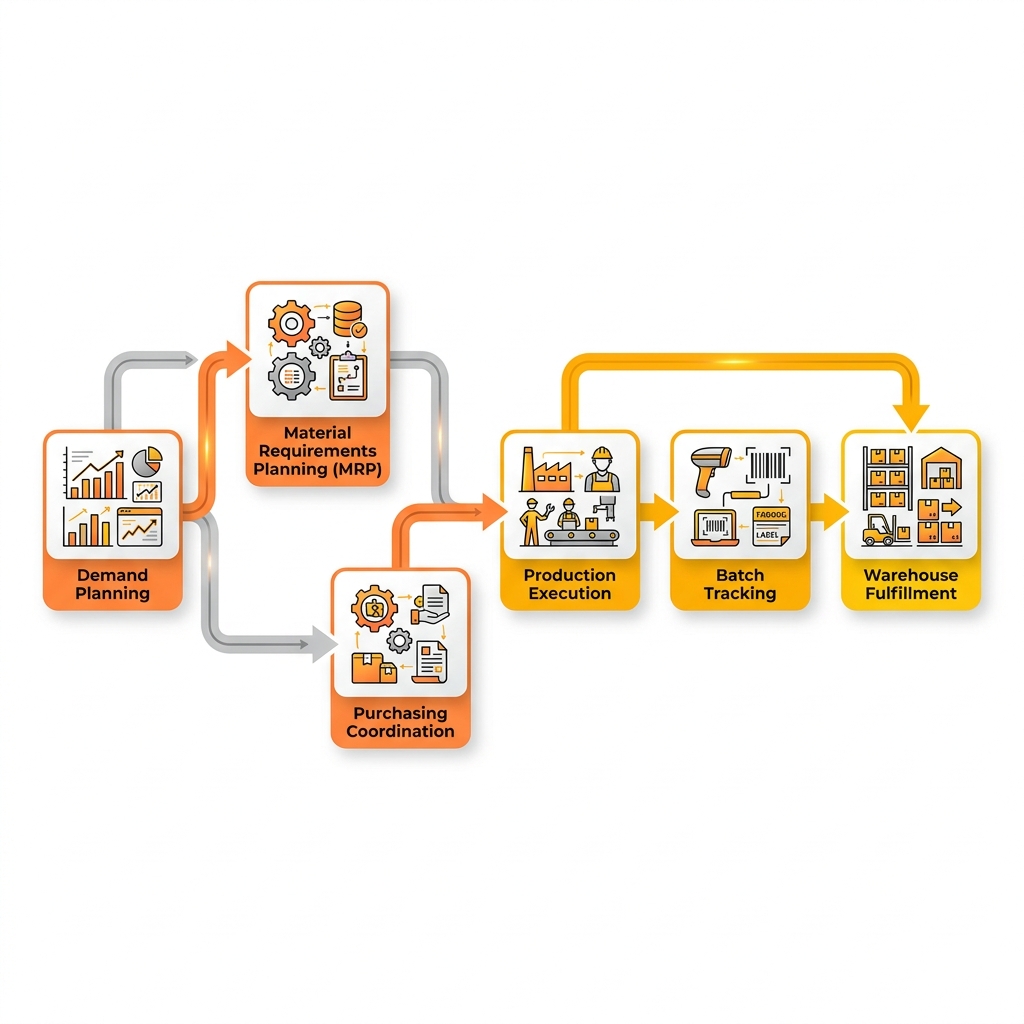
The pharmaceutical production planning workflow in SAP Business One bridges demand, MRP, and tracking.
Step 1: Demand Identification
Planning begins with understanding customer or internal business requirements.
Relevant sales information becomes an input into production planning.
Step 2: Inventory Review
Planners evaluate available inventory before generating unnecessary purchasing or production requirements.
Step 3: MRP
SAP Business One MRP evaluates relevant supply and demand information based on configured planning parameters.
Step 4: Material Planning
Production planners review what materials are required and where shortages may exist.
Step 5: Procurement
Purchasing teams can act on identified requirements and coordinate incoming materials with production needs.
Step 6: Production Order
Approved production requirements move into execution through production orders.
Step 7: Batch Tracking
Relevant batch information is recorded for batch-managed inventory.
Step 8: Quality-Related Activities
Quality-related processes may involve:
- Configured workflows
- Documentation
- Add-ons
- Customization
- Third-party systems
- Specialist integrations
The required architecture depends on the manufacturer’s specific quality and regulatory environment.
Step 9: Finished Goods and Warehouse
Completed production updates inventory processes and improves visibility into available finished stock.
Step 10: Customer Fulfillment
Warehouse and sales teams coordinate dispatch using connected inventory information.
Step 11: Financial Visibility
Purchasing, inventory, production, sales, and accounting activity contribute to management’s overall financial view.
The important point is not each individual step.
It is the flow of information between them.
Spreadsheet Production Planning vs SAP Business One
| Area | Spreadsheet-Based Planning | SAP Business One |
|---|---|---|
| Inventory visibility | Fragmented | Centrally maintained |
| Material planning | Manually calculated | MRP-supported |
| Bills of Materials | Separate files | Structured ERP records |
| Production orders | Manually tracked | Integrated production process |
| Procurement | Email/spreadsheet dependent | Connected with requirements |
| Batch information | Manual records | Batch-managed transactions |
| Financial visibility | Evaluated separately | Connected with accounting |
| Reporting | Manual consolidation | Integrated reporting |
| Scalability | Increasing administration | Structured ERP processes |
| Department coordination | Multiple handoffs | Shared information environment |
When Do Pharmaceutical Manufacturers Need SAP Business One?
The need for ERP often becomes visible through operational symptoms before management formally begins an ERP project.
Common warning signs include:
- Increasing production volumes
- Growing SKU counts
- Frequent material shortages
- High inventory levels
- Expiry-related inventory concerns
- Multiple warehouses
- Increasing batch complexity
- Repeated spreadsheet reconciliation
- Poor visibility into available materials
- Slow management reporting
- Manual communication between departments
- Difficulty determining available versus required stock
- Growing dependency on individual spreadsheet owners
- Administrative work increasing faster than production
- Difficulty scaling existing processes
These symptoms often point to one underlying problem:
Business complexity has exceeded the organization’s existing information-management processes.
At this stage, ERP selection becomes more than an IT upgrade.
It becomes a business scalability decision.
SAP Business One for Growing Pharmaceutical Manufacturers
A manufacturing ERP should not only solve today’s operational problems.
It should also support future complexity.
A pharmaceutical manufacturer may need to prepare for:
- More products
- More customers
- More warehouses
- Higher production volumes
- More suppliers
- More batch-controlled items
- More reporting requirements
- Additional locations
- Increased transaction volumes
Without a structured ERP environment, each stage of growth can create additional manual work.
The strategic value of SAP Business One lies in creating a connected information foundation that can support growth without requiring every increase in transaction volume to be matched by more spreadsheets and manual coordination.
Conclusion: Better Production Planning for Scalable Pharmaceutical Growth
Production planning becomes increasingly difficult as pharmaceutical manufacturers add:
- Products
- Materials
- Batches
- Suppliers
- Warehouses
- Customers
- Production volumes
Disconnected systems can contribute to material shortages, excess inventory, production delays, poor batch visibility, slow reporting, and inefficient departmental coordination.
SAP Business One for Pharmaceutical Manufacturing can provide an integrated ERP foundation connecting:
- Material Requirements Planning
- Bills of Materials
- Production orders
- Inventory
- Batch information
- Purchasing
- Warehouse activities
- Sales
- Financial management
With the right implementation strategy, pharmaceutical manufacturers can move from reactive production coordination toward a more connected, controlled, and scalable planning environment.
Better production planning is therefore not simply about manufacturing more efficiently.
It is about making better decisions across production, inventory, procurement, finance, and customer fulfillment as the business grows.
Frequently Asked Questions
Improve Pharmaceutical Production Planning with SAP Business One
Connect production, inventory, procurement, batch management, warehouse operations, and finance with SAP Business One.
Talk to Emerging Alliance to evaluate the right SAP Business One solution for your pharmaceutical manufacturing business.