
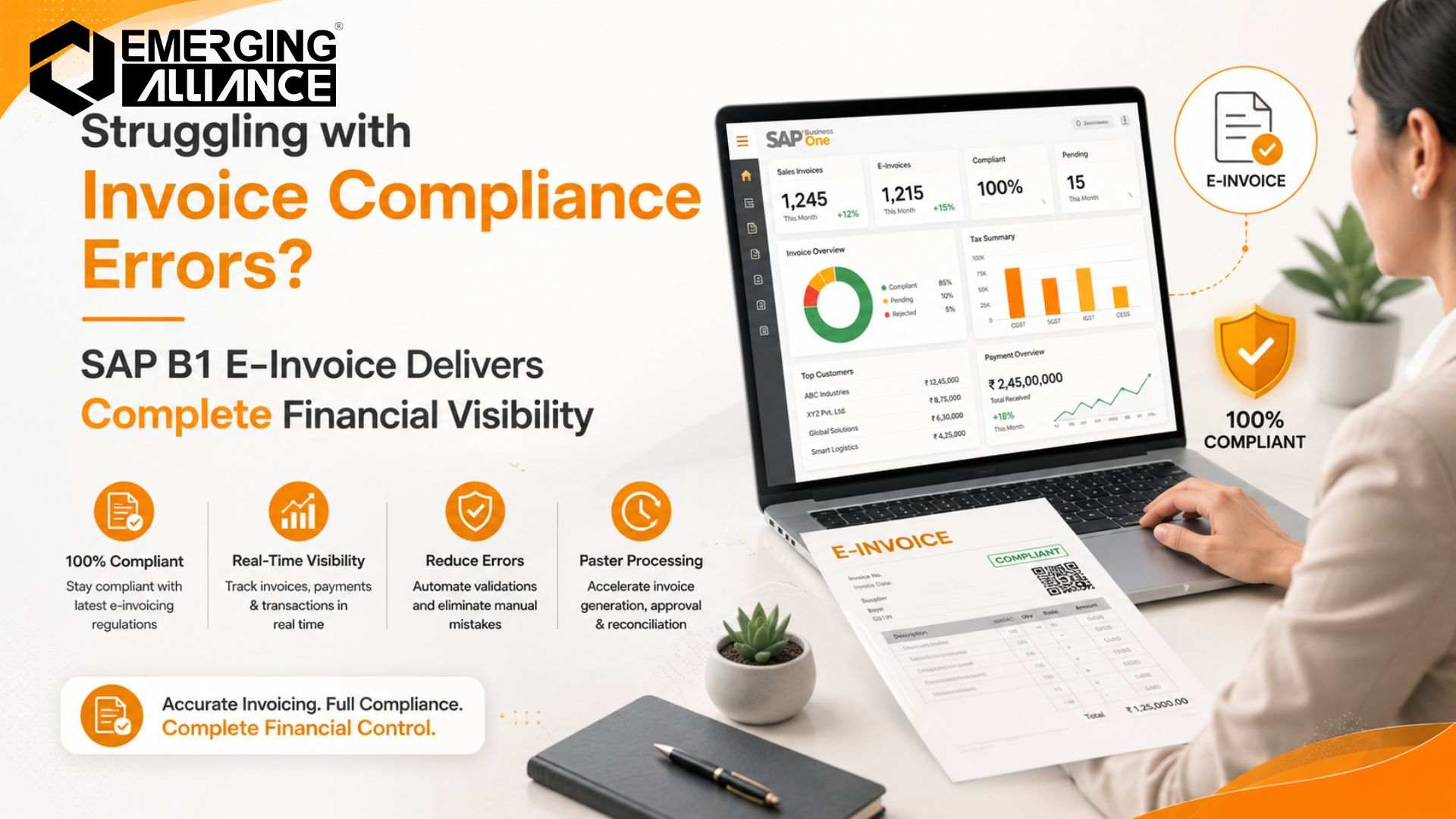
Struggling with Invoice Compliance Errors? SAP B1 E-Invoice Delivers Complete Financial Visibility
Reduce GST Errors and Improve Financial Accuracy with Automated E-Invoicing and Real-Time Compliance
Invoice compliance has evolved beyond a finance department responsibility. For growing enterprises, it directly influences cash flow, customer satisfaction, regulatory compliance, and operational efficiency. As transaction volumes increase across multiple branches, warehouses, and business units, manual invoicing processes become increasingly difficult to manage.
Finance leaders are expected to maintain complete GST compliance while ensuring invoices are generated accurately and delivered without delays. At the same time, executive leadership requires real-time financial visibility to make informed business decisions. When invoice processing depends on manual validation, spreadsheets, or disconnected systems, organizations often experience compliance risks, delayed payments, reconciliation challenges, and increased operational costs.
These challenges become even more significant as businesses expand into new markets or scale their operations. Without a standardized invoicing process, finance teams spend valuable time correcting errors instead of focusing on strategic initiatives.
SAP B1 E-Invoice helps organizations modernize invoice processing by automating GST-compliant invoicing, reducing manual intervention, and providing complete visibility into financial transactions. Rather than simply meeting regulatory requirements, businesses can build a smarter financial ecosystem that supports long-term digital transformation and sustainable growth.
Enterprise Invoice Compliance Challenges
As organizations grow, invoice management becomes more complex. Multiple sales channels, higher transaction volumes, evolving GST regulations, and distributed operations create significant pressure on finance teams.
Without automated invoicing, enterprises commonly encounter several operational challenges.
Manual GST Validation
Finance teams frequently spend hours reviewing invoice data before submission. Manual validation increases the likelihood of tax calculation errors, incorrect GSTIN entries, duplicate invoices, and rejected submissions.
Limited Financial Visibility
Many organizations lack centralized visibility into invoice status across departments and locations. Leadership teams often struggle to identify pending invoices, compliance exceptions, or delayed approvals until they begin affecting cash flow.
Disconnected Business Processes
Sales, finance, logistics, and compliance teams often operate using separate workflows. This disconnect creates duplicate data entry, inconsistent records, and unnecessary delays throughout the order-to-cash cycle.
Growing Regulatory Complexity
GST regulations continue to evolve. Keeping up with changing compliance requirements manually increases administrative workload and exposes businesses to avoidable compliance risks.
Business Impact of Manual Invoice Processing
Invoice compliance issues extend far beyond finance operations. They affect business performance, customer relationships, and organizational agility.
Some of the most common business impacts include:
- Delayed customer payments due to invoice discrepancies
- Increased risk of GST compliance penalties
- Revenue leakage caused by inaccurate invoice processing
- Longer month-end financial closing cycles
- Higher operational costs from repetitive manual work
- Increased audit preparation effort
- Reduced productivity across finance teams
- Poor visibility into receivables and cash flow
- Slower executive decision-making because of delayed financial reporting
These challenges often become more severe as transaction volumes increase. Simply adding more finance resources is rarely a sustainable solution. Instead, organizations need intelligent automation that standardizes invoice processing while maintaining compliance.
SAP B1 E-Invoice Solution Overview
SAP Business One e-invoicing enables organizations to automate invoice generation, GST validation, IRN creation, QR code generation, and invoice reporting directly from their ERP environment.
Instead of relying on disconnected applications or manual uploads, invoice data flows through a structured and automated process that improves both accuracy and operational efficiency.
A modern SAP B1 e-invoice solution helps organizations:
- Automate GST-compliant invoice generation
- Eliminate repetitive manual data entry
- Improve invoice accuracy
- Accelerate invoice approvals
- Reduce compliance risks
- Simplify financial reconciliation
- Improve audit readiness
- Provide real-time visibility into invoice status
By integrating invoicing directly into SAP Business One, organizations can establish a consistent and scalable financial workflow across all business functions.
SAP B1 E-Invoice Integration and Intelligent Automation
Automation is not simply about replacing manual tasks. It is about creating connected financial processes that improve speed, accuracy, and visibility throughout the organization.
SAP B1 E-Invoice Integration
A well-designed SAP B1 e-invoice integration connects financial transactions within SAP Business One to the approved GST e-invoicing platform.
Invoice information flows automatically between systems, eliminating duplicate data entry while maintaining data consistency across finance operations.
This integration enables organizations to:
- Reduce human intervention
- Maintain accurate master data
- Improve invoice consistency
- Minimize processing delays
- Support high transaction volumes
The result is a more reliable invoicing process that scales with business growth.
Automated GST Validation
Every invoice must comply with GST regulations before submission. Manual validation is both time-consuming and error-prone.
Automated validation checks critical invoice information before it reaches the GST portal, including:
- GSTIN verification
- Mandatory invoice fields
- Tax calculations
- HSN and SAC codes
- Customer information
- Document formatting
Early validation significantly reduces rejected invoices and minimizes compliance-related disruptions.
Automated IRN and QR Code Generation
Generating Invoice Reference Numbers (IRN) and QR codes manually can slow invoice processing, particularly during periods of high transaction volume.
SAP B1 GST e-invoice automates this process by generating IRNs and QR codes immediately after successful validation. This reduces processing time while ensuring invoices meet regulatory requirements before reaching customers.
Real-Time Invoice Exchange
Modern enterprises require immediate visibility into invoice processing.
Real-time invoice exchange enables finance teams to monitor invoice status from creation through validation and customer delivery. Instead of waiting for manual updates, stakeholders gain instant access to invoice progress, helping them resolve issues before they impact collections or customer relationships.
Intelligent Workflow Automation
Beyond compliance, SAP B1 electronic invoicing streamlines the entire invoice lifecycle through workflow automation.
Automated workflows can:
- Trigger approval notifications
- Route invoices to appropriate stakeholders
- Identify processing exceptions
- Track invoice status
- Maintain digital audit trails
- Reduce approval bottlenecks
This creates a standardized invoicing framework that improves collaboration between finance, sales, operations, and compliance teams while reducing administrative effort.
SAP B1 E-Invoice for Financial Visibility and Compliance Control
For enterprise leaders, invoice automation is only part of the equation. The real value lies in gaining complete financial visibility across every transaction.
Without centralized visibility, finance teams often struggle to identify invoice exceptions, pending approvals, rejected invoices, or delayed customer payments. These blind spots affect cash flow forecasting, compliance reporting, and executive decision-making.
A modern SAP Business One e-invoice solution provides real-time insight into the entire invoice lifecycle, enabling finance leaders to monitor invoice status from creation to payment.
Centralized Invoice Monitoring
Instead of tracking invoices across multiple spreadsheets or disconnected applications, organizations can manage every invoice through a unified dashboard.
This enables businesses to:
- Monitor invoice status in real time
- Identify rejected or pending invoices quickly
- Track IRN generation and validation
- Improve collection visibility
- Reduce reconciliation delays
Audit-Ready Financial Records
Audit preparation often consumes significant time because invoice records are scattered across multiple systems.
With SAP B1 e-invoice reporting, every invoice transaction is securely recorded with complete traceability, including validation history, approval workflows, document timestamps, and compliance records. This simplifies audits while improving governance and internal controls.
Better Executive Decision-Making
Real-time financial data enables leadership teams to make faster and more informed decisions.
Executives gain access to:
- Invoice processing performance
- Outstanding receivables
- GST compliance status
- Invoice exception reports
- Financial trends
- Operational KPIs
This level of visibility transforms invoicing from a routine finance process into a strategic source of business intelligence.
SAP B1 Digital Invoicing for Operational Efficiency and Business Performance
Automating invoice processing delivers measurable improvements across finance and operations. By eliminating repetitive manual tasks, organizations can focus resources on higher-value activities such as financial planning, customer service, and business growth.
Key operational benefits include:
- Reduced manual data entry
- Faster invoice processing cycles
- Improved invoice accuracy
- Shorter order-to-cash timelines
- Lower administrative costs
- Better collaboration across departments
- Increased finance team productivity
These efficiencies contribute to stronger cash flow, improved customer experiences, and greater organizational agility.
Scalable SAP Business One E-Invoice Solution for Enterprise Growth
As organizations expand, invoice volumes increase significantly. A scalable invoicing solution must support business growth without adding operational complexity.
A SAP B1 e-invoice solution enables enterprises to manage increasing transaction volumes while maintaining consistency and compliance.
Multi-Branch and Multi-Entity Operations
Organizations operating across multiple branches or legal entities can standardize invoice processes while maintaining centralized oversight. This ensures consistent compliance and reporting across the enterprise.
Cloud E-Invoice Solutions
Modern Cloud e-invoice solutions provide flexibility and resilience for growing businesses.
Benefits include:
- Secure remote access
- Automatic software updates
- Reduced IT infrastructure requirements
- Business continuity
- Faster deployment
- Easier scalability
Cloud-based invoicing also supports distributed teams, allowing finance professionals to collaborate efficiently regardless of location.
SAP B1 Add-On Capabilities
A specialized SAP B1 add-on extends the standard capabilities of SAP Business One by introducing advanced automation, workflow management, integration options, and compliance features.
Organizations can benefit from:
- Automated approval workflows
- Custom business rules
- Third-party system integration
- Enhanced reporting
- Workflow notifications
- Digital document management
These capabilities help businesses adapt their invoicing processes to changing operational and regulatory requirements.
Why Enterprises Choose Emerging Alliance
Technology alone does not deliver transformation. Successful digital initiatives require a partner that understands enterprise processes, compliance obligations, and long-term business objectives.
Emerging Alliance works with organizations to modernize financial operations through intelligent ERP solutions that improve efficiency, strengthen governance, and support sustainable growth.
Rather than focusing solely on implementation, Emerging Alliance helps enterprises:
- Align technology with business strategy
- Optimize finance and operational workflows
- Improve regulatory compliance
- Integrate critical business systems
- Enable scalable digital transformation
- Maximize long-term ERP value
By combining deep SAP Business One expertise with a consultative approach, Emerging Alliance empowers organizations to achieve measurable business outcomes—not just software deployment.
Conclusion
Invoice compliance is no longer just about meeting regulatory requirements. It has become a critical factor in improving operational efficiency, protecting revenue, and enabling informed business decisions.
As enterprises continue to grow, manual invoicing processes become increasingly difficult to manage. Delays, compliance errors, and limited financial visibility can hinder business performance and expose organizations to unnecessary risks.
SAP B1 E-Invoice helps businesses overcome these challenges by automating GST-compliant invoicing, improving financial transparency, reducing manual effort, and supporting enterprise scalability. By integrating invoicing directly into SAP Business One, organizations can establish a connected financial ecosystem that drives both compliance and operational excellence.
Frequently Asked Questions
1. When should a business implement a SAP B1 E-Invoice solution?
Organizations should consider implementing a SAP B1 E-Invoice solution when manual invoice processing leads to GST compliance issues, delayed approvals, reconciliation challenges, or limited financial visibility. It is especially beneficial for businesses experiencing increasing transaction volumes or expanding across multiple locations.
2. How does SAP B1 e-invoice integration improve enterprise financial workflows?
SAP B1 e-invoice integration connects invoice generation, GST validation, and financial records within a single workflow. This eliminates duplicate data entry, reduces processing delays, improves invoice accuracy, and enables seamless information flow between departments.
3. Can SAP Business One e-invoicing support multi-branch and multi-company operations?
Yes. A SAP Business One e-invoicing solution can standardize invoice processing across multiple branches, business units, or legal entities while providing centralized compliance monitoring and consolidated financial reporting.
4. How does SAP B1 GST e-invoice reduce audit and compliance risks?
By maintaining digital audit trails, validating invoice data before submission, and securely storing invoice records, SAP B1 GST e-invoice simplifies audit preparation and helps organizations demonstrate compliance with regulatory requirements.
5. What business insights can organizations gain from SAP B1 e-invoice reporting?
SAP B1 e-invoice reporting provides visibility into invoice processing performance, compliance status, pending invoices, payment trends, exception handling, and receivables, helping management make faster and more informed financial decisions.
6. How does SAP B1 digital invoicing improve the order-to-cash cycle?
SAP B1 digital invoicing accelerates invoice generation, validation, and customer delivery, reducing processing delays and helping businesses shorten the order-to-cash cycle while improving cash flow.
7. Why is cloud e-invoice solutions adoption increasing among growing enterprises?
Cloud e-invoice solutions offer greater scalability, secure remote access, automatic updates, reduced infrastructure costs, and easier management across multiple business locations, making them well suited for expanding organizations.
8. How does a SAP B1 add-on enhance electronic invoicing capabilities?
A SAP B1 add-on extends standard ERP functionality with advanced automation features such as approval workflows, real-time notifications, compliance monitoring, custom reporting, and integration with external business applications.
9. What should enterprises evaluate before selecting the best SAP B1 e-invoice solution?
Decision-makers should assess GST compliance capabilities, integration flexibility, automation features, reporting functionality, scalability, security, implementation expertise, and long-term support to ensure the solution aligns with business objectives.
10. Why should businesses partner with Emerging Alliance for SAP Business One e-invoice implementation?
Emerging Alliance combines SAP Business One expertise with a digital transformation approach to help organizations optimize financial workflows, improve compliance, integrate enterprise systems, and maximize long-term business value beyond software implementation.
Speak with an Emerging Alliance expert today to discover how SAP B1 E-Invoice can accelerate your organization’s digital transformation journey.